You're standing in a boutique in Paris, holding a blazer that's almost right. The sleeves work. The color works. The cut doesn't. You want to ask for something more fitted, not skin-tight, maybe with cleaner tailoring. Instead, you freeze and point.
That is the genuine challenge with fashion terms in French. It is not about memorizing random nouns. It is about getting what you want, sounding polished, and avoiding the awkward tourist-language trap that makes every shopping trip harder than it needs to be.
I've seen the same pattern again and again. Learners know “robe,” “jupe,” and “chaussures,” but they can't explain silhouette, fabric, or finish. Then they wonder why salespeople switch to English, why interviews feel intimidating, or why they leave stores with the wrong piece. The fix is simple. Learn the words that help you act, ask, compare, and decide.
Table of Contents
- That Perfect Piece is Right There But How Do You Ask For It
- Why French Fashion Terms Are More Than Just Words
- How Sarah Nailed Her Paris Fashion Week Internship
- The Essential Wardrobe A Glossary of French Clothing Terms
- Describing Your Style Fit Fabric and Patterns
- Navigating the Boutique Essential Shopping Phrases
- Sounding Like an Expert Haute Couture and Industry Terms
- Your Next Steps to Mastering French Fashion Vocabulary
That Perfect Piece is Right There But How Do You Ask For It
You don't need more vocabulary. You need the right vocabulary.
A learner once told me she could name plenty of clothes in French, but the second a Paris salesperson asked what kind of fit she wanted, her mind went blank. She knew she didn't want something “serré,” but she didn't know whether to ask for ajusté, fluide, or a different coupe entirely. That's the gap most phrase lists ignore.
The issue gets worse in a stylish store, because the staff won't describe clothes the way a beginner textbook does. They'll talk about line, structure, fall, drape, and whether something feels chic or ringard. If you can only label the object and not describe it, you lose control of the conversation.
You don't sound confident in a boutique because you know more nouns. You sound confident because you can make a precise request.
That's why I treat fashion terms in french like a toolkit. You need terms for cut, texture, pattern, and register. You also need the polite language that keeps the exchange smooth. Even something as simple as a warm thank-you matters in these moments, so if you want a quick refresher on polite expressions, this guide to French for Thank You is worth bookmarking.
Here's my blunt advice. Stop studying fashion vocabulary as isolated flashcards. Learn it in complete buying situations:
- When you enter: ask for help naturally.
- When you compare items: describe what you like and dislike.
- When you try on: ask for another size, cut, or fabric.
- When you buy: close the conversation gracefully.
That's how people stop translating in their heads and start speaking with ease.
Why French Fashion Terms Are More Than Just Words
French fashion vocabulary isn't difficult because there are so many words. It's difficult because every word carries grammar, sound, and social context. If you miss one of those, your sentence may still be understood, but it won't sound right.
Three things generic vocab lists get wrong
First, gender. Existing content often skips the system behind clothing words, even though article mistakes are a major stumbling block. A summary drawing on French Ministry of Education data notes that 80% of vocabulary errors in oral exams stem from article mismatches, especially with clothing terms like le jean, le short, la robe, and exceptions such as un t-shirt (Kylian on clothing in French).
Second, pronunciation. A word you know on paper can still fail you in a store if you can't say it cleanly. “Fringues” and “fluide” don't reward guesswork. If your pronunciation needs structure, study the basics of rhythm, sounds, and courtesy formulas with French language rules and etiquette.
Third, register. French fashion lexicon changes depending on where you are and who you're speaking to. In everyday speech, you'll hear terms like chic and slang like fringues or des pompes. In more formal or professional settings, words like tailleur and escarpins carry a sharper, more polished tone (Slimmersion's fashion vocabulary guide).
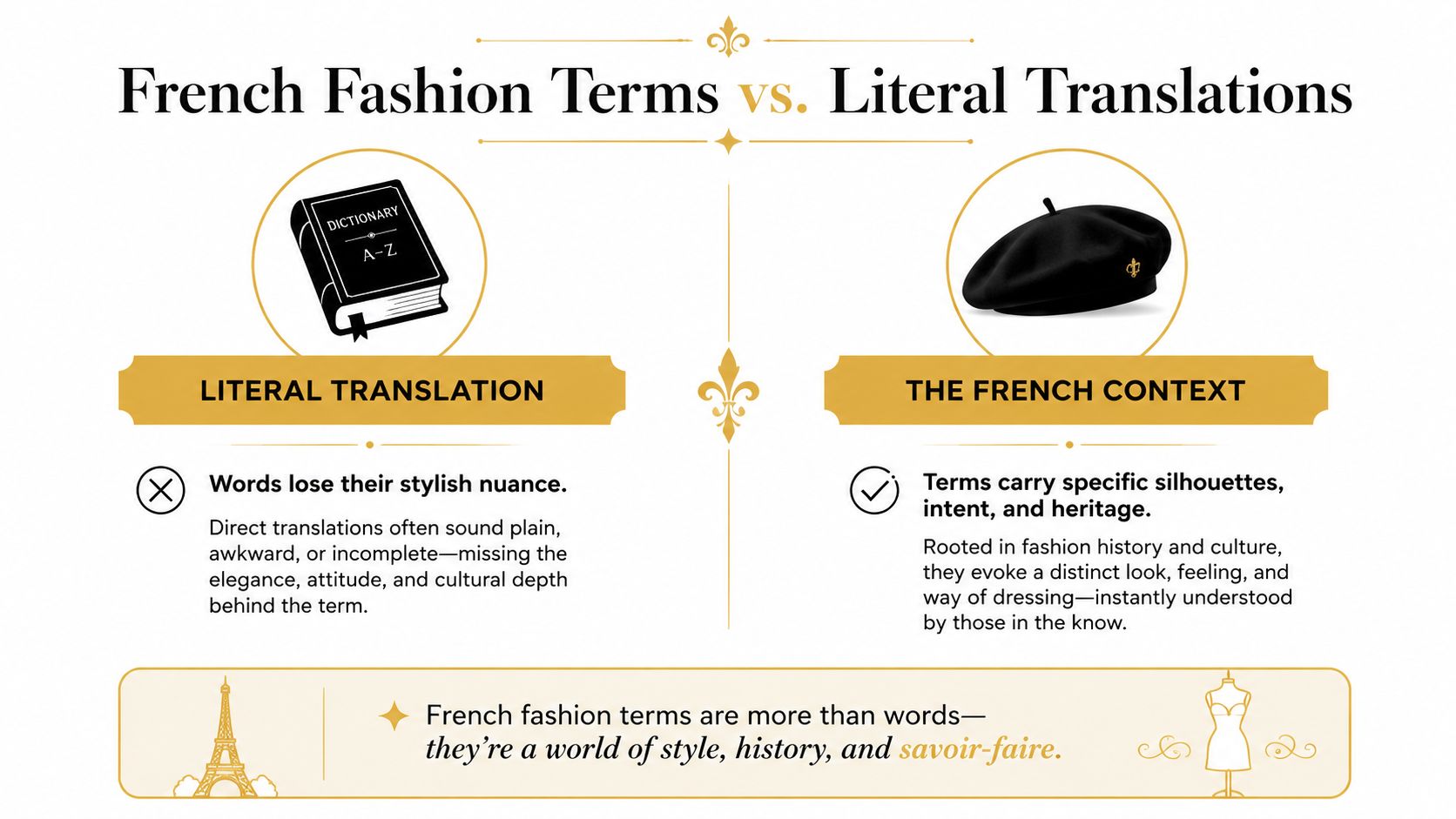
Comparison of everyday French vs fashion insider French
| Concept | Everyday French (Courant) | Fashion Insider French (Soutenu/Spécifique) |
|---|---|---|
| Clothes | vêtements, fringues | pièces, silhouettes |
| Stylish | chic, à la mode | raffiné(e), soigné(e) |
| Shoes | chaussures, pompes | escarpins |
| Suit | costume | tailleur |
| Fit | ça me va | coupe ajustée, coupe droite |
| Buying language | je veux ça | je cherche quelque chose de plus fluide |
Use the left column with friends. Use the right column in boutiques, interviews, and serious fashion conversations.
Practical rule: if you want better service, ask with specificity. “Je cherche une coupe ajustée” gets a stronger response than “Je veux quelque chose de joli.”
That is the true significance of fashion terms in french. They shape how people read your taste, your education, and your comfort level.
How Sarah Nailed Her Paris Fashion Week Internship
Sarah came to me with solid conversational French and a clear career goal. She wanted to work in fashion merchandising and interview confidently in Paris. On paper, she looked ready. In practice, she kept sounding broad and generic.
During a mock interview, she was asked to describe a garment's coupe and explain why it fit a collection. She knew basic clothing words. She didn't know how to talk about structure, proportion, or why one silhouette felt stronger than another. That kind of gap matters fast in a fashion setting.
What changed in her French
We stopped working on “general French” and got specific. She practiced speaking about garments the way people in the industry do. Not long lists. Not schoolbook dialogues. Real descriptions.
We focused on three upgrades:
- Precision: replacing vague words like “joli” with terms tied to fit, finish, and style.
- Control: answering follow-up questions without panicking or switching to English.
- Presence: sounding like someone who belonged in the room.
She also practiced transactional situations and professional ones separately. That mattered. Boutique French and internship-interview French overlap, but they aren't identical. One needs ease. The other needs credibility.
“I finally felt like I belonged in the room.”
That was Sarah's feedback after her interview practice started clicking. It wasn't about showing off. It was about removing hesitation.
The takeaway for ambitious learners
Her success didn't come from memorizing more words than everyone else. It came from learning which fashion terms in french do real work. She got comfortable with describing a piece's line, naming the effect of a fit, and reacting naturally when someone challenged her opinion.
That's the shift ambitious learners need. If your goal is fashion school, retail buying, styling, PR, merchandising, or luxury sales, basic travel French won't carry you far enough. You need targeted language that matches the room you want to enter.
And yes, that same precision helps in boutiques too. Once you can explain what you want clearly, conversations stop feeling intimidating and start feeling collaborative.
The Essential Wardrobe A Glossary of French Clothing Terms
Start with the words you'll use constantly. If these aren't automatic, everything else feels harder.
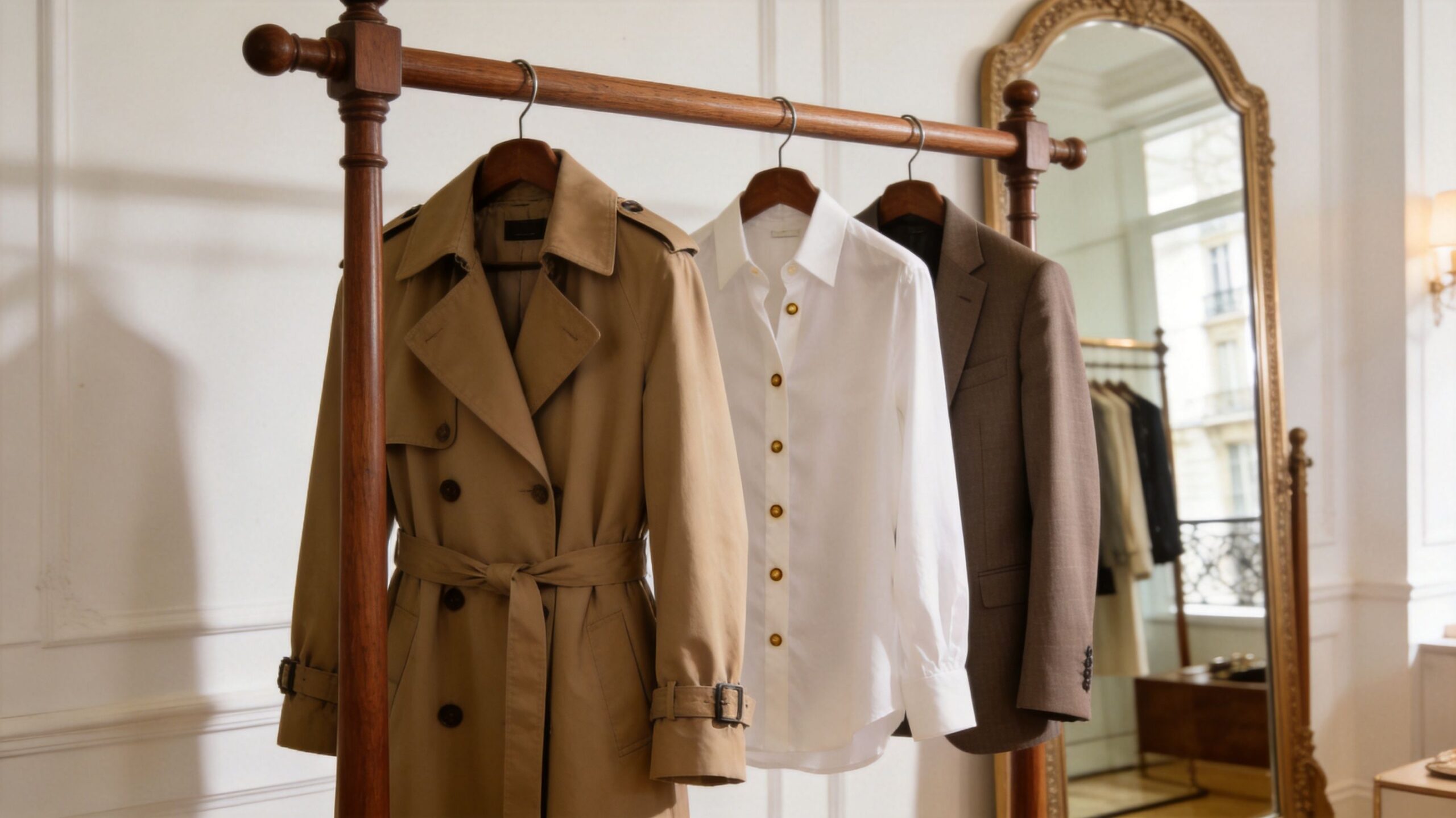
Core pieces you'll hear in every store
Here are the essentials I want every learner to know cold.
une robe (f)
Pronunciation: roughly “rohb”
Example: Je cherche une robe noire pour le soir.une jupe (f)
Pronunciation: “zhüp”
Example: J'aime cette jupe, mais je la veux plus longue.un pantalon (m)
Pronunciation: “pahn-tah-lon”
Example: Je cherche un pantalon noir, s'il vous plaît.un jean (m)
Pronunciation: close to “zhan”
Example: Ce jean est trop serré à la taille.un short (m)
Pronunciation: close to English, but softer
Example: Vous avez ce short dans une autre couleur ?une chemise (f)
Pronunciation: “shuh-meez”
Example: Je voudrais une chemise blanche en coton.un t-shirt (m)
Pronunciation: close to English
Example: Je préfère un t-shirt simple, sans motif.
Outerwear and polished basics
These are the words that make you sound more capable in a real store.
un manteau (m)
Example: Ce manteau est élégant, mais un peu trop lourd.un trench (m)
Example: Je cherche un trench beige, plutôt classique.un caban (m)
Example: Le caban bleu marine me plaît beaucoup.un imperméable (m)
Example: Je voudrais un imperméable léger pour voyager.une veste (f)
Example: Cette veste est belle, mais la coupe est trop droite pour moi.un blazer (m)
Example: Vous avez ce blazer en laine ?un tailleur (m)
Example: Je cherche un tailleur sobre pour une réunion.
Learn the noun with its article every single time. Never memorize “robe.” Memorize une robe.
Here's a quick buying guide that I give learners who want usable vocabulary, not trivia.
| French term | Gender | Best use case |
|---|---|---|
| une robe | feminine | dresses, occasion wear |
| un pantalon | masculine | everyday shopping |
| une chemise | feminine | smart casual, workwear |
| un blazer | masculine | boutiques, styling conversations |
| un trench | masculine | polished travel wardrobe |
| un tailleur | masculine | formal or professional settings |
If you're building a study list, choose pieces you'd buy. Don't waste energy on vocabulary for garments you never wear. A parent preparing for Paris travel, a student heading into DELF practice, and a fashion intern all need different priority words.
Describing Your Style Fit Fabric and Patterns
Learners stop sounding basic at this stage. Naming the item is step one. Describing it well is what gets results.
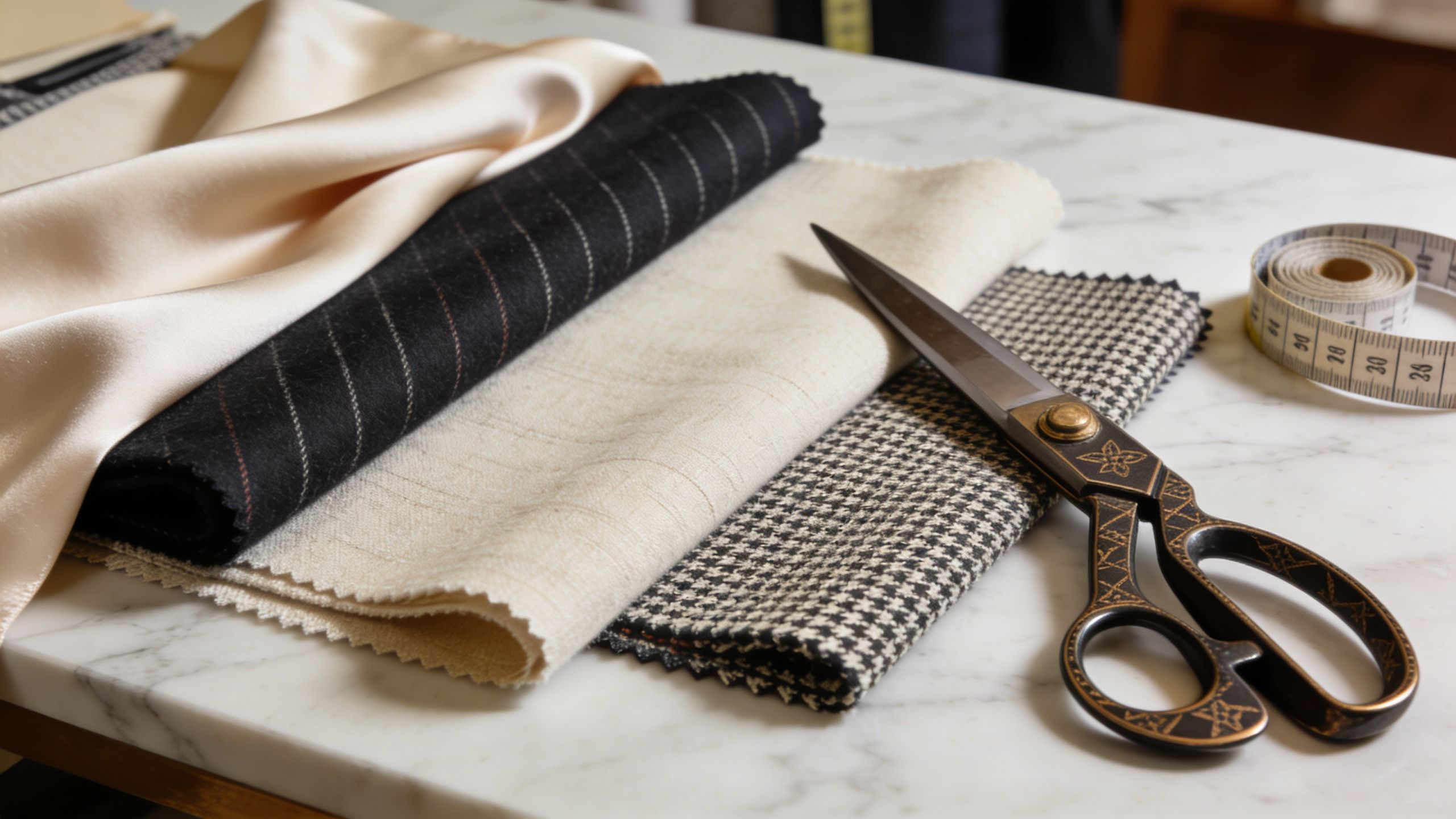
A useful starting point is une coupe, which means the cut or pattern of a garment. Key terms include droite, ajustée, moulante, and fluide. For trousers, specific cuts include pantalon cigarette and pantalon large (Private French Lessons Paris on fashion vocabulary).
How to talk about fit without sounding vague
Most English speakers overuse “tight,” “loose,” and “nice.” That language is too blunt for fashion conversations.
Use these instead:
- coupe droite for a straight cut
- ajusté(e) for fitted
- moulant(e) for body-hugging
- fluide for flowing
- déstructuré(e) for deconstructed
- ceinturé(e) for belted
Try these model phrases:
- Je cherche une veste ajustée, mais pas moulante.
- Je préfère une robe fluide pour l'été.
- Vous avez un pantalon large en noir ?
- Je voudrais quelque chose de ceinturé à la taille.
That second clause matters. French shoppers often refine a request by contrast. “Fitted, but not too fitted.” “Flowing, but still structured.” That's much closer to how real people speak.
Patterns and details that sharpen your request
Once the fit is clear, move to pattern or finish. That instantly makes you sound more competent.
Useful adjectives include:
- à pois for polka-dotted
- rayé(e) for striped
- écossais for plaid or tartan
- boutonné(e) for buttoned
- retroussé(e) for rolled up
- non-ajusté for relaxed or loose
Here's how I'd use them in a boutique:
| What you want to say | Better French |
|---|---|
| I want a striped shirt | Je cherche une chemise rayée |
| I like wide-leg pants | J'aime les pantalons larges |
| Do you have a belted dress | Vous avez une robe ceinturée |
| I want rolled sleeves | Je préfère les manches retroussées |
Specific adjectives do more than decorate your sentence. They save time, reduce misunderstandings, and help the salesperson edit the options for you.
If you work in fashion, this vocabulary also helps you discuss product more intelligently. You're no longer reacting with “pretty” or “interesting.” You're assessing line, movement, and construction.
That's the authentic jump in fashion terms in french. You stop talking like a shopper who hopes to get lucky. You start talking like someone who knows what belongs in their wardrobe.
Navigating the Boutique Essential Shopping Phrases
You spot the jacket you want in a Marais boutique. The salesperson walks over. That is not the moment to build a perfect textbook sentence. You need French that gets results fast.
In shops, the winning formula is simple. Greet the person, name the item, add one clear detail, then ask your question.
A boutique script that actually works
Start with a clean request:
- To get help: Bonjour, je cherche une veste pour le soir.
- To specify what you want: Je la voudrais plus ajustée.
- To ask for another size: Vous avez la taille au-dessus ?
- To ask for another color: Vous l'avez en noir ou en beige ?
- To try it on: Je peux l'essayer ?
- To react: Ça me va bien, mais je préfère une coupe plus fluide.
That structure works because it sounds natural, calm, and competent.
If you want stronger everyday French for stores, hotels, and quick social interactions, review these common French phrases for travelers. They help you sound polite without overthinking every line.
Speak like a good customer, not a dictionary
French boutique staff usually respond best to standard, polished vocabulary. Use words like chic, élégant, une veste, une robe, une paire de bottines. Save slang like fringues or pompes for casual conversations with friends.
This also matters if fashion is part of your career goals. In a boutique, showroom, or networking setting, your word choice signals your level right away.
Use this quick guide before you shop:
| Situation | Best phrase |
|---|---|
| You want help politely | Bonjour, je peux vous demander un conseil ? |
| You need another size | Vous avez une autre taille ? |
| You want to compare cuts | Je préfère une coupe droite |
| You need more time | Je réfléchis encore |
| You're ready to buy | Je vais prendre celui-ci |
A few habits make a real difference.
- Say Bonjour first. French retail culture expects it.
- Ask before disappearing into the fitting room. Staff will usually help more once you start the interaction properly.
- Be specific early. Item, size, color, fit.
- Close the exchange well. Merci beaucoup and bonne journée leave the right impression.
One more tip. Rehearse full mini-dialogues out loud, not isolated words. That is how vocabulary turns into a practical toolkit you can use in Paris, during a buying appointment, or in any fashion setting where confidence matters.
Sounding Like an Expert Haute Couture and Industry Terms
If you want to work in fashion, study fashion seriously, or speak credibly with industry people, you need more than boutique vocabulary. You need the terms that carry heritage and status.
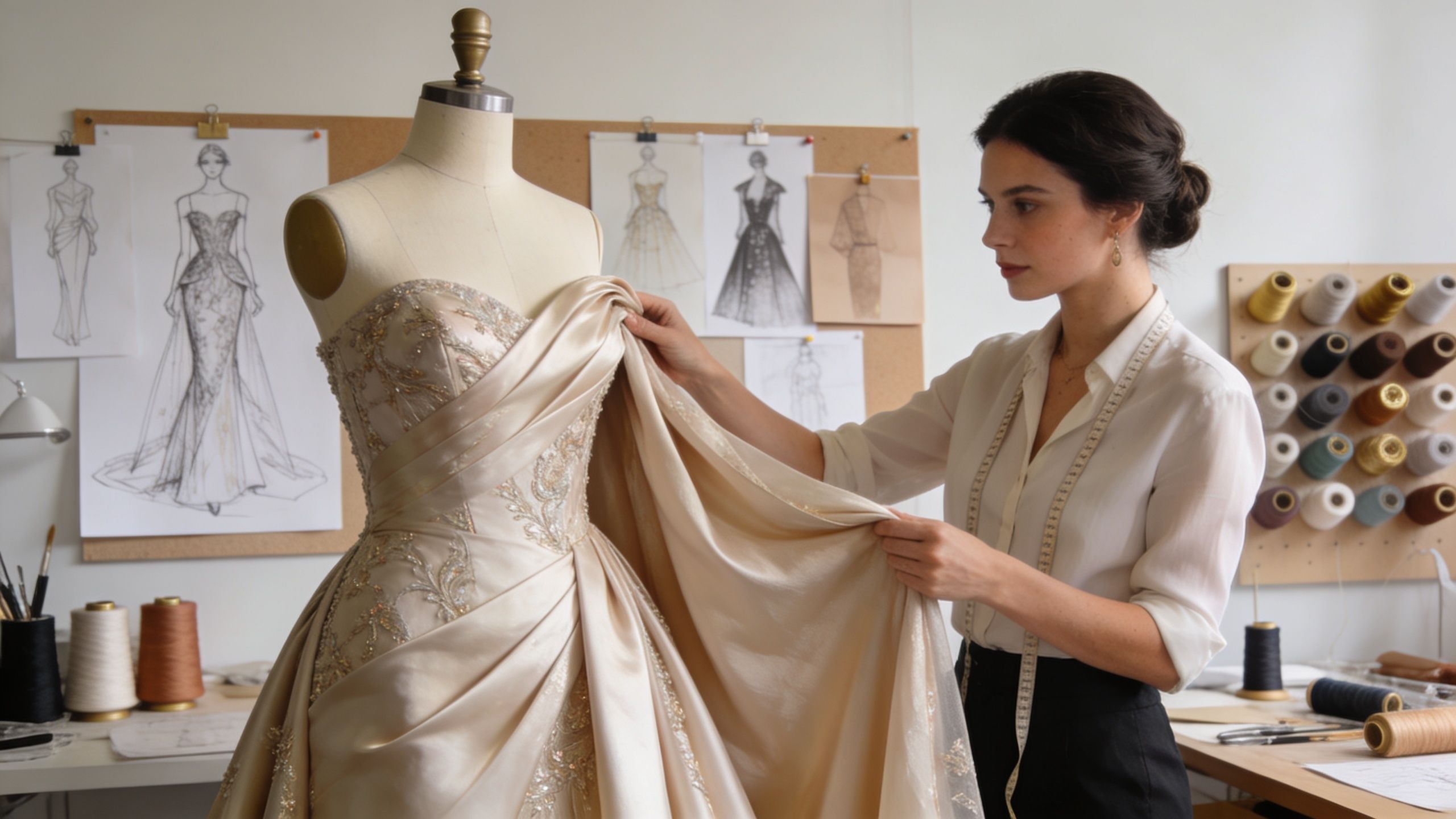
Haute couture is the obvious example. The term, meaning “high sewing,” originated in the 1860s, with Charles Frederick Worth establishing the first haute couture house in 1858. The system was formalized in 1911 by the Chambre Syndicale de la Haute Couture, and 12 houses were officially recognized as of 2023 (French fashion history on Wikipedia).
Why these terms matter in serious fashion conversations
Knowing haute couture, prêt-à-porter, and sur mesure changes how you sound because these aren't just translations. They signal that you understand category, craft, and context.
- haute couture means the highest level of custom fashion craftsmanship
- prêt-à-porter means ready-to-wear
- sur mesure means made-to-measure
When you discuss these terms aloud, pronunciation matters as much as meaning. If you want sharper delivery, work on nasal vowels and French rhythm with this guide on how to improve fast French pronunciation.
Here's a useful visual primer before you start using these expressions in conversation:
My opinion is simple. If you're serious about fashion, you can't treat these as decorative words. You need to know when they apply and when they don't. That's what separates someone who likes fashion from someone who can discuss it intelligently in Paris, in an interview, or at an industry event.
Your Next Steps to Mastering French Fashion Vocabulary
If you want fashion terms in french to stick, stop rereading lists. Start using them.
What to practice on your own
Do three things.
- Build a personal wardrobe deck: make flashcards only for items, cuts, and fabrics you'd discuss.
- Speak in full sentences: don't drill “une veste.” Drill Je cherche une veste ajustée en noir.
- Role-play real situations: boutique visit, fitting room request, interview answer, networking chat.
For learners who need help getting words out of their heads and into their mouths, this article on building French speaking confidence gives useful mindset and practice ideas.
You should also keep one organized vocabulary system. I prefer a simple list grouped by noun, fit, pattern, and shopping phrase. If you want a stronger general foundation, this guide on how to improve French vocabulary pairs well with specialized fashion study.
Why feedback changes everything
Self-study works for recognition. It's weaker for precision.
You usually won't catch your own article mistakes, awkward phrasing, or pronunciation issues in real time. That's exactly why so many learners feel “prepared” until a salesperson asks a follow-up question or an interviewer wants more detail. Feedback is what turns passive knowledge into usable French.
If your goal is confidence in Paris, in retail, or in fashion work, practice has to be spoken, corrected, and repeated.
That's the fastest route. Not more notes. Not more screenshots. Real conversation.
If you want specialized help with fashion vocabulary, travel French, DELF prep, or professional speaking, Elite French Tutoring offers customized private lessons online and in person. Every program starts with a free 20-minute consultation, so you can get clear guidance based on your level, goals, and timeline.
Drafted with the Outrank app