
You're probably here because the french a1 exam has stopped being a vague idea and turned into a deadline.
Maybe your child needs outside support for a bilingual school. Maybe your employer has started talking about Paris, Brussels, or Montréal. Maybe you've promised yourself that this time you won't “learn French casually” and drift for six months without a clear result. That's the moment when an exam becomes useful. It gives your effort a target.
I've worked with busy professionals, parents, diplomats, and complete beginners long enough to know what usually goes wrong first. People underestimate the structure. They think beginner means forgiving. It isn't. The A1 level is accessible, but only when your preparation matches the exam you're taking, not the French you wish you were learning.
Table of Contents
- Why the French A1 Exam Is Your First Big Win
- Deconstructing the DELF A1 Exam Format
- Self-Study vs Guided Prep A Comparison
- Your Practical 12-Week A1 Study Timeline
- What A1 Success Looks Like A Student Story
- Book Your Free Consultation and Start Your Path
Why the French A1 Exam Is Your First Big Win
The students who do best with the french a1 exam usually share one trait. They're not chasing “perfect French.” They're trying to achieve something concrete.
A parent wants their child to keep up with classroom French instead of dreading it. A project manager wants proof of commitment before an international move. An adult learner wants a real milestone, not another app streak. That's why A1 matters. It turns effort into an official result.

Who benefits most from A1 certification
The DELF A1 is not a decorative beginner certificate. It's the entry point to a system that matters internationally. The exam sits at the foundational CEFR benchmark, in a portfolio that tests 400,000 to 600,000 candidates yearly, and for business professionals and expats it can support 90% of entry-level French job requirements in Francophone Europe and Africa while adding 10 to 15 points to a Canadian Express Entry profile, according to this practical DELF A1 guide from CECFQ.
That matters if your goal is mobility. It also matters if your goal is credibility. A school, employer, or immigration pathway doesn't care that you “did Duolingo for a while.” They care whether you can show a recognized level.
Practical rule: If your French goal affects school placement, relocation, hiring, or formal applications, informal study alone usually isn't enough.
Why this level matters more than people think
I've seen beginners treat A1 like a box to tick. That's a mistake. This is the stage where habits form.
Students who build clean pronunciation, simple sentence control, and steady listening tolerance early move into A2 and B1 with far less friction. Students who rush, memorize disconnected phrases, and avoid speaking often arrive at the exam with false confidence. They can recognize words on a screen, but freeze when someone asks a basic question out loud.
A1 is your first big win because it proves you can do four things under structure: listen, read, write, and speak. That combination changes how people feel about French. It stops being abstract. It becomes usable.
For ambitious learners, that shift is often the ultimate prize.
Deconstructing the DELF A1 Exam Format
A common pitfall in preparation is studying general “French” instead of the exam itself. The DELF A1 rewards practical control under time pressure. It does not reward random exposure, passive app use, or memorizing long vocabulary lists with no context.
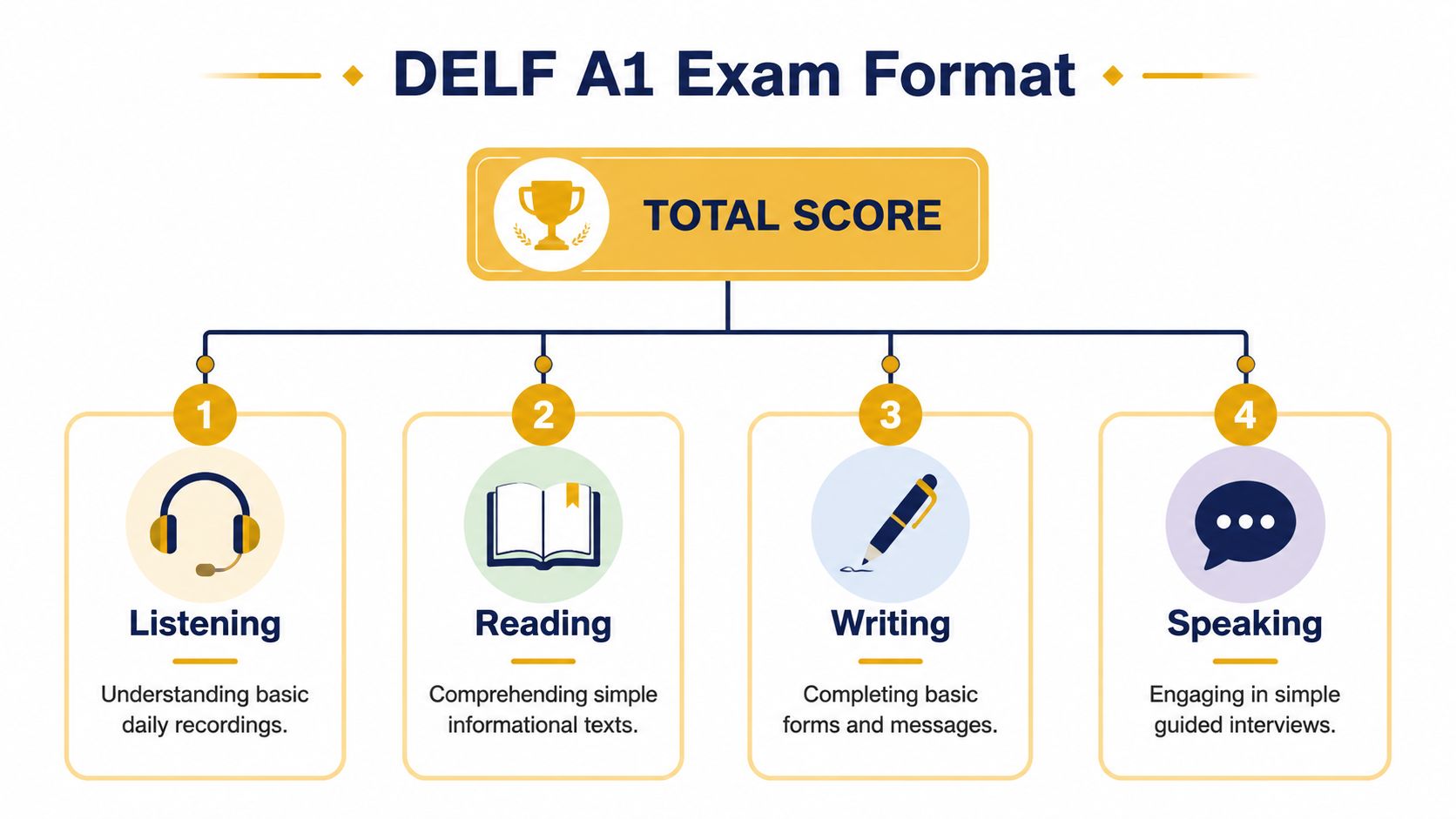
The exam has four equally weighted parts: Listening, Reading, Writing, and Speaking. Candidates need 50/100 overall and at least 5/25 in each skill to pass, and the four sections run for about 20 minutes listening, 30 minutes reading, 30 minutes writing, and 5 to 7 minutes speaking. For prepared candidates, pass rates hover around 70 to 80%, according to this DELF A1 exam overview.
What the exam is really testing
Listening checks whether you can survive ordinary spoken French, not whether you can decode every word. At A1, that usually means short everyday audio. Students often fail this section because they panic when they miss the first phrase and mentally leave the recording.
Reading tests functional comprehension. Can you spot the point of a short notice, message, form, or simple text quickly enough to answer accurately? Candidates who translate word by word usually run out of time.
Writing is where many beginners get surprised. It isn't just about grammar. It tests whether you can produce the right type of written French for the task, such as completing a form and writing a short practical message.
Speaking is not a performance. It's a controlled interaction. Examiners want to hear whether you can answer predictable personal questions, exchange basic information, and manage a simple role-play without collapsing into silence.
The strongest A1 candidates aren't the ones with the fanciest vocabulary. They're the ones who stay functional in all four skills.
How the scoring changes your strategy
The dual scoring rule changes everything. You can't “make up” for a weak skill by overperforming elsewhere. A student who feels comfortable writing and reading but avoids listening and speaking is taking a real risk.
That's why balanced prep works better than preference-based prep.
Here's the smarter way to divide your effort:
- Protect your weakest section early: If listening rattles you, address it from week one instead of saving it for later.
- Practice output before you feel ready: Waiting to speak or write until your grammar feels complete is one of the most expensive mistakes beginners make.
- Train under real timing: Unlimited practice creates fake confidence. Timed practice exposes where your processing breaks down.
The materials that help and the ones that waste time
A good A1 preparation stack is simple. You need exam-style tasks, correction, and repetition. You do not need ten apps and three notebooks full of untouched grammar tables.
For younger learners or adults who need extra support building personal information language, a structured worksheet like this Kuraplan educational resource can be useful because it forces the kind of basic self-description that shows up again and again in A1 speaking and writing.
What doesn't work well:
- Passive app use: Fine for exposure. Weak for correction.
- Unstructured YouTube hopping: Motivating at first, but it rarely builds exam stamina.
- Grammar-only study: Helpful in moderation. Dangerous when it replaces listening and speaking.
If you want a more direct exam-focused route, this DELF DALF test preparation page shows the type of structured support many candidates use when they need accountability and targeted feedback rather than more content.
Self-Study vs Guided Prep A Comparison
Once you've decided to take the french a1 exam, the next decision is practical. Do you prepare on your own, or do you work with someone who can see your mistakes before they become habits?
For some learners, self-study is enough to get started. For high-stakes goals, it often becomes inefficient fast.
| Factor | Self-Study | Elite French Tutoring |
|---|---|---|
| Structure | Usually pieced together from apps, videos, and worksheets | A clear sequence tied to exam tasks and your weak points |
| Feedback | Limited, delayed, or missing | Direct correction on pronunciation, writing, and speaking |
| Speaking practice | Hard to simulate honestly alone | Regular guided interaction under exam-style conditions |
| Efficiency for busy adults | Easy to start, easy to drift | Scheduled sessions create momentum and consistency |
| Error correction | Mistakes often go unnoticed and repeat | Patterns are identified and corrected early |
| Confidence before test day | Often uneven across skills | Built through targeted rehearsal and mock practice |
Where self-study works
Self-study can work well for motivated learners who already know how to organize language learning. If you're disciplined, comfortable finding quality materials, and honest about your weak spots, you can make real progress.
It's especially useful for:
- Daily vocabulary review: Flashcards, notebook review, and short drills are easy to manage alone.
- Reading exposure: Short notices, menus, messages, and forms are good independent practice.
- Routine reinforcement: Repeating familiar phrases and core verb patterns works fine outside class.
But self-study usually breaks down in the same places. Pronunciation drifts. Writing stays awkward because nobody corrects it. Speaking remains theoretical. Learners feel “not bad” until they try a timed oral exchange and discover they can't respond smoothly.
Where guided prep changes the outcome
Guided prep doesn't magically make French easy. It removes waste.
A tutor hears the hesitation you don't notice. A tutor cuts materials that aren't helping. A tutor can tell whether your answer is exam-appropriate, not just understandable. That matters a lot at A1 because beginners often practice the wrong thing for too long.
I also see a big difference in how busy adults use their time. Someone preparing alone may spend an evening switching between grammar videos, app exercises, and random listening clips. Someone following a guided plan usually knows exactly what to do that day and why.
Decision filter: If passing matters on a deadline, your biggest cost isn't tuition. It's lost time on ineffective prep.
For schools and tutoring businesses managing larger learner pipelines, tools like language school software can help organize scheduling and student follow-up. On the learner side, the more relevant question is whether your prep model gives you correction, accountability, and realistic speaking practice.
If you're weighing whether private support is worth it, this guide on whether a French tutor is worth the investment is a useful next step because the answer depends less on your level than on your deadline, schedule, and tolerance for trial and error.
Your Practical 12-Week A1 Study Timeline
The biggest planning mistake I see is vague ambition. “I'll study French every day” sounds responsible, but it doesn't tell you what to study, when to shift gears, or how to prepare for timed tasks.
A1 prep works better when the schedule matches the load. The curriculum targets 500 to 800 words within 60 to 100 hours of guided study, which works out to roughly 8 to 13 words per instructional hour. The listening section also demands resilience because A1 learners often lose 15 to 25% of comprehension on the first listen before recovering somewhat on the second, as explained in this DELF A1 preparation guide.
Weeks 1 to 4 build the base
The first month is not glamorous. It's where you install the language you'll keep reusing.
Focus on:
- Identity language: name, age, nationality, family, job, routine
- Core verbs: especially high-frequency everyday verbs
- Sound training: numbers, dates, spelling, and basic pronunciation contrasts
- Short written output: forms, labels, simple messages
This is also when I like students to start “small speaking” immediately. Not conversation for conversation's sake. Controlled answers. Short exchanges. Repetition with correction.
A strong week in this phase includes vocabulary review, one listening routine, one writing task, and one speaking rehearsal. If you want a more organized version of that approach, this structured French study plan gives a useful model for sequencing work instead of bouncing between topics.
Weeks 5 to 8 turn knowledge into exam skill
This is the middle stretch where students stop collecting French and start using it.
Your tasks should get narrower and more exam-like:
- Listening with purpose: identify names, times, places, prices, preferences
- Reading for extraction: pull the answer fast instead of translating everything
- Writing with constraints: produce short, correct messages within the expected format
- Speaking under prompts: answer simple questions on demand
A lot of learners hit resistance here. They know more than they can express. That's normal. The answer isn't more random input. The answer is repetition under the exact kind of pressure the exam creates.
The video below is a good companion when you want to hear task expectations and reinforce your rhythm between study sessions.
Weeks 9 to 12 rehearse under pressure
The last phase is about control, not expansion.
You should now be cycling through mixed practice:
- Timed mini-listening sets
- Short reading drills
- Form plus message writing
- Guided oral simulations
In the context of the A1 exam, students learn one of the hardest lessons: You do not need to know everything. You need to perform the basics cleanly and consistently.
Don't spend the final weeks chasing advanced grammar. Tighten the language you already need for the exam.
The best final prep blocks include correction, redo work, and at least a few full or partial simulations. By this point, every study session should answer one question clearly: which exam skill got stronger today?
What A1 Success Looks Like A Student Story
One of the most relatable A1 clients I've worked with was David, a project manager preparing for a move tied to work in Belgium. He started from zero. Not “rusty high school French.” Zero.
His first instinct was the same one I see all the time. He downloaded apps, watched short videos on his commute, and tried to squeeze French into leftover minutes. He was busy and motivated, but his study never held together. He could recognize a few phrases, but if someone asked him a direct question, he froze.
What changed for David
What helped David wasn't more material. It was sharper focus.
We stripped his prep down to what he needed: predictable speaking frames, functional vocabulary, controlled listening, and writing tasks that matched the exam. He practiced introducing himself until it felt automatic. He learned how to listen for essentials instead of trying to catch every word. He stopped treating pronunciation as optional.
I won't invent a score or pretend every student has the same path. What I can say is that he not only passed his exam but also arrived in Belgium able to handle the first layer of real life in French. That changed his confidence at work immediately.
He didn't need elegant French. He needed dependable French, and that's exactly what A1 should give you.
Why his result mattered beyond the exam
This is the part people underestimate. Passing the french a1 exam often solves more than the exam itself.
For David, the certificate mattered because it showed commitment. The preparation mattered because it made the relocation feel real and manageable. That's true for parents, professionals, and adult learners alike. A1 success gives you proof on paper, but it also gives you enough language to stop feeling locked out.
If you want to see another example of what online preparation can look like in practice, this story about how DELF online prep helped Lucas is worth reading.
Book Your Free Consultation and Start Your Path
If you've read this far, you probably don't need more motivation. You need a decision.
The french a1 exam rewards people who prepare with intention. It punishes drift. That's why so many beginners stay stuck for months. They're working, but they're not moving in a straight line. They study what feels comfortable, skip the parts that expose weakness, and hope the pieces will come together by test day.
What happens in the consultation
A good consultation should make things clearer fast.
You should leave knowing:
- What level you're starting from
- Which exam skills need the most attention
- What kind of schedule fits your life
- Whether your goal and timeline match
That kind of clarity is useful even if you're still comparing options. Serious preparation starts when the plan becomes specific.
Who this is a fit for
This path tends to work best for learners who have a reason to pass, not just a vague interest in French. Parents with school-related pressure. Professionals facing relocation. Adults who want efficient progress and don't want to waste another season on scattered study.
I'd also say this plainly. If you love experimenting with free resources, have no timeline, and enjoy building your own curriculum, you may be happy preparing independently for a while. If your priority is speed, accuracy, accountability, and confidence under exam conditions, personalized support usually makes the process much cleaner.
The exam is beginner level. The decision to prepare properly is not beginner thinking. It's strategic.
If you want a clear next step, book a free consultation with Elite French Tutoring. We'll talk through your goals, your current level, and the fastest realistic path to A1 success without guesswork.
Drafted with Outrank