Skip to content

You're probably here because you opened a few tabs for French lessons in Dallas and immediately hit the same common problem. One tutor looks cheap but vague. One school sounds polished but rigid. One online option seems convenient, but you can't tell whether it's serious instruction or just conversation time on Zoom.
I've seen this happen with busy professionals in Uptown, parents trying to support a child in French class, and adults who finally decided they're done “trying apps” and want real progress. The mistake isn't choosing the wrong tutor first. The mistake is shopping without a decision framework.
We don't advise people to start with “Who's the best French teacher in Dallas?” That question is too broad. The better question is, “What kind of learner am I, and what kind of teaching will move me forward?” If you're a Corporate Communicator, your needs are different from a DELF Driver, a Travel Speaker, or a parent looking for curriculum-aligned support.
Table of Contents
Finding French Lessons in Dallas Can Be Overwhelming
A Dallas parent recently described the search perfectly. Her child needed help with school French, she wanted someone dependable, and after twenty minutes online she had a page full of profiles, lesson marketplaces, schools, and “fluent in 30 days” promises. She didn't need more options. She needed a way to eliminate the wrong ones.
That's the core problem with French lessons in Dallas. There isn't a lack of supply. There's too much noise, and most of it looks similar until you know what to screen for. A polished profile doesn't tell you whether the teacher can correct pronunciation well, adapt to a child's school sequence, or prepare an executive for a high-stakes presentation.
Start with your learner type
I like to sort new learners into a few practical categories before we discuss format or teacher background.
Corporate Communicator: You need spoken confidence, meeting vocabulary, email polish, and role-play built around work situations.
DELF Driver: You need a structured plan, exam-specific correction, and a teacher who understands scoring logic, not just general fluency.
School Support Student: You need tutoring aligned to class material, quizzes, verb units, reading assignments, and teacher expectations.
Travel Speaker: You want useful speaking skills fast, with listening practice and realistic travel scenarios.
Culture-Motivated Adult: You want consistency, conversation, and enough structure to avoid plateauing.
Don't pick a tutor by personality first. Pick by fit for your goal, then personality, then logistics.
What usually goes wrong
Most bad matches happen because the student buys the wrong lesson model.
A casual learner books an exam-focused teacher and burns out. A professional hires a friendly conversation partner but never learns the language needed for client calls. A parent picks the cheapest option, then discovers the tutor can speak French but can't teach children.
That's why I'm opinionated about this. If you want results, stop browsing randomly. Define the outcome first, then choose the lesson type and instructor who can produce it.
Comparing Your Main Options Private Group and Online Lessons
Not every format deserves your time. Some are efficient. Some are pleasant but slow. Some are only a good deal if your goals are casual.
Here's the side-by-side view I'd give any Dallas client.
| Lesson format | Best for | Personalization | Scheduling flexibility | Pace | Social interaction | My take |
|---|---|---|---|---|---|---|
| Private lessons | Professionals, exam prep, students who need targeted support | High | Medium to high | Fast | Low | Best choice when results matter |
| Group classes | Hobby learners, social learners, people who like classroom energy | Low to medium | Low | Moderate | High | Good for motivation, weaker for precision |
| Online lessons | Busy adults, families, remote learners, inconsistent schedules | High if one-on-one | High | Fast to moderate | Low to medium | Best convenience-to-results balance when well run |

Private lessons for goal-driven learners
If your deadline is real, private lessons usually win. That includes job relocation, DELF/DALF, school recovery, and business communication. You don't spend half the session waiting while other students participate. The teacher can correct you immediately, assign the right materials, and adjust pace every week.
For Dallas learners, private lessons also reduce a common local problem. You don't want your French progress tied to a crosstown drive after work. If the lesson itself is strong, one-on-one instruction often makes better use of limited time than commuting to a class.
Group classes for accountability and energy
Group classes help when motivation is your bigger issue. If you enjoy routine, like hearing other learners, and don't need intense customization, they can work well.
I don't recommend group classes for people who say any of the following:
“I need French for work soon.”
“My child is behind and needs targeted help.”
“I freeze when I speak and need active correction.”
“I'm preparing for a specific exam.”
Those learners usually need direct intervention, not shared airtime.
Online lessons for modern Dallas schedules
Online tutoring isn't the backup option anymore. It's become a primary delivery model for serious learners. The global online language tutoring sector is projected to reach USD 12.7 billion by 2032, with a 20.2% CAGR from 2025 to 2032, according to Meticulous Research's online language tutoring market projection.
That tracks with what we see. Dallas professionals want flexibility. Parents want fewer logistics. Adults want access to stronger tutors than they can always find locally. If you want a broader look at digital options, this guide on top ways to learn French online is worth reviewing.
Practical rule: If your schedule changes often, choose online private lessons over an in-person group course. You're more likely to stay consistent.
My recommendation by learner profile
For Corporate Communicators: Private, usually online.
For DELF Drivers: Private only.
For school-age support: Private, online or in person depending on the child's attention and parent logistics.
For casual adult learners: Group or online private.
For travel prep: Short-term private instruction beats a long group course.
What a Great French Lesson Actually Looks Like
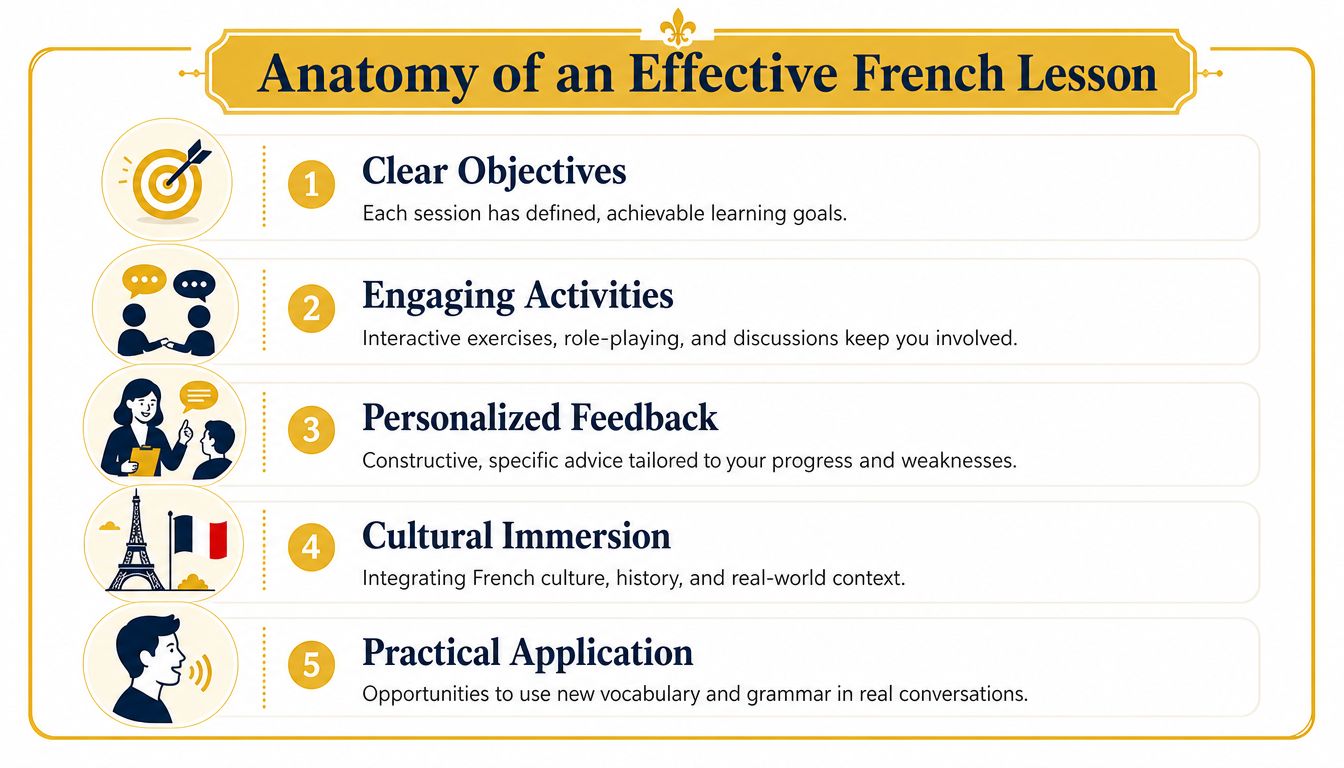
A strong lesson doesn't feel random. It has direction, pressure in the right places, and enough personalization that you know why you're doing each activity.
Too many tutors teach whatever comes to mind that day. That's not premium instruction. That's improvisation.
What you should experience in the first sessions
The first lesson should tell you a lot. A good teacher won't just chat and “see how it goes.” They'll identify your level, ask what success looks like, and start shaping a learning plan immediately.
Here's what I consider essential:
Clear objectives: You should know what the lesson is training.
Active speaking time: You need to produce French, not just listen to explanations.
Targeted correction: Good teachers don't correct everything. They correct what matters most first.
Useful materials: Not just one generic textbook page after another.
Follow-through: You should leave with notes, assigned focus points, or practice tasks.
Two lesson models that work
A business professional in Dallas who needs French for meetings should not get the same lesson as an adult preparing for a vacation.
For a Corporate Communicator, an effective session might include pronunciation drills on names and numbers, role-play for introductions, vocabulary drawn from actual meetings, and short writing tasks for emails. For a Travel Speaker, the lesson may center on survival speaking, listening for real-world interactions, and confidence-building through repetition.
A great lesson feels customized within minutes. If it still feels generic after several sessions, the program isn't doing its job.
How to spot quality before you commit
Ask yourself three simple questions after a trial lesson:
Did the teacher identify my weaknesses accurately?
Did the activities match my reason for learning?
Did I leave with a sense of momentum, not confusion?
If you want a benchmark for what a structured, customized approach should include, review this page on French tutoring methodology. It reflects the standard serious learners should expect from any premium provider.
Understanding the Real Cost of Learning French in Dallas
A common mistake is asking the wrong pricing question. Many inquire, “What's the cheapest French lesson in Dallas?” The better question is, “What format gives me the best return for my goal?”
Cheap lessons can cost more if they waste months.
In the Dallas-Fort Worth metroplex, the average market rate for a private French tutor is $29 per hour, with listings ranging from $9 to well above the mean for instructors with stronger credentials and DELF/DALF specialization, according to Superprof's Dallas French tutor listings. That spread tells you something important. The market includes both budget tutoring and premium specialist instruction. They are not interchangeable. Elite French Tutoring offers premium private instruction at $125/hour for learners who need a more customized, goal-driven approach.
What actually drives price
A higher rate usually reflects some combination of the following:
Teaching skill: Speaking French and teaching French are different abilities.
Specialization: Exam prep, children's support, and business communication require targeted experience.
Customization: Personalized lesson plans take more work outside session time.
Consistency: Reliable scheduling and feedback matter.
Material quality: Better programs use curated resources, not random worksheets.
I'm skeptical of ultra-low pricing when the learner's goal is important. If your child is struggling, if you need French for a promotion, or if you're aiming for certification, price alone shouldn't drive the decision.
Buy value, not just hours
The right tutor can reduce wasted repetition. A weaker tutor often gives you more time but less progress. That's why premium instruction can be the smarter financial choice even when the hourly rate is higher.
A practical way to understand it:
| If your goal is… | Cheapest option usually works? | Better buying decision |
|---|---|---|
| Casual conversation | Sometimes | Group or lighter private support |
| School catch-up | Rarely | Private tutor who can align to coursework |
| DELF or DALF | No | Specialist private instruction |
| Business French | No | Customized private lessons |
| Travel prep | Sometimes | Short-term targeted private lessons |
If you're weighing whether premium tutoring is worth it, this article on whether a French tutor is worth the investment gives a useful lens for comparing price against actual outcomes.
How to Evaluate and Choose Your French Tutor
Dallas learners have options. That's good news, but it also means you need standards. The U.S. language learning market was valued at USD 42.59 billion in 2025, according to this language learning market report. In a large, active market, quality varies. A lot.

Interview the tutor like you mean it
You're not buying a commodity. You're hiring someone to shape how you learn, what habits you build, and how quickly you improve.
Ask direct questions:
“Who do you work with most often?” If their answer doesn't match your profile, keep looking.
“How do you structure lessons?” You want a real process, not “it depends” with no substance.
“How do you correct mistakes?” Good teachers correct strategically, not randomly.
“What materials do you use?” Listen for customization, not dependence on one textbook.
“How do you track progress?” If they can't explain this clearly, they may not be measuring it.
“What happens if my schedule changes?” This matters for Dallas professionals and families.
“Have you worked with students like me?” This is especially important for parents, executives, and exam candidates.
A real student success story
One student we worked with, “Sarah,” was a Dallas-based marketing executive preparing for a role that required regular interaction with French-speaking colleagues. She didn't need academic French. She needed confident speaking, better listening under pressure, and the ability to stop apologizing for her French in meetings.
Her first sessions focused on three things: concise self-introductions, predictable meeting language, and pronunciation patterns that were affecting clarity. We built lessons around her real work life, not generic dialogues. She practiced summaries, transitions, and common business questions until they became automatic.
Within a relatively short period, she stopped treating French as a performance and started using it as a tool. That shift matters more than any flashy promise. Good tutoring changes behavior, not just grammar scores.
If a tutor can't explain how they'd help someone in your exact situation, they probably don't have enough depth.
Here's a useful outside perspective before you book consultations: tips for adult learners choosing the right French tutor.
A short video can also help you think through what strong instruction should sound like in practice.
Red flags I wouldn't ignore
No diagnostic process
No clear answer about methodology
Lots of friendliness, little structure
Vague claims about “fluency”
No examples of similar students served
Rigid materials for every learner
If you're shopping for French lessons in Dallas, confidence should come from evidence. Not charm. Not branding. Not a discount.
Common Questions from Dallas Learners
Can tutoring help my child catch up in school French
Yes, if the tutor works from the actual class sequence. The best support usually comes from aligning lessons to quizzes, reading assignments, grammar units, and teacher expectations. If a tutor insists on using a separate curriculum with no relation to school, I'd be cautious.
I need French for work, but my schedule is unpredictable
That's exactly where flexible online private lessons tend to work best. Busy professionals need scheduling that can adapt without losing momentum. Ask how rescheduling works, whether lesson notes are shared, and whether sessions can focus on your industry vocabulary instead of generic topics.
Should I choose a native speaker
Not automatically. Native fluency helps, but it's not enough. You want someone who can teach, diagnose errors, and explain patterns clearly. For children, exam prep, and business communication, teaching skill matters as much as language background.
How many lessons should I book at first
Start with enough lessons to establish momentum, but not so many that you commit blindly. I usually prefer an initial block that lets the teacher assess consistency, adapt materials, and identify patterns. One isolated lesson rarely tells the full story.
Is online really as effective as in-person
It can be, especially for adults and older students who benefit from convenience and consistency. The key is lesson design. A weak online lesson feels flat. A strong one is interactive, focused, and well-paced.
Parents should ask, “Can you work from my child's current school materials?” Professionals should ask, “Can you build sessions around my actual work scenarios?”
Your Next Step to Speaking French Confidently
The best French lessons in Dallas aren't the ones with the loudest marketing or the lowest hourly rate. They're the ones that fit your goal, your schedule, and your learning style with enough precision to keep you moving.
If you're a parent, choose alignment and teaching skill. If you're a professional, choose customization and flexibility. If you're preparing for DELF or DALF, choose specialization. That's how smart buyers make this decision.
If you want help sorting through your options, book a free 20-minute consultation with Elite French Tutoring. We'll help you assess your level, clarify your goal, and determine whether private online French lessons are the right fit for you or your child.