Skip to content

You're probably doing what most Stamford families and professionals do first. Open three tabs, scan tutor profiles, compare hourly rates, and still have no idea who can help with your situation.
That confusion is normal. A parent looking for support tied to a bilingual school curriculum shouldn't hire the same kind of tutor as a finance professional preparing for meetings in French, and neither of them should rely on the same approach as a student aiming for DELF or DALF. The local market gives you plenty of names. It doesn't always give you clarity.
That's where smart buying decisions start. Not with “Who teaches French?” but with “Who teaches my kind of French, for my kind of goal, on a schedule and budget that actually works?”
Table of Contents
Why Finding the Right French Lesson in Stamford is Tricky
Individuals searching for French lessons in Stamford quickly encounter a common problem. The profiles look similar, the promises sound broad, and the difference between a casual tutor and a specialist is often buried or missing altogether.
One profile may be perfect for beginner conversation. Another may be a strong fit for a middle school student. A third may be the right choice for an adult who needs polished speaking skills in a professional setting. But if you skim instead of vetting carefully, they can all look interchangeable.
Generic listings hide important differences
Many buyers lose time and money. A tutor can be fluent and still not be the right instructor for exam prep, business communication, or curriculum-based support. We see this especially often with families who need reinforcement tied to classroom expectations, not just extra vocabulary practice.
A good local search should answer questions like these:
School support: Can this tutor work with a child's actual class materials and teacher expectations?
Professional use: Can they teach formal speaking, meeting language, and industry-specific communication?
Exam readiness: Do they know how to structure lessons around DELF or DALF performance, not just general improvement?
Adult confidence: Can they build speaking fluency without turning every lesson into a grammar lecture?
Generic tutor marketplaces are good at showing availability. They're much less reliable at showing fit.
The Stamford market rewards careful screening
Stamford gives you access to local, online, and hybrid options, which is a good problem to have. But volume creates noise. Families compare rates. Professionals compare convenience. Very few people compare methodology until they've already had a disappointing first month.
That's why it helps to start with a clearer buying lens and not just a tutor directory. If you're weighing local support against more specialized options across the state, this guide to French lessons in Connecticut gives useful context on how programs differ once you move beyond basic listings.
First Define Your Goal Then Find Your Tutor
Before you compare tutors, define the outcome. That sounds simple, but it changes everything about who you should hire, how often you should meet, and what you should expect to pay for.
A student who needs homework support does not need the same lesson design as an executive preparing for cross-border meetings. The mistake isn't choosing a bad tutor. It's choosing a tutor whose strengths don't match the job.
Four goals that require very different tutors
Some Stamford clients need academic support. That usually means reading help, writing correction, speaking practice tied to class units, or reinforcement before tests. In this category, curriculum fit matters more than personality alone.
Others need business French. That's a narrower market. The demand for French in global sectors is rising, with a 28% increase in French-speaking roles in international diplomacy and corporate sectors in the Northeast, yet only 15% of Stamford's tutors on platforms like Care.com advertise this specialized business expertise according to L'Alliance New York's adult language center page cited in the market data. If your goal is professional communication, don't assume a general tutor can bridge that gap.
There's also the exam-prep track. DELF and DALF preparation requires more than “advanced French.” It requires a tutor who knows how to train for oral structure, listening demands, written tasks, and time pressure.
Then there's adult fluency for real life. This group often needs consistency, accountability, and a tutor who can keep speaking active without making lessons feel academic or slow.
A quick self-check before you book
Use these questions before you schedule any trial lesson:
What will success look like in three months? Better grades, smoother conversation, presentation confidence, or exam readiness?
What will you bring to lessons? School materials, work scenarios, interview practice, or no materials at all?
What matters more right now? Flexibility, specialization, budget control, or measurable structure?
Practical rule: If you can't describe the result you want, you can't evaluate whether a tutor is delivering it.
A clear goal also helps you avoid paying premium rates for the wrong service. Some learners need high-touch custom instruction. Others need a reliable weekly rhythm with strong correction and accountability.
If you're an adult learner sorting through those options, this advice on how to find the perfect French tutor for adult learners is a smart next step before you start booking intro calls.
Comparing Your French Lesson Options in Stamford
Once your goal is clear, the next decision is format. In Stamford, format affects price, customization, convenience, and how quickly lessons start helping with your actual objective.
There are approximately 171 French tutors available in Stamford, the average price for a private lesson is $34 per hour, and 97% offer the first lesson for free according to Superprof's Stamford tutor listings. That tells us two things. First, buyers have a lot of choice. Second, introductory sessions are part of how tutors compete.
French Lesson Formats in Stamford Compared
| Format | Best For | Customization | Typical Cost Range |
|---|---|---|---|
| Private In-Person | Children, local families, learners who focus better face-to-face | High | Around the local private-lesson market, often benchmarked against $34 per hour in Stamford listings |
| Private Online | Busy professionals, older students, remote learners, highly specific goals | High | Varies by tutor and specialization |
| Elite French Tutoring | Professionals, exam prep, curriculum-aligned support, and learners who want to speak French with confidence | High | $125 per hour |
| Group Classes | Social learners, general conversation, budget-conscious adults | Low to medium | Usually lower per person than private lessons |
Private in-person works best when accountability matters
For many younger students, in-person support still works well because it's easier to keep attention steady, review printed materials, and coordinate with school routines. Parents also tend to like the visibility. They can see whether the tutor is structured, prepared, and able to redirect when a student drifts.
That said, in-person only makes sense if the tutor is right for the child's academic need. A nearby tutor with open slots can still be the wrong buy.
Private online is often the strongest value for specialists
For adults, exam candidates, and families with narrow requirements, online instruction often gives access to stronger specialists and more flexible scheduling. The quality gap between “available local tutor” and “best-fit instructor” can be significant.
This matters if your goal is not just exposure but progress tied to a deadline or professional use. For buyers comparing remote options, this overview of the best online French lessons helps frame what to look for beyond convenience alone.
Group classes are useful, but they solve a different problem
Group classes are fine for routine exposure, social motivation, and low-pressure conversation. They are less effective when the learner needs targeted correction, school alignment, or role-specific speaking practice.
A group class can support a language journey. It usually won't replace focused one-to-one work when intensive progress is required.
Choose in-person private lessons if your child needs direct support with schoolwork and benefits from close supervision.
Choose online private lessons if your objective is specialized and your schedule is crowded.
Choose group classes if your main priority is affordability and casual practice, not highly customized outcomes.
What to Look For in a Top-Tier French Tutor
Price matters. It just shouldn't be the first filter.
A lower hourly rate can be a good value when the learner needs light support. It becomes expensive very quickly when lessons drift, feedback is vague, or the tutor can't teach toward a concrete outcome. The best buyers in this market screen for quality first, then decide whether the rate matches the result.
Here's a practical visual checklist worth using as you compare options:
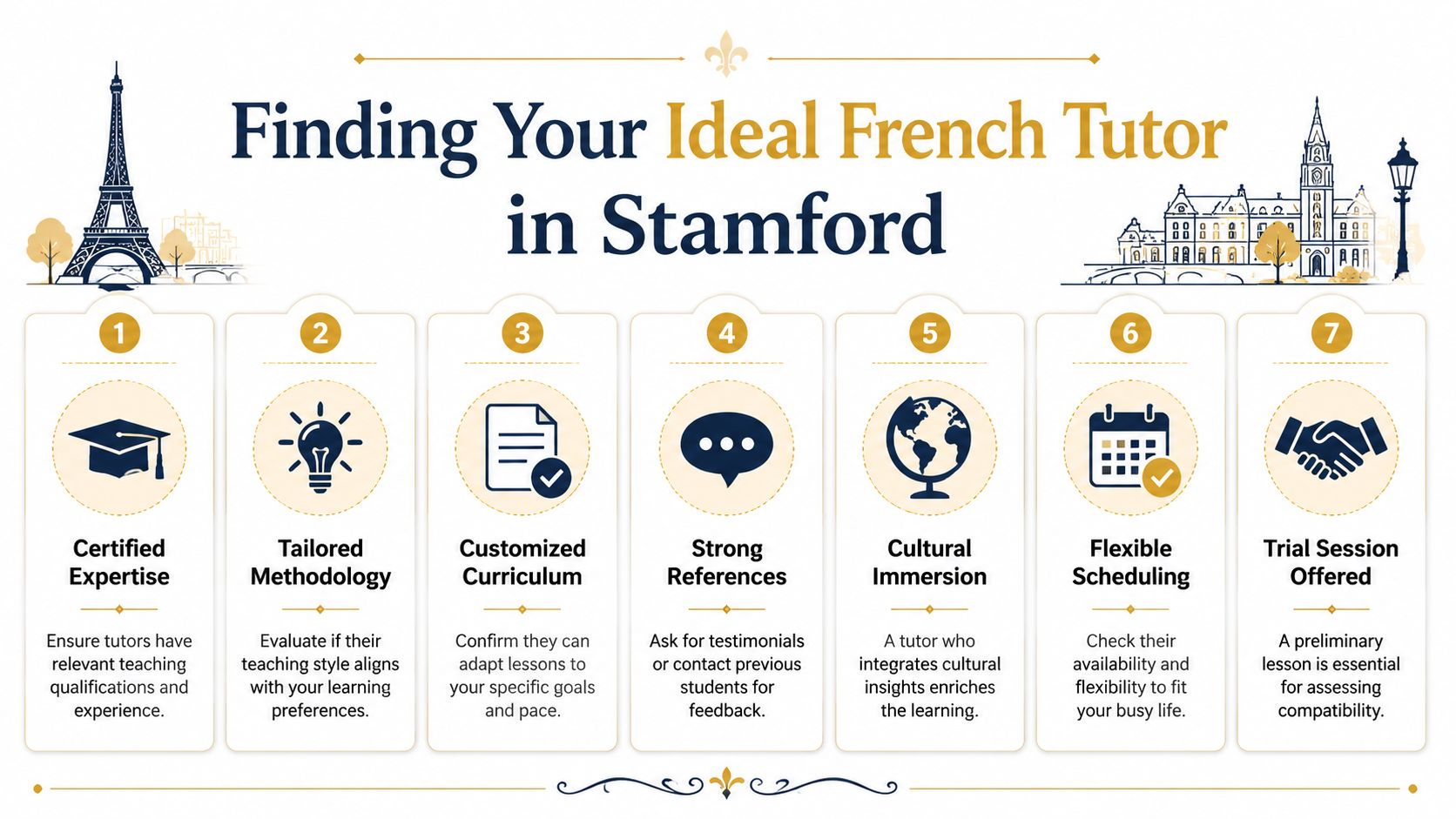
Native ability and teaching ability are not the same thing
A native speaker who cannot diagnose errors, sequence lessons, or correct with precision won't automatically produce better results. At the same time, pronunciation modeling and real-time oral correction matter a lot, especially once speaking confidence becomes the goal.
The strongest evidence point in this market is this: learners studying with native instructors achieve B2 proficiency 30 to 40% faster than those with non-native tutors, due to immersive phonological modeling and real-time corrective feedback, according to the Wyzant Stamford tutor market analysis cited in the verified data. That's one reason serious programs often insist on high-immersion speaking protocols.
If speaking is the goal, ask how much French is actually used during the lesson. Many tutors say they teach conversation. Far fewer create real immersion.
Specialization beats general fluency
When you interview a tutor, don't ask only “How long have you taught?” Ask what they teach repeatedly and well.
A good screening list includes:
Curriculum match: Can they work from school assignments, teacher comments, or specific reading lists?
Exam fluency: Do they understand DELF or DALF task types and correction standards?
Professional usage: Can they train formal email, presentation language, and meeting interaction?
Lesson design: Do they adapt content each week or repeat a standard template with every student?
One local professional example worth noting is Sandy McAndrews, whose background includes teaching elementary, middle, and high school students in Greenwich Public Schools and providing private and group French lessons to adult education students and business professionals in Stamford since June 2016, as described on her LinkedIn profile. That kind of cross-context experience matters because it signals range, not just language ability.
Watch how the tutor handles the trial lesson
A trial lesson tells you more than the profile does. Strong tutors don't just chat pleasantly. They assess, clarify goals, and show how future lessons would be structured.
Look for signs like these:
They ask targeted questions about school, work, deadlines, or prior study.
They correct with purpose instead of interrupting constantly or letting errors slide.
They explain next steps clearly, including what should happen between sessions.
They can say no when your goal needs a different type of instructor.
The best tutors don't try to fit every client. They qualify the match.
How One Stamford Professional Mastered Business French
A Stamford professional came to us with a familiar problem. He'd studied French before, could read more than he could say, and kept freezing in live conversation when the stakes rose. His company had more interaction with French-speaking colleagues, and he needed to sound capable, not tentative.
He'd already tried the usual path. Language apps gave him repetition but not judgment. Group classes gave him exposure but not enough speaking time. He didn't need “more French.” He needed the right kind of French.

The turning point was specificity
Once his lessons centered on business introductions, meeting language, objection handling, and concise spoken summaries, progress became visible. The content finally matched the pressure points he faced at work.
What helped most was not volume of material. It was relevance. Each session targeted situations he encountered, then repeated them until the language became usable under pressure.
Why this matters beyond business learners
The same principle applies to families. For children in bilingual schools, curriculum alignment is a major and underserved need. A 2025 report showed 42% of French bilingual school students in the Northeast felt they had inadequate home-school support, and local platforms show virtually no tutors specifying experience with Lycée or UNIS programs, according to the Albertine Foundation's French Heritage Language Program information cited in the verified data.
That's the broader lesson from this Stamford case. Generic tutoring underperforms when the learner's real need is narrow, high-stakes, or context-specific.
If your goal is professional communication rather than general conversation, it helps to compare options built specifically for French for business before you commit to a generalist tutor.
Start Your French Journey with a Clear Plan
The Stamford market gives you options. The hard part is choosing the option that fits the result you want.
Most bad tutoring experiences come from a mismatch in one of three areas. The goal wasn't defined, the format didn't suit the learner, or the tutor's expertise didn't match the actual job. Once you fix those three, the search becomes much simpler.
A practical way to choose well
Keep the process tight:
Name the outcome first. School support, business communication, exam prep, or fluent adult conversation each require different teaching choices.
Choose the format second. Convenience matters, but only after you know what type of instruction you need.
Screen for specialization third. Trial sessions should reveal methodology, correction style, and fit.
Here's the benchmark many Stamford buyers use when comparing value. The average hourly rate for a private French tutor in Stamford is $43.00, based on 38 tutors on Care.com, according to Care.com's Stamford French tutor listings. That's a useful suburban baseline. It also explains why premium instruction sits in a different category when the service includes specialized work such as DELF or DALF preparation, business French, or highly customized support.
This screenshot gives you a sense of what a more structured service model looks like when you move beyond open-market listings:

The right next step
If you're still comparing French lessons in Stamford, don't start by buying a package. Start by clarifying fit.
A good first move is to book a short consultation where your level, goals, schedule, and learning style are evaluated before lessons begin. Elite French Tutoring offers a free 20-minute consultation for exactly that reason. It's a low-pressure way to determine whether you need curriculum-aligned support, business French, exam preparation, or a more flexible conversation-based program. If you're ready to compare your options with a clear framework, visiting Elite French Tutoring is a sensible next step.
The right tutor doesn't just know French. They know how to teach your French.