
You sit down with an AP French language practice exam, start the timer, and suddenly everything feels harder than it did in class. The reading is manageable until the clock starts pressing. The email seems simple until you realize you have to answer every part cleanly and fast. Then the speaking prompts arrive, and your brain starts translating instead of responding.
That reaction is normal. It also tells me exactly what you need.
Most students don't need more random AP French questions. They need a practice method that matches the pressure of the actual exam, especially in timed writing and spontaneous speaking. That's where scores stall. That's also where top scores are won.
If you're serious about a 5, treat every AP French language practice exam as a performance rehearsal, not just a worksheet. That's the difference between knowing French and scoring well in AP French.
Table of Contents
- Your Guide to Acing the AP French Exam
- Deconstructing the Exam Structure and Scoring
- Your 6-Week AP French Study Schedule
- Mastering Each Skill Under Timed Conditions
- Self-Study vs Tutoring Which Path to a 5
- Common AP French Pitfalls and How to Avoid Them
Your Guide to Acing the AP French Exam
A lot of strong students get blindsided by AP French because they assume classroom success will carry them through. Sometimes it does. Often, it doesn't.
The exam rewards control under pressure. You need to read quickly, listen accurately, write within a structure, and speak before self-doubt takes over. If even one of those skills breaks down when the clock starts, your score drops.
I want you to think about the AP French language practice exam differently. It isn't just a way to measure progress. It's your main training tool. Used badly, it becomes a discouraging grind. Used correctly, it becomes the fastest way to identify weak spots and fix them before test day.
Know what you're really training
Students usually say, "I need to improve my French." That's too vague to be useful.
For AP French, you're training these things instead:
- Speed of retrieval: Can you produce usable French immediately?
- Task control: Can you answer the exact prompt instead of drifting?
- Timing discipline: Can you finish without rushing the last third?
- Rubric awareness: Can you give scorers what they reward?
If you ignore those, you're just hoping your general French ability carries you.
Practical rule: Never take an AP French language practice exam just to "see how you do." Take it to diagnose one specific problem, then fix that problem in your next session.
The approach that works
Here's the approach I recommend to nearly every serious student:
- Start with one timed diagnostic. Not to panic yourself, but to see where you lose control.
- Break the exam into repeatable parts. Speaking, email, essay, reading, listening.
- Train the hardest pieces more often than the easiest ones. For most students, that's speaking first, timed writing second.
- Review your output, not just your answers. A correct instinct isn't enough if you can't deliver it fast enough.
- Repeat under real timing. Untimed practice has value, but it won't solve performance problems.
The good news is that this exam is highly learnable. Once you understand the structure and train to it, the test stops feeling mysterious. It starts feeling familiar.
Deconstructing the Exam Structure and Scoring
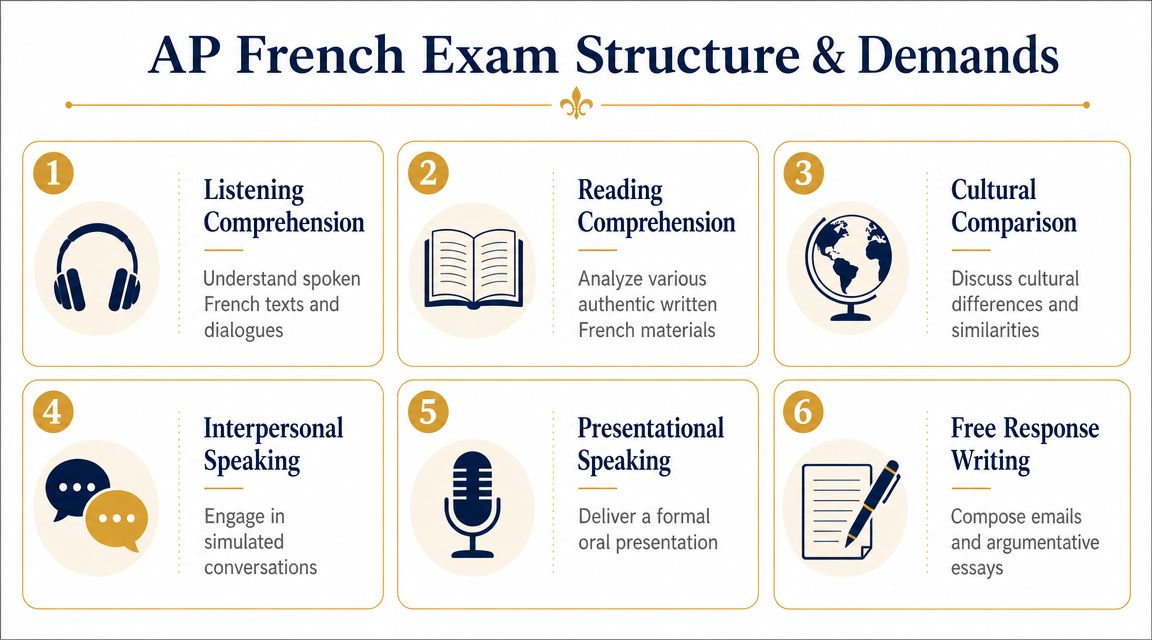
The AP French exam is easier to handle when you stop treating it like one giant event and start treating it like a series of distinct performance tasks. According to the College Board's AP French assessment overview, it's a three-hour exam with two sections worth 50% each. Section I is multiple-choice with 65 questions in 95 minutes. Section II includes an email reply, an argumentative essay, a simulated conversation, and a cultural comparison presentation.
Know the test like a coach
If you've been using AP French language practice exam PDFs casually, this is the reset you need. The exam isn't just long. It's mixed. Your brain has to switch from interpretation to production, then from writing to speaking.
That matters because students often overpractice what feels comfortable. They do reading drills, skim sample essays, maybe listen to some French audio, and call it preparation. But the actual test asks for fast transitions between skills.
A smart student studies French. A high scorer studies the exam's demands.
What each part demands from you
Here's the strategic breakdown I give students.
| Exam Part | Official Task | What it really tests | Best practice focus |
|---|---|---|---|
| Print multiple-choice | Reading authentic texts | Focus, inference, pacing | Fast annotation and elimination |
| Audio and combined multiple-choice | Listening and integrated comprehension | Attention under one-shot audio pressure | Note-taking and anticipation |
| Email reply | Short formal writing | Precision, completeness, register | Answering every part cleanly |
| Argumentative essay | Source-based writing | Organization and evidence control | Quick outlining and source use |
| Simulated conversation | Interpersonal speaking | Immediate response | Automatic openings and connectors |
| Cultural comparison | Presentational speaking | Structure and clarity | Organized speaking from memory |
The simulated conversation is where many capable students unravel. You don't get generous thinking time. You get a prompt, then you respond. That means your training can't be based on silent planning and slow perfectionism.
The essay creates a different trap. Students often know enough French to write something decent, but they waste time deciding what to say. The fix isn't "learn more vocabulary." The fix is building a repeatable response structure.
Students who score well don't sound magical. They sound prepared, organized, and calm under the exact conditions the test creates.
One more point matters. Because the exam splits weight evenly between multiple-choice and free response, you can't hide behind one strength. If you're a strong reader but weak speaker, or a fluent speaker but sloppy writer, your preparation has to become more balanced.
The AP French language practice exam works best when you rehearse each task as its own event. That's how you stop bleeding points in predictable ways.
Your 6-Week AP French Study Schedule
Cramming doesn't work well for AP French because this exam asks for stamina, speed, and consistency. You need a plan that builds those habits step by step. The most effective timing profile comes from AP Central's exam page: 40 minutes for 30 print-text questions, 55 minutes for audio or combined questions, 1 hour 10 minutes for written free response, and about 18 minutes for spoken free response.
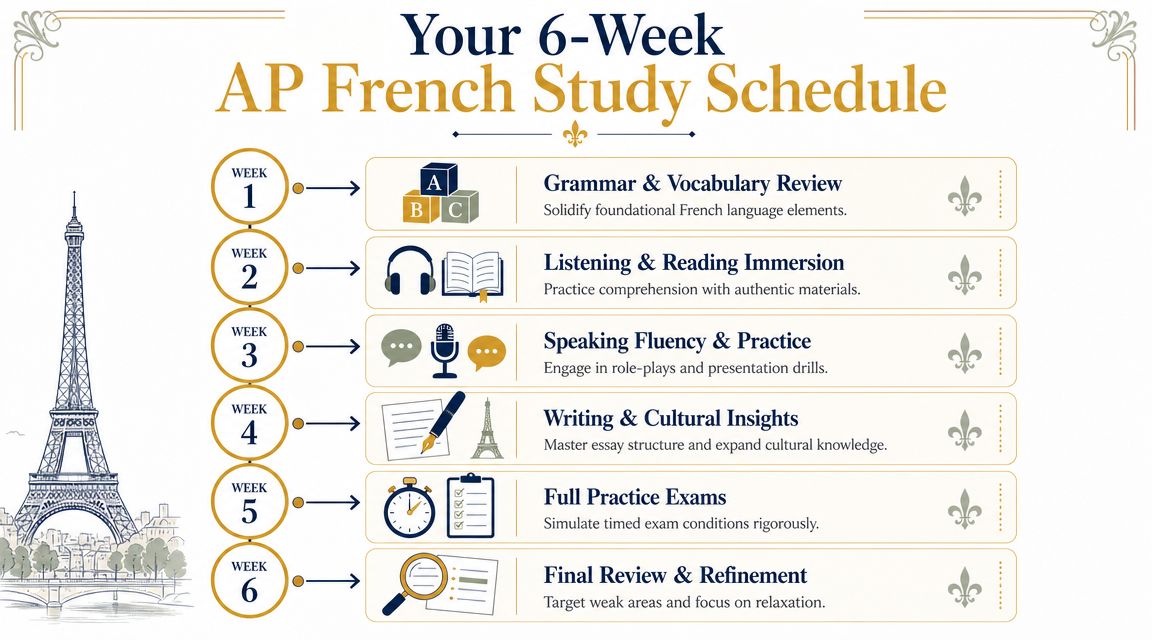
If you want a broader framework for organizing your prep outside AP French, this structured French study plan is a useful companion. For the exam itself, I'd use this six-week build.
Weeks 1 and 2 build control
Week 1: Diagnose and stabilize
Take one partial or full AP French language practice exam under real timing. Don't obsess over the score. Track where you lost time, froze, guessed badly, or produced weak French.
Then spend the rest of the week correcting patterns:
- Reading: Practice moving passage by passage without lingering on one hard question.
- Listening: Take notes in keywords, not full sentences.
- Writing: Draft one email and one short outline for an essay.
- Speaking: Record brief responses every day.
Week 2: Tighten listening and email writing
This week is about accuracy under pressure. The email task looks easy until students miss a question, use the wrong register, or run out of time polishing one sentence too much.
Use short sessions:
- One listening set under timed conditions.
- One email reply with a strict stop time.
- One speaking drill with instant responses.
- One review session where you identify recurring language errors.
Weeks 3 and 4 train output
Week 3: Attack speaking
Most students wait too long to train speaking seriously. That's a mistake. Start now.
Do daily micro-drills:
- Listen to a prompt.
- Give yourself no extra time.
- Respond out loud.
- Replay and mark hesitation, filler, and grammar breakdowns.
Your goal isn't fancy French. Your goal is continuous, relevant, organized French.
Week 4: Build essay structure and cultural comparison
This is the week to stop writing from scratch every time. Build templates.
For the essay, rehearse a fast outline routine. For the cultural comparison, practice a dependable structure with an opening, one culture, the francophone comparison, and a conclusion that actually compares rather than merely describes.
Coaching note: A repeatable structure lowers anxiety. Students often call it "sounding robotic." I call it "finishing on time with a coherent answer."
Weeks 5 and 6 sharpen performance
Week 5: Full simulations
Now you need pressure. Do at least one full AP French language practice exam with strict timing and no pausing. Treat it like test day. Sit at a desk. Use the same sequence. No checking answers midstream.
Afterward, review in two stages:
- Content review: What did you misunderstand?
- Performance review: Where did your timing or confidence crack?
Week 6: Refine, don't overload
This is not the week to stuff in new grammar topics and hope for the best. It's the week to protect your strongest habits and clean up recurring mistakes.
Prioritize:
- one final timed speaking session
- one final email and essay set
- light reading and listening to stay sharp
- sleep and routine
If you only have six weeks, this schedule is enough to make real progress. If you have longer, stretch it rather than intensify it blindly. AP French rewards disciplined repetition more than marathon study days.
Mastering Each Skill Under Timed Conditions
One student I worked with, Alex, had solid French instincts and terrible timed performance. In conversation, he sounded thoughtful and natural. On AP-style speaking tasks, he froze, restarted, and left dead air in places where he knew what to say.
That's a common AP French problem. The gap isn't knowledge. It's delivery.
The biggest weakness in a lot of prep materials is exactly this issue. As noted in AP Central's past AP French exam materials, students need stronger training for spontaneous, high-scoring speech under pressure, not just more prompts. If you're trying to build that skill outside class, this guide on how to practice French conversation can help you set up better speaking sessions.
The student who stopped freezing
Alex improved when we stopped saying, "Let's practice French," and started saying, "Let's practice response behavior."
That change matters. A strong AP French language practice exam routine trains behaviors:
- starting immediately
- organizing fast
- using familiar connectors
- recovering smoothly after mistakes
Once Alex did that consistently, he sounded more confident because he was more prepared.
Reading and listening under pressure
For reading, the highest-impact change is simple. Stop reading every passage as if it's literature class.
Read for purpose first. Ask yourself: what's the point, who is speaking, and where will the trap answers appear? Then answer with elimination, not gut feeling.
Try this drill:
- First pass: Find the main idea and tone.
- Second pass: Mark details tied to likely questions.
- Final step: Eliminate answers that are partly true but don't match the text's actual claim.
For listening, don't try to capture everything. That's how students panic. Capture anchors. Names, opinions, contrasts, and any shift in point of view.
If you miss one word, keep moving. Students lose more points from spiraling than from missing one detail.
A good timed listening session feels a little uncomfortable. That's normal. You're training attention, not perfection.
Writing faster without sounding rushed
For the email reply, completeness beats elegance. Students often write one polished paragraph and still lose strength because they didn't answer every question or forgot to ask one relevant question of their own.
Use a checklist before you stop:
- Greeting and register: Stay formal and consistent.
- Every prompt addressed: No skipped detail.
- Question included: Make it relevant.
- Closing: Keep it clean and appropriate.
For the argumentative essay, the fastest improvement usually comes from outlining before writing. Not a long outline. A skeletal one.
I like this sequence:
- Choose your position quickly.
- Assign each source a role.
- Draft your main point for each body paragraph.
- Write with transitions you already control.
This short video is worth watching if you want to hear AP French advice explained in a more guided format before your next practice session.
Speaking without translating in your head
At this stage, most 5-score attempts either get serious or fall apart.
Students think speaking practice means "talk more." That's incomplete. AP speaking practice has to target instant organization.
Use these methods:
- Build opening phrases you can deploy automatically. Not memorized speeches, just reliable starts.
- Practice connectors until they come out without effort. If you have to search for transitions, your fluency collapses.
- Answer aloud with a recorder. Silent planning doesn't count.
- Limit complexity on purpose. A clear sentence now beats a complex sentence that never arrives.
For simulated conversation, train short response frames. For cultural comparison, train a stable structure that you can adapt to different topics.
Alex's breakthrough came when he accepted one uncomfortable truth. Speaking naturally under pressure doesn't come from waiting to feel ready. It comes from rehearsing the exact pressure until it stops feeling foreign.
Self-Study vs Tutoring Which Path to a 5
Some students can get a lot done on their own. They use released materials well, stick to a schedule, and correct themselves accurately. That's a real path.
But if your goal is a 5, you should be realistic about what self-study can and can't do. According to this 2024 AP French score breakdown summary, 72.3% of test takers earned a 3 or higher, while only 14.5% earned a 5. Passing is one thing. Breaking into the top band is another.
Who can self-study effectively
Self-study works best for students who already have strong discipline and decent self-awareness. If you can hear your own speaking weaknesses, spot your writing patterns, and maintain strict timing, solo prep may take you pretty far.
It tends to work especially well when:
- Your reading and listening are already strong
- You don't procrastinate
- You can review rubrics objectively
- You have access to quality prompts and scoring materials
The problem is feedback. Self-study gives you volume. It doesn't always give you correction.
When tutoring becomes the smart move
Tutoring isn't magic. But it is efficient.
A strong tutor catches things a book or video won't catch. Your pacing. Your pronunciation. Your tendency to avoid direct answers. Your habit of writing long, vague introductions instead of making a clean argument.
Here is the trade-off clearly.
| Feature | Self-Study (Books/Online) | Personalized Tutoring |
|---|---|---|
| Cost | Lower upfront | Higher upfront |
| Flexibility | High | High if scheduled well |
| Accountability | Depends on you | Built in |
| Speaking feedback | Limited | Immediate and specific |
| Writing correction | Often delayed or generic | Personalized and targeted |
| Strategy adjustment | Slow | Fast |
| Best for | Independent students building a base | Students aiming higher or correcting plateaus |
If you're comparing options, this guide on finding the right French tutor is a sensible place to start.
A plateau usually means one thing. You no longer need more effort. You need better feedback.
My opinion is simple. Start with self-study if you're organized. Add tutoring when your speaking stays shaky, your writing isn't improving, or your practice results stop moving. That's usually the point where personalized coaching stops being a luxury and starts being the efficient choice.
Common AP French Pitfalls and How to Avoid Them
The students who underperform usually don't fail because they were lazy or incapable. They make a few predictable mistakes repeatedly, and those mistakes cost them when timing gets tight.
The mistakes I see most often
They wait too long to time their work.
Untimed practice feels productive because it feels comfortable. But the AP French language practice exam is a timed performance. Start using time limits early, even on short drills.
They translate in their heads during speaking.
This is deadly for fluency. If you build your response in English first, you're already behind. Train simpler French that comes out fast and clearly.
They give broad cultural comparisons.
Vague answers sound underprepared. You need concrete examples and an actual comparison, not two separate mini-speeches.
They chase advanced grammar they can't control.
Students trying to impress scorers often produce messy French. Clear, correct language wins more often than ambitious language with obvious errors.
What strong students do differently
They simplify when needed. They answer the task directly. They train speaking before they feel ready. They review mistakes with honesty instead of just hoping the next practice exam goes better.
If you know you make recurring language errors, this roundup of common mistakes in French is useful for tightening your basics before exam day.
You don't need to be perfect to do very well on AP French. You need to be prepared in the right way. That's a much more manageable problem.
If you're deciding whether to keep self-studying or get expert help for speaking and timed writing, a short consultation can save a lot of trial and error. At Elite French Tutoring, you can compare private lesson options and book a free consultation to see whether targeted AP French coaching makes sense for your timeline and score goal.