Skip to content

You open your inbox, see “French placement test required”, and your first thought probably isn't excitement. It's usually some version of: How hard is this? What if I place too low? What if I place too high and get buried in a course I can't keep up with?
That reaction is normal. I've worked with students, parents, and professionals long enough to know that the stress usually isn't about French alone. It's about consequences. One test can affect your course schedule, your confidence, and the pace of your next semester.
What makes modern french placement tests more frustrating is that the process often feels scattered. Some schools use learning platforms, some use outside testing tools, some include writing, some don't, and important rules about exemptions or retakes are often buried across different university pages. If you're trying to make a smart decision quickly, the lack of one clear roadmap is the primary problem.
A good placement result isn't just a high result. It's the right result. That's the difference between spending months bored in a class that's too easy and spending months scrambling in one that moved too fast.
Table of Contents
- That "French Placement Test" Email Just Landed What Next
- Understanding the Goal of French Placement Tests
- Comparing Common French Placement Test Formats
- What to Expect Inside the Test Sample Questions
- Your Placement Test Prep Plan and Timeline
- After the Test Interpreting Your Score and Next Steps
That "French Placement Test" Email Just Landed What Next
Most readers reach this point in one of three situations. You studied French years ago and barely remember what you know. Your child has been told to test before entering a program. Or you've been taking French in school for a while, but you have no idea how your classroom grade translates into placement.
The first move is not studying random grammar worksheets for hours. The first move is to figure out what test you've been asked to take.
Some institutions now run placement through online systems, and the process can be less straightforward than students expect. The UCI French placement and exemption information notes that institutions may use a mix of platforms such as Canvas, paid tools like Avant STAMP 4S, and varied formats that can include multiple-choice and writing, with retake and exemption rules spread across separate pages. That's exactly why so many students feel lost before they answer a single question.
The first three things to check
- Test format: Is it multiple-choice only, or does it include writing or listening?
- Retake policy: Some schools are flexible. Others are not.
- Exemption path: AP, IB, prior coursework, or heritage-speaker status may change what you need to do.
Practical rule: Don't prepare for a generic “French test.” Prepare for your institution's version of it.
I've seen students waste precious time reviewing the wrong material because they assumed all placement tests work the same way. They don't. A short university diagnostic and a formal proficiency exam ask for different preparation, different pacing, and different expectations.
There's also a mindset trap here. Students often think they need to “beat” the test. Usually, they need to show their current level clearly and accurately. That doesn't mean you shouldn't prepare. It means your prep should sharpen what you know, not distort the result with frantic cramming.
If you're in that post-email panic window, slow the process down. Gather the testing details first. Once you know the format, the preparation becomes much more manageable.
Understanding the Goal of French Placement Tests
A placement test is not the same thing as a pass-fail exam. It's closer to a sorting tool. Its job is to find the course level where you can work hard, improve steadily, and avoid avoidable frustration.
That distinction matters. Students who treat placement as a contest often make poor choices afterward. They chase the highest possible course number, then discover they can decode grammar questions but can't keep up with live discussion, reading load, or writing expectations.

Why accurate placement matters more than ego
French placement systems have been used as academic tools for a long time. The University of Wisconsin French placement program states that Wisconsin high school teachers and UW faculty have worked together since 1984 to develop a test for placing incoming students into college French courses, and that the current model includes separate tests for language usage and reading comprehension while each campus sets its own cutoff scores. That history tells you something important. These tests were built to match students to instruction, not to create an arbitrary gate.
In practice, the best placement is the one that gives you enough challenge to grow without forcing you to spend the semester in survival mode.
A student placed too low often gets bored, disengages, and builds bad habits. A student placed too high may feel smart for a week, then starts dreading every assignment. Neither outcome is efficient.
For families trying to translate a school result into something more universal, it helps to understand how class placement lines up with broader proficiency benchmarks. A quick review of CEFR levels in French can make the result feel much less abstract.
What a strong result actually looks like
Here's the standard I use with students:
- You can follow the class pace without constant panic.
- You make mistakes that are teachable, not foundational gaps that block everything else.
- You leave room for progress instead of repeating material you've already mastered.
The right placement often feels slightly challenging, not crushing and not trivial.
If you're ambitious, that's good. Ambition helps. But placement decisions work best when they're grounded in realistic language performance, not pride. The students who progress fastest are usually the ones who start in the level that lets them participate fully from the beginning.
Comparing Common French Placement Test Formats
It's a common misconception that a single standard exam exists for french placement tests. There isn't. What you're facing could be a university screening tool, a formal credential, or a lighter online diagnostic used for advising or tutoring intake.
That matters because each format answers a different question. One asks, “Which class should you take?” Another asks, “Can you prove your level formally?” Another asks, “Where should we start working with you?”
French Placement Test Formats at a Glance
| Test Type | Primary Purpose | Skills Tested | Scoring |
|---|---|---|---|
| University-specific placement exam | Course placement within a school or university | Often grammar, vocabulary, reading, and sometimes listening or writing | School-specific result tied to course placement |
| DELF or DALF | Formal certification for study, work, or personal credentialing | Listening, reading, writing, and speaking | Certification-level outcome tied to the exam framework |
| Online diagnostic quiz or tutor assessment | Quick level estimate for planning study | Varies widely by provider | Informal level guidance rather than institutional placement |
A university placement exam is usually the most practical and least glamorous of the three. It doesn't need to impress anyone outside your institution. It only needs to place you into the right course. That's why these tests are often efficient, focused, and narrower in scope.
DELF and DALF are different. They're not just sorting mechanisms. They're formal external exams with their own logic, pacing, and performance standards. If you're comparing those options because you need recognized exam prep rather than school placement, it helps to look at a dedicated DELF and DALF preparation overview.
How to identify which format you are facing
Ask these questions before you prepare:
- Is the result tied to one school only? If yes, it's likely a university placement tool.
- Will the result produce a certificate? If yes, you're probably dealing with a formal proficiency exam.
- Is the test mainly for advising or onboarding? Then it may be diagnostic rather than high-stakes.
One of the biggest mistakes I see is preparing for a certification exam when the student has a short campus placement screen. The reverse also happens. Someone assumes their test is “just a placement quiz” and underestimates a format that includes writing or a more complete skill profile.
There are also trade-offs within university tests themselves. Some institutions favor speed and broad coverage. Others want a richer sample, so they add a writing component or use an outside platform. Short tests are convenient and scalable, but they can't capture every nuance of spoken fluency or writing maturity. Longer formats often produce a fuller picture, but they demand more time and clearer student instructions.
That's why I don't recommend copying a friend's prep plan unless your testing format is identical. Two students can both say “I have a French placement test next week” and be dealing with very different tasks.
A practical approach looks like this:
- For a university exam: Refresh grammar patterns, reading speed, and common classroom vocabulary.
- For a formal proficiency test: Train all tested skills under realistic conditions.
- For a diagnostic: Use it as a measurement tool, not a performance event.
If you're a parent choosing support, or a student deciding whether to self-study or get guidance, this comparison is where the buying decision becomes clearer. The more specific the format, the easier it is to choose the right kind of preparation.
What to Expect Inside the Test Sample Questions
Most students calm down once they see the kinds of questions these tests usually ask. The mystery is often worse than the content.
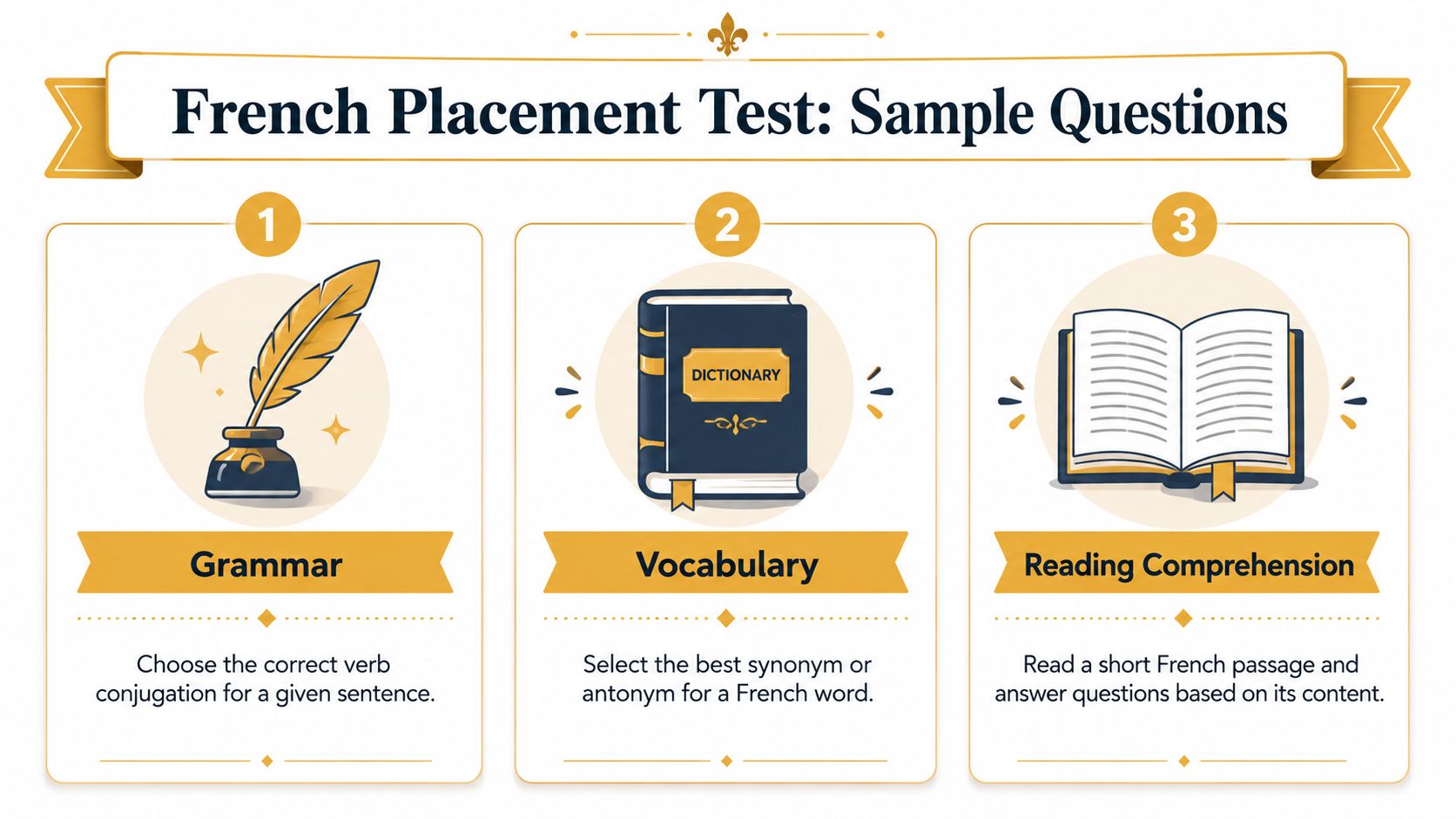
A good real-world model comes from Michigan State University. The MSU French placement test page says the test has 39 multiple-choice questions across listening, grammar, vocabulary, and reading, is designed to take about 30 minutes, shows students a raw score and recommended placement after submission, and requires a 6-week wait before retaking. That's a very useful example of how structured these tests can be.
The most common question styles
Here are the patterns that show up again and again.
Grammar choice
You might see a sentence like:
Quand j'étais petit, nous ___ à la campagne chaque été.
Options could include forms that test whether you know when to use a past narrative tense for habit versus a completed event. A question like this doesn't just test memorization. It checks whether you understand how French organizes time and context.
Vocabulary in context
A test may ask for the closest meaning of a word or the best word to complete a sentence. These items look simple, but they reveal a lot. Students who know isolated word lists often struggle when the surrounding sentence changes the meaning.
Reading comprehension
You read a short passage, then answer questions about main idea, detail, or inference. Many strong classroom students are often surprised here. They may know grammar rules well but read too slowly to process a passage comfortably under time pressure.
What the test is really measuring
The test is rarely asking, “Are you brilliant at French?” It's asking something narrower and more useful.
- Can you recognize core structures quickly?
- Can you understand familiar vocabulary in context?
- Can you extract meaning from written French without translating every word?
- Can you stay accurate while moving at a reasonable pace?
If you freeze on one difficult item, the issue usually isn't your French. It's your test management.
That's why test prep should include pacing. On shorter multiple-choice formats, one stubborn question can cost more than the question itself. Students who place appropriately tend to keep moving, make informed choices, and let the full test reflect their level.
If you want a low-pressure way to gauge where your grammar and reading currently stand before test day, a structured French level assessment option can help you spot weak areas before the official exam does.
Your Placement Test Prep Plan and Timeline
Cramming is the wrong strategy for most french placement tests. These exams usually reward activation, not last-minute overload. You're not trying to build a whole new level of French in a few days. You're trying to make your existing knowledge available on demand.
That changes the prep plan completely.
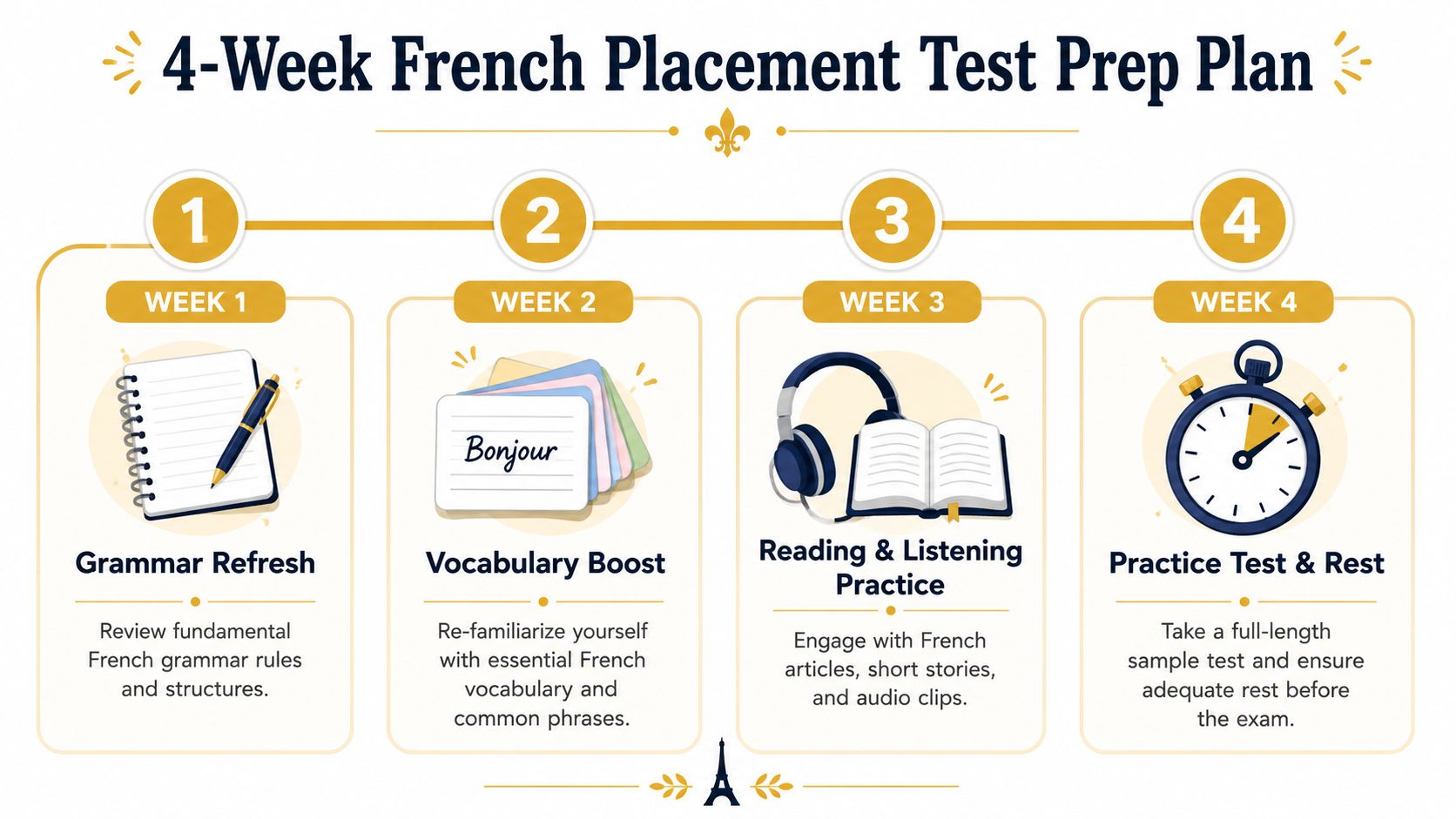
A four week tune up that actually works
Week 1 should focus on grammar retrieval. Review the structures that placement tests love to probe: articles, agreements, present tense, common past tense contrasts, pronouns, and prepositions. Don't try to master obscure literary forms. Clean up the parts of the language that show up constantly.
Week 2 is for vocabulary and sentence patterns. I prefer thematic review over giant random lists. Daily routines, school life, travel, opinions, time expressions, and connectors give students the highest return because those areas support both grammar and reading.
Week 3 should shift toward reading and listening. Read short French texts and answer basic questions on them. Listen for gist first, then detail. If your test includes no listening, reading still matters because it strengthens speed and tolerance for unfamiliar words.
Week 4 is where students often sabotage themselves. They panic and start adding too much material. Instead, do one or two realistic practice sessions, review recurring errors, and taper down. Fatigue lowers performance more reliably than most students realize.
A clear study structure helps. If you need a model for turning these weekly priorities into repeatable sessions, a structured French study plan is a useful reference point.
A real student story
I remember working with a student named Sarah who needed French support before a school placement process. She wasn't weak in French overall. Her real problem was scattered knowledge. She could recognize advanced vocabulary in reading, then miss very basic prepositions and verb patterns in sentence-level questions.
We didn't build an ambitious plan. We built a selective one.
- First, we identified the errors she made repeatedly.
- Then, we narrowed her review to the grammar categories most likely to affect placement.
- Finally, we practiced switching quickly between grammar, reading, and vocabulary so the test format itself stopped feeling jarring.
By test day, she wasn't “perfect.” She was steady. That's what mattered. She placed where her classroom performance and long-term readiness aligned.
A strong prep plan doesn't cover everything. It removes the friction points most likely to distort your true level.
If you're deciding whether to self-study or get targeted support, that's the fundamental dividing line. General review helps. Personalized review is what uncovers the few habits that keep producing the wrong answer. One option some families and adult learners use is Elite French Tutoring, which starts with a short assessment conversation and then builds customized lessons around the learner's actual level, goals, and weak spots.
After the Test Interpreting Your Score and Next Steps
The result lands, and many students make the same mistake immediately. They judge the number or course code emotionally before they interpret it academically.
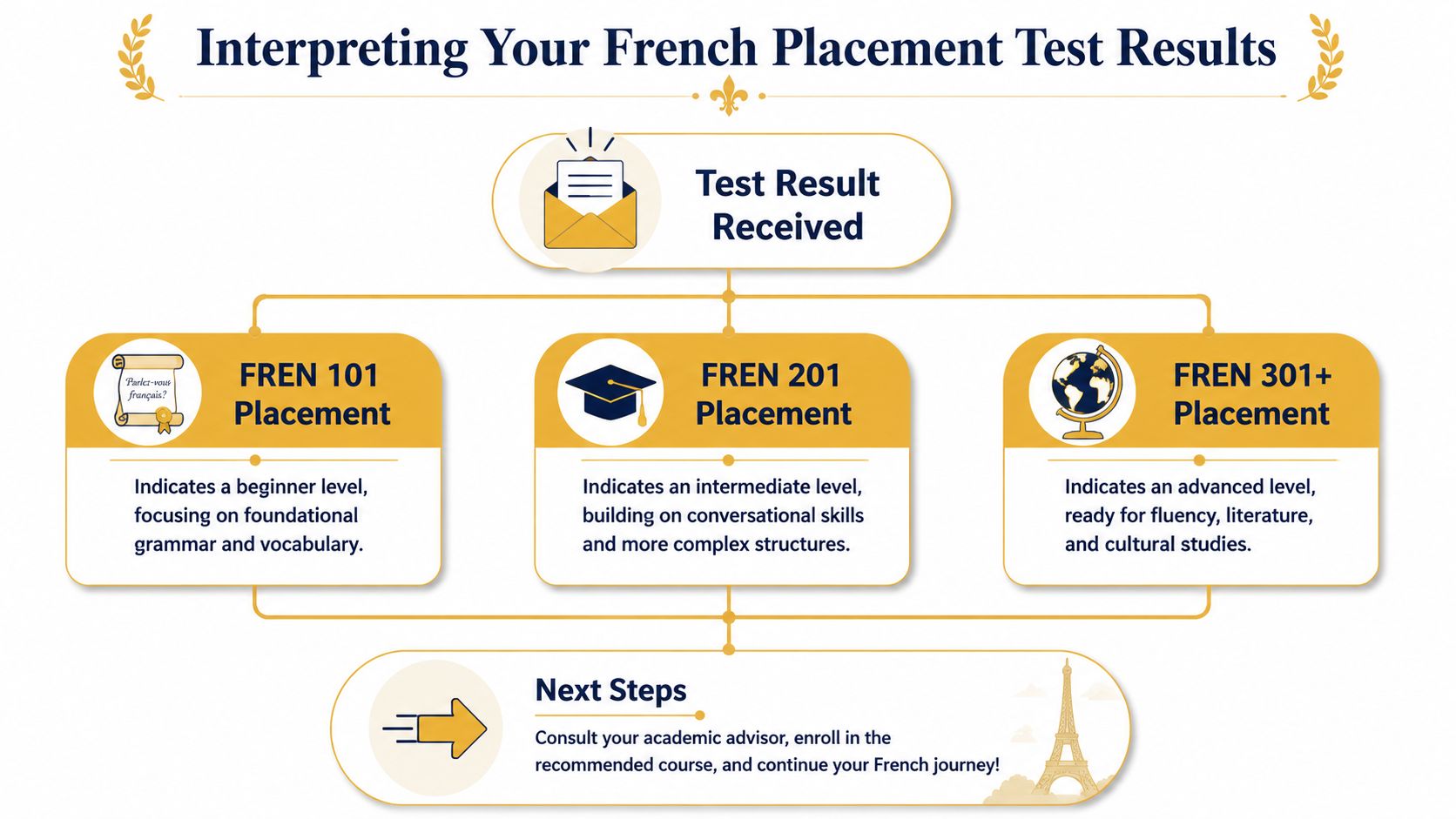
A placement result only becomes useful when you connect it to real classroom demands. “Placed into FREN 201” isn't just a label. It implies a certain reading load, a certain pace of grammar review, and a certain expectation for participation and writing.
How to read the result calmly
Use this filter:
- Can I handle the workload at this level today?
- Will this class stretch me without making me shut down?
- Do my reading, grammar, and writing abilities match the placement, not just my confidence?
Sometimes students are disappointed because they expected a higher placement. Sometimes they're nervous because they placed higher than expected. Both reactions are common. Neither tells you whether the result is wrong.
What to do if the placement feels wrong
Start with the institution's process. Some schools allow advisor review, instructor consultation, or additional testing. Follow those channels first.
Then be honest about the mismatch. If you placed lower than you wanted, the question is whether you need to challenge the result or bridge the gap quickly and move up later. If you placed higher than feels comfortable, the goal may be support, not pride.
If you'd like a second opinion on what your score means in practical terms, or you want help deciding whether to stay, appeal, or prepare for the assigned course, booking a short consultation with a French tutor can save a lot of confusion. The most useful conversation at this stage isn't “Was my score good?” It's “What placement gives me the best chance to progress well from here?”
If you're weighing lesson options before a school test or after receiving a placement result, compare tutoring support based on format familiarity, feedback style, and how specifically the plan is customized for your institution's exam. A short consultation is often enough to tell whether you need broad review or highly targeted preparation.