Your presentation is solid. Your numbers are tight. Then the email arrives from Paris asking for a revised version “avec quelques ajustements” and you freeze for a second. You know enough French to greet people politely, but not enough to read the temperature of a negotiation, push back without sounding rude, or spot when a “small admin step” is a compliance bottleneck.
That gap matters more than most foreign professionals expect. In French business, language isn't decoration. It's part of execution, credibility, and risk control. I've watched smart, accomplished people lose momentum in France not because their offer was weak, but because their French was too generic, too casual, or too dependent on English at exactly the wrong moment.
Many foreign managers assume English is enough, but local-language requirements affect daily operations in France, especially around tax filings, banking, employment documentation, and contract administration, as noted by TMF Group's overview of operating challenges in France. If you're preparing for meetings, relocation, client work, or a market entry push, you need more than phrase lists. You need a strategy.
Table of Contents
- That Big French Deal Is Coming Up Are You Ready
- Understanding Your Audience The Registers of Business French
- Key French Phrases for Business Scenarios
- Decoding French Business Etiquette and Culture
- Choosing Your Path to Business French Mastery
- How We Prepare Professionals for Success A Student Story
That Big French Deal Is Coming Up Are You Ready
A client once came to me three weeks before a meeting in Lyon. He didn't need tourist French. He needed to open a meeting, respond to objections, soften disagreement, and survive the lunch afterward without sounding like he'd memorized an app. That's a very different problem.
His real fear wasn't grammar. It was status. He worried that speaking awkward French would make him look junior, even though he was the decision-maker. He was right to care. In French business, people often judge your command of tone before they judge your argument.
What changed things was not a giant vocabulary list. It was targeted preparation. We worked on how to greet each stakeholder, how to move from polite formality into useful discussion, and how to stall for time gracefully when he needed to think. That gave him control.
Practical rule: Don't aim to “speak French.” Aim to handle the exact moments that affect the deal.
If you're in this position now, stop spreading your effort across random lessons. Build around your real business tasks:
- Pre-meeting communication: Draft the email that confirms agenda, timing, and expectations.
- Live discussion control: Practice transitions, clarification requests, and polite disagreement.
- Operational follow-through: Prepare the French you'll need after the meeting, especially for documentation and internal coordination.
- Social credibility: Rehearse small talk that sounds natural in a professional setting.
That last point gets ignored. It shouldn't. A lot of momentum in french business comes from what happens around the formal exchange, not only inside it.
If your timeline is short, use a targeted training format instead of broad language study. I'd start by comparing focused corporate French language classes for professionals and choosing the option that lets you rehearse your actual meetings, not imaginary textbook scenes.
Understanding Your Audience The Registers of Business French
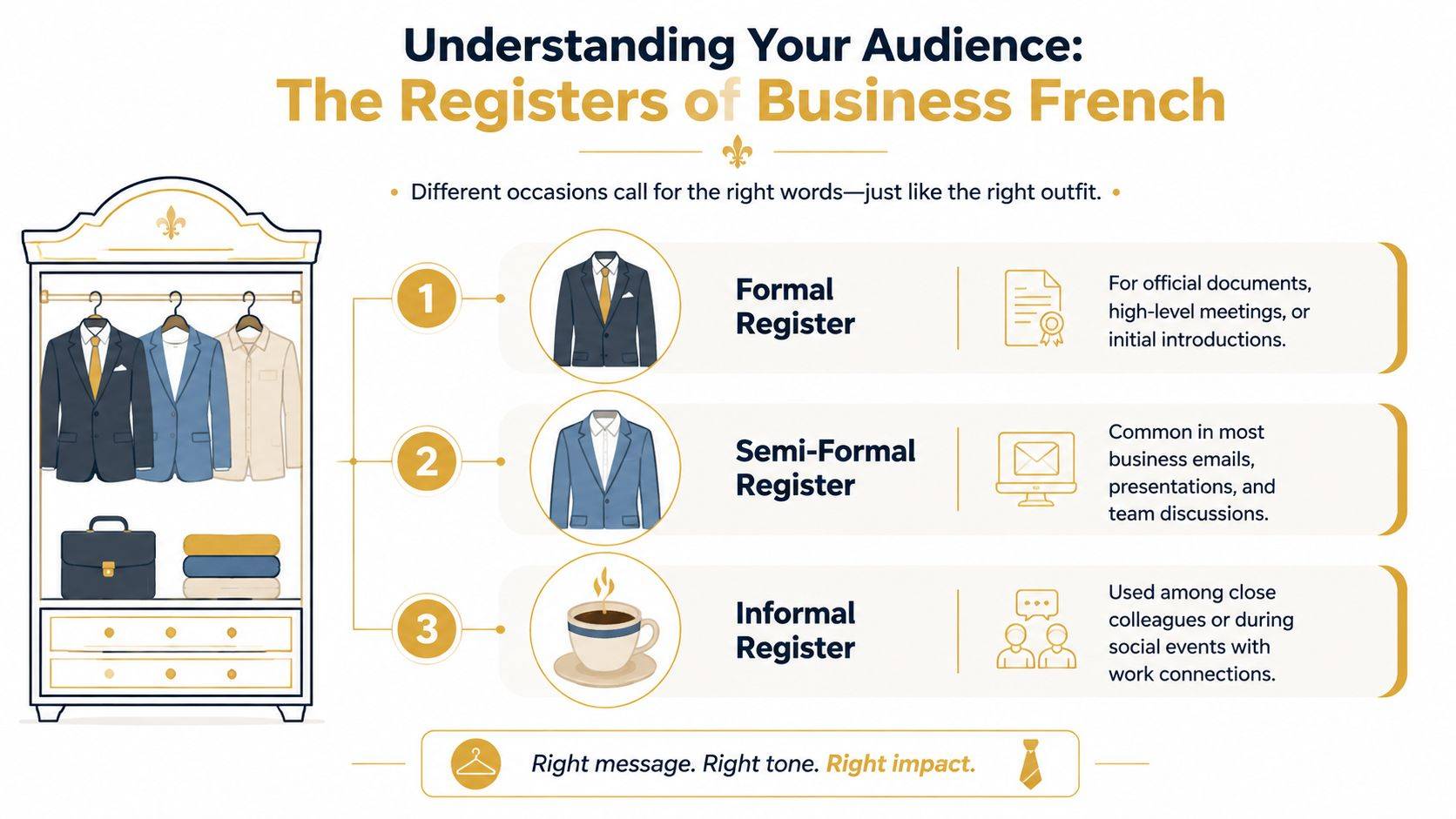
French has a wardrobe system. If you wear a tuxedo to a startup coffee chat, you look strange. If you show up to a board meeting in gym clothes, you lose authority. Language works the same way.
Why register matters more than vocabulary
Most professionals focus on terms. I focus first on register, meaning the level of formality and social distance in your language. That's because the wrong register damages trust faster than a missing noun ever will.
France's business environment is diverse. It includes large corporate environments and a huge base of smaller firms. In 2023, more than 8 million companies paid VAT in France, and the country had more than 4.3 million micro-enterprises, according to Statista's overview of companies in France. That matters because your French has to flex. One day you may address a senior executive in a formal setting. The next, you may work with a founder who prefers a warmer, faster-moving style.
The three registers you actually need
Soutenu
This is the formal register. Use it for first contact with senior people, official correspondence, sensitive negotiations, and moments where you need distance and precision.
You'll hear it in phrases like:
- Je vous remercie pour votre retour.
- Permettez-moi de préciser ce point.
- Nous restons à votre disposition pour toute information complémentaire.
Soutenu doesn't mean old-fashioned. It means controlled.
Courant
This is the standard professional register. It's where most strong business communication should live. It sounds competent, clear, and natural without becoming stiff.
Examples:
- Merci pour votre message.
- Je propose que nous validions ce point aujourd'hui.
- Je comprends votre position, mais j'aimerais nuancer ce point.
If you're unsure, stay here. Courant is the safest default.
Familier
This is the informal register. Use it carefully. It belongs with close colleagues, friendly debriefs, or social moments where the relationship is already established.
Examples:
- On se dit quoi pour la suite ?
- Tu peux me renvoyer ça quand tu as une minute ?
The danger is obvious. If you use familier too early, you sound presumptuous.
Use vous until the other person clearly invites tu. Don't improvise social closeness.
One more point. Register isn't only spoken. It shapes your emails, slides, follow-up notes, and even how direct your requests sound. If you want help with that layer of communication, this guide on French language rules and etiquette for professional settings is a practical next step.
Key French Phrases for Business Scenarios
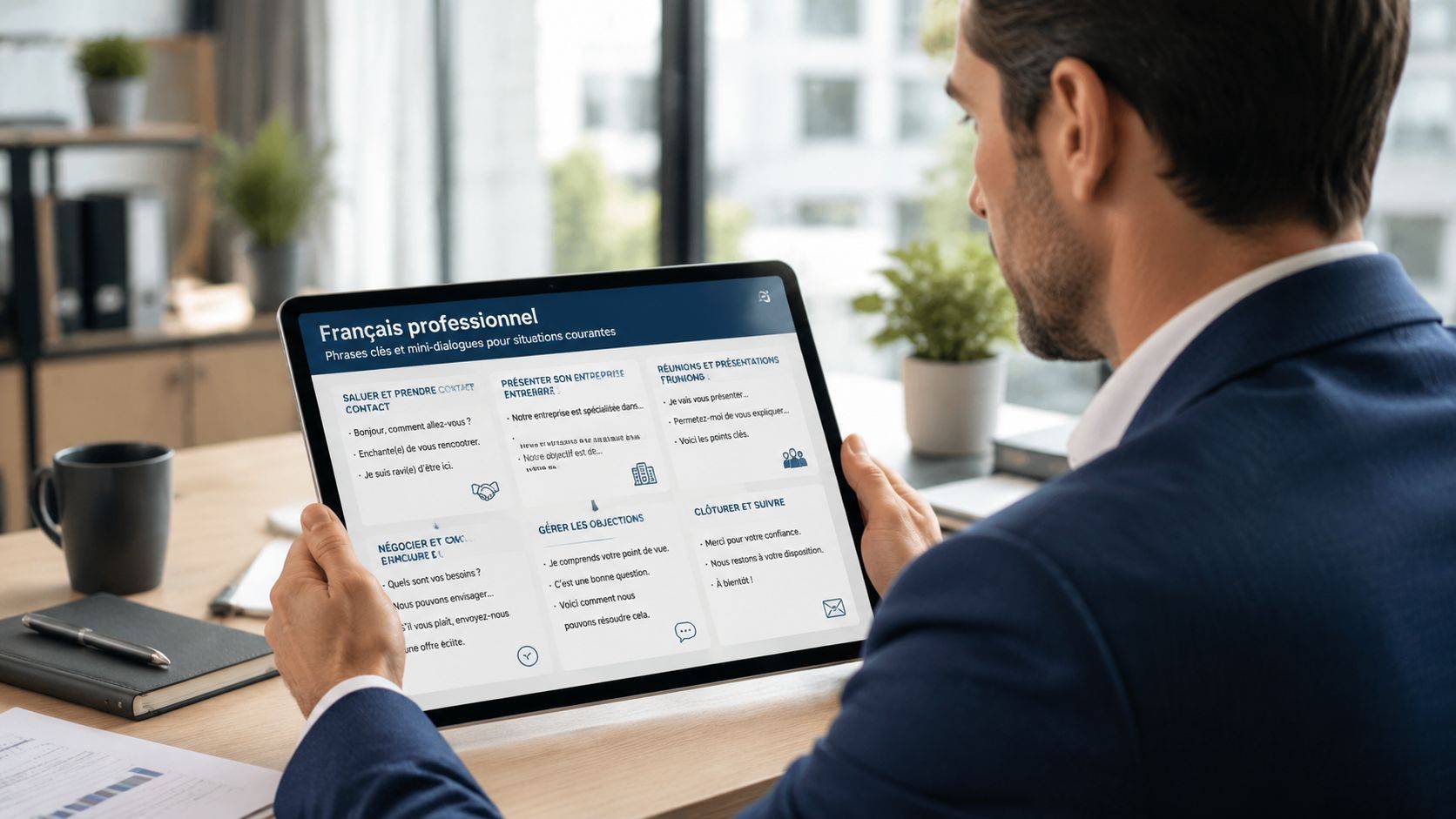
You do not need hundreds of phrases. You need a few reliable scripts that you can adapt under pressure.
Writing emails that sound professional
French business emails usually open more formally than English ones. If your message is too abrupt, even when your intention is efficient, it can read as careless.
Try this structure:
Opening
- Bonjour Madame Martin,
- Je vous remercie pour votre message.
- Suite à notre échange, je vous confirme que…
Request
- Pourriez-vous nous transmettre la version finale d'ici vendredi ?
- Merci de bien vouloir valider ce point avant la réunion.
Closing
- Je vous remercie par avance.
- Bien cordialement,
- Cordialement,
Cultural tip: French professionals often expect a bit more framing before the ask. Don't jump straight into demands.
Running meetings without sounding stiff
In meetings, your job is to structure the exchange and show respect for other viewpoints without giving up your own position.
Useful lines:
- Merci à tous d'être présents.
- Je vous propose de commencer par le premier point à l'ordre du jour.
- Si je comprends bien, votre priorité est…
- Je partage en partie votre analyse, mais j'ai une réserve sur ce point.
- Peut-on revenir un instant sur la question du calendrier ?
That last one is especially useful. It lets you redirect without sounding combative.
A strong program in French for business communication should drill these live meeting moves, not just vocabulary.
Negotiating with tact
French negotiation style often rewards reasoning, nuance, and verbal precision. If you sound too aggressive, you create friction. If you sound too vague, you lose your advantage.
Try these instead of blunt yes-or-no language:
- Nous sommes ouverts à cette option, sous réserve de certains ajustements.
- Il me semble qu'un compromis serait possible sur ce point.
- Notre marge de manœuvre est limitée, mais nous pouvons examiner une autre structure.
- J'entends votre demande. En revanche, nous aurions besoin de garanties supplémentaires.
Don't translate your negotiation style word for word from English. Rebuild it for French expectations.
Here's a useful example of tone and cadence in spoken French:
Presenting and handling questions
Presentations fail in French for one simple reason. The speaker knows the content but not the transitions.
Use these anchors:
| Moment | Useful French |
|---|---|
| Opening | Merci de votre présence. Je vais commencer par un bref aperçu du projet. |
| Transition | Passons maintenant au deuxième point. |
| Emphasis | Le point essentiel, c'est que… |
| Clarification | Permettez-moi de reformuler. |
| Q&A response | C'est une excellente question. À ce stade, nous pouvons dire que… |
Cultural tip: If someone challenges your reasoning during Q&A, don't panic. In many French business settings, debate is part of professional engagement. A challenge often means the person is taking your argument seriously.
Decoding French Business Etiquette and Culture
Language alone won't carry you. You also need to understand what French counterparts are signaling when they ask detailed questions, insist on titles, or turn a meeting into a long analytical exchange.
France's business scene is highly varied. In 2024, more than 1,111,200 businesses were created, up 6% from 2023, and roughly 64% were micro-entrepreneurs, according to the official business creation figures discussed here. That mix creates two realities at once. You'll encounter formal structures, but you'll also work within founder-led and relationship-driven environments where style shifts fast.
Do respect hierarchy
Do: Use titles and surnames at the beginning of a relationship.
Don't: Assume immediate first-name familiarity.
Why: Formal acknowledgment of role often signals professionalism, not distance.
In practice, that means starting with Madame, Monsieur, or a professional title when appropriate. Let the other side relax the formality first.
Do treat meetings as intellectual work
Do: Arrive prepared to explain your reasoning.
Don't: Treat questions as resistance.
Why: French business culture often values logic, structure, and debate.
A meeting may sound more critical than what many Anglophone professionals expect. That doesn't automatically mean you're losing the room. Sometimes the room is testing the strength of your thinking.
- If challenged on assumptions: respond with a structured explanation.
- If interrupted: stay calm and finish the point cleanly.
- If discussion expands: steer back with a summary rather than forcing a hard stop.
A sharp question in France is often a sign of engagement, not hostility.
Do build trust outside the formal agenda
Do: Invest in small talk, meals, and follow-up courtesy.
Don't: Treat every interaction as a transaction.
Why: Relationships often support execution, especially in smaller firms and founder-led settings.
In this regard, many international professionals underperform. They prepare the deck, but not the lunch. They can explain product specs, but not talk naturally about their role, background, or view of the market.
Use simple professional small talk:
- Votre trajet s'est bien passé ?
- Comment voyez-vous l'évolution du marché en ce moment ?
- J'ai beaucoup entendu parler de votre activité dans ce secteur.
That last line is useful because it shows respect without sounding theatrical.
A final warning. Don't confuse friendliness with informality. You can be warm and still remain linguistically precise. That balance is one of the most valuable skills in french business.
Choosing Your Path to Business French Mastery
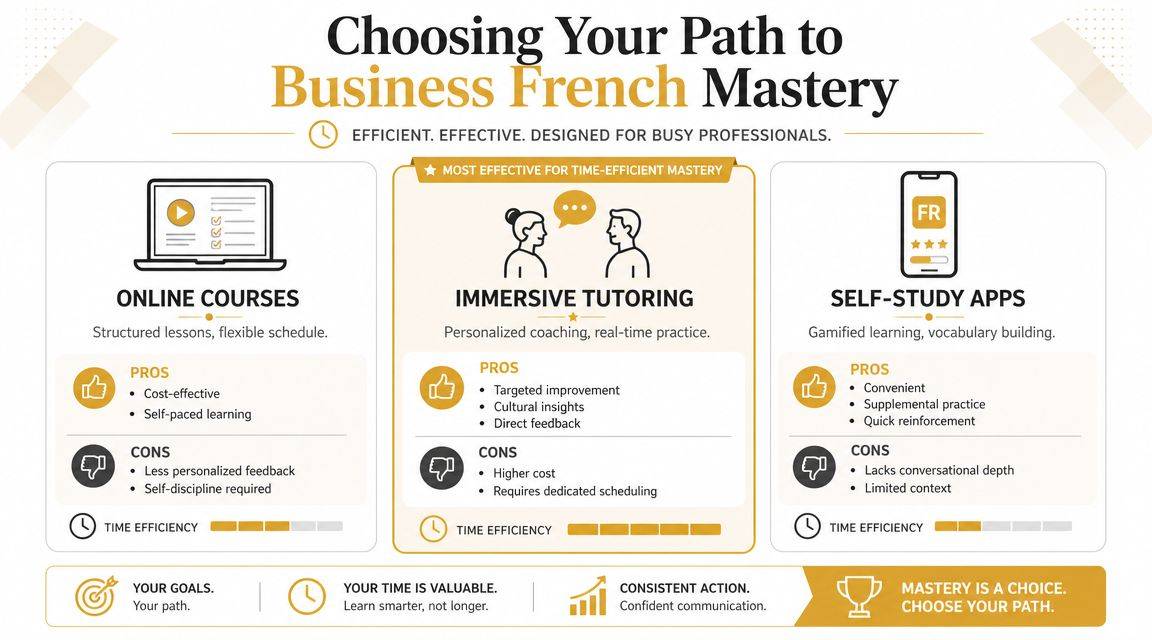
Busy professionals waste time in the same way. They choose the cheapest or most convenient format, then realize too late that it doesn't prepare them for real conversations.
That's a problem in a service-heavy market. Services account for 78.8% of France's GDP, according to this overview of the French economy. In that environment, communication is part of the service itself. If your role touches clients, internal stakeholders, leadership, or operations, your French needs to fit your job, not just a generic curriculum.
What busy professionals should optimize for
Don't optimize for entertainment. Optimize for speed to business readiness, quality of correction, and relevance to your work.
If you need French for a relocation, client pitch, internal leadership role, or cross-border project, ask three blunt questions before you buy any course:
- Will I get corrected in real time on tone and register?
- Can I practice my industry-specific situations?
- Will this help me write and speak the way I need to at work?
If the answer is no, keep looking.
Comparing Business French Learning Methods
| Feature | Self-Study (Apps/Books) | Group Classes | Private Tutoring |
|---|---|---|---|
| Speed to business readiness | Slow for speaking under pressure | Moderate | Fastest for targeted goals |
| Feedback quality | Limited or automated | Shared across the group | Direct and immediate |
| Industry customization | Minimal | Occasional | High |
| Schedule flexibility | High | Medium | Medium to high |
| Best use case | Vocabulary maintenance | General progression | High-stakes professional needs |
| Main limitation | Weak on live nuance | Pace may not match your needs | Higher investment |
Here's my opinion after years of coaching professionals. Apps are supplements. Group classes are fine for steady general progress. Private tutoring is the efficient choice when the stakes are real.
That doesn't mean every professional needs one-on-one coaching forever. It means that if you have a live business objective with a deadline, personalized training usually gets you there with less waste.
One option in that category is Elite French Tutoring's corporate French training approach, which offers customized private lessons and consultation-based planning. It fits professionals who need role-specific speaking practice rather than broad academic study.
If you're still comparing options, look for providers that can build sessions around your documents, meetings, emails, and likely objections. That's where the return comes from.
How We Prepare Professionals for Success A Student Story

The client and the challenge
One of my clients was a senior consultant taking on a major French-facing assignment. He already had classroom French. He could introduce himself, describe a project, and survive basic conversation. None of that was enough for the role he had to play.
His challenge was authority. He needed to lead meetings, handle pushback, and sound decisive without becoming blunt. He also needed to stop translating directly from English, because his phrasing was technically correct but professionally off-key.
He told me, “I can explain the project. I just don't sound like the person in charge.”
That's a common business French problem. The issue isn't always level. It's alignment.
The process and the outcome
We built a focused program around his actual work. No generic chapter progression. No tourist dialogues. We worked from his meeting agenda, his presentation flow, and the kinds of objections he expected from French stakeholders.
Our sessions centered on:
- Role-play under pressure: opening meetings, interrupting politely, and pushing discussions back on track.
- Negotiation language: sounding firm without sounding rigid.
- Register control: knowing when to stay formal and when to warm up.
- Post-meeting follow-up: writing concise emails that felt natural in a French professional context.
“I didn't need more words. I needed better decisions about tone.”
By the time his assignment began, he wasn't speaking perfect French. He didn't need to. He was speaking credible French, and that's what changed the outcome. He led discussions more calmly, handled disagreement without retreating into English, and stopped overexplaining every point.
If you want to see how this kind of customized preparation works in practice, this corporate professionals success story in French classes is worth reading.
The biggest win wasn't linguistic elegance. It was professional control. He no longer sounded like a guest in the room. He sounded like a peer.
If you're weighing lesson options for a move, a client-facing role, or a French market project, book a short consultation and compare formats based on your deadline, your work context, and the conversations you need to handle. That's the fastest way to choose the right path instead of drifting through generic French study.