You're on the call, the French team has listened politely, nobody has objected, and the meeting ends on time. Your side leaves thinking the deal is basically done. Then the follow-up goes quiet, the document comes back covered in questions, and the “yes” you thought you heard never turns into a signed next step.
That gap is the core problem in French business culture. It isn't mainly about dress codes or which greeting to use first, it's about reading the operating logic behind hierarchy, debate, timing, and written proof. In France, where there are about 3.3 million businesses and 99% of them are SMEs (20countries.com), many counterparts are making careful, structured decisions inside formal organizations, not improvising in the room. France is also firmly tied into cross-border commerce, with about $641.4 billion in exports and $627.2 billion in imports in 2022 (20countries.com), so the people you meet are often used to international business, but still expect clear preparation and professional discipline.
The mistake foreign executives make is treating French norms like a checklist. That approach misses the point. French business is less about memorizing etiquette and more about understanding why protocol, evidence, and credibility matter so much. A meeting may be for testing logic, not sealing agreement. A challenge may be engagement, not hostility. A delay may reflect centralized approval, not indifference.
For readers who want to understand the contrast between French and Anglo-American expectations at a practical level, this overview of differences between French and American culture is a useful companion, but the deeper advantage comes from learning how the system works.
Table of Contents
- Why French Business Culture Confuses Even Experienced Executives
- Hierarchy and Decision-Making in French Companies
- Meeting Etiquette, Email Phrasing, and Communication Style
- Dress, Small Talk, and the Unwritten Social Layer
- Negotiation Logic and When Debate Signals Engagement
- A Real Client Story From Our French Business Coaching Work
- Putting It Into Practice With Tailored French Lessons
Why French Business Culture Confuses Even Experienced Executives
A lot of foreign managers walk out of a French meeting with the wrong read. They heard objections, saw energetic discussion, and assumed resistance. In reality, they may have just sat through a serious test of the idea.
The meeting was not the decision
French business culture is often described as formal and relationship-conscious, but the part that trips people up is the sequence. The room is used to refine positions, challenge weak logic, and establish whether the speaker has done the work. The final answer often comes later, after the conversation has been filtered upward through the organization.
Practical rule: If you treat the meeting like a closing event, you'll push too early. If you treat it like a credibility test, you'll usually behave better.
That's why the usual checklist, polite greeting, title use, clean slides, doesn't go far enough. The key question is who has authority, who is listening for substance, and what written follow-up will carry the conversation forward. In a market this integrated and structured, preparation isn't a courtesy, it's part of the signal of competence.
Formality is operational, not decorative
A French counterpart often sees formality as a way to reduce ambiguity. That means titles, tone, and order matter because they tell people where decisions sit and how information should move. In practice, this is why some foreign teams feel they're being kept at arm's length when they are being evaluated.
The best mindset is simple. Don't ask, “Did they like us?” Ask, “Did we make it easy for them to trust our judgment?” That one shift changes how you enter the meeting, phrase the email, and plan the next step.
Hierarchy and Decision-Making in French Companies
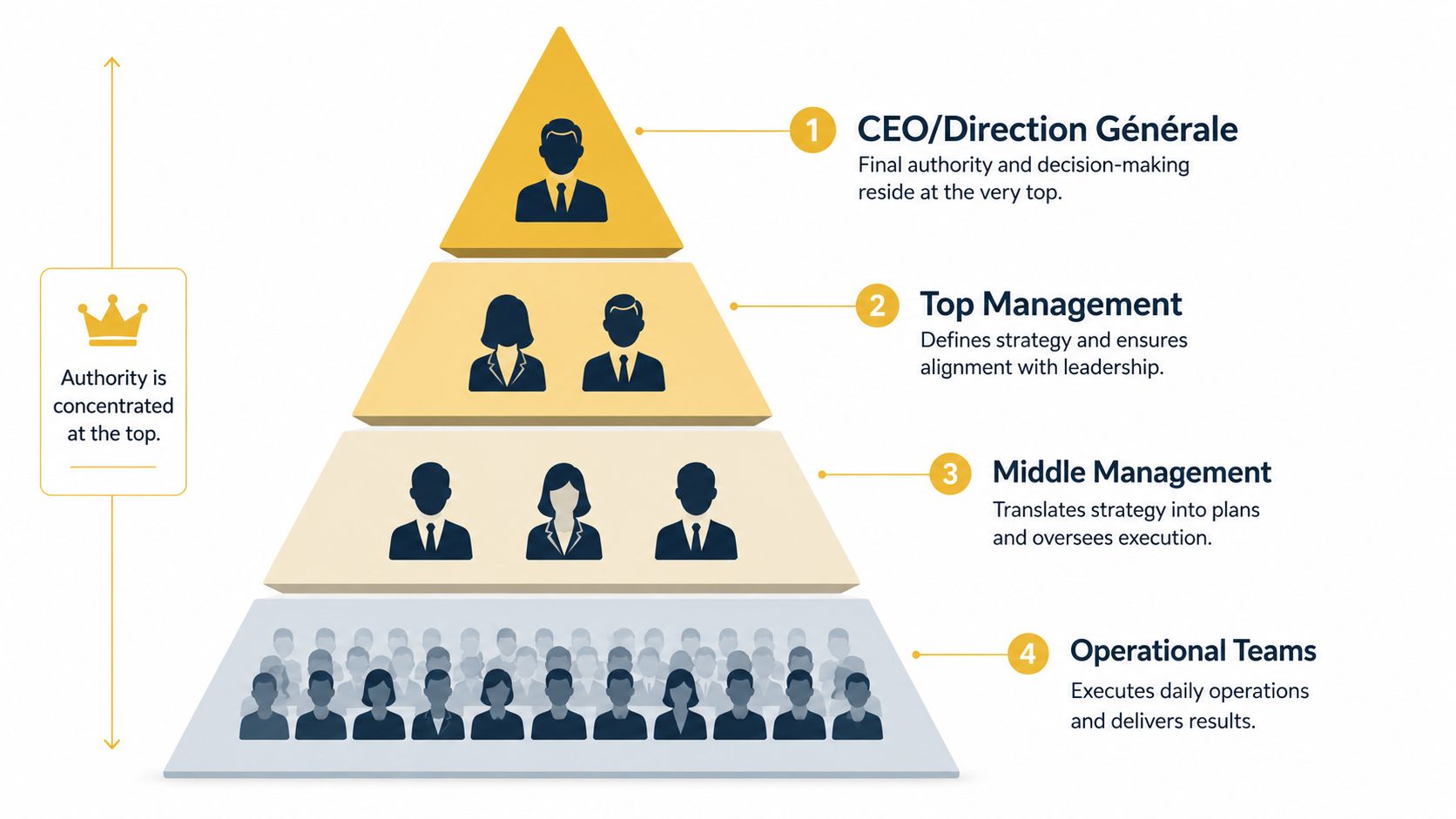
French organizations are typically hierarchical and centralized, which means authority sits high up and isn't spread casually across the middle. That matters because the person speaking to you in the meeting may not be the person who can approve the deal. The decision-maker is often one level, or several levels, above the people you're talking to.
What the room is really for
Meetings in French companies often function as a place to clarify positions, pressure-test logic, and surface objections before the file moves upward. If you keep asking for an immediate yes, you can make yourself look impatient rather than persuasive. The cleaner move is to leave the room with a sharply defined next step and a written record that can travel internally.
A useful way to think about it is this. The meeting is rarely the place where authority is created, it's the place where authority is informed. That's why the seniority structure, the seating, and the order of speech all carry meaning.
How to position yourself
If you're trying to influence French counterparts, don't perform urgency. Build a case they can defend internally. That means concise documents, precise terminology, and enough structure that a senior executive can read it once and understand the stakes.
The practical trade-off is obvious. Informality can feel faster, but in French settings it often weakens your case. Formal preparation feels slower, but it usually shortens the approval path because the right people trust what they're reading.
For companies mapping this environment, French business guidance can help teams align language training with the way authority works.
What signals authority
- Titles and role clarity matter because they tell everyone who routes information upward.
- Written materials carry weight because senior reviewers often judge the quality of the argument off the page.
- Patience with staged approvals signals that you understand how the organization moves.
- Overfamiliar behavior can backfire because it blurs the professional distance French counterparts expect early on.
If you know who the final call-maker is, you can design the whole engagement differently. If you don't, you'll keep getting technically polite meetings that lead nowhere.
Meeting Etiquette, Email Phrasing, and Communication Style
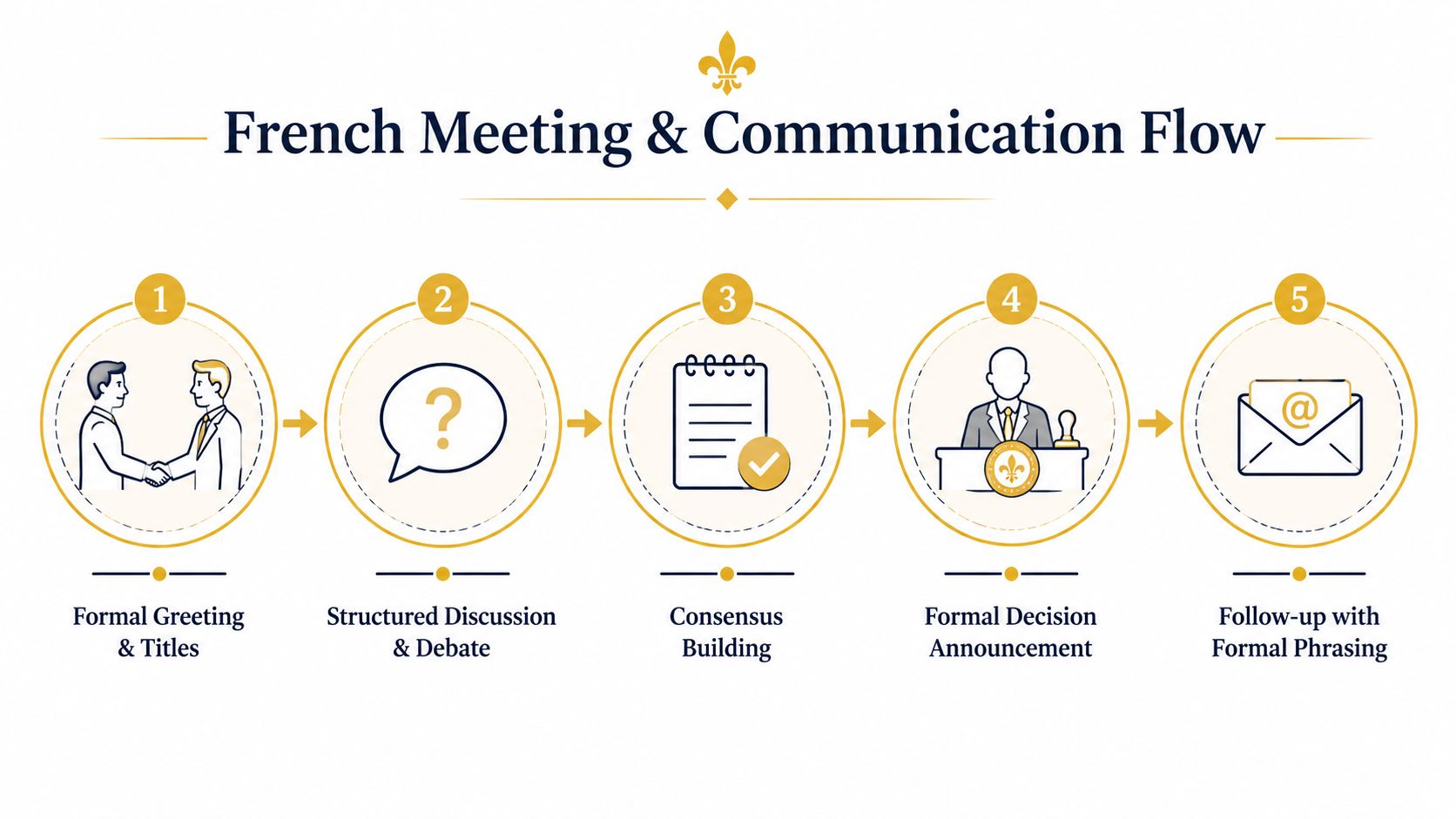
French business communication rewards precision, not performance. The fastest way to look unprepared is to arrive with vague enthusiasm and no structure. The safest way to move well is to be formal, concise, and intellectually clear.
How the meeting should sound
Start with proper titles. Monsieur and Madame are the safe defaults, and vous is the right choice until you're clearly invited to use something else. A clean opening sounds more like, “Good morning, Monsieur Dupont, thank you for making the time,” than a casual first-name greeting.
During the meeting, interruptions don't automatically mean disrespect. In many French rooms, they're part of a serious discussion, especially when people are stress-testing an argument. The key is to stay composed, answer the substance, and avoid turning the exchange into a personality contest.
The person who stays precise usually sounds more confident than the person who sounds upbeat.
What to send before and after
The day before a meeting, send the document that supports the discussion. Keep it structured, evidence-led, and easy to scan. If you're presenting in English, make the language exceptionally clean. If you can write in French, even better, because quality French still signals respect and seriousness in professional settings.
For written follow-up, keep the tone formal and the ask specific. A strong closing line is something like, “Please let me know whether you'd like us to revise the proposal or prepare the next version for review.” That keeps the discussion moving without pretending the decision has already been made.
If your team needs help with written business French, French business writing support is worth considering alongside in-house coaching or translation.
Phrases that work better than casual versions
- “Thank you for your time” is better than a breezy opener because it acknowledges the meeting as a professional exchange.
- “I'd like to clarify one point” works better than “I just wanted to say” because it frames the contribution as useful, not loose.
- “Please find attached” gives the email an ordered, businesslike tone.
- “Cordialement” or “Bien cordialement” usually fits better than anything too familiar.
The rule is simple. Write as if a senior person may forward your message unchanged. That's often exactly what happens.
Dress, Small Talk, and the Unwritten Social Layer
Business attire in France is never just about clothes. It's a proxy for judgment. People notice whether you look disciplined, whether your choices feel deliberate, and whether your presentation matches the seriousness of the conversation.
A comparison that helps on day one
| Dimension | United States | United Kingdom | France |
|---|---|---|---|
| Dress | Often more flexible, especially in some sectors | Conservative but practical | Elegant, polished, and intentionally put together |
| Small talk | Friendly and open, often quick to personal warmth | Light, reserved, often understated | Professional, selective, and more cautious at the start |
| Hierarchy | Can feel flatter in day-to-day conversation | Moderately formal | More visibly structured and rank-aware |
French business culture also values privacy. So the light, probing questions that feel normal in some countries can land badly here. Money, salary, religion, and politics are poor early conversation topics, and assuming everyone wants to switch to English immediately can look careless rather than efficient.
For a more lifestyle-driven read on presentation and social cues, how to be a Parisian is a helpful related page, especially if your team is trying to calibrate tone for in-person meetings.
What to do before the meeting starts
Use the first minutes for restrained, neutral conversation. Food, travel, cultural observations, and general current events are safer than personal details. Keep the tone professional, and don't overshare just to create warmth.
The right lesson here isn't to become stiff. It's to become selective. French counterparts often prefer a conversation that shows taste, judgment, and restraint before it shows familiarity. That's especially true when the relationship is new.
Practical rule: Dress like you expect the room to judge your attention to detail, because it often will.
The social layer is subtle, but it's not mysterious. If you present yourself with care and keep the opening conversation appropriately measured, you make it easier for people to take your ideas seriously.
Negotiation Logic and When Debate Signals Engagement
The lazy version of French business culture says it's formal, slow, and hierarchical. That summary is incomplete. The more useful truth is that debate often signals engagement, because French professionals frequently use disagreement to test whether an idea is rigorous enough to survive scrutiny.
Debate can be a good sign
In a French meeting, a sharp question may mean the opposite of resistance. It can mean the other person is paying attention, wants more precision, and is deciding whether your proposal is coherent enough to justify internal support. That's why aggressive reassurance doesn't help much. Logic helps.
The operational mistake is pushing for speed before trust in the argument has formed. If you try to force consensus too early, you can slow the process down because people will keep reopening the file later. A better approach is to welcome the challenge, answer directly, and treat the discussion as part of quality control.
How to separate engagement from resistance
Engagement usually looks like detailed questions, close reading, and pointed but relevant objections. Resistance looks more like stalled replies, missing documentation, or a request for yet another round with no clear path forward. The difference matters because one is a sign to sharpen your case, while the other is a sign that the approval path itself is stuck.
Use a four-stage rhythm:
- Prepare the dossier. Send clear background material before the meeting.
- Frame the question. Open with the business problem, not a sales pitch.
- Reinforce in writing. Summarize what was discussed and what happens next.
- Close patiently. Let the internal process run without chasing it every day.
Many foreign teams misunderstand this. They interpret the absence of immediate closure as indecision, when the actual issue is that the French side is moving through a more deliberate approval path. One recent business-culture guide makes the same point, noting that meetings are often for testing credibility and framing arguments, not for instant consensus (Global Business Culture France profile).
Practical rule: If the challenge is specific, stay analytical. If the follow-up disappears, check whether the real blocker is inside the organization.
The people who do best here don't try to dominate the room. They make it easy for a senior decision-maker to say yes later.
A Real Client Story From Our French Business Coaching Work
A senior consultant came to us with a problem I've seen many times. She had a polished English pitch, strong credentials, and a meeting schedule in Paris that looked promising on paper. The conversations were friendly, but the deal kept stalling.
What wasn't working
Her original approach relied on open-ended small talk, a broad verbal pitch, and a lot of confidence that the room would “get it” once the value was obvious. They didn't. Her French counterpart asked good questions, but the proposal never seemed to land with the people who mattered. The process drifted for months.
We changed three things. First, she replaced generic opening chatter with a brief, professional exchange that respected the tone of the room. Second, she sent a tighter written brief in advance, with cleaner structure and sharper terminology. Third, she stopped treating the meeting as the point of closure and started using it to surface the underlying decision path.
What shifted
Once she began framing the discussion around specific, debate-friendly questions, the French side engaged more. The questions weren't a rejection, they were the beginning of serious internal review. She also routed the proposal to the decision-maker instead of assuming the person in front of her could close it.
The stalled negotiation eventually moved forward and closed in eight weeks. The important lesson wasn't speed alone. It was that her team stopped fighting the system and started working with it.
One thing I've learned from cases like this is that confidence without cultural calibration is expensive. The people who win are rarely louder. They're usually better prepared, more precise, and more patient than their competitors.
Putting It Into Practice With Tailored French Lessons
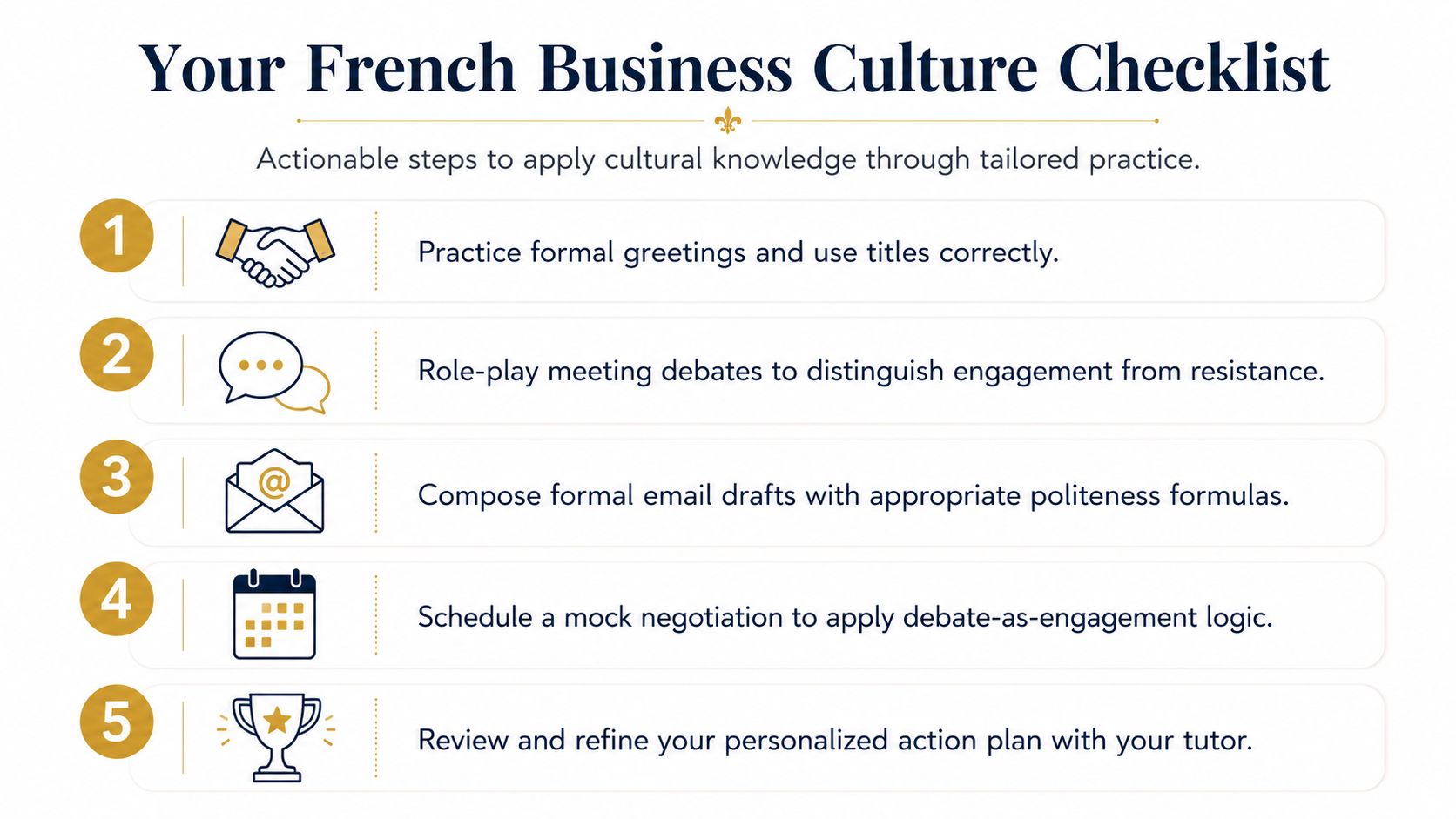
Knowing the pattern is useful. Executing it in real time is what changes outcomes. That's where personalized French training earns its keep, because the right lesson plan can rehearse the exact phrases, timing, and decision logic your team needs in actual meetings.
What effective corporate training looks like
For business teams, the best setup is rarely generic classroom French. It's scenario-based practice tied to the reader's industry, counterpart profile, and actual negotiation cycle. At Elite French Tutoring, that often starts with a free 20-minute consultation, then moves into role-play around live meetings, written follow-up practice, and business vocabulary that matches the user's real work.
That matters because the skill isn't only language. It's judgment under pressure. You need to know when to use formality, how to answer a challenge without overexplaining, and how to keep the process moving without sounding impatient.
How to choose the right format
If you're comparing options, look for three things. Does the program fit your meeting calendar, does it handle email and speaking, and does it reflect your sector. A finance executive, an NGO lead, and a founder pitching distributors won't need the same scenarios.
The commercial decision is straightforward. Pick the format that lets you rehearse your own conversations, not generic textbook examples. That's where confidence compounds.
If you're preparing for French boardrooms, the most useful next step is to book a consultation, compare corporate lesson formats, and build a plan around your own meetings, emails, and counterpart profiles.