Skip to content

You're probably in one of three situations right now. Your child is in a bilingual program and generic homework help isn't cutting it. You need French for work, but you can't commit to a rigid class every Tuesday at 6 p.m. Or you've finally decided to stop “meaning to learn French” and want a program that will get you speaking.
That's a common challenge in Sacramento. They find a few group classes, a handful of tutors, and a lot of vague promises. What they usually don't find is guidance that matches the way real adults, parents, and ambitious students make buying decisions.
French lessons in Sacramento can work very well, but only if you choose the format that fits your goal. The wrong setup wastes months. The right one builds momentum fast.
Table of Contents
Finding the Right French Lessons in Sacramento
A Sacramento parent recently described the search perfectly to me. She didn't need “French exposure.” She needed someone who could help her child keep up with class expectations, correct pronunciation, and explain assignments in a way that made sense. Instead, she found broad claims like “all levels welcome” and “school support available.”
That gap matters. Those seeking French lessons in Sacramento are rarely looking for a hobby in the abstract. They're buying a solution to a specific problem.
Sacramento does have real demand for French learning. The Alliance Française de Sacramento, founded in 2000, has grown to serve over 600 members and roughly 250 students per session, which tells you this is not a fringe market but a durable one in the region, according to this local profile of Alliance Française de Sacramento. I take that as a good sign. People here want French. The challenge is finding the right delivery model.
The problem isn't demand. It's fit.
A lot of learners choose the first respectable option they find. That's understandable, but it's not smart. A working professional has different needs from a DELF candidate. A child in a bilingual school needs something far more targeted than a traveler brushing up for a trip.
Practical rule: Don't buy a French program until you can clearly state your goal in one sentence.
Try these examples:
For a parent: “My child needs support that matches what happens in class.”
For a professional: “I need to speak comfortably with colleagues or clients.”
For an adult beginner: “I want structured speaking practice, not just apps and worksheets.”
If you can't define the outcome, you'll end up buying convenience instead of progress.
What I'd look for first
I'd start with three filters:
Goal match: Does the program explicitly serve your situation, or are you forcing a generic option to fit?
Instructor quality: Can the teacher correct spoken French well, not just explain grammar?
Scheduling reality: Will this still work when your week gets messy?
If you're weighing private options, this guide on how to find the perfect French tutor for adult learners is a useful place to sharpen your criteria.
Most buyers don't need more options. They need better standards.
Comparing Your Sacramento French Lesson Options
Once you've decided to invest in French, a key buying question is format. In Sacramento, learners often end up choosing between a local group class, a private in-person tutor, or a private online program. Each can work. They do not work equally well for every buyer.
Here's the visual overview most shoppers wish they had on day one.

What the local market looks like
Private tutoring sounds simple until you start calling around. In practice, availability is tighter than many people expect. The Sacramento area has only 22 active private French teachers, and the average rate is $27 per hour, according to this Sacramento French tutor marketplace page. That scarcity is one reason families and professionals often struggle to find a tutor who is both qualified and consistently available.
Group classes solve one problem. They create structure. But they introduce another one. You move at the class pace, not your pace.
Private in-person tutoring gives you more customization, but Sacramento's limited teacher pool can make quality and scheduling uneven. Private online tutoring removes the commute and dramatically widens your access to specialized instructors, which matters a lot if your needs are narrow.
Comparison of French Lesson Types in Sacramento
| Feature | Group Classes | Private In-Person | Private Online (Elite French Tutoring) |
|---|---|---|---|
| Personalization | Low to moderate. Built around the group syllabus. | High, if the tutor is strong. | Very high. Best option for tailored pacing and goals. |
| Scheduling flexibility | Fixed schedule | Moderate, depends on tutor availability and travel | High. Easiest for parents and professionals |
| Speaking time | Shared across the group | Focused on you | Fully focused on you |
| Best for | Social learners, casual enrichment | Learners wanting local face-to-face support | Busy adults, families, exam prep, professional French |
| Main drawback | Slower pace, less individual correction | Limited local supply | Requires choosing a provider with a strong live teaching method |
| Buying verdict | Good starter option | Good if you find the right person | Best for buyers who want premium flexibility and faster progress |
My blunt recommendation
If your goal is casual exposure and you enjoy a classroom atmosphere, group classes are fine. If your goal is results, buy personalization. Elite French Tutoring is a strong fit for readers who want fully customized private online French lessons instead of a one-size-fits-all class.
That's especially true if you're dealing with any of the following:
A tight calendar: You can't waste time commuting across Sacramento for a lesson.
A specialized goal: You need business French, curriculum alignment, or exam prep.
A confidence barrier: You need repetition, correction, and accountability without an audience.
A language program should fit into your life closely enough that you can sustain it. If it doesn't, you won't stay with it.
For buyers comparing digital options, I'd also review these top ways to learn French online before committing. Not all online learning is the same. Live, customized instruction is a completely different product from self-paced platform content.
How to Choose the Right French Program for You
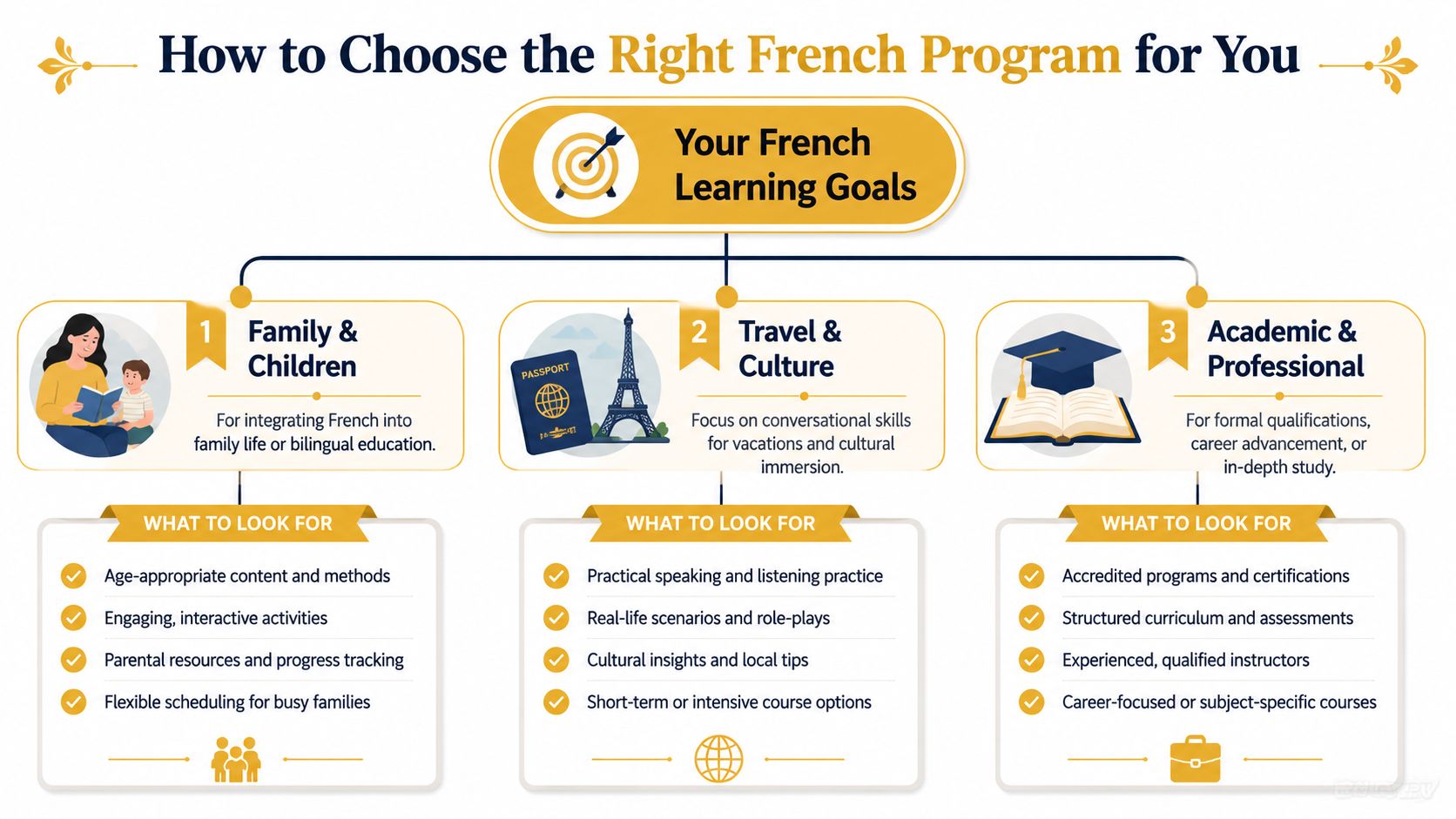
The best French program isn't the most popular one. It's the one built around the pressure point in your life right now. That's how I'd make the decision in Sacramento.
This visual is a useful starting frame.
For families in bilingual and French school settings
This is the most underserved segment in the Sacramento market. Parents often think they need “a French tutor.” They usually need something much narrower: someone who can align with school expectations, homework style, reading level, and classroom vocabulary.
That gap is growing. There is a 35% increase in Sacramento families needing specialized curriculum support for bilingual schools, yet virtually no local providers explicitly market Lycée-curriculum alignment, according to this analysis of the bilingual school support gap.
If I were hiring for my own child, I'd ask these questions before booking anything:
Can you support school-based French, not just general conversation?
Can you work from my child's actual class materials?
Do you know how to balance correction with confidence?
A tutor who can't answer those directly is probably not the right fit.
For professionals who need flexibility
Professionals often buy the wrong product because they feel they “should” take a standard weekly class. That setup fails a lot of busy people. If your workday changes constantly, rigid scheduling becomes the enemy.
I'd choose a program that can handle:
live conversation practice,
practical business or meeting vocabulary,
lesson formats that work even when your calendar shifts.
That usually points to private online instruction, not a classroom model. A commute and a fixed group slot are friction points. Friction kills consistency.
Buy the format you can keep showing up for. Consistency beats enthusiasm every time.
For exam prep and serious adult learners
DELF and DALF candidates need precision. So do adults who want polished speaking, stronger writing, or advanced comprehension. This buyer should be picky.
Look for a program that offers:
Specific correction: You want clear feedback on what is wrong and how to fix it.
Level-appropriate material: Not random articles and generic conversation prompts.
A visible plan: You should know what you're training and why.
For serious adult learners, I also care about whether the teacher can connect language to real usage. French without culture sounds sterile and often becomes hard to retrieve under pressure. Sacramento does have an advantage here. The city offers access to French cultural touchpoints, including film events, restaurants, and bakeries that can support immersive practice, as noted in this discussion of Sacramento's local French learning environment.
The right program doesn't just teach French. It fits the buyer's life, stakes, and attention span.
What to Expect from Your First French Lessons
A first lesson is often anticipated with discomfort. Expectations frequently include awkward introductions, a grammar lecture, and that sinking feeling of being already behind. A good program should feel nothing like that.
Your first lesson should be diagnostic, practical, and human. The teacher should figure out how you listen, where you hesitate, what you already know, and what you need next.
Your first sessions should feel practical
I want early lessons to produce momentum. That usually means the student starts speaking immediately, even if the sentences are short and imperfect.
A strong first phase usually includes:
A level check: Not a formal interrogation. Just enough to see your real starting point.
Targeted correction: Pronunciation, sentence structure, and high-frequency mistakes.
Usable language: Phrases and structures you can say again the same week.
For adults, I care less about whether you can recite rules and more about whether you can respond. For kids, I want engagement first. For professionals, I want relevance from day one.
The time commitment matters too. Achieving conversational fluency typically requires 3 to 5 hours of total weekly engagement, including live conversation practice and independent study, over a period of 6 to 12 months, according to this article on learning French efficiently for Sacramento professionals. That's a manageable standard, but only if the program is structured around real speaking.
A real Sacramento success story
One Sacramento-based marketing executive came to us with the profile I see all the time. She had old classroom French, decent reading comprehension, and almost no confidence speaking in real time. Her company needed her to interact more comfortably with colleagues in Quebec, and she was tired of sounding hesitant.
We rebuilt her training around live conversation, correction, and work-specific vocabulary. No fluff. No textbook theater. Just repeated practice on the situations she faced.
Within four months, she was leading bilingual meetings with confidence.
That result didn't come from talent. It came from fit. She bought a program aligned with her professional reality, then showed up consistently.
Early lessons should prove one thing fast. You are capable of speaking more French than you think, if the instruction is built correctly.
If a trial lesson leaves you feeling confused, generic, or invisible, move on.
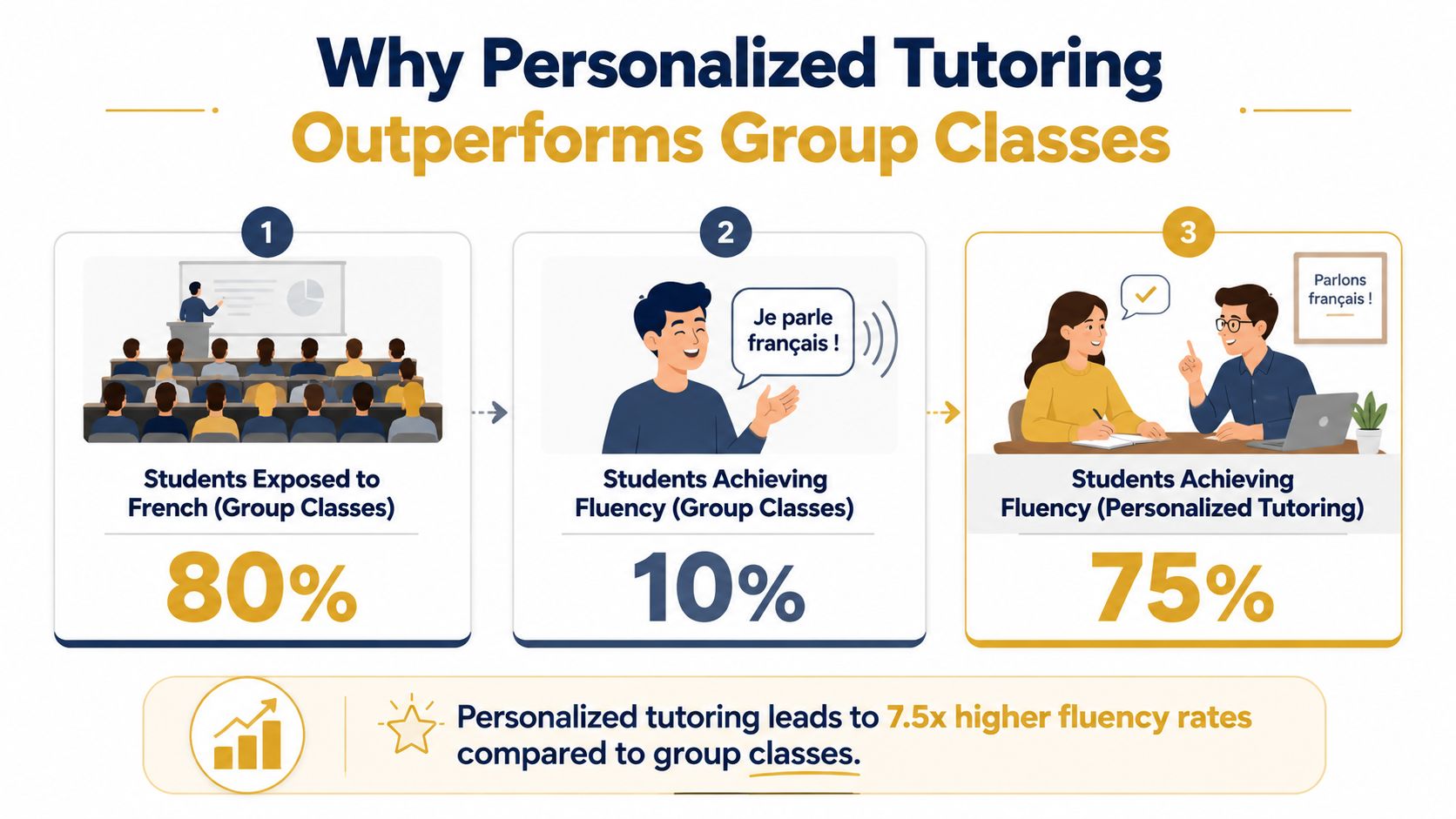
Why Personalized Tutoring Outperforms Group Classes
I'm opinionated on this because I've watched too many learners lose time in the wrong format. Group classes are good at one thing. They create a pleasant structure for many people at once. They are not the fastest route to functional speaking for most serious buyers.
The broader pattern is hard to ignore. While over 70% of North American students start French before high school, only about 2% achieve functional proficiency, according to this discussion of the French proficiency gap. That tells me standard exposure is not the same as usable ability.
Group classes are built for the middle
That's the core limitation. In a group, the teacher has to keep everyone moving together. Stronger students wait. Struggling students hide. Quiet students speak less than they need to. Everyone gets less correction than they should.
That model works if your goal is light enrichment. It breaks down if your goal is confident conversation, curriculum support, or professional performance.
Here's what group classes often can't do well:
Catch your recurring mistakes quickly
Adjust pace week by week
Focus the full session on your speaking
What one-on-one tutoring fixes immediately
Personalized tutoring changes the ratio of passive time to active time. You speak more. You get corrected more. The teacher notices patterns faster. That's why progress usually feels sharper.
A good private tutor can also do something a group teacher usually can't. They can build lessons around your exact pressure points, whether that's pronunciation, school support, business French, or exam tasks.
For buyers wondering whether the premium is justified, this piece on whether a French tutor is worth the investment is worth reading.
If speaking matters, you need a format where your voice is in the center of the lesson, not waiting its turn.
That's the simplest argument for personalized tutoring, and in my view, it's the strongest one.
Your Next Step to Speaking French Confidently
By now, the pattern should be clear. Sacramento has real demand for French, but the best option depends on how specific your needs are. Group classes can be a solid starting point. Private in-person tutoring can work if you find the right local fit. A customized online model is usually the strongest choice for families, professionals, and serious learners who need precision and flexibility.
If you're shopping carefully, don't ask, “What French class is available?” Ask, “What format gives me the best chance of staying consistent and getting the result I want?” That question leads to better decisions.
Before you book anything, it also helps to think through how you'll use French between sessions. This short guide on how to practice French conversation is a smart next read if you want your lessons to stick.
Book Your Free Consultation
If you want a premium, flexible option built around your goals, Elite French Tutoring is the one I'd recommend looking at closely. We offer fully customized private online French lessons with native, expert instructors, and every engagement begins with a free 20-minute consultation to assess your level, goals, and learning style.
It's a low-pressure way to compare lesson options and see whether a customized program fits what you need right now.
Frequently Asked Questions
Can I really learn French online if I'm a complete beginner?
Yes. Beginners often do better in private online lessons than in a group because they get a quieter setting, more speaking time, and immediate correction without social pressure.
How do you keep kids engaged in online lessons?
Good children's lessons use variety. That means games, visual prompts, stories, movement, and frequent interaction. Kids don't need longer lectures. They need stronger pacing.
What if my schedule is unpredictable?
That's one of the clearest reasons to choose a flexible private model. Parents and professionals usually need a program that adapts to real life instead of punishing every calendar change.
If you're comparing French lessons in Sacramento and want expert guidance before committing, booking a conversation with Elite French Tutoring is a practical next step. You'll get a clear recommendation based on your goals, not a generic sales script.