

You've probably already done the frustrating part. You searched for French lessons in Portland, opened a dozen tabs, saw group classes, tutor profiles, online platforms, and community programs, then realized none of those pages told you which option fits your life.
That's the problem. Individuals don't need “French lessons” in the abstract. They need the right kind of French support for a specific result, with a schedule and teaching style they'll stick with. If you're serious about making progress, you need to buy based on fit, not just availability.
I'm going to make this simple. Portland has enough options to serve casual learners, committed students, and professionals with urgent goals. But the market is fragmented, and that means you have to judge value carefully.
Table of Contents
Finding Your Place in Portland's French Scene
A lot of Portland learners get stuck before lesson one. Not because they lack motivation, but because the choices don't line up neatly.
One student I spoke with had three tabs open at once: a college program, a private tutor marketplace, and a local cultural organization. She wasn't indecisive. She was trying to solve three different problems at the same time. She wanted flexible scheduling, real speaking practice, and enough structure to know she was improving.
That's normal in Portland. The city has a real French-learning ecosystem. On one side, you've got established institutions. Portland Community College says its French program has 25+ years of experience teaching French and offers both in-person and remote classes on its French program page. Alliance Française de Portland also offers structured classes, with levels ranging from A1.1 complete beginner through C1-C2 advanced, and weekly classes kept to 8-12 students.
On the other side, the private market is active too. A major lesson marketplace lists many tutor options around Portland, which means learners can shop by format, personality, and schedule instead of taking the only class available.
The local market is good, but it's not self-explanatory
That's where people make bad decisions. They assume more options means easier decisions. It usually means the opposite.
Practical rule: Don't choose your French lessons by brand familiarity alone. Choose by goal, pace, and how much speaking time you'll actually get.
If you're comparing cultural immersion, classroom structure, and personalized coaching, you're not really comparing the same product. You're comparing different paths to different outcomes.
Here's my blunt advice. If your goal is casual and social, group learning can work well. If your goal is specific, urgent, or high-stakes, you'll need much tighter alignment between curriculum and your real-world use of French.
Cultural fit matters too. A learner preparing for travel often needs more than vocabulary lists. They need context, tone, and social confidence. That's why I often suggest learners read something like this short piece on differences between French and American culture before choosing a program. It helps clarify whether you want language exposure, cultural fluency, or both.
First What Is Your French Learning Goal
If you skip this step, you'll waste time and money.
The best French lessons in Portland for a child who needs school support won't be the best option for a professional preparing for meetings, and neither of those paths looks like exam prep. You need a target before you choose a teacher or program.

Choose the outcome before the format
Start with one sentence: “I need French for…”
Finish it realistically. Not aspirationally. Realistically.
If you say, “I want to become fluent,” that's too vague to guide a purchase. If you say, “I need to speak comfortably during a family trip,” “I need to improve writing for school,” or “I need structured DELF preparation,” now you can evaluate options.
Ask yourself these questions:
What situation matters most: travel, school, work, relocation, or certification?
What skill matters first: speaking, listening, reading, writing, or test performance?
What constraint is fixed: schedule, budget visibility, pace, or accountability?
What kind of teaching keeps you engaged: structured homework, conversation-heavy lessons, visual materials, or correction in real time?
A lot of students also benefit from understanding how proficiency levels work before they buy. If you're not sure what beginner, intermediate, or advanced really means in practice, this guide to mastering French language proficiency CEFR levels helps you translate vague goals into an actual starting point.
Four common learner profiles I see in Portland
Some learners fit neatly into one category. Most overlap. Still, these four patterns are useful.
The traveler.
This learner needs practical speaking, listening, and cultural confidence. They do not need endless grammar drills up front. They need role-play, survival phrases, pronunciation support, and enough repetition to avoid freezing in real situations.
The professional.
This learner usually needs precision. Meetings, email etiquette, introductions, client conversations, and industry-specific vocabulary matter more than broad textbook progress. Generic conversation classes often feel pleasant but inefficient for this group.
The exam candidate.
This learner needs structure, correction, and familiarity with task types. Casual tutoring isn't enough if the goal is performance under exam conditions. The right teacher should be able to identify patterns in your mistakes and train you toward the exam, not just “practice French.”
The parent.
This learner may be buying for a child, a teen, or a bilingual household. In that case, motivation, pacing, and curriculum alignment become central. A charming tutor who improvises everything may not be the right fit if your child needs reinforcement tied to school expectations.
A good program doesn't just teach French. It matches the reason you need French.
If you're between categories, choose the one with the highest consequence. A vacation is one thing. A work transfer, exam date, or child's academic confidence should drive the decision.
Comparing French Lesson Formats in Portland
Portland gives you several legitimate ways to learn French. That's the good news. The bad news is that many learners compare them badly.
They compare by hourly price alone. That's a mistake.
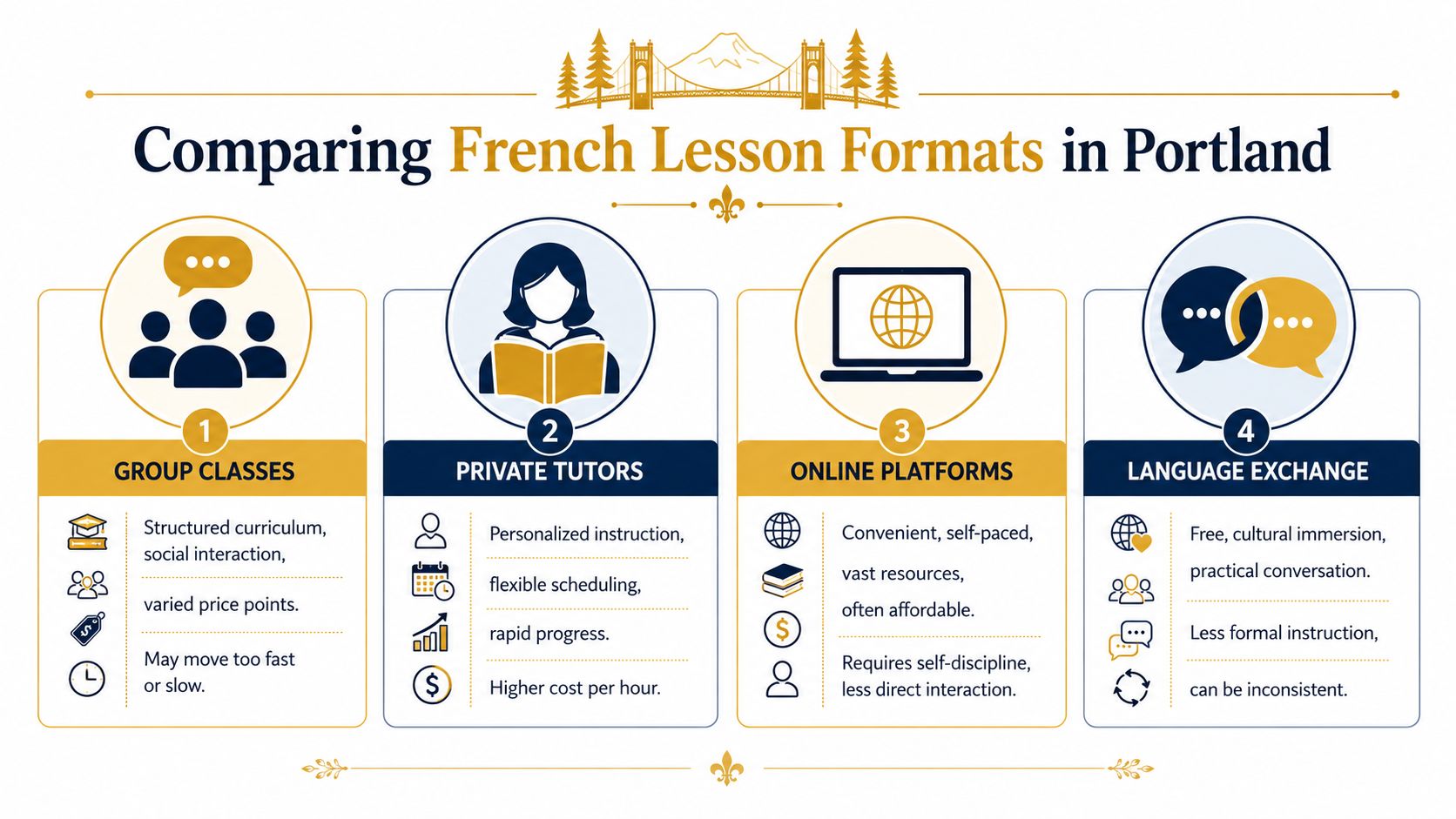
A private tutor listing, a group class, and an online platform aren't interchangeable. Each one solves a different problem. Portland's market makes that especially clear. A tutor listing on Superprof shows $45/hour for one private tutor, online services advertise lessons from $23/hour, and Alliance Française markets classes as low as $17/hour on the referenced listing context at this Portland-area comparison source. That price spread looks dramatic, but it doesn't tell you which option gives you the right outcome.
Portland French Lesson Formats Comparison
| Format | Best For | Typical Portland Cost | Pros | Cons |
|---|---|---|---|---|
| Group classes | Learners who want structure and peer energy | Alliance Française classes as low as $17/hour in the Portland market context | Clear progression, social accountability, level-based learning | Less personalization, limited speaking time per student |
| Private tutors | Professionals, students with urgent goals, learners who want fast customization | Private tutor listings range upward, with one Portland-area example at $45/hour | Customized lessons, flexible scheduling, targeted feedback | Higher hourly cost, quality varies by tutor |
| Premium private tutoring (e.g., Elite French Tutoring) | Children, professionals, and serious learners who want a vetted native teacher and a fully customized program | We sit at the premium end of this spectrum at $125/hour, because we offer something the marketplace listings can't guarantee: a vetted native teacher, a fully personalized program, and consistent quality from the first lesson. | Native expert teachers, fully personalized curriculum, consistent quality, fastest progress | Highest hourly cost, premium positioning |
| Online platforms | Busy adults who want convenience and broad choice | Some services advertise lessons from $23/hour | Easy scheduling, accessible, wide instructor pool | Requires self-discipline, variable consistency |
| Institutional programs | Learners who want formal curriculum and continuity | Varies by program and enrollment model | Stable structure, level pathways, reliable administration | Less adaptable to narrow or time-sensitive goals |
| Language exchange and informal practice | Casual conversation practice | Often free or low-cost qualitatively | Useful for speaking confidence and exposure | Not a complete learning plan, inconsistent correction |
How to think about value instead of sticker price
Here's the better question: what are you buying besides the hour?
You're buying some mix of these things:
Customization: Does the lesson adapt to your work, school, child, or exam needs?
Speaking time: Will you actively produce French, or mostly listen?
Correction quality: Does someone catch patterns and fix them?
Momentum: Will the format keep you showing up?
Outcome fit: Does this format serve your specific goal or just offer general exposure?
Portland's institutional side is strong. PCC offers in-person and remote classes through a long-established program, and Alliance Française uses defined levels and small groups. That's excellent for learners who want orderly progression. But if you need a program built around your calendar or job, personalization usually matters more than formal structure.
For online-first learners, I generally recommend looking closely at live instruction rather than app-heavy subscriptions. Passive exposure has a role, but it won't replace interaction. If you want a broader sense of what strong virtual options look like, this review of best online French lessons is useful.
One more opinion, and I'll be direct. Cheap French lessons are often expensive in the long run if they keep you busy without moving you toward your real target.
How to Evaluate a French Tutor or Program
Once you know the format you want, the filtering begins.
Many people often lower their standards. They see a native speaker, a friendly bio, and an open slot on Tuesday night, and they assume that's enough. It isn't. A tutor or program should fit your goal with precision.
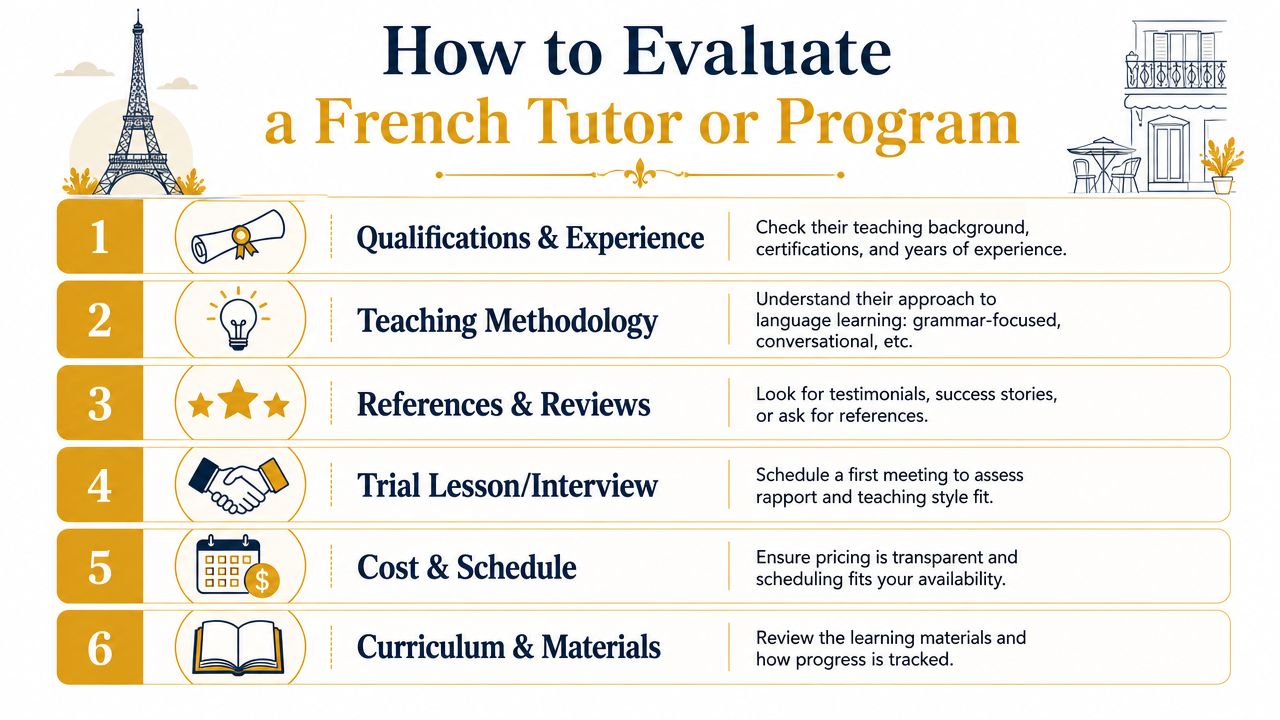
In Portland, trial access is common enough that you should expect it. A major tutor marketplace lists around 41 private French tutors in Portland and nearby, with an average hourly rate of about $30-$31, and it reports that 95% of tutors offer the first class for free on its Portland French tutor listings. That matters because it sets a market expectation. You shouldn't have to commit blindly.
Questions worth asking before you commit
I'd ask these before buying any package or enrolling in any course:
Who do you teach most often: adults, kids, professionals, exam candidates, or mixed learners?
How do you customize lessons: do you adjust materials and goals, or do you use the same sequence for everyone?
How do you correct mistakes: immediately, at the end, in writing, or only when communication breaks down?
What happens between lessons: homework, review notes, recordings, vocabulary lists, or nothing?
How do you track progress: informal impressions, level benchmarks, skill check-ins, or goal-based milestones?
Have you worked with my exact use case: business calls, school support, DELF/DALF, relocation, conversation confidence?
A polished answer matters less than a specific one. If the teacher can't explain methodology clearly, that's a warning sign.
Don't ask only “Are you qualified?” Ask “How would you teach someone like me?”
One option in this category is Elite French Tutoring, which starts with a free consultation and offers customized private lessons online and in person depending on location. That model works well for learners who need a program shaped around a narrow goal rather than a standard syllabus.
What a trial lesson should tell you
A trial is not a courtesy. It's a diagnostic.
After a first session or consultation, you should know the answer to these three questions:
Did this teacher understand my actual goal?
Did the lesson feel targeted or generic?
Can I imagine staying consistent with this person or program?
If the first session is all charm and no structure, be careful. If it's all structure and no rapport, be careful too. Good teaching needs both.
I also pay attention to whether a teacher can say no. A serious educator won't pretend every student needs the same format. They'll tell you when a group class is enough, when private tutoring is worth it, and when your timeline is unrealistic unless you increase intensity.
That honesty is part of what you're paying for.
A Student Success Story From the Pearl District
A Pearl District professional gets off a Zoom call with Montreal colleagues and realizes the problem immediately. Reading scattered French is one thing. Explaining a product issue clearly, catching follow-up questions, and sounding credible in real time is another.
Consider a professional like David from the Pearl District. He had studied French years earlier, enough to recognize familiar words and follow the general topic. He could not use it well under pressure, which is the only standard that matters if French is tied to your job.

Why the standard options did not fit
He started where many Portland professionals start. Local classes, established programs, and anything that looked organized enough to justify the time.
Those options can be good. Portland has reputable classroom-based French programs, and they serve many learners well. But David did not need a general sequence or a level-based class that treated business communication as a side benefit. He needed a format built around a demanding tech schedule, meeting pressure, and specific work tasks.
That is the key distinction.
A lower hourly rate or a familiar classroom structure is not automatically the better value. If your real goal is workplace performance, the better value is the option that cuts wasted practice and gives you relevant repetition fast. For David, a broad course would have cost less per hour and more in delay.
What changed when the lessons matched the job
Once the goal was defined properly, the path became obvious. He needed guided speaking practice tied to his actual calendar and responsibilities. That meant meeting simulations, technical vocabulary he would really use, polished self-introductions, strategies for clarifying a point, and practice disagreeing politely without freezing.
That kind of work suits a very specific learner profile. Busy professionals usually do better with targeted private lessons than with a standard curriculum because the content can match the stakes. Parents looking for exposure and routine may do well in a group setting. A DELF candidate may need exam-focused correction and timed drills. David needed job performance training.
The improvement did not come from more French in the abstract. It came from practicing the exact conversations that had been causing stress.
After a stretch of consistent work, the change was practical and visible. He spoke more clearly in meetings. He recovered faster when he lost a word. He stopped aiming for perfect French and started aiming for competent, professional communication. That is the right target for many Portland professionals, and it gets results faster.
That is why I tell people in Portland to stop treating French lessons like a generic purchase. Match the lesson type to the job you need French to do. Everything gets easier after that.
Your Next Steps and Portland French FAQs
At this point, the decision should feel narrower. Not because Portland lacks options, but because you should be filtering aggressively.
Three smart next steps
Write down your real goal.
Not “learn French.” Write the actual use case. Travel conversation. Child support. DELF prep. Client meetings. If you can't name the use case, you can't judge value.
Compare formats based on outcome, not price alone.
A lower hourly rate can be the right call for casual learning. It's often the wrong call for urgent or specialized goals. Choose the structure that gives you the right kind of practice.
Book a consultation before you commit.
A real conversation with a tutor or program director will tell you more than five polished sales pages. Ask how they'd teach your situation specifically. If the answer is vague, move on.
If you want help sorting through your options, a simple next step is to book a French lesson consultation or compare private lesson formats before enrolling anywhere. A short conversation can save you weeks of trial and error.
French lessons Portland FAQ
Are there enough French tutors in Portland to compare options properly?
Yes. Portland has enough private-market availability that you can compare for fit instead of grabbing the first opening you see. That's useful if you care about schedule, teaching style, or a specific goal.
Are group classes or private lessons better in Portland?
Neither is automatically better. Group classes are a solid buy for learners who want routine, peer energy, and a defined curriculum. Private lessons are usually the stronger choice when the goal is narrow, time-sensitive, or professional.
What counts as good value for French lessons in Portland?
Good value means the lesson format matches your objective. If you want casual exposure, a lower-cost group or platform option may be perfectly sensible. If you need measurable progress for work, school, or an exam, customization and accountability matter more than the lowest sticker price.
Should I expect a trial lesson?
Yes, in many cases you should. Trial sessions are common in Portland's private tutor market, so I'd treat that as part of your vetting process rather than a bonus.
What if I'm not sure whether I need in-person or online lessons?
Choose based on consistency and instructional quality. If online lessons make it easier for you to show up regularly and work with the right specialist, that's often the smarter option. In-person is useful when location and face-to-face interaction clearly improve your commitment.
What's the best option for a child or teen?
Look for curriculum alignment, patience, and age-appropriate teaching, not just fluency. Kids need a different lesson design from adults. If the goal is school support, the tutor should be able to work with class material and classroom expectations.
What's the best option for business French?
Private coaching usually wins here because business learners need vocabulary, tone, and role-play tied to actual work situations. Generic conversation practice won't cover enough ground if your French needs to function on the job.
How do I know a program is serious?
You'll see it in the questions they ask you. Serious programs want to know your level, timeline, learning style, and use case before recommending a plan. They don't just sell you hours. They diagnose first.