Skip to content

You're probably here because you've already done the first search. You typed something like “French lessons Baltimore,” opened a few tutor profiles, saw a mix of hourly rates, class formats, and promises, and realized the hard part isn't finding options. It's choosing one that fits your goal.
That choice matters more than most students think. A parent looking for support for a child at a bilingual school should shop differently than a professional preparing for meetings in French, and both should shop differently than an adult aiming for DELF or DALF certification. I've seen students waste months in the wrong format because nobody helped them match the lesson type to the outcome they wanted.
Baltimore gives you a strong starting point. As of May 2026, Care.com lists 42 verified French tutors in Baltimore with an average posted hourly rate of $24.00 and an average 5.0-star rating. That's a healthy market. The opportunity is there. The smart move is knowing how to sort through it.
Table of Contents
Start Here Your Baltimore French Learning Journey
A Baltimore parent books the first available French tutor because report cards are due soon. A Harbor East professional picks a weekly class because it fits the calendar. A traveler heading to Montreal downloads an app, practices for a month, and still freezes when someone speaks back at normal speed. The problem usually starts before the first lesson. The lesson type did not match the goal. If you want a personalized program built around your schedule and goals, explore Elite French Tutoring.
Start by defining the result you want in one clear sentence. A vague goal leads to vague lessons, and vague lessons are expensive. Students make faster progress when they can say exactly what they need the French to do for them.
Choose the outcome before the lesson type
Use a goal statement that names the task, the context, and the timeline. For example:
Travel goal: “I want to manage hotels, restaurants, directions, and basic conversation before my July trip.”
School support goal: “My child needs weekly help with reading, speaking, and French homework during this semester.”
Professional goal: “I need to speak more clearly in meetings and write better client emails in French.”
Certification goal: “I need targeted preparation for the DELF or DALF, including timed practice and feedback.”
Those goals lead to different buying decisions. Travel learners usually need high-frequency speaking practice, survival vocabulary, and listening work with real speed. Students who need school support often need structure, review of assigned material, and communication with a parent about what happened in the lesson. Exam candidates need a teacher who knows the format, scoring criteria, and common mistakes, not just someone who speaks French well.
I tell students to test their goal with one simple question: “What would make me say these lessons are working after eight weeks?” If the answer is specific, you are ready to compare options. If the answer is still “get better at French,” spend ten more minutes clarifying it before you book anything.
If you need help sorting out your starting point, this guide on how to start learning French gives a practical framework before you commit to a class or tutor.
The wrong goal creates the wrong plan
I have seen the same mismatch many times in Baltimore. An adult learner wants conversation for travel and ends up with grammar-heavy lessons built around worksheets. A child needs support for school and gets casual chat practice with no connection to classroom material. An exam candidate hires a fluent speaker who has never prepared a student for DELF production orale or production écrite. The lessons may be pleasant. They still miss the target.
Good shopping starts with a short self-check:
Timeline: Is there a trip, school deadline, job need, or exam date?
Priority skill: Do you need speaking, writing, listening, reading, or a balanced plan?
Lesson rhythm: Can you commit to a fixed weekly slot, or do you need more flexibility?
Specialization: Do you need children's support, business French, or exam preparation?
Feedback style: Do you want direct correction in real time, written notes after class, or lighter guidance so you keep talking?
These answers help you ask smarter questions during a consultation. They also help you interpret the answers. If a tutor cannot explain how lessons change for a travel learner versus a DELF candidate, keep looking. If the tutor gives the same materials to every student, expect slower progress unless your needs are very general.
A strong first consultation should leave you with a clear plan, not just a price. You should hear how the tutor assesses level, what a typical lesson looks like, how homework is handled, and how progress will be measured. That is how students in Baltimore avoid buying lessons that sound good and work poorly.
Private vs Group Lessons A Baltimore Comparison
Once your goal is clear, the next decision is format. In Baltimore, that usually means choosing between private tutoring and group classes. Both can work. They just work for different people and different objectives.
Group classes appeal to students who want structure, predictability, and the motivation of learning alongside others. Private lessons appeal to students who need personalization, scheduling flexibility, and faster movement toward a specific target.
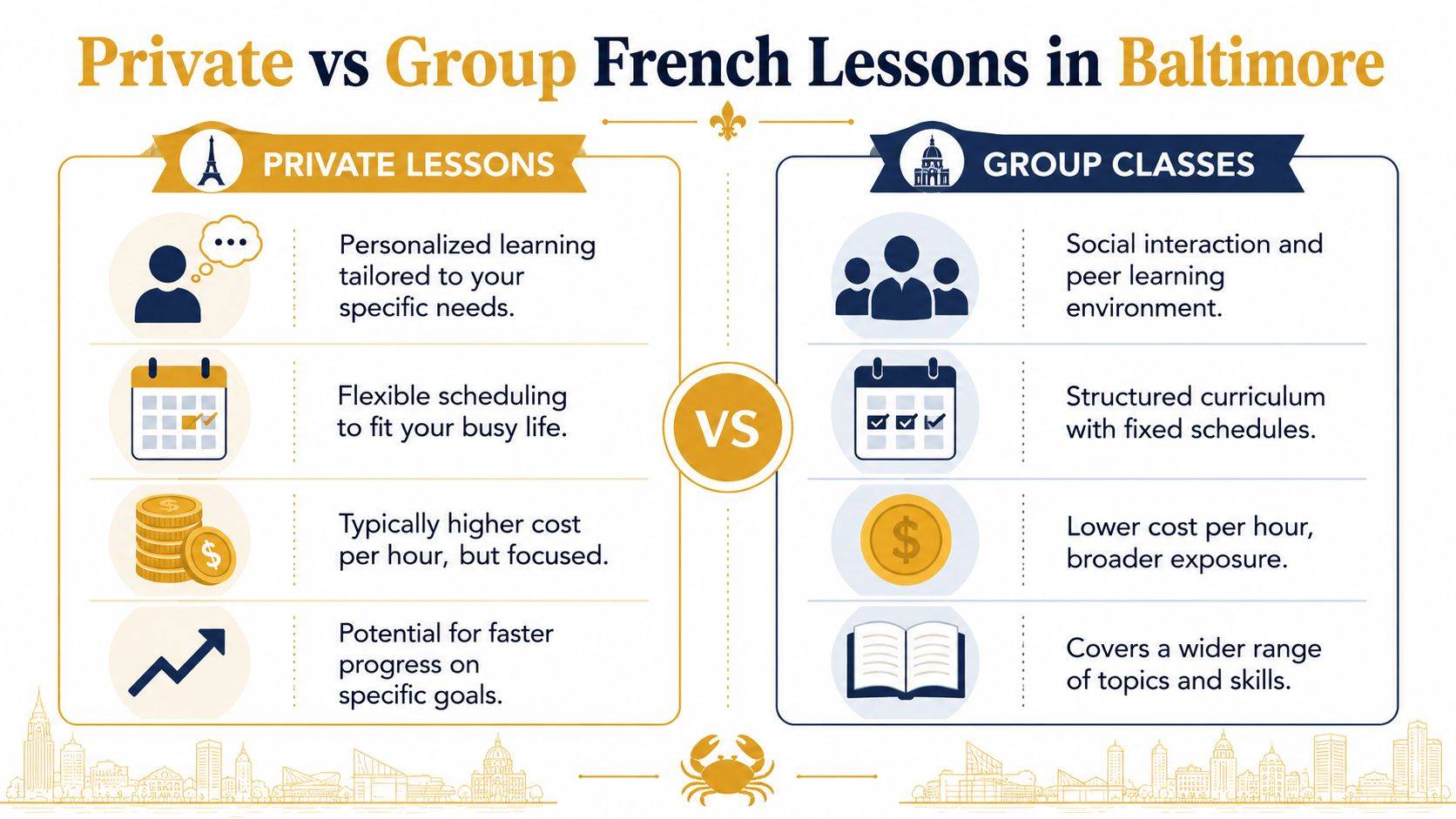
French lesson formats in Baltimore compared
Baltimore's group-class model is easy to benchmark because Alliance Française de Baltimore offers adult group classes that are typically 18 hours long, such as 2 hours per week for 9 weeks. That's useful because it gives you a concrete structure to compare against private tutoring, which is usually more flexible and individualized.
| Feature | Private Tutoring (Elite French Tutoring) | Group Classes (General) |
|---|---|---|
| Pacing | Built around the student's speed and gaps | Moves at the pace of the class |
| Scheduling | Flexible, easier for busy professionals and families | Fixed schedule |
| Curriculum | Customized to travel, school support, work, or exam goals | Standardized sequence |
| Speaking time | High individual speaking time | Shared across the group |
| Peer interaction | Limited unless lessons are arranged for pairs or teams | Built-in social environment |
| Accountability | Strong when the tutor tracks progress closely | Strong if you like external structure |
| Best fit | Students with specific goals or uneven skill profiles | Students who enjoy routine and group energy |
The mistake I see most often is assuming cheaper per-hour access always means better value. It doesn't. If a student needs targeted speaking practice, school-specific support, or certification prep, broad exposure can feel productive without solving the problem.
Who usually does better in each format
Group classes often suit true beginners who want a regular schedule and don't mind covering material at a shared pace. They can also be a good fit for learners who enjoy hearing other students make mistakes, ask questions, and normalize the process.
Private lessons are stronger when the student's needs are narrow, urgent, or inconsistent. That includes professionals with changing schedules, children who need direct intervention, and adults who already know some French but have obvious weak spots. Private work also helps when one skill lags behind the others, which is common.
Group classes are good at delivering a curriculum. Private lessons are better at solving a person's problem.
I also look at temperament. Some students thrive in a room with others. Some get quiet, defer to stronger speakers, and leave with less real speaking practice than they expected. That's not a flaw in the format. It is a mismatch.
If you're weighing both paths, compare the trade-offs carefully and review these advantages when you take French lessons in a more personalized format.
A useful buying question is this: Do you want exposure, or do you want precision? Group classes usually deliver exposure well. Private tutoring usually delivers precision better.
How to Find and Vet Vetted French Tutors in Baltimore
A polished profile doesn't tell you enough. Neither does native fluency on its own. A good tutor is not just someone who speaks French well. It's someone who can diagnose your gaps, explain clearly, adapt the lesson in real time, and keep you moving toward a defined outcome.
That's why vetting matters. The best students don't just ask, “How much do you charge?” They ask questions that reveal how the tutor thinks.
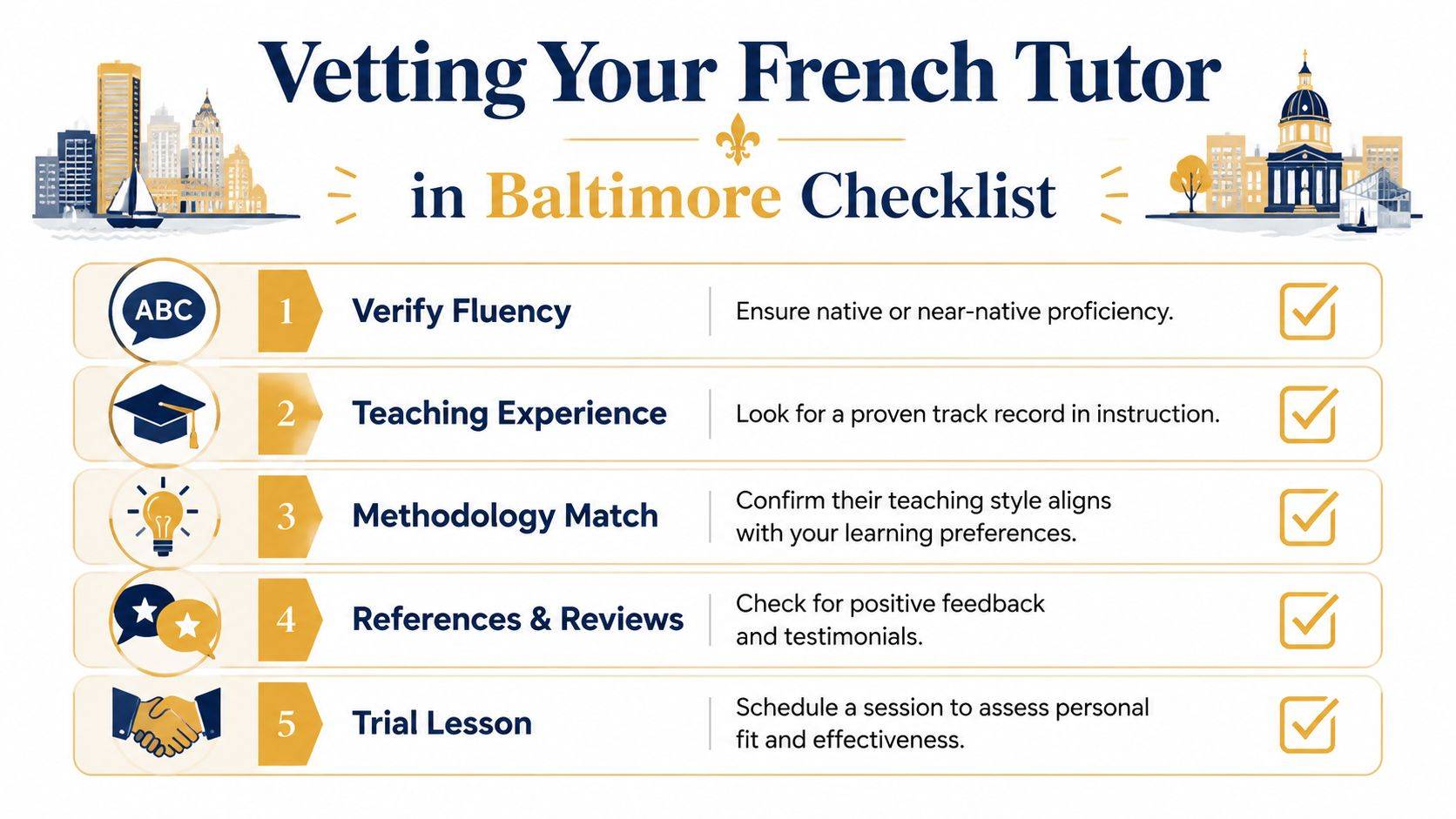
What to check before you book
Start with the tutor's fit for your category of learner. A teacher who works beautifully with young children may not be the right choice for a corporate executive. A great conversation coach may not be strong in writing correction. A fluent speaker may still be weak at sequencing lessons.
Check these first:
Learner match: Have they worked with students like you, or like your child?
Teaching style: Do they teach in a structured way, or do they improvise each session?
Materials: Do they rely only on conversation, or do they bring texts, audio, writing tasks, and review systems?
Progress tracking: Can they explain how they measure improvement?
Specialization: If you need school support or exam prep, can they show experience in that area?
Reviews matter, but they're only part of the picture. A tutor can be warm, punctual, and encouraging, and still not be the right instructional fit for your objective.
Questions that reveal how a tutor really works
A trial lesson or consultation should help you hear the tutor's method, not just their personality. Ask questions that force specifics.
Try these:
“How would you teach differently for travel conversation versus DELF preparation?”
“What do you do when a student understands grammar on paper but freezes when speaking?”
“How do you decide what to cover in the first month?”
“What would homework look like for someone with my schedule?”
“How do you adjust if the student progresses faster or slower than expected?”
Listen for concrete answers. Strong tutors usually talk about sequencing, diagnostic observation, feedback loops, and adaptation. Weak answers sound vague, generic, or overly dependent on one textbook.
If a tutor can't explain how they make decisions, they may be teaching by habit instead of by design.
One more point that often gets missed. Personal fit matters. You don't need a tutor who feels like a friend. You need one who helps you stay engaged, challenged, and honest about your weaknesses.
If you want a deeper checklist for evaluating fit, this guide on how to find the perfect French tutor for adult learners is a practical next read before you commit.
A Student Success Story The Right Tutor Makes All the Difference
A Baltimore project manager came to me after doing many of the "right" things. She had taken regular classes, completed assignments, and stayed consistent for months. Yet the moment she had to speak with colleagues in Lyon, her French fell apart under pressure.
The problem was not motivation. It was lesson fit.
Why the first approach failed
Her earlier group course gave her useful exposure, but it trained the wrong skill set for her immediate goal. She could recognize grammar, follow written exercises, and answer predictable classroom prompts. She could not jump into a live work call, respond to follow-up questions, or present updates without long pauses.
Her need was narrow and high stakes. She needed French for meetings, short presentations, and professional back-and-forth with real consequences if communication broke down.
I see this often in Baltimore. Adult learners blame themselves when progress stalls, even though the underlying issue is usually a mismatch between the lesson format and the task they need to perform.
What changed once the lessons matched the learner
Once we clarified the goal, the lesson plan became much more specific. We stopped spending time on broad textbook coverage and built sessions around her work reality. That meant role-plays based on her meetings, vocabulary drawn from her projects, short speaking drills, and corrections focused on clarity rather than academic perfection.
She improved because every lesson asked her to do the thing she had been avoiding.
That is the trade-off many students miss. Group lessons can be cost-effective and motivating, but they often move too broadly for a professional target like client calls or internal presentations. Private lessons cost more, yet they let a tutor cut material that does not serve the goal and repeat the situations that matter until the response becomes more automatic.
The right tutor does more than explain French well. The tutor builds practice that matches the pressure the student will face outside the lesson.
Her progress became visible within a few weeks. She was not speaking flawless French, and that was never the goal. She was handling openings, clarifying points, recovering after mistakes, and getting through conversations that used to shut her down.
If your goal is job-specific communication, travel speaking, or certification, shop for lessons the same way. Ask what the tutor would have you do in week one, what they would cut, and how they would measure progress for your exact use case. For students with exam goals, a tutor who also offers targeted DELF and DALF test preparation may be a better fit than a general conversation teacher.
The lesson from her story is simple. Progress usually comes faster when the lesson is built around the actual task, not around a generic idea of "learning French."
Planning for DELF DALF Exam Success
DELF and DALF students need to shop differently. Many Baltimore learners make expensive mistakes in this area. They hire a general French tutor when what they need is an exam-prep specialist.
Those are not the same service.
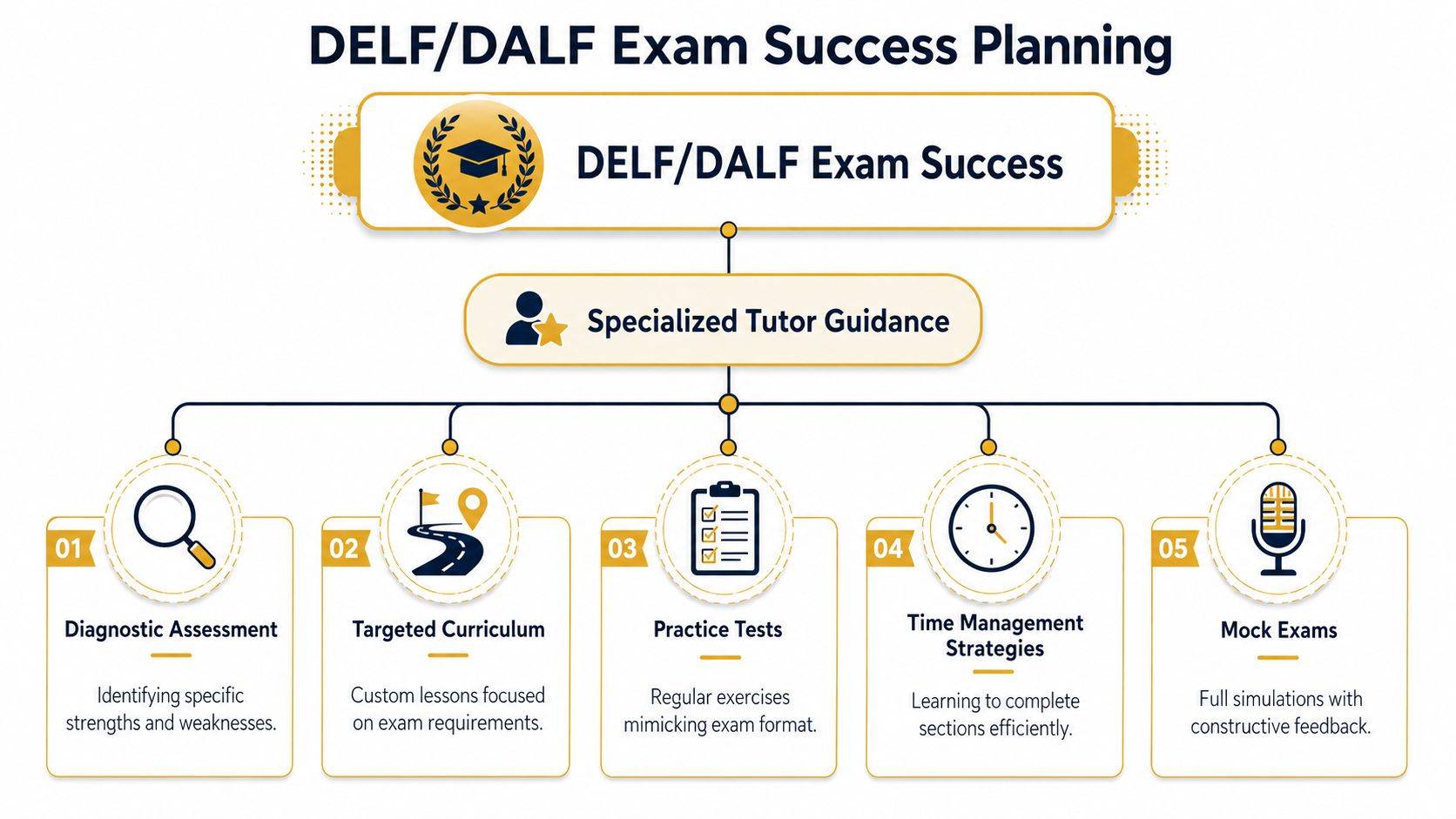
General French tutoring is not the same as exam prep
A conversation tutor can help you speak more naturally. A school-support tutor can help with homework and reading comprehension. An exam tutor has to do something more technical. They need to understand the structure of the test, the scoring expectations, the timing pressure, and the skill balance across listening, reading, writing, and speaking.
That specialization matters because demand is high and local signaling is weak. In the U.S., 68% of adult learners prioritize exam certification for career mobility, yet only 12% of local Baltimore listings on platforms like Superprof explicitly highlight specialized DELF/DALF exam prep tracks, according to Superprof's Baltimore French lesson marketplace reference. That gap leaves a lot of students guessing.
When I evaluate an exam-prep setup, I look for five things:
Diagnostic start: The tutor should identify the student's level and the weakest tested skill.
Exam familiarity: They should know the structure and demands of the target exam level.
Targeted materials: Lessons should include exercises that resemble actual task types.
Timed practice: Students need to rehearse under constraints, not only in untimed comfort.
Feedback quality: Corrections should connect directly to exam expectations, not just general language advice.
What to ask before hiring a DELF or DALF tutor
You don't need to interrogate the tutor. You do need to be specific.
Ask questions like:
“How do you diagnose whether I'm ready for this level?”
“How much lesson time goes to speaking, writing, listening, and reading?”
“Do you use timed tasks and mock exams?”
“How do you correct written production?”
“What would a typical month of preparation look like for my level?”
If the answers stay broad, keep looking. Exam preparation should sound structured. It should also sound selective. A serious tutor won't promise that every student is ready for every level on any timeline.
Exam prep is a performance service, not just a teaching service. The tutor has to train you for the test you will actually sit.
If certification is your main goal, compare providers with that lens and review a more focused option for DELF and DALF test preparation before booking.
Your Next Steps Pricing and Booking Your First Lesson
A Baltimore parent often starts the search one way. The child needs help in school, a trip to Montreal is coming up, or a job now requires basic French. Two tabs are open, five tutor profiles look similar, and the rates vary enough to make the cheapest option feel tempting. That is the point where students often waste money.
Price matters. Fit matters more.
In Baltimore, posted rates for French lessons range widely depending on the teacher's background, whether lessons are private or group-based, and how specialized the work is. Conversation practice for travel usually costs less than structured exam coaching or highly customized one-to-one instruction. The question is not “What is the hourly rate?” It is “What am I buying with that hour?”

How to judge value before you book
I tell Baltimore students to compare lessons in four areas before they look at the calendar.
Goal match: Ask, “How would you teach someone preparing for my exact goal?” A strong answer should sound different for travel speaking, school support, business French, or DELF preparation.
Lesson format: Ask, “Why do you recommend private lessons, a small group, or online sessions for me?” Good teachers can explain the trade-off. Private lessons give faster correction and tighter focus. Group classes can help with consistency and cost.
Correction style: Ask, “How do you correct mistakes during a lesson?” Some students need immediate interruption. Others speak more freely if correction comes in batches. Neither is universally better.
Plan for the first month: Ask, “What would we work on in the first four lessons?” If the answer stays vague, expect vague progress.
A lower rate is a good deal when the teacher can solve the problem you have. It is a poor deal when each lesson feels pleasant but unfocused.
What to prepare before the first booking call or trial lesson
Show up with specifics. That makes it easier to spot whether the tutor can work with real constraints.
Bring three things:
Your target: “I need restaurant and hotel French for a trip in three months,” or “I need B1-level speaking practice.”
Your schedule: Once a week, twice a week, short sessions, evening only, in person only, or flexible online.
Your sticking point: Listening speed, verb forms, pronunciation, confidence, writing, or test structure.
Then listen carefully to how the tutor responds. A good provider usually starts with some kind of diagnostic process, such as a short consultation or trial lesson focused on goals, level, and obstacles, before recommending a package. That approach is a better sign than a polished sales pitch.
The best first lesson does three jobs at once. It checks your level, shows how feedback will work, and gives you a realistic sense of pace.
One more point. Do not buy a large package until you know how the teacher teaches. One trial lesson or a short introductory conversation often reveals enough to judge whether the fit is strong, especially if your goal is narrow and time-sensitive.
The right French lesson in Baltimore is not the one with the lowest posted rate or the busiest calendar. It is the one built for your goal, your timeline, and the way you learn.