Skip to content


A Denver parent can find a school French class, a community course, an online instructor, and several private tutors in a single search, then still be unsure which option will help their child speak with more confidence. Adults face the same problem when they want French for a work call or a trip but don't know whether they need a class, an exam coach, or one-to-one lessons.
I'd choose by what the learner needs to do in French, not by a tutor's title or a promise of fluency. The strongest fit is the one that identifies a specific goal, measures the relevant skills, and shows observable progress toward it.
Table of Contents
- Where Denver Learners Find a French Tutor Today
- What Personalized French Lessons Really Mean
- Vetting Criteria for Choosing a French Tutor
- Online Versus In-Person Lessons by Learner Situation
- How to Match Lesson Frequency to Your Goal
- Real Learners Using Personalized French Tutoring
- Book a Free Level Check Before You Commit
Where Denver Learners Find a French Tutor Today
A Denver adult with a changing work calendar might want conversation practice, while a parent might be looking for support after school. Both can find a long list of options, but those options don't offer the same kind of instruction. An estimated 14,327 people in the Denver metropolitan area spoke French at home, based on the 2020–2024 American Community Survey, as reported by the American Association of Language Businesses. That's a local French-speaking community, not a directory of tutors or a measure of how many people are studying.
Here's how the main formats compare:
Denver French Tutoring Options Compared
| Option | Format | Best For | Main Trade-Off |
|---|---|---|---|
| Private in-person tutor | At home or a public space | Adults who want face-to-face conversation | Limited to local tutors and their schedules |
| Private online tutor | Video lessons | Busy adults and remote learners | Needs a reliable connection and a quiet room |
| Community college or continuing education | Group class over a term | Beginners who want structure | Pace is set by the group |
| University French courses | Credit-bearing classes | Students who need transcripts | Less individual feedback |
| Denver Language School (Gilpin) | Public school French in grades 6–8 | Students already in middle school | Only useful within the grade range |
| French American School of Denver | Full-day K–5 bilingual program | Young children in a French-English setting | Not designed for adult learners |
A private tutor can shape lessons around a personal goal, such as speaking up in a meeting or understanding a child's French homework. Group classes and school courses provide a set curriculum, which can be helpful for structure, but the teacher can't devote every lesson to one learner's priorities.
Online tutoring also opens the search beyond local schedules. Elite French Tutoring offers online lessons across the U.S., giving Denver learners access to specialists who may not be available nearby.
Before comparing individual instructors, answer three questions: How old is the learner? What should they be able to do in French? How many hours each week can they spend practicing outside lessons? Those answers narrow the choice faster than browsing credentials alone.
What Personalized French Lessons Really Mean
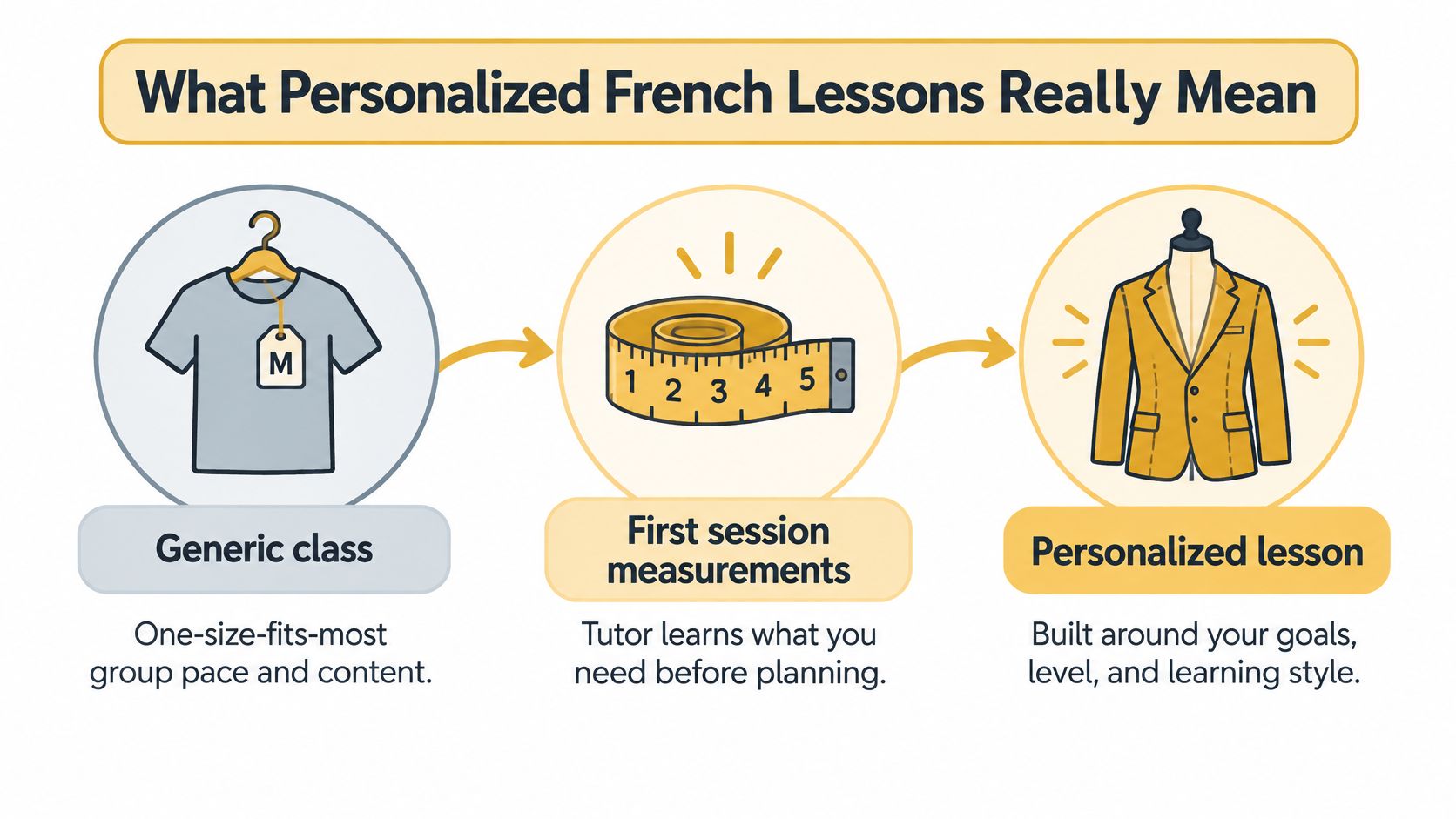
A generic class is like off-the-rack clothing: it fits the average learner's pace and needs, but it may not fit yours. A personalized lesson is designed from measurements taken in the first session, so the tutor starts with the learner's current ability and a practical goal.
Personalization begins with diagnosis. A useful target describes an action, not a vague ambition: ordering a meal, presenting a project, or handling a school conversation. From there, the tutor can identify what the learner already does well and which skill is getting in the way.
Measure skills separately
ACTFL's proficiency guidelines assess listening, speaking, reading, and writing separately. That distinction matters: someone may understand written French at an intermediate level yet struggle to answer an unexpected question aloud. The framework looks at what learners can accomplish, their accuracy, the contexts and content they handle, and the type of language they produce, as described in ACTFL's proficiency guidelines.
The target task determines what practice should look like. A business learner preparing to join a professional conference needs practice following speakers, entering a discussion, and expressing a point. A traveler may need to give personal information, understand practical instructions, and ask for clarification when they miss a word.
Grammar exercises have a place, but they don't prove that a learner can use French spontaneously. Lessons should include unscripted listening and speaking, so the tutor can hear whether the learner can retrieve language, respond to a follow-up, and keep an exchange moving without memorized lines.
Monthly check: The learner should be able to name one new thing they can do in French, and the tutor should be able to show evidence, such as a role-play, recorded response, or short presentation.
Vetting Criteria for Choosing a French Tutor
Use this checklist during a consultation. A good answer connects the tutor's approach to observable tasks and clear feedback. A polished résumé may be reassuring, but it won't tell you whether the lessons will address the learner's actual communication gap.
Tutor Vetting Checklist
| Criterion | What to Ask | Green Flag | Red Flag |
|---|---|---|---|
| Level assessment | How is my starting level measured, and by which skills? | Separate scores for listening, speaking, reading and writing | One grade or a generic worksheet placement |
| Goal alignment | Which real tasks will my lessons prepare me for? | Named tasks such as a work call, a school talk or a DELF oral | Promises of general fluency |
| Progress reporting | What does each progress report contain? | Current level, demonstrated tasks, recurring breakdowns, next target | Attendance and vocabulary counts only |
| Lesson continuity | Will the same tutor work with me over time? | One tutor and a fixed weekly slot | Rotating instructors |
| Exam scoring | Are practice tests scored with official DELF or DALF criteria? | Rubric-based scoring with per-component results | An informal overall estimate |
| Feedback quality | How do you correct my speaking and writing? | Recorded role-play and written notes that name criteria | General praise or unexplained corrections |
What good answers sound like
For the starting level, ask whether the tutor checks speaking, listening, reading, and writing independently. ACTFL describes proficiency through spontaneous communication across these skills, so a single worksheet score can miss an important weakness, as ACTFL's framework overview explains. For goals, ask for a lesson task you can picture, such as answering questions about a project or explaining a work decision.
For DELF B2, the scoring rules make skill-by-skill preparation essential. The official DELF B2 candidate manual says each of the four components is scored out of 25; candidates need at least 50 points overall and at least 5 points in every component, with a score below 5 in any component eliminatory. A tutor who reports only an estimated total may overlook a weak section that could invalidate the result.
Ask how the tutor handles written and oral feedback, too. In DELF and DALF exams, productions are assessed separately by two examiners, then discussed and harmonized using a completed scoring grid, according to France Éducation International's examiner manual. Exam preparation should therefore include rubric-based corrections and practice with the task format, not just general conversation.
A useful progress report names the learner's current level, demonstrated tasks, repeated breakdowns, and next target. For school-age students, also ask whether the tutor can connect practice to class assignments. Stanford's National Student Support Accelerator highlights frequent sessions, small tutor-to-student ratios, formative assessment, classroom alignment, and continuity as features of effective tutoring programs in its tutoring synthesis.
For more questions to use when comparing instructors, see this guide to finding the right French tutor for adult learners.
My rule: A red flag on goal alignment or progress reporting disqualifies a provider, however strong their credentials look.
Online Versus In-Person Lessons by Learner Situation
A Denver marketing manager has postponed French for two years because her calendar changes every month. She's deciding between lessons on a screen and meeting a tutor face-to-face. The practical question isn't which format is universally better; it's which one supports the practice she'll keep doing.

Online Versus In-Person French Tutoring
| Factor | Online | In-Person | Best If |
|---|---|---|---|
| Scheduling | Easy to fit around work and travel | Fixed around the tutor's location | Your calendar changes often |
| Pronunciation feedback | Strong with recordings, weaker on mouth position | Strong on mouth position and live correction | You struggle to hear sounds |
| Conversation feel | Good, but slightly more formal on screen | Natural and relaxed | You want spontaneous speech practice |
| Materials and recording | Easy to record and replay | Needs notes and a separate recording device | You want to review sessions |
| Children's supervision | Needs a parent nearby | Supervised at the lesson location | Your child is under ten |
| Time lost to travel | None | Commute each session | Your weekly time is tight |
Online sessions can make an early or late lesson easier to schedule, including with a tutor in another time zone. A recording can also help a learner replay one sentence and listen closely to how the vowels sound. The trade-off is that a camera may not show a tutor the mouth position clearly enough to correct a new sound in real time.
In-person lessons make it easier to watch a learner form a sound and offer a correction immediately. Meeting face-to-face may also help some learners relax into spontaneous conversation, though a commute adds friction to an already full week.
Choose by the learner's situation. Busy adults with irregular schedules often do well online; beginners who can't yet hear the difference between sounds may benefit from starting in person. Children under ten need in-person lessons or an online lesson with a parent in the room. A hybrid plan, face-to-face at first and online later, can balance pronunciation support with flexibility. You can compare online French tutoring options when remote lessons fit your routine.
For school-age learners, format alone doesn't guarantee alignment with schoolwork. Ask how the tutor connects each lesson to the current class curriculum, assignments, or upcoming assessment.
How to Match Lesson Frequency to Your Goal
Lesson frequency should follow the learner's target, not a promise that more sessions automatically mean faster progress. ACTFL's research brief reports that students studying French and other languages for two years commonly averaged between Novice-Mid and Novice-High speaking proficiency; after three to four years, the median speaking result reached Intermediate-Low, according to its proficiency-levels brief. Those benchmarks make sustained practice a more useful planning principle than a short burst of lessons.
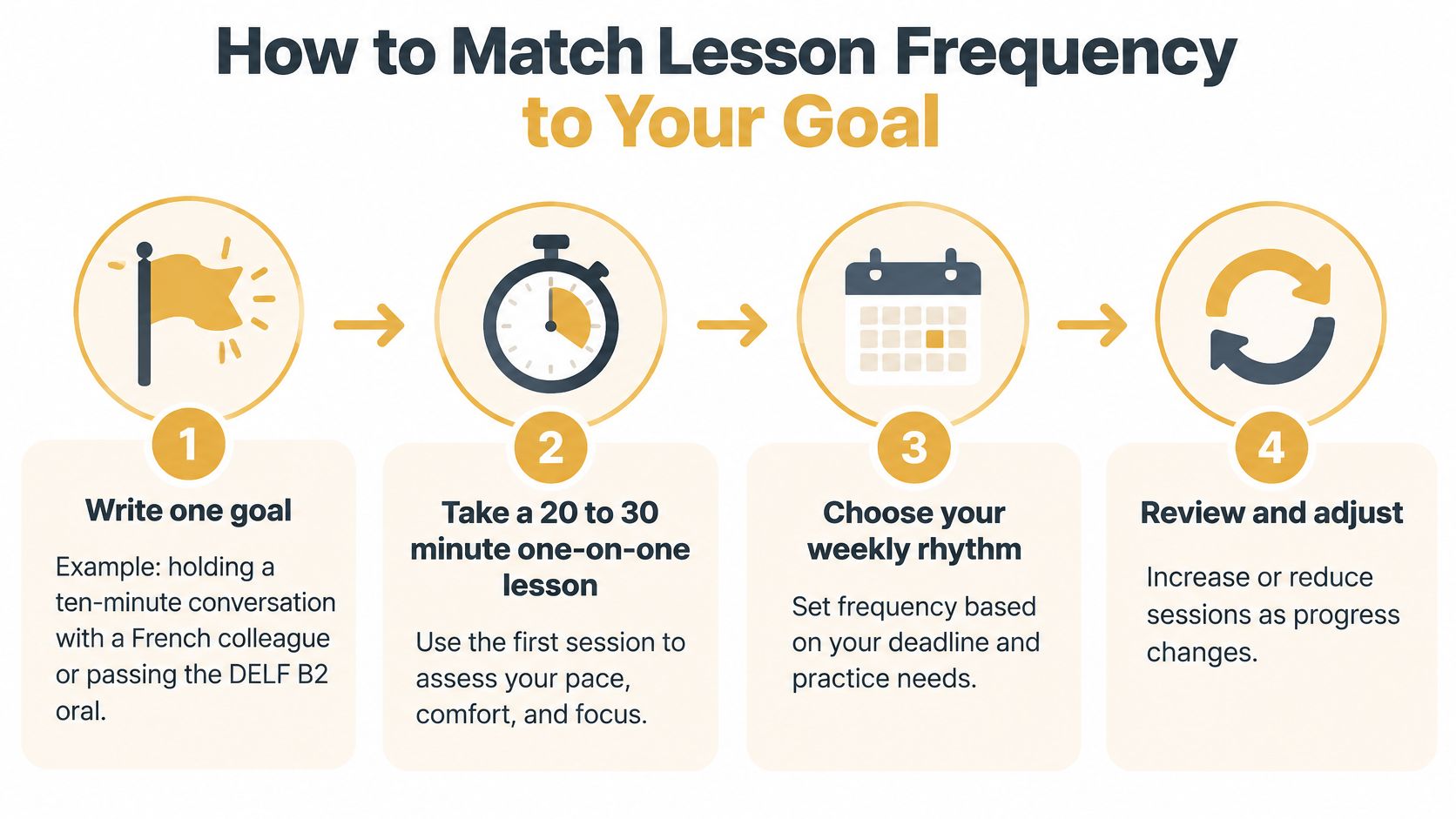
Write one goal as a task. For example, aim to hold a ten-minute conversation with a French colleague or pass the DELF B2 oral. A task gives both learner and tutor a concrete result to practice.
Take a speaking baseline. Use a 20–30-minute one-on-one interview modeled on the ACTFL Oral Proficiency Interview, which ACTFL describes as a valid and reliable speaking assessment in its Can-Do framework resource. Record spontaneous speech length, question formation, control of major time frames, comprehensibility, and the ability to sustain interaction so later comparisons have a clear starting point.
Choose a weekly lesson count. One session can support maintenance, two can provide a steady rhythm, and more sessions make most sense when a firm deadline justifies the extra commitment. The learner's practice between meetings also matters, so don't use lesson count as the only measure of effort.
Add brief daily practice. Spend five to ten minutes shadowing spoken French and using spaced recall for high-frequency phrases, then record one response to a realistic prompt each week. Short, repeated retrieval gives the learner practice producing language between lessons.
Re-test every four to six weeks. Compare the learner's performance against proficiency descriptors and keep a sample, such as a role-play or presentation, for reference. The checkpoint shows whether the current routine is producing a meaningful change.
Shift time toward the limiting skill. If reading outpaces speaking, use more lesson time for unscripted responses rather than adding more reading exercises. Skill-by-skill adjustment keeps practice tied to the goal.
Two checkpoints with no measurable change are a warning: the method or frequency needs adjusting, not more lessons. A monthly report that names a next target makes that decision easier.
Real Learners Using Personalized French Tutoring
Grace describes Cyril as an excellent French tutor in NYC whose lessons are a very valuable investment in her child's education. Alexa calls Pierre an amazing French tutor who pushes students to challenge themselves. Both testimonials come from New York-area families. They report no test scores or specific learning outcomes, so read them as evidence of fit rather than proof of a result. What they do show is a pattern worth noting: parents value a tutor who stretches a student, and students tend to respond when the work demands more than the classroom does.
A Denver family might face a different challenge. Consider an illustrative composite, not a named client: a 12-year-old finishes a K–5 immersion program and moves into middle school French. Denver Language School – Gilpin had 966 students enrolled in 2025, with French offered in grades 6–8, according to the Mile High School Guide.
The student may read confidently but hesitate when asked to speak without preparation. A classroom course can cover the curriculum, but it rarely has time to pinpoint whether that hesitation comes from finding words, forming questions, or worrying about pronunciation. A private tutor can assess each skill separately, set a task such as explaining a school project in French, then use relevant class material as practice.
That support should complement the classroom rather than repeat it. One workable split: the tutor spends sessions on spoken explanation of current topics while reading and writing tasks reinforce what the student needs next. When readiness supports it, the family and tutor can also set a certification target. DELF Junior is a common choice for young learners, and its scoring rules give both sides a concrete standard to measure against instead of a vague promise of fluency.
The case shows the difference between adding lessons and filling a gap. A good tutor strengthens the skill the classroom has not had room to diagnose, keeps practice tied to school material, and reports progress skill by skill so the family can see what changed. You can review French tutoring case studies for examples of the kinds of learning situations families bring to a private tutor.
Book a Free Level Check Before You Commit
Before committing to a Denver or online French tutor, use a level check to test whether the provider measures skills and goals clearly. We offer a complimentary 10–20-minute call in which our experts assess the student's French level. It's a low-risk way to discuss what the learner needs and how a tutor might approach it; Elite French Tutoring also offers adult French classes for conversation, travel, and professional goals, with online lessons available to Denver learners.
Use the call to make a shortlist, not to rush into a decision. Take these steps:
- Write one goal as a task, such as holding a ten-minute conversation with a French colleague.
- Prepare three questions from the vetting checklist, including how the starting level is measured and what progress reports show.
- Book the level check or a comparable call through our French placement test page.
- Compare the answers with the format table for a week before choosing, so the lesson plan and schedule both fit your routine.
If you'd like to ask a question before booking, call (212) 470-2128. You can leave the conversation with a useful shortlist even if you decide to work with a different provider. Book a free level check when you're ready to compare your goals, current skills, and lesson options.