You're probably looking at summer French classes in NYC because you want one of three things, and you want it fast. You need enough French for a trip or relocation. You need a serious academic boost before fall. Or you need a credentialed path, usually DELF or DALF, and you've realized most summer listings are vague, youth-focused, or built around a generic group format that doesn't match your schedule.
I've worked with New York families, professionals, and exam-focused students long enough to know the pattern. People spend hours comparing programs, only to discover the problem isn't finding a French class. It's finding the right summer format for the result they care about.
That's why I don't treat summer french classes nyc as a simple list-post topic. NYC has real options, but the market also has real gaps. If you're an adult with a full-time job, a parent trying to support a bilingual school student, or a professional who needs focused progress rather than social enrichment, your decision should be much more selective than most guides suggest.
Table of Contents
- Finding Your Perfect French Class in NYC This Summer
- The Three Main Paths to Summer French in New York
- Comparing NYC Summer French Programs Side by Side
- How to Evaluate a French Program Beyond the Brochure
- A Real Student Story From Zero to Exam Ready
- Your Enrollment Checklist for a Successful Summer
- Frequently Asked Questions About NYC French Classes
- How much should I expect to pay for summer French classes in NYC
- Can I really become fluent in one summer
- What is the difference between a trial class and a free consultation
- Is online or in-person better for learning French
- Are summer programs in NYC good for adults
- What's the best option if I need DELF or DALF prep
Finding Your Perfect French Class in NYC This Summer
Last summer, a finance executive came to me after enrolling in a group program that looked polished on paper. She wanted business French for an internal transfer. What she got was a pleasant class, a decent workbook, and almost no room to practice the language she needed in meetings. She wasn't in the wrong school. She was in the wrong format.
That happens constantly in New York.
The city gives you impressive names, strong institutions, and plenty of marketing copy. What it doesn't always give you is clarity. One program may be structured and rigorous but tied to an academic calendar. Another may be flexible but too broad. A third may be immersive but aimed at children or teens, not working adults.
What serious learners usually want
Nearly everyone I speak with isn't shopping for “fun exposure.” They want a result they can feel by the end of the summer:
- Adults want conversation that transfers to real life.
- Parents want support that matches school expectations.
- Professionals want usable language for travel, clients, or relocation.
- Exam candidates want a program that doesn't waste time on irrelevant material.
The mistake is assuming every French class can serve all four goals.
Practical rule: Choose the program type first. Choose the school second.
If you're still sorting through what kind of teacher or structure fits your goals, this guide on how to find the perfect French tutor for adult learners is worth reading before you book anything.
The result you should actually be buying
In NYC, the right summer French program should do one of two things well. It should either give you a clear progression path or a highly specific outcome. If it does neither, skip it.
That means I like programs that can tell you exactly how the summer is organized, who it's for, what kind of learner succeeds in it, and what comes next after the session ends. If the answer is just “all levels welcome,” I get cautious fast.
The Three Main Paths to Summer French in New York
You find a summer French class in NYC that looks promising. Then you read the details. It meets twice a week when you travel, the pace is too slow for your goal, or the program is really built for teens, not adults with jobs. I see this constantly. The smart move is to choose the path that matches your constraint first.
In New York, summer French usually falls into three categories. Each solves a different problem. Very few solve all of them well.
Group intensives
Group intensives are the standard language-school route. I recommend them for adults who want structure, a defined level, and the accountability that comes from showing up with other learners.
L'Alliance New York is the clearest example. Its adult program is organized by CEFR level, offers multiweek formats, and gives new students a low-cost way to test the fit through a trial class, according to L'Alliance adult French course details.
Here is my view. Group intensives work well if your goal is steady progress across listening, speaking, reading, and writing. They work poorly if you need highly targeted speaking practice, school-specific support, or fast correction of fossilized mistakes. That gap matters more than many buyers realize.
University courses
University summer classes are the academic route. Fordham is a useful local example because its summer French offerings follow a formal session calendar and include scheduled courses in both virtual and campus-based formats, as shown in Fordham's summer French course descriptions.
I only recommend this option to students who want a college-style framework and can commit to the institution's timeline. If your summer changes week to week, this path becomes frustrating fast.
It also has a narrower use case than many guides admit. University courses can be solid for transcript-minded students and learners who like academic pacing. They are usually not the answer for working adults who want conversational fluency by late August.
Personalized private tutoring
Private tutoring is the right choice when the target is specific. Exam prep. Relocation. Executive presentations. Middle school support. Recovery after years of stalled classroom study.
This is also where the NYC market shows its weakness. There are not many adult-focused summer French intensives built around real scheduling constraints, and official exam preparation is often hard to find in standard group classes. That is why serious learners often get better results from a personalized plan than from a generic summer course.
I tell clients this all the time. If a program tries to serve tourists, teens, casual hobby learners, and DELF candidates in the same format, it will underserve at least two of those groups.
Private tutoring costs more upfront, but it wastes less time. For learners who need flexibility or higher weekly frequency, comparing in-person lessons with online French classes for adults and busy professionals usually opens up better scheduling and a better teacher match.
Comparing NYC Summer French Programs Side by Side
You book a summer class in June, miss two sessions by July, and realize in August that the course was built for a different kind of student. I see this constantly in NYC. The problem is not a lack of French classes. The problem is fit.
Most roundups flatten the market and pretend these options serve the same goal. They do not. Adult learners looking for fast speaking gains, flexible scheduling, or official exam preparation run into real gaps, especially in summer. That is why I compare formats first and schools second.
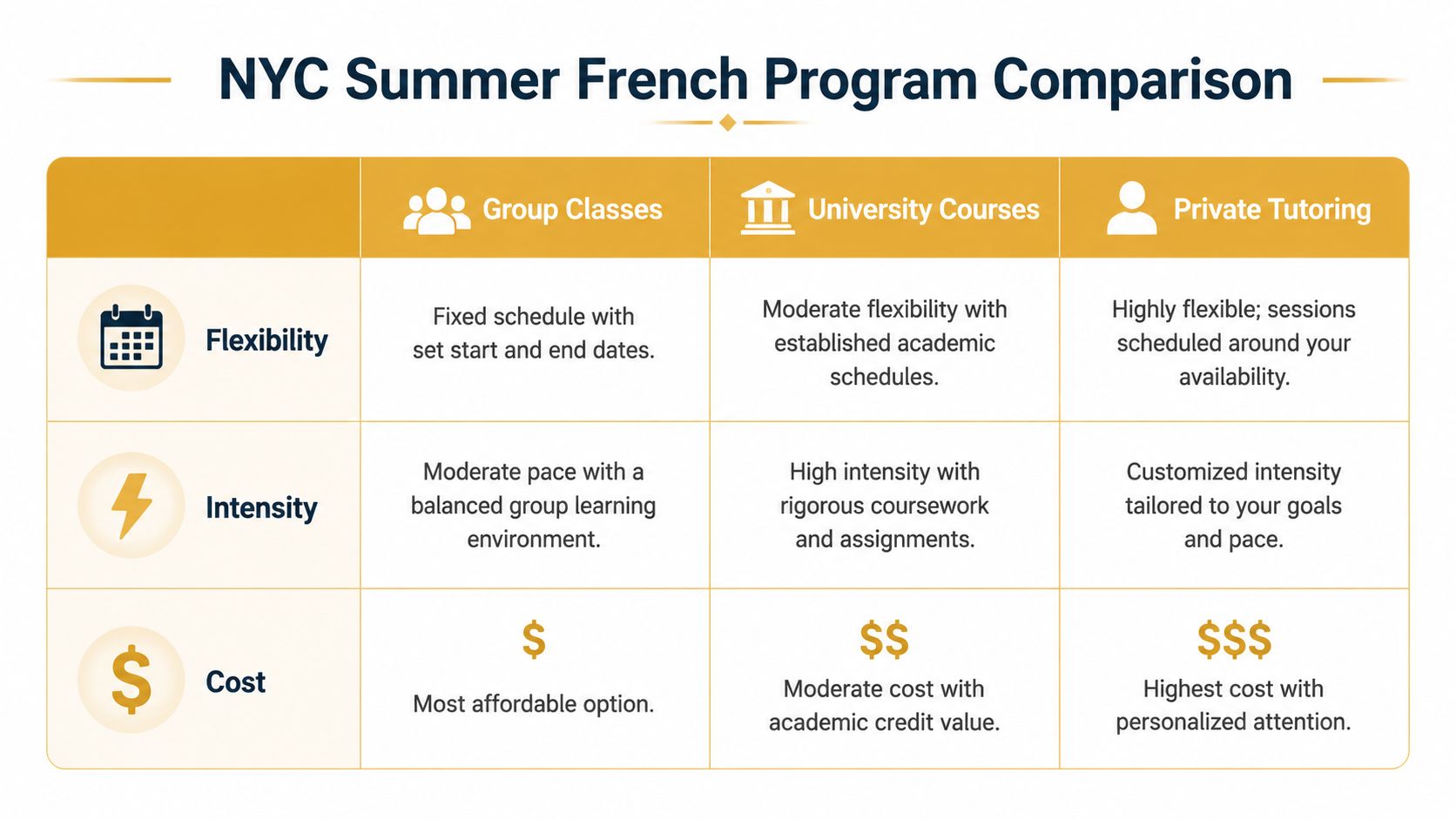
Comparing Summer French Program Types in NYC
| Criteria | Group Intensive (e.g., L'Alliance) | University Course (e.g., Fordham) | Private Tutoring (e.g., Elite French Tutoring) |
|---|---|---|---|
| Ideal for | Adults who want level placement, routine, and a classroom cohort | Students who want academic structure and are comfortable with institutional pacing | Adults, families, and professionals with a specific outcome in mind |
| Pace and intensity | Moderate to high, depending on session design | Fast, with a course calendar you do not control | Flexible. Light review or high-frequency intensive work |
| Schedule flexibility | Limited | Low | High |
| Estimated cost | Mid-range | Tuition-based and often expensive for the hours you actually need | Highest per hour, but the work is tightly targeted |
| Typical summer outcome | General progress across speaking, listening, reading, and writing | Strong course completion within an academic framework | Progress tied to one goal, such as conversation, school support, relocation, or DELF prep |
My blunt take on the trade-offs
Group intensives work well for adults who want consistency and can keep the school's schedule. They usually do not work as well for serious learners who need more speaking time, more correction, or exam-focused preparation. NYC still does not offer enough adult-focused summer intensives built around those needs.
University courses make sense if you like deadlines, syllabi, and formal progression. I recommend them to students who want academic accountability, not to busy professionals trying to squeeze French into an unstable summer calendar.
Private tutoring is the best use of money when the goal is specific and time matters. Exam prep is the clearest example. Group classes in New York often claim broad proficiency gains, but official exam preparation in a standard summer group format is much harder to find than people expect. If you need DELF, TEF, or targeted speaking work by late summer, a personalized plan is usually the smarter choice.
What to do if you fit more than one column
Some students need both structure and customization. The fix is simple. Use a class for routine, then add one-on-one sessions to cover the gap the class will not cover.
If you are still sorting through formats, this guide to the best French classes in New York City for 2026 gives a useful broader view of the local options.
Choose based on outcome, not branding. Your summer program should match your calendar, your urgency, and the kind of feedback you need.
How to Evaluate a French Program Beyond the Brochure
You sign up in June because the website promises conversation, small groups, and fast progress. By mid July, you are spending half the class waiting for other students to answer basic questions, and no one can tell you how this course gets you from your current level to your actual goal. I see this all the time in NYC.
A brochure shows you how a program wants to be perceived. Evaluation begins with what the program is designed to achieve. In this market, that matters even more because significant gaps are obvious once you know where to look. Adult-focused summer intensives are still limited. Official exam prep inside standard group classes is even harder to find. If your goal is specific, you need to test whether the program can deliver that result, not just fill a classroom.

Look closely at the curriculum
I start with the lesson design. Good programs build around real language use. Students read, listen, speak, write, and respond in French with a clear progression from week to week. Weak programs hide behind vague promises like “immersive” or “interactive” while relying on scattered drills and light conversation.
Ask to see the syllabus, not the marketing copy. I want to know what happens in week one, how correction works, how speaking is structured, and whether the course is built for adults with real goals or for a mixed group of casual learners. If the answer is fuzzy, assume the class will be too.
I also separate general enrichment from outcome-based study. Travel French, business communication, school support, and DELF or TEF preparation require different tasks, different pacing, and different feedback. In NYC, plenty of summer programs blur those categories. That is one reason I often steer serious learners toward a customized plan instead of a standard group.
Ask better questions before you enroll
Use an info call or trial class to get specifics:
- Who makes the best progress in this class. Ask for a real student profile, not “everyone.”
- How much speaking time does each student get per session. General claims about conversation are useless.
- How are errors corrected. Immediate correction, delayed notes, and written feedback produce very different results.
- What happens if one student is much stronger or weaker than the group. A serious program has a clear process.
- Is there any built-in support for exams or goal-specific work. If not, decide whether you are comfortable adding private sessions.
If you want a concrete example of what goal-based planning looks like, read this French tutoring success story in NYC. It shows the difference between taking “a French class” and following a program designed around a deadline.
The room matters more than people think
Teacher quality matters. Group composition can matter just as much.
A class full of motivated adults with similar pace and expectations can move fast. A class split between social learners, vacation planners, and one student chasing a certification deadline usually stalls. No teacher can fully solve that mismatch in a short summer term.
I pay close attention to energy, seriousness, and fit. If you need disciplined progress, choose the room where everyone came for that reason. If that room does not exist, do not force the group-class format. Get targeted help and protect your summer hours.
Ask one blunt question before you enroll. Do you want enrichment, or do you want measurable progress by August? In New York's summer French market, that answer usually tells you whether a class is enough.
A Real Student Story From Zero to Exam Ready
One student I worked with, whom I'll call Anna, came to me after trying to solve the wrong problem with the wrong class.
She worked in finance and needed French for a possible move abroad. At first, she enrolled in a standard group course because it seemed efficient and social. The class itself wasn't bad. It just wasn't built around certification, timed speaking, or the kind of written production she'd eventually be judged on.
Why the group route failed her
Anna's issue wasn't motivation. It was fit.
She needed targeted DELF preparation. The local summer market often misses that completely. Many NYC summer offerings don't explicitly build in DELF or DALF preparation, even though those credentials matter to professionals and school families, and that gap is one reason private tutoring becomes the practical route for strategic prep, as noted in LFNY's summer activities page discussing the broader summer landscape.
In plain English, she was spending time on general French when she needed exam French.
What changed when the plan became specific
Once she shifted to a personalized plan, everything got cleaner. Her sessions focused on the exam tasks that mattered most to her. We worked on speaking under pressure, organized writing, listening discipline, and the kind of corrections that generic classes often can't give every student.
Just as important, her schedule stopped fighting the program. She wasn't trying to bend a workweek around a fixed class built for a mixed group.
One reason families and professionals choose this route is that it can be shaped around a real target. Services such as French tutoring success stories in NYC show what happens when the curriculum is built around the learner instead of the other way around.
General classes help when your goal is general. They stall when your goal is specific.
By the end of the summer, Anna wasn't “fluent.” That's not how serious language progress works. But she was organized, exam-ready, and much more confident in exactly the situations that mattered to her.
Your Enrollment Checklist for a Successful Summer
A smart enrollment decision doesn't require endless research. It requires a short, honest checklist.

Start with your real goal
Don't say, “I want to improve my French.” That's too vague to guide a purchase.
Pick one primary outcome:
- Travel and conversation if you want to speak comfortably and understand everyday exchanges.
- Academic support if you need school alignment or a stronger start before fall.
- Professional French if your use case involves meetings, relocation, clients, or diplomacy.
- Exam prep if DELF or DALF is the actual target.
Then narrow the field fast
Once the goal is clear, run this filter:
- Assess your current proficiency level. Beginner, false beginner, intermediate, and advanced need different pacing.
- Map your actual summer availability. Don't shop for an intensive if your calendar can't support one.
- Set a realistic budget. Cheap classes get expensive when they don't move you toward the right outcome.
- Shortlist only two or three options. Too many choices delays action.
- Book a trial class or consultation. You'll learn more in one direct conversation than in an hour of browsing.
My final recommendation
If you're choosing between a group course and a more personalized option, don't ask which is “better.” Ask which one makes it easiest for you to stay consistent and reach the goal you care about this summer.
For families, professionals, and adult learners who want help sorting that out, Elite French Tutoring offers private in-person and online lessons that start with a free 20-minute consultation to assess your level, objectives, and learning style, then build the plan around that information.
If you're still comparing summer french classes nyc and want a clearer fit before enrolling, booking a consultation or trial lesson is the most efficient next step. It turns a vague search into an actual plan.
Frequently Asked Questions About NYC French Classes
How much should I expect to pay for summer French classes in NYC
It depends entirely on format. Group classes usually spread the cost across multiple students. University courses follow tuition-based pricing. Private tutoring is usually the most expensive per hour, but it's also the most targeted. I tell clients to judge value by relevance, not sticker shock.
Can I really become fluent in one summer
Usually, no. You can make meaningful progress in one summer, especially with consistency and a strong format, but fluency is too broad and too individual to promise on a short timeline. A better question is what specific situations you want to handle better by August.
What is the difference between a trial class and a free consultation
A trial class lets you experience the teacher or group environment directly. A consultation is a planning conversation. Good consultations help identify your level, goals, and best-fit format before instruction starts. They solve different problems.
Is online or in-person better for learning French
Neither is automatically better. In-person is often helpful for learners who focus better with physical presence and local accountability. Online works extremely well for busy adults who need consistency and frequency. If online means you'll show up and practice, it's the better option.
Are summer programs in NYC good for adults
Some are. Many aren't designed primarily for adults, especially in summer when youth camps dominate search results. That's why adult learners need to read descriptions carefully and avoid assuming every French listing is meant for their needs.
What's the best option if I need DELF or DALF prep
Choose a program that explicitly works toward the exam. If the course description stays general and never mentions exam tasks, don't assume it will somehow become exam prep once you're enrolled. That's where many students lose valuable time.