

If you're reading this with a stack of DELF B1 books open, a few saved YouTube videos, and no real idea how to turn that into a passing result, you're in the right place. Most candidates don't fail because they're “bad at French.” They struggle because their preparation is scattered, too passive, or heavily tilted toward the skills they already like.
I've seen the same pattern for years in DELF B1 preparation. Students spend weeks reviewing grammar tables, avoid timed work, and leave speaking until the end because it feels uncomfortable. Then the exam exposes exactly that imbalance. The fix isn't studying harder. It's studying in the right order, with the right pressure, and getting feedback where self-study usually breaks down.
Table of Contents
- Decoding the DELF B1 What Success Really Looks Like
- Your Actionable 3-Month DELF B1 Study Plan
- Mastering Each Section of the Exam
- Self-Study vs Tutoring for Your DELF B1 Preparation
- Avoiding the Most Common DELF B1 Pitfalls
Decoding the DELF B1 What Success Really Looks Like
Many learners treat the exam like four separate tests. That's a mistake. DELF B1 is really asking one bigger question. Can you function as an independent user of French across the situations this level expects?
The exam is made up of four equally weighted parts: listening, reading, writing, and speaking. Each section is scored out of 25, for a total of 100, and you need at least 50/100 overall while also getting at least 5/25 in every section to pass, as outlined by Alliance Française's DELF B1 exam overview. That single rule changes how smart preparation works.
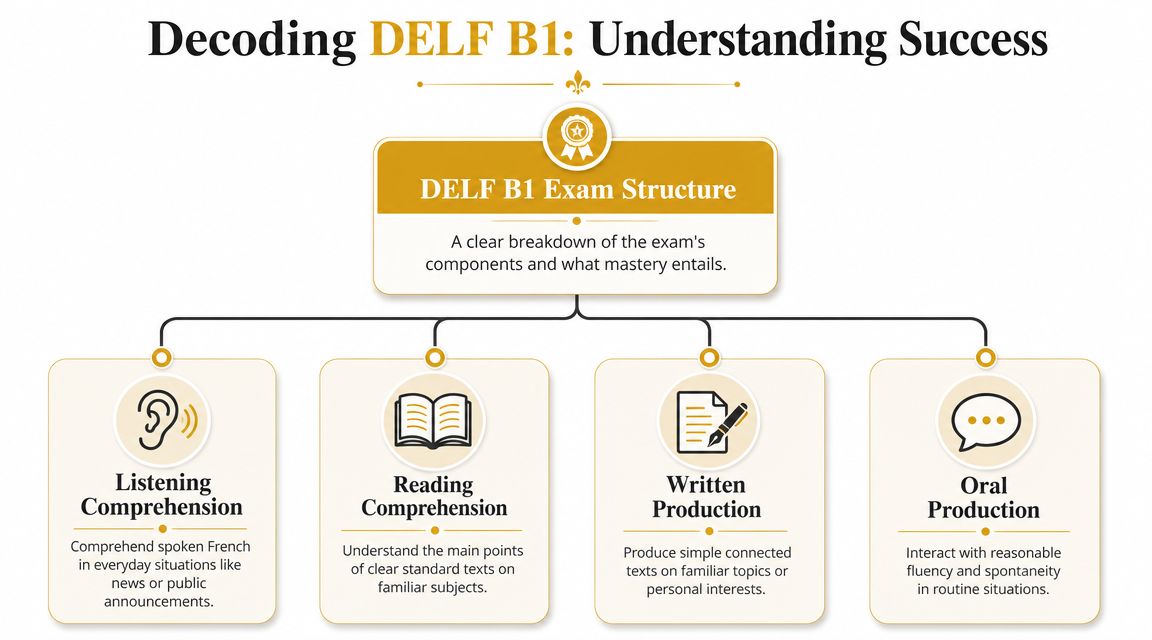
Why the scoring rule matters so much
A lot of students assume a strong reading score will rescue weak speaking, or that polished grammar can compensate for shaky listening. It doesn't work that way. The exam punishes neglect.
Practical rule: Build your DELF B1 preparation around your weakest section first, not your favorite one.
That doesn't mean equal time every single week forever. It means honest diagnosis. If your speaking freezes under pressure, or your writing loses structure, those aren't side issues. They're pass-or-fail issues.
What B1 success looks like in practice
At this level, examiners aren't looking for elegant academic French. They want clear communication. You need to understand the main idea, respond on topic, organize your thoughts, and keep going when your French isn't perfect.
That changes how you should study. Passive exposure helps, but it's not enough. You need task-based practice that matches the exam: short listening decisions, quick reading extraction, connected writing, and spoken interaction that sounds natural rather than memorized.
A strong candidate at B1 usually does these things well:
- Stays understandable: Even with mistakes, the message is clear.
- Responds to the task: No drifting into a memorized paragraph that doesn't match the prompt.
- Shows control under pressure: The timing and structure hold together.
- Avoids collapse in one skill: That's where many borderline candidates lose the diploma.
If you're unsure how your current level maps onto B1 expectations, this guide to mastering French language proficiency CEFR levels helps put the exam in the right context.
Your Actionable 3-Month DELF B1 Study Plan
A three-month plan works well when you're already near the level and need structure, not miracles. A practical DELF B1 preparation timeline often falls around 2 to 4 months for learners already close to B1, while someone coming from a rusty A2 level may need roughly 6 to 9 months of consistent work at about 8 to 12 hours per week, according to this DELF B1 preparation timeline.
That matters because many learners pick the wrong plan for their starting point. If you're already functioning around B1, three months can be excellent. If you're still rebuilding basics, stretching the timeline is smarter than forcing a rushed schedule.
Start with the visual roadmap.
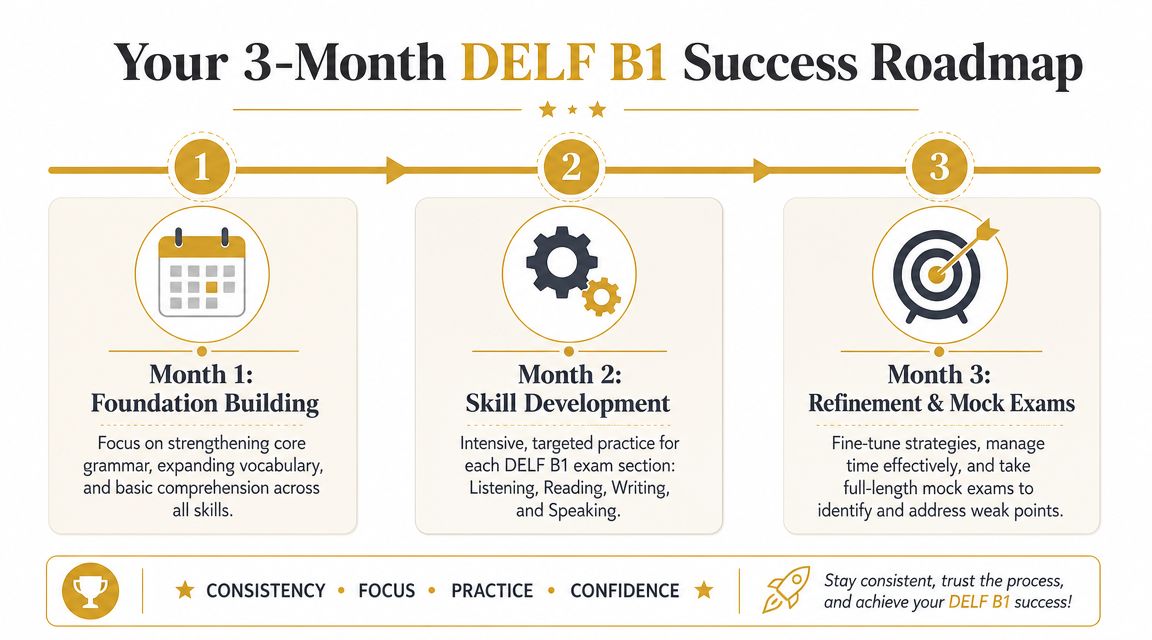
Month one foundation before speed
The first month should feel steady, not dramatic. You're shoring up the structures and vocabulary that appear repeatedly in B1 tasks.
Focus on:
- Core grammar in use: Review forms you need in writing and speaking, especially contrasts, narration, common opinion structures, and everyday sentence linking.
- Topic vocabulary: Build word banks around work, studies, travel, health, technology, environment, and daily life.
- Short production every week: One short writing task and several short spoken responses beat occasional marathon sessions.
I usually tell students to stop measuring progress by how much they “covered.” Measure it by what you can now produce without notes.
A useful support here is a structured French study plan that helps turn broad goals into weekly tasks.
A quick visual explanation can help if you're still organizing your calendar:
Month two targeted section work
Preparation now becomes exam-specific. Each week should touch all four skills, but not in the same way.
Try a rotation like this:
- Listening days: Do focused audio tasks and review why answers were right or wrong.
- Reading days: Practice speed, gist, and information-finding.
- Writing days: Produce complete responses with correction and rewriting.
- Speaking days: Work on interaction, follow-up questions, and staying coherent without a script.
The students who improve fastest in month two aren't always the strongest linguistically. They're the ones who review mistakes aggressively instead of just doing more exercises.
Month three simulation and repair
Month three is where many candidates finally start doing what they should have done earlier. Timed work. Full sections. Pressure. Self-correction.
This month should include:
- Regular timed practice
- Error logs by section
- Speaking drills with interruption and follow-up
- Rewrite work after correction, not just before
- A final narrowing of weak spots
Don't keep adding new materials at this stage. Use fewer resources more thoroughly. One corrected writing task teaches more than five unchecked ones. One speaking session with real feedback is worth far more than repeating memorized oral templates alone at your desk.
Mastering Each Section of the Exam
Technique matters. The exam isn't won by “knowing French” in the abstract. It's won by recognizing what each section rewards and training that exact behavior.

What to do for listening
Listening at B1 punishes perfectionism. If you try to catch every word, you'll miss the structure of the audio and lose the answer that matters.
Train yourself to listen in layers:
- First pass for situation: Who is speaking, where, and why?
- Second pass for answerable detail: Dates, choices, intentions, opinions, contrasts.
- Afterward for patterns: Which distractors fooled you and why?
What works:
- Reading the questions first
- Predicting the kind of information you need
- Noting key words, not full sentences
- Reviewing wrong answers carefully
What doesn't:
- Replaying the same easy clip again and again
- Using only slow learner audio
- Translating mentally while listening
If listening is a weak point, use authentic sources alongside exam practice. A lot of students plateau because they only hear textbook French. You also need real rhythm, real speed, and varied speakers.
How to approach reading under pressure
Reading is usually more controllable than listening, but time pressure causes preventable mistakes. Strong candidates don't read every line with the same intensity. They change speed depending on the task.
A useful order is:
- Look at the prompt or questions first.
- Skim the text for topic, tone, and structure.
- Scan for the information tied to each question.
- Return only to the lines that matter.
This section often improves when students stop panicking about unknown words. At B1, one unfamiliar term rarely destroys the whole meaning. But losing the thread because of that word absolutely can.
Use connector words as road signs. They often reveal whether the writer is adding, opposing, explaining, or concluding. That gives you meaning faster than vocabulary hunting.
How to make writing score better
Writing is where overthinking shows up most clearly. Some learners try to write above their level. Others write something understandable but disorganized. Both problems are fixable.
For most B1 writing tasks, stick to a simple skeleton:
- Opening that addresses the prompt directly
- Two or three clear idea blocks
- Connectors that show sequence or contrast
- Closing sentence that wraps the task cleanly
Your goal is controlled clarity. Short, correct sentences beat ambitious ones that collapse midway.
I also recommend building a reusable toolkit:
- opinion phrases
- contrast phrases
- example phrases
- polite openings and closings
- narrative markers for sequence
A focused vocabulary system helps here. This resource on how to improve French vocabulary is useful if your writing feels repetitive or too basic.
Write once for the exam. Rewrite once for progress. The second version is where the learning happens.
One more practical point. Corrected writing must be rewritten. Reading a teacher's markings and nodding isn't enough. If you don't produce the corrected version yourself, the same errors usually return.
Why speaking needs a different kind of practice
This is the section many learners underestimate. A frequently underserved angle in DELF B1 preparation is interaction quality, not just grammar or memorized monologues. Independent exam guidance emphasizes that candidates need to stay on topic and answer spontaneously in a structured way, as noted in Kwiziq's DELF B1 speaking tips.
That means speaking practice must include unpredictability. If your preparation is only solo monologues, you're not training for the hardest part of the oral.
What strong speaking practice includes:
- Role-play: Not just “say your opinion,” but negotiate, respond, clarify, and react.
- Reformulation: Say the same idea another way when you get stuck.
- Follow-up questions: Train your ear to answer what was asked.
- Time pressure: Practice short prep time, then speak.
What weak speaking practice looks like:
- Memorizing a polished speech about your hobbies
- Repeating set phrases with no real exchange
- Practicing only with yourself
- Avoiding interruption
If you're doing this alone, record yourself and then force a second attempt without notes. Better yet, work with someone who can push back, ask for clarification, and expose the gaps between “prepared French” and responsive French.
One good middle path is hybrid prep. Brown's DELF resource page reflects how learners now mix official samples, online materials, and self-paced tools instead of relying only on classroom study. You can see that shift in these Brown DELF preparation resources. In practice, that means self-study can cover a lot. But speaking still improves fastest when another person challenges your answers in real time.
Self-Study vs Tutoring for Your DELF B1 Preparation
Some learners absolutely can prepare alone. Others lose months because they don't notice what they're reinforcing. The core question isn't which option is morally better. It's which one gets you exam-ready with the least wasted effort.
Here's the trade-off in plain terms.
| Feature | Self-Study (Books & Apps) | Personalized Tutoring (Elite French Tutoring) |
|---|---|---|
| Structure | You build the plan yourself | The plan is adjusted around your current level and exam goals |
| Feedback | Delayed, limited, or absent | Immediate correction, especially in writing and speaking |
| Speaking practice | Often solo or inconsistent | Interactive practice with follow-up questions and correction |
| Efficiency | Can work well for disciplined learners | Better for learners who need targeting and accountability |
| Error detection | You may miss recurring mistakes | A tutor spots patterns quickly |
| Flexibility | High, but easy to drift | High if sessions are scheduled around work or school |
| Best fit | Independent learners with strong self-correction habits | Learners who want direction, feedback, and faster adjustment |
A lot of people begin with self-study and then add tutoring later. That's often sensible. Use books, official samples, and audio tools for regular exposure. Bring in professional help when you hit the predictable bottlenecks: speaking interaction, writing correction, pacing, and exam strategy.
One student I worked with had been sitting around the same level for a long time. He could read decently and knew plenty of grammar terms, but his spoken French stalled the moment someone asked an unexpected follow-up. His writing had the same problem. He had ideas, but no structure under time pressure.
What changed things wasn't “more French.” It was sharper practice. We used short oral role-plays, rewritten writing tasks, and section-specific correction. Once he stopped rehearsing perfect answers and started training responsive ones, his performance became much more stable.
If you're weighing whether added support would save time or money in the long run, this breakdown of whether a French tutor is worth the investment is a practical next read. One option in this space is Elite French Tutoring, which offers customized DELF and DALF preparation as part of its private French tutoring programs.
Avoiding the Most Common DELF B1 Pitfalls
The biggest mistakes in DELF B1 preparation are rarely mysterious. They're habits. Students avoid timed work, overinvest in passive exposure, and keep studying in ways that feel productive but don't resemble the exam.
The first trap is poor pacing. A practical benchmark for DELF-style preparation is to complete at least five to ten full timed practice tests in the three months before the exam, because that trains recognition of question types, pacing, and section timing, according to this DELF practice test guidance from italki. If you haven't trained your timing, you haven't really trained for the exam.
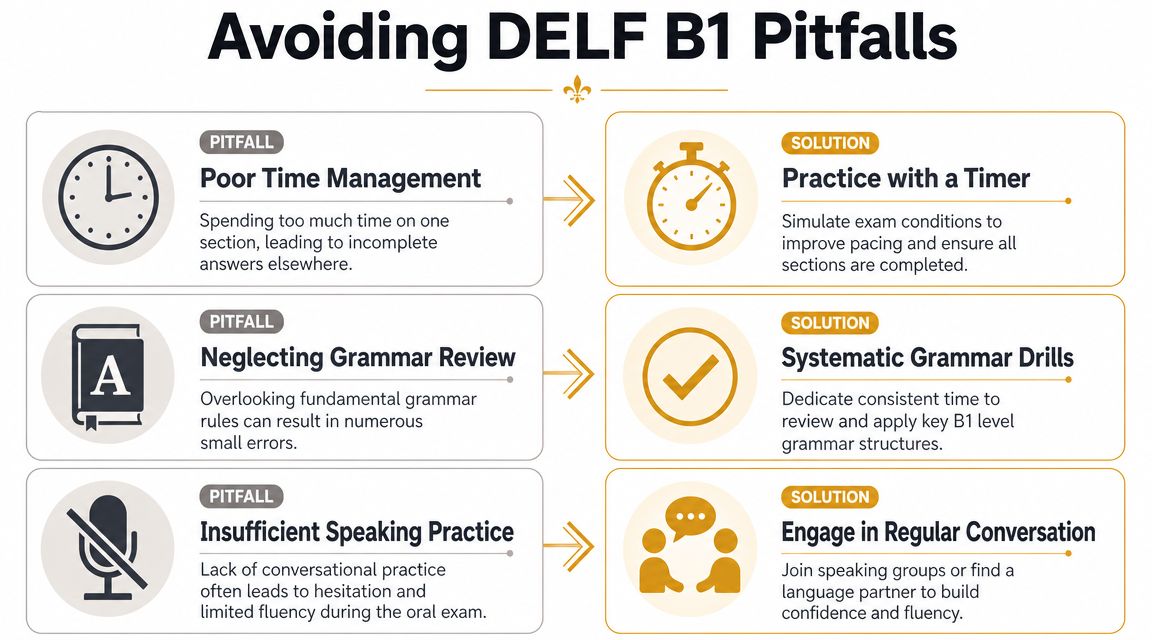
The habits that quietly hurt scores
Here are the patterns I would stop first:
- Passive-only study: Watching videos and listening casually can help, but not if you never answer questions, summarize, speak back, or write.
- One-skill comfort zones: Some students live in reading because it feels safe. The exam doesn't reward that imbalance.
- No review loop: Doing exercise after exercise without analyzing mistakes gives the illusion of progress.
- Memorized speaking: Examiners can hear when an answer doesn't match the exchange.
If your preparation doesn't include correction, timing, and interaction, it's not exam training yet.
Better replacements for those habits
Use these instead:
- Timed section drills: Not every day, but regularly enough that pacing becomes familiar.
- Active correction logs: Keep recurring errors in one place.
- Recorded speaking retries: Answer once, listen back, then answer again more clearly.
- Targeted support when stuck: Especially for writing and oral interaction.
A calm exam day usually comes from having faced the pressure in advance. That's why the strongest candidates don't just “study French.” They rehearse performance.
If you want to turn this plan into a personalized DELF B1 preparation program, a good next step is to compare lesson options or book a consultation with a tutor who can diagnose your weak sections, build a realistic study schedule, and run live speaking practice under exam conditions.