

You're staring at two French programs that both claim to be “beginner friendly,” and they look nothing alike once you ask how the lessons run. One school talks about conversation, another talks about grammar, and a third gives you a schedule that sounds polished but says almost nothing about pacing, feedback, or level placement. That's where most families, adults, and executives get stuck: they're not really choosing a class, they're guessing at the structure behind it.
A strong French class structure isn't just a calendar. It's the logic behind how a lesson is built, how levels are placed, how practice is paced, and how a tutor decides when to push, slow down, or change course. In French, that matters because the system itself can be rigid in some settings and highly customized in others, from the old Ancien Régime class divisions that shaped society before 1789 to the modern emphasis on education, occupation, and inherited advantage in today's society (World History on the Three Estates, HAL research on changing class identity).
For learners, the confusion usually comes from mixing up age, school grade, language level, and exam target. A child's French primary class follows a formal age band, from CP through CM2 (French primary school structure), while a language learner's real progression should follow CEFR levels from A1 to C2 (CEFR overview). Those are different systems, and if a program blurs them, you'll feel it in the results.
Table of Contents
What a French Class Actually Looks Like
The first thing parents and adult learners usually want is simple, what happens after they pay? A real lesson is rarely a vague “conversation session.” It's a structured block of time, often 45 to 90 minutes, led by a native or expert instructor, delivered one-on-one or in a small group, with a clear purpose for every segment.
The lesson has a job, not just a topic
A well-run class starts by activating what the learner already knows, then adds new material, then gives guided practice before asking for freer speech or writing. That sequence sounds obvious, but many packaged programs skip a step and call it immersion. The result is either too much talking too soon or too much explanation with no real production.
Practical rule: if a program can't tell you what changes from the beginning of the lesson to the end, it probably doesn't have a true structure.
That's why two classes at the same advertised level can feel wildly different. One may be built around a textbook chapter, another around a placement goal, and another around a child's schoolwork or an executive's relocation needs. The label on the brochure doesn't tell you whether the teacher is pacing for accuracy, fluency, or test readiness.
What readers usually misunderstand
Most learners assume a French class is mainly about content. In practice, the structure matters more than the topic. A good tutor makes small decisions about review, correction, and production time that shape whether a student moves forward.
That's also why class structure becomes a buying decision, not just a teaching style. If you're comparing programs, ask how much of the lesson is devoted to guided work versus open output, and how the teacher decides when to move a student ahead. The answer tells you more than a slick description ever will.
By the end, you should be able to look at any French program and tell whether it's built for progress or just built to fill a calendar.
CEFR Levels and DELF DALF Placement
For French language learning, the clearest structure is CEFR, the six-level scale from A1 to C2. It gives a lesson series a target, so “I want to improve my French” becomes a placement question instead of a vague wish. A class built for A2 learners should not feel like a class for B1 learners, even if the students are the same age or share the same school setting.
A placement decision only works if the level is named clearly. That is why a tutor who uses a clear CEFR guide for French proficiency levels can map the next step without guessing. The label matters because it shapes pacing, correction, and the kind of output a learner is ready for.
Why level beats age
French school age bands are fixed, but language learning is not. A 10-year-old in CP follows a formal primary-school progression (French primary school structure), while a 10-year-old learning French as a second language may be anywhere from starter level to advanced beginner. Age tells you where a child sits in school. It does not tell you what that child can do in French.
That is why effective tutoring has to be level-based, not age-based, whenever the goal is language growth rather than school enrollment. A teenager who can already manage routine exchanges needs different material from a younger child who is still learning basic sentence patterns. The same is true for adults. An executive preparing for relocation may need a faster route through speaking tasks, while another learner at the same age may need slower work on listening and accuracy.
The CEFR hour bands published in the overview are approximate, but they are useful for planning. A1 is listed at roughly 80 to 100 hours, A2 at 100 to 120 hours, B1 at 150 to 180 hours, B2 at 180 to 200 hours, C1 at 200 to 250 hours, and C2 at 250+ hours (CEFR overview with hour bands). Those ranges do not replace assessment, but they do help set realistic expectations for pacing and prevent a course from moving too fast or stalling for too long.
CEFR Levels Hours and Exam Alignment
| CEFR Level | Estimated Hours | DELF or DALF Exam | Learner Can |
|---|---|---|---|
| A1 | 80 to 100 | DELF A1 | Handle simple greetings, personal details, and very familiar needs |
| A2 | 100 to 120 | DELF A2 | Manage everyday exchanges and short, routine tasks |
| B1 | 150 to 180 | DELF B1 | Handle travel, daily life, and straightforward opinions |
| B2 | 180 to 200 | DELF B2 | Participate in extended discussion and more independent work |
| C1 | 200 to 250 | DALF C1 | Function in complex academic or professional settings |
| C2 | 250+ | DALF C2 | Operate with near-native command in demanding contexts |
A useful French program does more than promise “progress.” It places the learner, chooses the next target, and checks whether speaking, listening, reading, and writing are advancing together. If a course says “intermediate” but cannot say whether that means B1 or B2, the label is not helping anyone make a sensible placement decision.
For a deeper placement framework, I also point readers to this CEFR guide for French proficiency levels, because clear level naming prevents a lot of wasted time.
Anatomy of a Single French Lesson
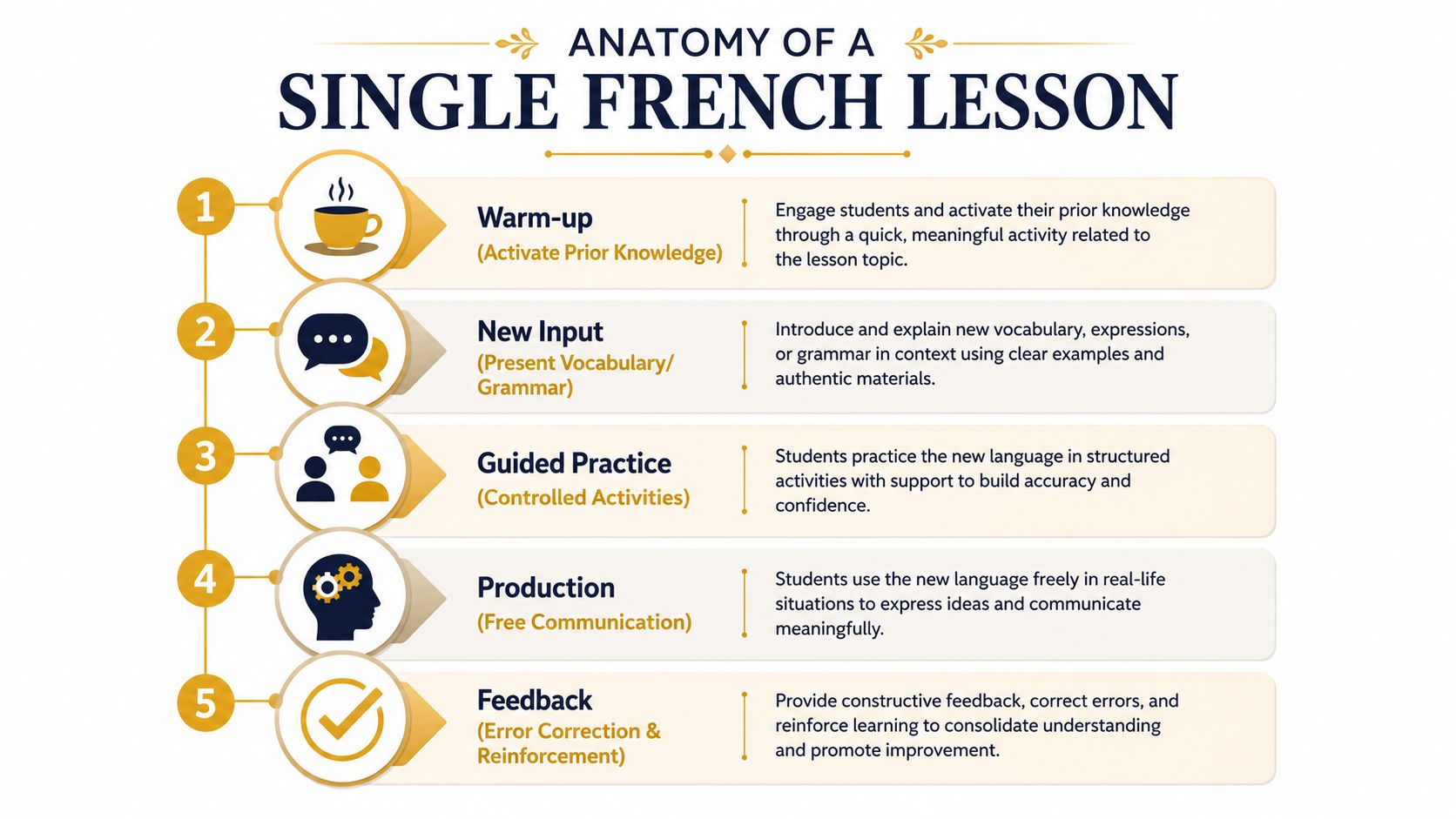
A strong lesson usually has five moving parts, and each one earns its place. When one part gets squeezed out, the lesson may still feel busy, but learning slows down.
The five parts that matter
A warm-up activates prior knowledge. A new input stage introduces vocabulary, grammar, or a model text. Guided practice lets the learner use it with support. Production asks for freer communication. Feedback corrects mistakes and locks in what the learner should do next time.
In my experience, the fastest way to weaken a lesson is to let production consume the correction time. Learners enjoy the speaking, but they don't always improve from it unless the feedback closes the loop.
Here's how that might look in a B1 conversation class. The teacher might begin with a short recap of a previous topic, then introduce a new set of expressions for discussing work or travel, then run a controlled dialogue with prompts, then move into open discussion, and finally correct recurring errors. The point isn't to cram every possible activity into sixty minutes. The point is to allocate time so each stage feeds the next.
Common structural mistakes
The biggest errors are easy to spot. Some lessons skip the warm-up and force learners into speaking cold. Others overload the input stage and leave almost no time for practice. Some teachers give lots of encouragement but little correction, which feels pleasant in the moment and frustrating a month later.
If you're comparing tutors, ask how they handle correction. A useful answer sounds specific, not sentimental. You want to hear about when corrections happen, what gets corrected immediately, and what gets saved for end-of-lesson review.
For a related teaching framework, this methodology page from Elite French Tutoring shows how lesson design and feedback style can be aligned without turning class into a lecture.
Sample Syllabi for K 12 Adults Corporate and DELF Prep
Different learners need different structures, and the best tutors don't pretend otherwise. A child at a bilingual school, a traveler learning survival French, a corporate professional preparing for meetings, and a DELF candidate all need distinct pacing, material choices, and assessment rhythms.
Four common structures side by side
| Learner Profile | Weekly Frequency | Lesson Length | Primary Focus |
|---|---|---|---|
| K 12 student | Regular weekly support, sometimes more during school stress points | Usually shorter, with attention to attention span and homework load | School alignment, literacy, and class vocabulary |
| Adult conversation learner | Steady weekly rhythm | Often longer than child lessons, with space for discussion | Speaking confidence, travel needs, everyday interaction |
| Corporate professional | Predictable weekly cadence, sometimes intensive before a trip or presentation | Often efficient and focused | Meetings, industry language, emails, and presentation language |
| DELF prep learner | Consistent weekly work with targeted review blocks | Long enough for timed practice and correction | Exam tasks, timed production, and level-specific skills |
A K 12 student usually needs the lesson to match school rhythm, not just language goals. An adult conversation learner often benefits from more open practice and real-life scenarios. A corporate client needs vocabulary that maps to job tasks, while a DELF candidate needs the lesson to resemble the exam format closely enough that timing and task type feel familiar.
One sign of a serious program is that it can explain the syllabus without sounding identical for everyone. If every learner gets the same weekly plan, the tutor is selling convenience, not personalization.
For DELF B1 learners, this preparation page is a useful reference point for what targeted exam support can look like when pacing is tied to the certificate, not to a generic “intermediate” label.
The structural difference isn't cosmetic. A child may need more repetition and lighter output, while an executive may need faster topic shifts and more correction on professional phrasing. If the syllabus doesn't change with the learner, the learner ends up adapting to the syllabus instead of the other way around.
Online vs In-Person French Classes
The right format depends on the learner's goal, not on fashion. Online and in-person French classes can both work well, but they don't solve the same problems equally.
What the format changes
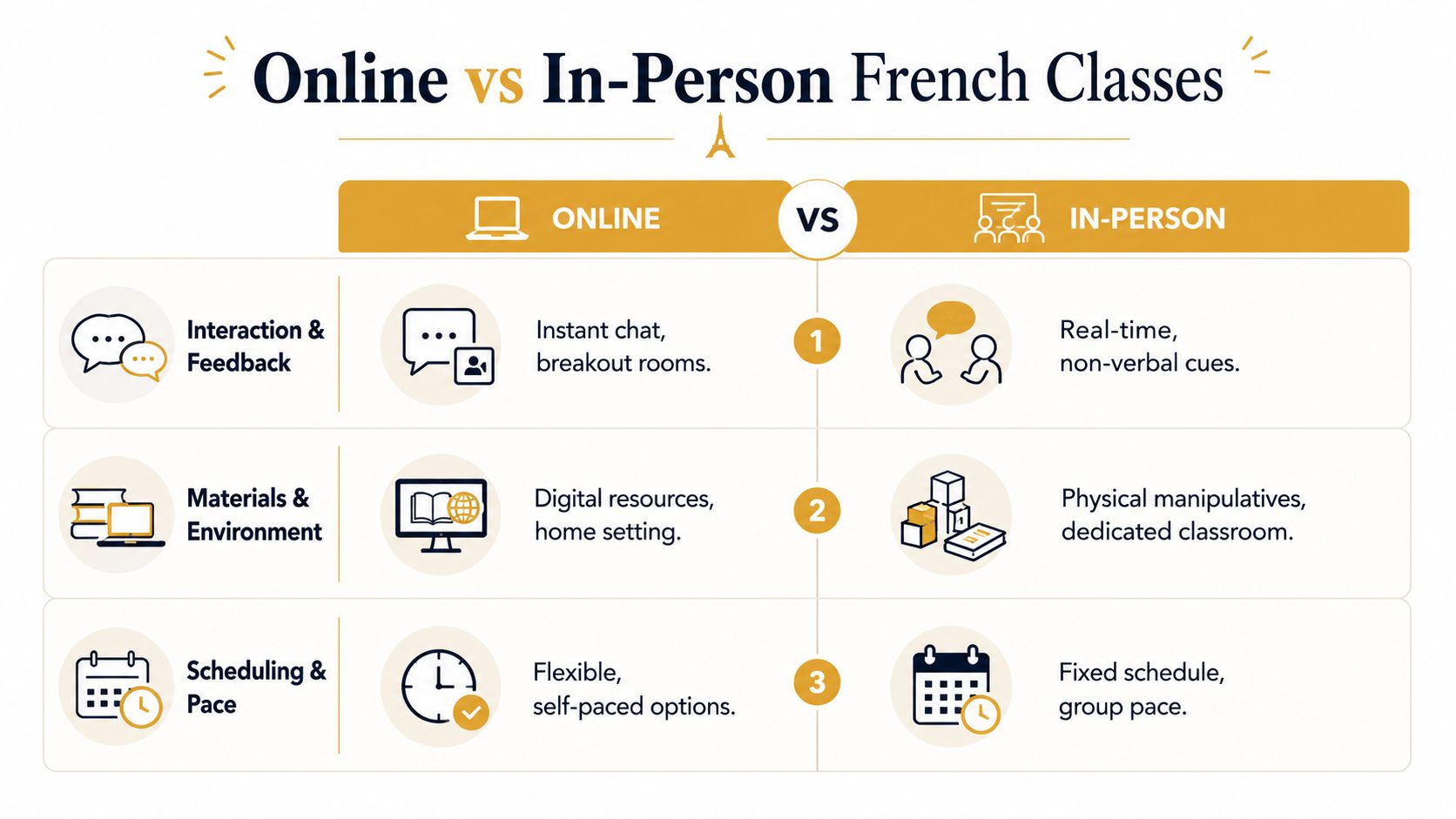
Online classes give you more scheduling flexibility and easier access to a wider range of instructors. They're often strong for adults, professionals, and learners who need consistent access from outside a single city. In-person classes can make pronunciation work, visual cues, and classroom energy easier to manage, especially when a learner benefits from immediate face-to-face correction.
The trade-off is structural. Online lessons often rely on digital resources and breakout-style interaction, while in-person lessons can use physical materials and a dedicated classroom environment. Neither is automatically better, but each one supports different kinds of practice.
A hybrid model can be useful when a learner wants both flexibility and direct feedback. Elite French Tutoring offers private French classes in person and online, which is one way to match format to need instead of forcing every student into the same setup.
Where each format tends to fit
Online can fit well when the learner needs flexible scheduling, lives far from a strong French-speaking area, or wants regular one-on-one work without commuting.
In-person can fit well when the learner benefits from non-verbal cues, a dedicated study space, or a more immersive live interaction.
Either format can work if the lesson structure is strong, but neither format can rescue weak pacing or poor placement.
The YouTube overview below is helpful if you want a visual sense of how format affects interaction and pacing.
For a direct service comparison, these online French class options show how format and structure can be matched to a learner's schedule and goal.
How We Personalize a French Program
A senior executive relocating to Paris didn't need a generic “business French” course. He needed a structure that would help him lead meetings, handle introductions, and adjust quickly when his first draft phrasing sounded too rigid for the room. That's the kind of case where a fixed syllabus usually wastes time.
What changed after the first consultation
The program began with level placement and a clear relocation goal. Weekly lessons were then built around the language he would use first, not around a textbook sequence. Early sessions focused on professional introductions, then moved into practical meeting language, then into the kinds of small corrections that make speech sound natural instead of translated.
The structure changed again once his priorities shifted. When he became more comfortable with basic exchanges, the lessons moved toward more spontaneous discussion and more precise correction on tone, clarity, and register. That's the point many packaged programs miss, a learner doesn't stay at one need level for the whole course.
Good customization isn't endless improvisation. It's a planned syllabus that changes when the learner's next bottleneck changes.
The consultation process matters because it forces a tutor to choose. If someone says they can teach everyone the same way, they're usually hiding the core decision, which is what to leave out. A customized program admits that not every skill can be prioritized at once.
For clients who want that kind of tailoring, I've seen structured private tutoring work especially well when the lesson plan is allowed to shift after the first few sessions. It keeps the pacing honest and the goals visible.
How to Evaluate or Customize Any French Class Structure

You don't need to be a French teacher to spot a solid program. You just need to ask the right questions and listen for concrete answers.
Five questions worth asking
How do you place the learner? A good answer mentions a conversation, sample work, or a level check. A weak answer jumps straight to enrollment.
What does a typical lesson look like? Look for a real sequence, not a vague promise about “interactive learning.”
How do you correct mistakes? Strong programs explain timing, not just encouragement.
How often do you assess progress? Good tutors can name a review rhythm, a milestone, or a check-in process.
Can the structure change if the learner's goal changes? If the answer is no, the syllabus is probably too rigid.
A good consultation should leave you with a sense of fit, not just a schedule. You should know whether the teacher understands your level, your target, and your pacing needs. If you're comparing options, ask each program the same five questions and compare the specificity of the answers.
If you want a warm, low-pressure starting point, a free 20-minute consultation can be a useful way to compare one structure against another before committing. It's often the fastest way to tell whether you're buying a real learning plan or just a seat in a class.
Frequently Asked Questions About French Class Structure
How often should I meet for French lessons
Most learners do better with a regular weekly rhythm than with random bursts of study. Consistency matters more than cramming, especially when the class is designed around speaking and correction.
When should I switch levels
Switch when the current work feels easy but accurate, not when it merely feels familiar. If the learner can handle the current tasks without much strain and the feedback is getting repetitive, the class may be too slow.
What materials should a good program provide
A serious program should provide clear lesson notes, correction feedback, and materials matched to the learner's goal. Children may also need school-aligned support, while adults may need topic-based material for travel, work, or exams.
How long does DELF prep usually take
It depends on the starting level and the target exam. The CEFR hour bands give a practical sense of how much work different levels require, and a good tutor should connect those bands to the learner's current ability rather than promising a shortcut.
What if my program feels too generic
Ask whether the placement, pacing, and correction style can be adjusted. If the answer is vague, you're probably looking at a packaged course rather than a real French class structure.
If you're comparing French programs right now, book a free 20-minute consultation with Elite French Tutoring and bring your level, your goal, and your schedule. I'd also encourage you to compare that call against any other option you're considering, because the right structure should feel precise before you ever pay for the first lesson.