

You're staring at two tabs, one says DELF B2, the other says TCF, and the question isn't which exam sounds more impressive, it's which one won't waste your time when an admissions office, prefecture, or employer asks for proof. I've seen this mistake derail good candidates more than once, they study hard, choose the wrong format, then discover the certificate they earned doesn't fit the procedure they need. In french language certification, the winning move is almost always the one that matches your outcome first, exam brand second.
What changed in 2026 is the pressure around the outcome itself. France's official rules now tie language proof much more tightly to administrative thresholds, with different procedures requiring A2, B1, or B2 depending on the route, and with some certificates carrying time limits that can force a retake if you wait too long. If you're planning study, residence, work, or citizenship, treat this like a decision with a deadline, not a language hobby.
Table of Contents
Why Picking the Right Certification Matters in 2026
A university applicant I worked with last year submitted DELF B2 because it felt safer than a timed test. A few weeks later, that same candidate learned the program wanted a recent score report for its internal file. That is the mistake, you can be fluent enough and still end up holding the wrong document for the office in front of you.
The mistake most candidates make
Candidates often start with the wrong question. They ask, “Which exam is hardest?” The better question is, “Which document will the authority accept, and how long will it remain valid?” For DELF and DALF, the answer is clear, they are lifetime diplomas issued under the French Ministry of Education, and that permanence matters when you are building a long-term academic or professional file.
For TCF and TEF, the logic is different. These are score-based tests, and some official uses require a recent certificate, so timing matters as much as competence. France's official nationality guidance says a qualifying test certificate can need to be less than 2 years old for certain applications, including the rules cited for French nationality files in the government guidance on service-public.
A recent score can matter more than a stronger memory of French.
Why 2026 raises the stakes
The 2026 framework is stricter for people on residence and citizenship tracks. The route now points clearly to A2 for multi-year residence permits, B1 for permanent residence, and B2 for naturalization, with recognized proof coming from exams such as TEF, TCF, or DELF as summarized in the 2026 guidance. That makes your exam choice a compliance decision, not just a study decision.
If your goal is university admission, residence, citizenship, or professional registration, choose the certification that matches the document requirement first. If you need a proof that stays usable for years, a lifetime diploma is the safer move. If you need a score for a file that expects recent evidence, a timed test fits better.
For anyone comparing levels before booking an exam, Elite French Tutoring's CEFR guide gives a clean way to map the target to the test. Use that mapping before you register, because retesting after a certificate expires is avoidable trouble.
Practical rule: choose the certification by the document your destination asks for, not by the exam name your friends recognize.
How the CEFR Scale Anchors Every French Exam
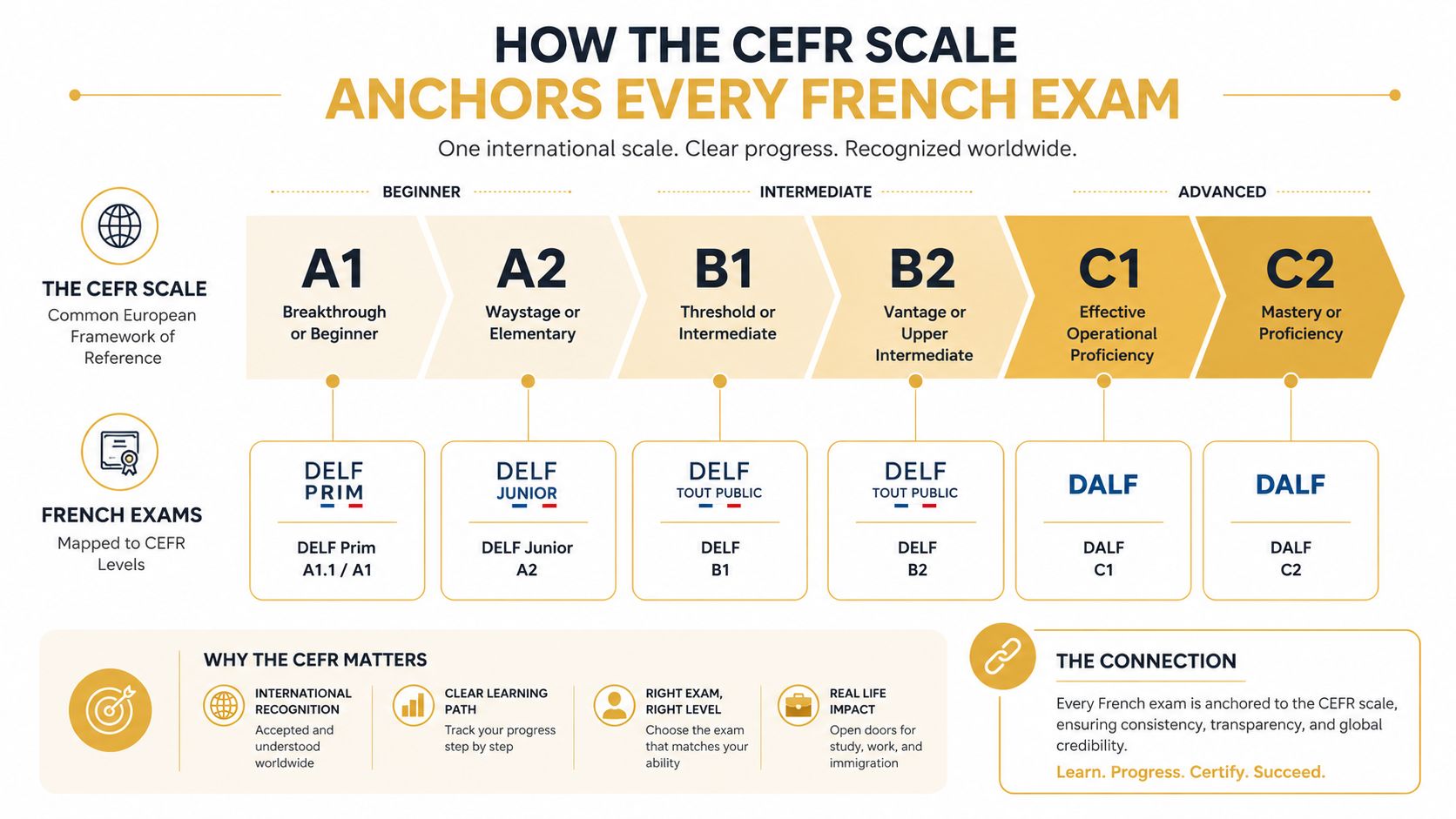
The CEFR, or Common European Framework of Reference for Languages, is the shared yardstick behind almost every serious French exam. Think of it as a six-rung ladder, starting at A1 and rising to C2. Once you understand that ladder, the exam names stop looking mysterious.
Read the ladder before you read the brochure
The levels are not decorative labels. They tell universities, employers, and immigration offices what kind of French a candidate can use in real life. The CEFR structure is the backbone of the system, and the official diplomas are built around it, with DELF covering A1 through B2 and DALF covering C1 and C2 as described by CIA France.
That structure also explains why some people feel confident in conversation but still miss a target level. Reading and listening can lag behind writing and speaking, or the reverse. A test that reports one overall level can hide that imbalance, while a section-based score report shows exactly where the gap is.
What the scale means in practice
Use the ladder to decode any exam listing:
A1 and A2 mean basic survival French, enough for simple tasks and everyday exchange.
B1 and B2 mean more independent use, with stronger control of arguments, explanations, and routine professional needs.
C1 and C2 signal advanced command, the kind institutions expect when they need confident academic or professional French.
That's why a candidate aiming for a permit or a university place should never skip the level requirement and jump straight into exam branding. The CEFR level tells you what the office wants.
If you want a deeper breakdown of the level logic, I'd point you to this clear reference on CEFR French level mastery, then compare it against the procedure you're targeting.
DELF and DALF Lifetime Diplomas Explained
DELF and DALF belong to the same credential family, and I advise students to think of them that way from the start. DELF covers A1 to B2, while DALF covers C1 and C2. Together, they make up the core official diploma track for people who want a durable French qualification.
The versions that actually matter
The family is broader than many assume. There are audience-specific versions for children, adolescents, adults, and professional settings, including DELF Prim, DELF Junior, DELF Scolaire, DELF tout public, DELF Pro, and DALF. That segmentation matters because a school-age student and a working adult do not need the same exam environment or vocabulary profile.
The other big advantage is permanence. Once earned, these diplomas are valid for life. That's a serious asset if you're building a file for future study or migration, because you don't have to worry about renewal cycles the way you do with many timed proficiency tests.
DELF and DALF variants at a glance
| Diploma | CEFR Level | Audience | Best For |
|---|---|---|---|
| DELF Prim | A1 to A2 | Younger children | Early school learners who need a first official diploma |
| DELF Junior | A1 to B2 | Adolescents | Secondary students building a long-term academic profile |
| DELF Scolaire | A1 to B2 | School-age learners in a school setting | Curriculum-linked certification |
| DELF tout public | A1 to B2 | Adults | University, work, or immigration preparation |
| DELF Pro | A1 to B2 | Workplace candidates | Professional French for job contexts |
| DALF | C1 to C2 | Advanced learners | Academic, professional, or high-level administrative goals |
Who should choose this family
If you need a document that won't expire, DELF and DALF are the cleanest choice. That's especially true if your goal is long-term academic mobility or professional credibility. Their standardized design and official recognition make them easy to explain to admissions teams and HR departments.
For exam prep support, I'd look at DELF and DALF preparation options if your target is one of these lifetime diplomas. If you're still unsure whether you need B2 or C1, that's the point where a placement conversation saves time.
TCF and TEF Score-Based Tests Compared
TCF and TEF work differently from DELF and DALF in one decisive way, they are time-limited, score-based tests. That makes them the right choice when an authority wants recent proof, not a lifetime diploma. It also means timing matters. If you sit the exam too early or let the certificate sit unused, you can end up having to test again.
How they differ on the page
The TCF relies on multiple-choice sections. The TEF also uses multiple choice, but it adds written production, so it combines screening with a more direct performance component. In both cases, you do not receive a pass-or-fail diploma in the DELF sense. You receive a score report by skill, which is useful when a procedure wants more precise evidence.
That skill-by-skill reporting can help, but it can also create problems. A candidate may be strong in reading and weaker in writing, then discover that the target procedure gives more weight to the weaker skill. I do not recommend these tests casually. I recommend them only when the administrative rule points directly to a recent score report.
Why the date on the certificate matters
For French nationality applications, the official guidance requires recent proof, so the certificate has to be current at the time of filing, as noted by according to service-public. That is why you plan backward from the filing date, not from how confident you feel today.
A recent certificate beats a strong certificate that has already expired for your file.
The choice is straightforward. Use DELF/DALF if you want permanence. Use TCF/TEF if the procedure asks for recent proof and you can schedule the exam close to submission. If your timeline is tight, the date on the document can matter more than the score itself.
Matching Each Certification to Your Real Goal
The guesswork ends here. If you're choosing a french language certification for a real administrative or career outcome, start with the destination, then match the document to it. The wrong pairing is how smart candidates end up retesting under pressure.

The goal decides the exam
Here's the clearest way to consider it:
University admission: many programs ask for B2, and some higher-level programs may want C1. In practice, DELF B2 or DALF C1 is often the safest long-term academic route because the diploma doesn't expire.
Multi-year residence permit: the current framework points to A2.
Ten-year residence permit: the level to target is B1.
Naturalization: the official baseline is B2, and the government guidance also requires oral and written French at least at that level as stated on service-public.
Professional mobility or sector-specific roles: the required level can be B1 or higher, depending on the field and employer.
The 2026 shift matters because these thresholds are now much more obviously tied to procedure, not just language pride. If your goal is residence, don't overshoot and then ignore validity. If your goal is university, don't settle for a lower level just because it feels achievable sooner.
My recommendation by use case
For students, I usually steer them toward DELF B2 unless their target institution clearly prefers a recent score report. For citizenship, I lean toward the exam route that stays valid long enough to match filing timing, then I watch the certificate date carefully. For residence and permit renewals, I focus on the exact level rule first and worry about exam brand second.
The commercial opportunity here is obvious, but so is the risk. One exam choice can fit multiple goals, yet it can also fail if the validity window or target level is wrong. That's why I tell clients to choose by procedure, not by prestige.
Exam Format, Registration, and Scoring in Practice
The exam room matters less than most candidates think, but the logistics matter more. You're usually dealing with listening, reading, writing, and speaking, and you need to know whether the exam reports one diploma, one score, or separate skill results before you register. That choice shapes your prep plan, your scheduling, and your stress level.
What registration looks like
Most candidates register through an Alliance Française or another approved testing center. In Ireland, the French government lists six training and examination centers, including Alliance Française of Cork, Dublin, Limerick, Waterford-Wexford, Kilkenny, and the French Institute in Galway on the official Irish network page. That's a good reminder that access is real, but it's still local and organized, not casual.
For many learners, the registration step is where the timetable becomes real. You pick the center, confirm the date, and then train backward from that booking. If you're choosing TCF or TEF, the clock matters because the resulting certificate may need to stay fresh for the target procedure. If you're choosing DELF or DALF, the date matters less for validity and more for readiness.
How scoring usually works
In structured exam prep, candidates often aim for a threshold around 50 out of 100 per skill when a test reports per-section performance, though the exact benchmark depends on the specific exam and use case. The important point is not the number itself, it's the fact that an uneven profile can hold you back even when your overall French feels solid.
Practical rule: don't book until you know which skill is weakest. That's the section most likely to decide your result.
If you want help mapping your current level to an exam window, I'd use a placement conversation before paying for a registration slot. A good starting point is a French placement test discussion, especially if you're deciding between B1 and B2. The point is to remove guesswork before the calendar starts working against you.
A Student Story From B1 to DALF C1 in Twelve Months
She came to us with a solid B1 and a very specific problem, she needed DALF C1 for a professional path connected to international work, and she had already failed once on the writing side. Her spoken French was fine, which is exactly why she was frustrated. At C1, that's not enough, because the exam rewards the ability to synthesize dense texts and build a structured argument under pressure.
We rebuilt her prep around the tasks that mattered most. Reading moved from general comprehension to timed extraction of ideas, and writing shifted toward essays with clear thesis, evidence, and transitions. I pushed her hard on feedback revision, because at C1 you don't pass by sounding intelligent, you pass by showing control.
The result wasn't instant, and I wouldn't present it that way. She passed on her second attempt after eight months of focused work, and the difference came from targeted correction, not brute-force studying. Her speaking improved too, but the major jump happened when she stopped translating ideas in her head and started organizing them in French.
If you want a parallel example of how structured prep changes outcomes, you can read about how DELF online prep supported another learner's progress. The lesson is simple, the higher the level, the more the exam rewards precision over charisma.
Your Prep Timeline and a Free Consultation Offer
If you're targeting A2, the CCFS framework gives you a useful benchmark of about 90 to 100 hours in a structured path as shown by CCFS-Sorbonne. For B1, the same reference points to roughly 350 to 400 hours. For B2, it moves to about 500 to 600 hours. Those are not casual estimates, they're the kind of numbers that should shape your weekly calendar before you book anything.
What that means for your schedule
A smart plan starts with the level gap. If you're one step away, you can move quickly with focused work. If you're climbing from intermediate to advanced, you need a longer runway and more speaking, writing, and correction than people often expect.
My advice is blunt. Don't sign up for a certification date until your study load can support it. A rushed attempt costs more than a well-timed one, especially when a certificate must line up with a permit or application deadline.
If you want a personalized route, Elite French Tutoring offers private French lessons and French exam preparation with a free 20-minute consultation to map your current level, target certification, and timeline before you commit to a program. That's the next sensible step if you want to avoid the wrong exam, the wrong date, or the wrong level.
If you're deciding between DELF, DALF, TCF, or TEF, book your consultation now and we'll map the exact certification path that fits your university, residence, citizenship, or professional goal, so you can prepare with a timeline that works.