You can get through a dinner in French, keep a meeting moving, and even sound polished in a work email, then the conversation shifts to politics, a film, or a social issue and you stall. That gap is exactly where french advanced conversation becomes a different skill, because fluency at this level isn't just about vocabulary recall, it's about pace, nuance, register, and the ability to hold your ground without sounding scripted.
At Elite French Tutoring, I see the same pattern over and over. Strong learners don't usually fail because they lack French, they fail because they've never trained a repeatable speaking system that works under pressure.
Table of Contents
Beyond Greetings The Advanced Conversation Plateau
A lot of advanced learners describe the same frustrating moment. They can handle daily life in French, then a native speaker asks for a real opinion and their mind goes blank. The grammar is there, the words are there, but the response feels too slow, too safe, or too flat.
That's the advanced conversation plateau. It's the point where beginner and intermediate habits stop working, because the conversation is no longer about surviving, it's about participating with precision, speed, and social awareness.
Why this plateau feels so hard
At this stage, most learners do not need more random exposure. They need a way to organize ideas quickly, challenge a point politely, and shift tone depending on who's speaking. The problem isn't effort, it's that casual practice rarely forces the brain to build those higher-order habits.
Practical rule: if you can speak comfortably only when the topic stays light, you are not stuck in French, you are stuck in a narrow practice range.
This distinction matters because advanced French is not just everyday dialogue. It includes abstract and nuanced topics, idiomatic expression, complex grammatical structures, and the ability to persuade and debate effectively, as described in Talkpal's advanced conversation guide. In practical terms, the move from “good” to “fully fluent” is less about knowing more words and more about using them with control.
A structured approach also makes sense when you look at the learning curve. The CEFR benchmarks from CCFS Sorbonne place B2 around 500 to 600 hours of study, C1 around 700 to 800 hours, and C2 around 1,000 to 1,200 hours. That is a strong reminder that nuanced conversation usually does not come from casual chatting alone, it emerges from deliberate practice over time.
One pattern appears again and again in our work at Elite French Tutoring. Learners often have enough French to sound convincing in short exchanges, but not enough structure to stay clear under pressure. They can answer. They struggle to expand, qualify, and respond when the conversation shifts direction.
That is why advanced conversation needs a repeatable system, not just more conversation.
Why Your Current French Practice Is Not Enough
In my experience, learners at this stage rarely need another reminder to “practice more.” They need practice that forces a different kind of output. The habits that build basic fluency, app drills, casual language exchanges, memorized answers, often stop delivering real gains once you have to argue in real time and choose wording that fits the situation.

Three reasons advanced learners stall
First, unstructured practice does not force coherence. A friendly chat partner may correct a mistake here and there, but if the conversation keeps drifting back to easy ground, you never train the full shape of a high-level answer. You end up sounding fluent in fragments, not in sustained discussion.
Second, feedback is often too weak or too delayed. Apps can be useful for exposure, but they usually cannot tell you whether your argument landed, whether your register sounded too direct, or whether your transition felt clumsy. At advanced level, those choices matter as much as grammar accuracy.
Third, many learners stay in safe topics too long. They get comfortable talking about routine activities, but hesitate when the subject turns to politics, religion, money, migration, or professional hierarchy. That hesitation is understandable, and it usually means the practice set has not been calibrated to the social risk of real conversations.
Advanced French conversation sits at a different level of control, and that is why a structured approach matters. You are not just adding more words. You are learning to hold a position, develop it cleanly, and adapt when the other person pushes back.
The hidden issue is cultural risk. A guide from Polyglottist Language Academy points to the gap between avoiding sensitive subjects in theory and knowing when to move from small talk to deeper topics in real life. That gap is exactly why advanced learners need more than vocabulary lists.
If you want a practical list of the mistakes that keep strong learners from sounding natural, I have also laid out the most common ones on our page about common French mistakes that still appear at advanced level.
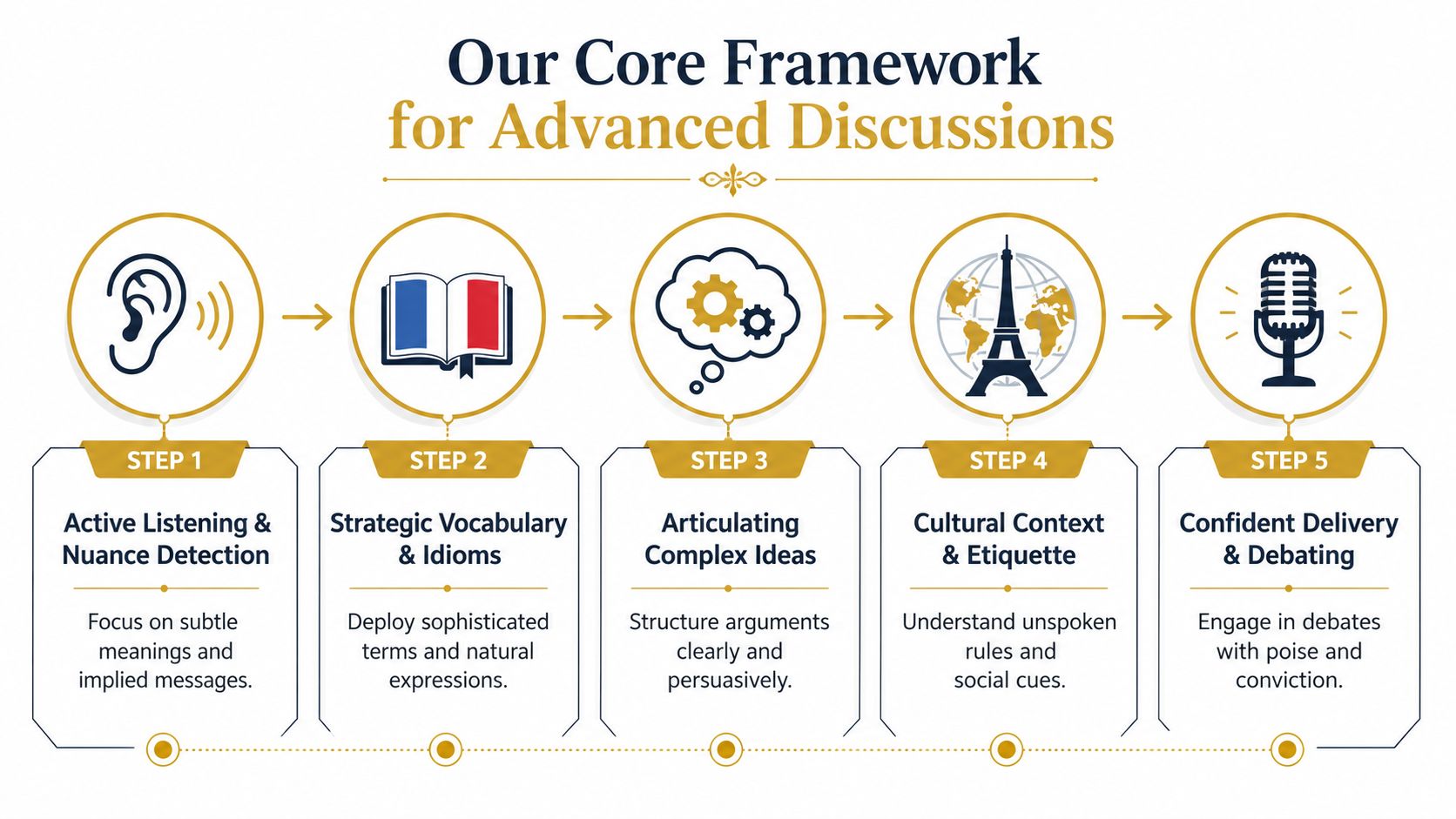
Our Core Framework for Advanced Discussions
The fastest way to improve advanced speaking is to stop treating conversation as improvisation only. In our tutoring sessions, we use a repeatable structure that helps students stay coherent when the topic gets complicated, the pace gets fast, or the other speaker pushes back.
Our core rule: don't try to sound brilliant first. Try to sound organized, then precise, then persuasive.
The framework itself is simple enough to remember, but powerful enough to hold up in a difficult exchange:
Position, evidence-backed reasons, counterargument with response, synthesis or call to action.
That structure mirrors the workflow described in PrepFrenchClass's advanced discussion method, which recommends a four-move approach, a four-line outline, at least three connectors, one reformulation, and one hedge. Those elements matter because advanced French isn't only about what you say, it's about how cleanly you connect ideas under pressure.
How we apply it in tutoring
We start with a clear position. That prevents rambling and gives the listener a reason to follow your point. In French, a direct opening also helps you sound more intentional from the first sentence.
Then we add two or three evidence-backed reasons. Not random facts, not filler, just reasons that support the position. At this stage, connectors like d'abord, ensuite, and en plus become functional, not decorative.
Next comes the counterargument. Skill in this area separates strong speakers from merely fluent ones. If you can anticipate the other side and answer it calmly, your French starts to sound adult, social, and persuasive.
Finally, you end with a synthesis. That may be a balanced conclusion, a recommendation, or a question that keeps the discussion open. The point is to finish cleanly instead of trailing off.
The sentence tools that keep you afloat
A practical speaking system also needs language tools. One reformulation helps you recover if your first wording feels too blunt. One hedge, such as a careful softening expression, keeps you accurate when you're not fully certain. Both are essential in real French conversation, where overstatement can sound careless.
I also expect students to build a short outline before they speak, even when they only have a minute. That tiny habit reduces panic and gives the brain something to hold on to when the discussion moves quickly.
If your grammar breaks down in these moments, the issue is often not “knowing the rule” but not being able to use it on demand. That's why we pair discussion work with targeted structure practice, including the French subjunctive, which you can see in our French subjunctive practice guide.
Choosing Your Practice Method Self Study vs Tutoring
The right practice method depends on what you're trying to buy with your time. If you want entertainment, apps can be enough. If you want social exposure, exchanges help. If you want reliable progress in nuanced speech, you need feedback that changes your habits, not just your mood.
Here's the honest comparison.
| Feature | Self-Study (Apps/AI) | Language Exchange | Professional Tutoring |
|---|---|---|---|
| Feedback quality | Limited, often surface-level | Variable, depends on partner | Direct, targeted, corrective |
| Topic control | High, but usually shallow | Moderate, often uneven | High, can be matched to goals |
| Cultural nuance | Usually weak | Mixed, depends on partner | Stronger, because the tutor can correct register and context |
| Accountability | Low unless you're unusually disciplined | Medium, schedules can drift | High, because sessions create routine |
| Speed of progress | Slow for advanced speaking | Uneven | Faster for serious learners |
| Best use case | Vocabulary refresh, solo review | Low-pressure practice | Business French, exams, relocation, advanced discussion |
What each option is good for
Self-study works best when you need flexibility and don't mind gaps in feedback. It's useful for reviewing forms, listening to level-appropriate audio, or drilling vocabulary, especially when you're studying between sessions.
Language exchange can be energizing, and it does expose you to real voices and real reactions. The downside is that you can't control the difficulty, the correction style, or the depth of the topic. Some conversations feel useful. Others drift into pleasant but unproductive chat.
Professional tutoring is different because it turns conversation into a managed skill. A skilled tutor can push you into harder subjects, correct your phrasing in the moment, and adjust the lesson when your register, logic, or pronunciation starts to slip.
If your goal is to speak with nuance in professional or high-stakes settings, the question isn't whether you can practice alone. It's whether alone practice is producing the exact habits you need.
That's also where a structured service can help. Elite French Tutoring offers customized private French lessons after an initial assessment, which makes it a practical option when the goal is advanced conversation rather than generic practice.
How to choose without overthinking it
Choose self-study if you mainly want low-cost exposure and can already speak comfortably.
Choose language exchange if you want social practice and don't mind inconsistent feedback.
Choose tutoring if you need correction, accountability, and conversations shaped around your goals.
For readers comparing lesson options, I also recommend looking at whether the program is worth the investment by checking the specific outcomes it targets, not just the format. Our overview on whether a French tutor is worth the investment is a useful decision aid if you're weighing cost against progress.
A Student's Journey to Conversational Mastery
Sarah came to us with strong French and a very specific problem. She was preparing for a diplomatic post in Geneva, and while her B2-level French worked fine in ordinary conversation, she froze when a discussion became political or strategic. She didn't need “more French” in the abstract, she needed French that could carry an argument.

We built her sessions around our discussion framework and focused on topics that forced both precision and tact. One of the most useful topics was the changing global center of French conversation, including the fact that OIF reporting in 2022 placed about 321 million French speakers worldwide and showed that 54.7% of daily French users lived in Africa. That topic pushed Sarah to practice both factual clarity and cultural sensitivity, which is exactly what diplomatic French demands.
The breakthrough came during a mock debate. She had to respond to a complex argument without sounding defensive, and for the first time she used a clean counterargument structure instead of circling the idea. She didn't just answer, she moved the discussion forward.
Later in the session, she gave a more balanced synthesis than she had ever produced in spontaneous speech. That was the moment she realized she wasn't waiting to be rescued by vocabulary anymore, she was steering the conversation herself.
If that kind of progress is what you need, a consultation can be the right first move. You can use the conversation to define your goals, assess your level, and decide whether a private program fits your schedule and speaking targets. For another example of how focused coaching can change a learner's trajectory, see how Emma moved from zero to fluent with structured lessons.
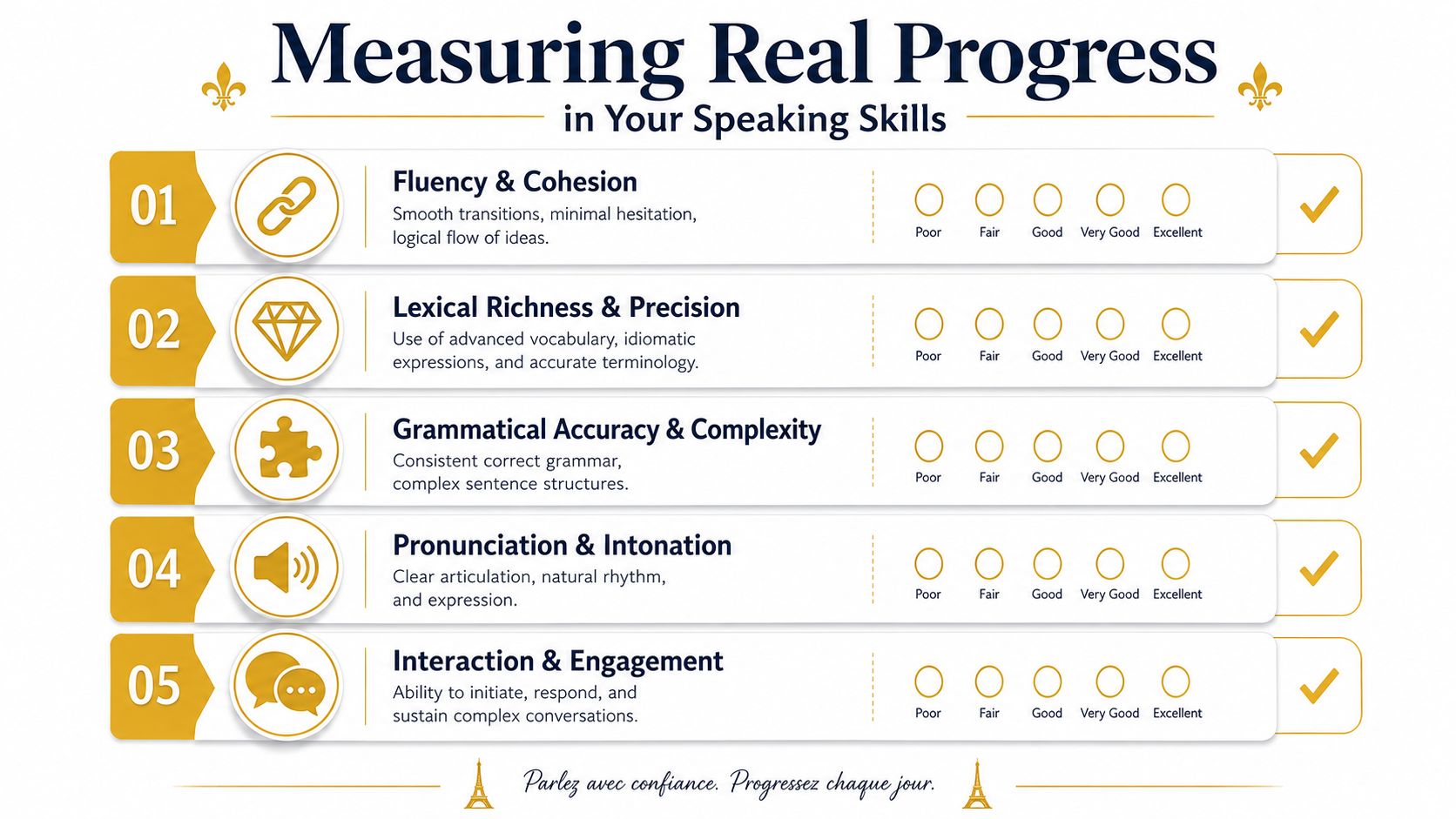
Measuring Real Progress in Your Speaking Skills
Confidence helps, but confidence without evidence can mislead you. The clearest way to know your speaking is improving is to watch what changes inside a real conversation, how easily ideas connect, how stable your grammar stays, and how naturally you respond when the topic gets more demanding.
Three ways to track improvement
Start with a one-minute challenge. Record yourself on one complex topic, then listen back for pauses, repetition, weak connectors, and missing counterarguments. If your answer sounds more organized the second time you attempt a similar prompt, that is real progress.
Track your use of advanced structures. I want students to notice whether they are using idiomatic expressions, reformulations, and grammatically demanding forms like the subjunctive under pressure, not just in drills. Advanced French conversation is about abstract topics, idioms, complex grammar, and debate, as described in Talkpal's guide to advanced French speaking.
Build a can-do list from real situations. Do not write vague goals like “speak better.” Write tasks such as handling a disagreement politely, responding to a counterpoint, or explaining a nuanced opinion on a cultural issue.
What progress looks like in practice
A useful sign of growth is that you start recovering faster. You may still search for a word, but you do not lose the thread of the argument. Your speech becomes less about survival and more about control.
Practical rule: if your answers are getting clearer, more balanced, and less dependent on memorized phrasing, you are moving in the right direction.
The strongest progress usually comes from consistent, guided work, because someone has to keep pushing you past the comfortable zone and correcting what you cannot hear in yourself. That is why advanced conversation improves fastest when the practice is structured and the feedback is specific.
If you are ready to compare options, book a private consultation and see whether a customized lesson plan would fit your French goals, your schedule, and the kind of conversations you need to win.