Skip to content
Trying to find the right French classes in Pittsburgh can feel like navigating the city's winding roads without a GPS. But the bigger problem isn't finding any class. It's figuring out which option fits your schedule, your budget, and the way you learn best. A university-style course can be great for structure and terrible for a busy parent. A casual conversation group can be welcoming and still leave you underprepared for an exam or workplace goal.
We've been there, and we've helped learners sort through the same decision. If you're comparing French classes Pittsburgh options, the smart move is to treat this like a buying decision, not a directory search. You need to know how each option teaches, what kind of commitment it expects, and where the hidden trade-offs show up.
This guide breaks down seven of the strongest options in the Pittsburgh area and beyond, including private tutoring, structured group classes, community-based conversation practice, and family-focused programs. I'm keeping the focus practical. Which option works for serious adults, which one suits kids, which one gives you structure, and which one helps if your schedule changes every week.
Table of Contents
- 1. Elite French Tutoring
- 2. Alliance Française de Pittsburgh & Western Pennsylvania
- 3. Community College of Allegheny County CCAC French Language & Culture
- 4. Carnegie Mellon University Open Learning Initiative OLI French
- 5. Carnegie Library of Pittsburgh French Language Culture & Conversation Learning Circle
- 6. Club Z! Tutoring of Pittsburgh French Tutoring
- 7. French Cultural Center of Pittsburgh Centre Francophone de Pittsburgh L'École du Samedi
- Pittsburgh French Classes, 7-Way Comparison
- Your Next Step to Speaking French in Pittsburgh
1. Elite French Tutoring
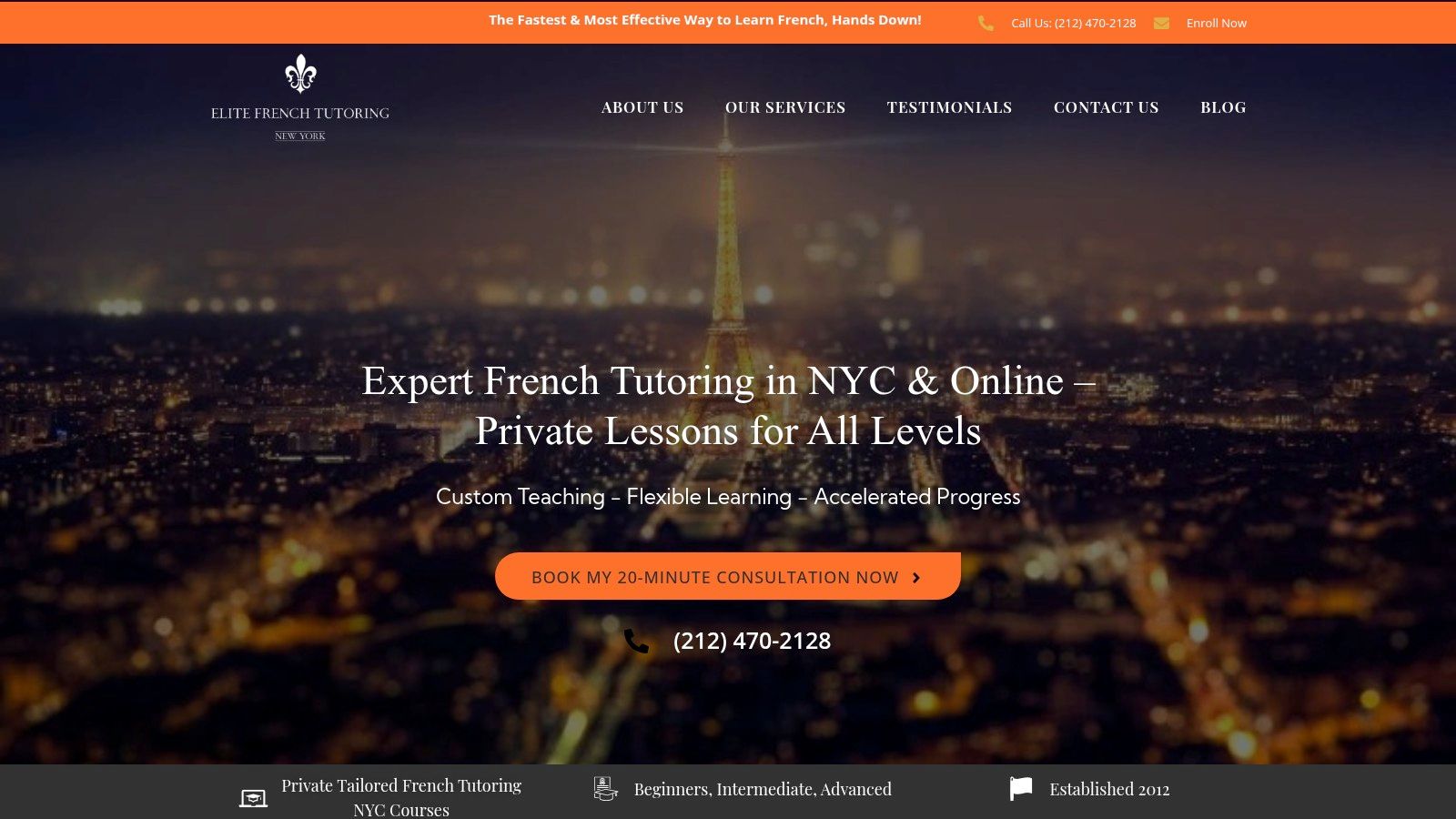
If you want the shortest path between “I understand some French” and “I can effectively use French,” this is the option I'd put first. Elite French Tutoring is built around private, customized instruction with native expert teachers, and that matters because most adults and most families don't fail from lack of motivation. They fail from getting dropped into a format that doesn't match their goals.
Elite French Tutoring has been operating since 2012 and has taught thousands of learners through private in-person work in New York, limited in-home options in Washington, D.C., and flexible online lessons for learners elsewhere. The range of programs is unusually strong: adult conversation, travel French, K to 12 support, corporate and professional French, and DELF/DALF exam prep. That last category is especially important for those seeking French classes Pittsburgh options with certification goals, because local public listings don't clearly advertise DELF/DALF coaching, which leaves a real gap for exam-focused students in the area, as shown on the Alliance Française de Pittsburgh course page.
Why I'd choose Elite French Tutoring
Every engagement starts with a free 20-minute consultation. That sounds small, but it solves one of the biggest buying mistakes students make. They choose a class before anyone has assessed their level, learning style, or actual use case.
The lessons are customized from day one, with immersive practice, clear corrective feedback, premium materials, and consistent scheduling. In practice, that means a professional preparing for relocation needs something very different from a middle-school student in a bilingual program, and the program is set up to handle both.
Practical rule: If your goal is specific, such as business communication, school support, or exam prep, private instruction usually beats a general group course.
A nice starting point for adults comparing tutors is this guide on how to find the perfect French tutor for adult learners.
Best fit and trade-offs
What works well:
- Customization first: Lessons are built around your level, goals, and pace.
- Strong credibility: The program highlights long-term student testimonials and clients that include executives, diplomats, academics, and public-sector professionals.
- Flexible delivery: Online lessons make this accessible even if you're based in Pittsburgh.
What doesn't work as well for every buyer:
- No published pricing: You need to contact the team for exact rates and package details.
- In-person geography is limited: Pittsburgh learners should expect online lessons rather than local in-home availability.
A prominent student success story that stands out involves Elite French Tutoring publicly highlighting long-term work with high-level professionals, including CEOs, Manhattan's District Attorney, UN mission staff, and Ivy League faculty. That's not a vanity detail. It shows the program can support learners whose stakes are high and whose time is tight, which is often the exact profile of adult students who need results instead of hobby-level exposure.
2. Alliance Française de Pittsburgh & Western Pennsylvania

Want a French class that gives you both instruction and a reason to keep showing up? Alliance Française de Pittsburgh & Western Pennsylvania is one of the strongest local options for that kind of learner. I recommend it most often to adults who know community helps them stay consistent. You are not only buying class time here. You are joining an organization built around French language and culture.
That matters more than many buyers expect. A good group course can teach grammar and conversation, but a local Alliance chapter also gives you access to events, cultural programming, and recurring contact with other learners. For some students, that social layer is what turns a short-lived interest into a habit. If your motivation is tied to travel, personal growth, or cultural connection, the broader case for why adults benefit from taking French classes beyond just language study applies especially well here.
Alliance Française also has a clearer structure than informal conversation groups. Classes are organized by level, and placement support helps returning learners avoid enrolling too high or too low. I see real value in that for adults who studied French years ago and want a sensible re-entry point without starting from scratch.
A concrete example helps with budgeting. Alliance Française de Pittsburgh has publicly listed a 10-session A1 beginner course at $375, with a fixed weekly meeting time, as referenced by AmazingTalker's published note on that course schedule. The organization also uses a membership model before class enrollment, so total cost is not just tuition. This positions Alliance Française differently from independent tutoring. The value comes from structured classes plus access to a local French-learning community.
The trade-off is flexibility.
If your calendar is stable, that is usually fine. If you travel often, work shifts, or need to reschedule frequently, fixed-term courses can feel restrictive fast. Seats can fill, start dates are set in advance, and the membership step adds one more decision before you begin.
For the right student, though, those limits are acceptable. Alliance Française is a strong buy for learners who want routine, level-based progression, and an in-person cultural anchor in Pittsburgh.
3. Community College of Allegheny County CCAC French Language & Culture
CCAC is the best pick in this list for learners who want an academic framework. If you learn well with a syllabus, assignments, and a clear sequence, Community College of Allegheny County is usually easier to stay consistent with than looser community options.
I like CCAC for buyers who want the discipline of college coursework without stepping into a four-year university environment. You get progression, accountability, and the possibility of transferable credits. Adult learners who need a transcript or who know they do better when someone sets deadlines often do well here.
Who gets the most value from CCAC
This isn't the choice I'd recommend for someone who only wants conversational confidence before a trip. It is a strong choice for a beginner who wants foundations done properly, or for a student who needs formal language study that can sit alongside other academic plans.
The main trade-off is the academic calendar. Add/drop deadlines, homework, and assessments aren't minor details. They shape the whole experience. That's helpful for committed learners and annoying for casual ones.
If you're starting from zero and want a stronger foundation before stepping into a college-style sequence, I'd pair your comparison with this article on French classes for beginners and how to stay motivated.
A practical buying note: CCAC sits in the middle ground between private tutoring and cultural organizations. It won't give you the same personalized lesson design as one-to-one tutoring, but it can offer more structure than community conversation groups. For the right student, that's exactly the sweet spot.
4. Carnegie Mellon University Open Learning Initiative OLI French
Carnegie Mellon's Open Learning Initiative French program is the best match for self-directed learners who still want live accountability. I think of it as a hybrid buy. More polished than a casual app-based routine, but more flexible than commuting to a weekly in-person class.
The design matters here. OLI uses interactive courseware with authentic multimedia and adds weekly live Zoom speaking practice. That combination works well for people who like to prepare on their own and then use live time efficiently for speaking.
What OLI does well
The strongest part of OLI is pacing. Cohort-based learning with weekly deadlines gives enough structure to prevent drift, but the online format still reduces travel friction. If your schedule is packed but predictable, that balance can work very well.
This is also one of the better fits for adults who value educational design and want material that feels intentionally built rather than assembled from generic worksheets. The certificate of completion adds a light credentialing element, which some students appreciate.
- Best for disciplined learners: You need to show up weekly and keep up with the modules.
- Less ideal for social learners: There are live sessions, but you won't get the same local in-person community feel as an organization based around events.
- Good for Pittsburgh residents who prefer remote options: You get a CMU-linked learning experience without needing a local classroom meetup.
For adults deciding whether formal French study is worth the commitment, this overview of why adults should consider taking French classes is a useful companion read.
5. Carnegie Library of Pittsburgh French Language Culture & Conversation Learning Circle
Carnegie Library of Pittsburgh is the option I'd hand to a nervous beginner who says, “I want to practice, but I don't want to feel tested.” Its French Language, Culture & Conversation Learning Circle is community-centered and lighter-pressure than college coursework or formal institutional programs.
That lower-pressure environment matters more than people think. Many adult learners don't need harder material. They need a place where speaking imperfectly feels normal. A facilitator-led conversation setting can remove enough pressure to help them finally use the language out loud.
Why this works for hesitant speakers
The learning circle format tends to work best for learners who need rhythm and accountability, but not grades. It also makes sense for budget-conscious students who want in-person contact without committing to premium private rates.
Some students don't need more grammar first. They need more chances to speak before fear hardens into avoidance.
This isn't a formal course, so I wouldn't choose it for transcript needs, exam prep, or a tightly sequenced curriculum. I would choose it for confidence-building, light accountability, and regular exposure.
A nice complement to this path is a curated set of French learning resources for independent practice. That combination often works well. Use the library circle for real interaction, then reinforce between meetings on your own.
6. Club Z! Tutoring of Pittsburgh French Tutoring
Club Z! Tutoring of Pittsburgh is a practical choice for families and students who need support tied to school performance. If your child is in French class already, struggling with homework, or heading toward AP French, this kind of tutoring model can be easier to justify than a broad conversation-based program.
The biggest strength is flexibility. In-home and online options make scheduling easier, and one-to-one tutoring is naturally better for course-specific support than a group class. That's especially true when a student has immediate academic needs rather than long-range language goals.
Best use cases for Club Z!
I'd put Club Z! high on the shortlist for these buyers:
- K to 12 families: The tutoring model maps well to school-year needs.
- Students with upcoming tests: Customized support is easier than fitting into a preset class syllabus.
- Adults with narrow goals: It can also work for college coursework help or targeted conversation practice.
There are exactly 11 French tutors currently listed and available for private lessons in Pittsburgh, PA on Care.com's Pittsburgh French tutor listings. That tells me the local one-to-one market isn't overflowing with options, which makes an organized tutoring provider more appealing for people who don't want to vet independent tutors on their own.
The downside is that tutoring providers like this usually don't deliver the same cultural ecosystem you get from Alliance Française. You come here for problem-solving and convenience, not for a francophone social scene.
7. French Cultural Center of Pittsburgh Centre Francophone de Pittsburgh L'École du Samedi
For families, this is one of the most distinctive options in the region. The French Cultural Center of Pittsburgh and its L'École du Samedi program give children a weekend space to build or maintain French outside the regular school week.
I like this path for households that care about continuity, identity, and community, not just language mechanics. Weekend programming can fit more naturally than weekday lessons for families juggling school, activities, and work.
Where this option shines
This is not an adult-first purchase. It's a family-first one. If you want your child around other francophone or francophile families, a community-based Saturday program can do something private lessons often can't. It creates routine, peer visibility, and a sense that French belongs in life, not just in homework.
The trade-off is scope. Adult offerings are limited, and the school-calendar rhythm won't suit everyone. But for parents trying to keep French alive over time, that regularity can be a strength rather than a constraint.
One buying distinction matters here. If your child needs immediate help with grades, a private tutor may solve the problem faster. If your family wants a longer cultural runway and weekend continuity, L'École du Samedi is usually the better fit.
Pittsburgh French Classes, 7-Way Comparison
| Program | Complexity 🔄 | Resources & Speed ⚡ | Expected outcomes ⭐ | Ideal use cases 💡 | Key advantages 📊 |
|---|---|---|---|---|---|
| Elite French Tutoring | Moderate–High, one‑to‑one onboarding and tailored lesson design | High resource intensity, native expert instructors; flexible online/in‑person; pricing by consultation | Rapid speaking confidence, DELF/DALF readiness, measurable accelerated progress | Busy professionals, private adult learners, targeted exam or corporate prep | Fully personalized native instruction; flexible delivery; strong testimonial‑based track record |
| Alliance Française of Pittsburgh & Western PA | Low–Moderate, term schedules and placement process | Moderate, local instructors, in‑person facilities; membership required | Steady CEFR‑aligned progress through structured courses | Learners seeking structured group classes plus cultural immersion | Community events, native/near‑native teachers, consistent term format |
| Community College of Allegheny County (CCAC) | Moderate, academic syllabus, assessments, fixed semester calendar | Low–Moderate cost; for‑credit option with transcripts and possible financial aid | Transferable credits and formal assessed progression | Students seeking accredited courses, academic pathways, cost‑effective study | Clear course progression, transcripts, accessible open admission |
| Carnegie Mellon OLI French | Moderate, 14‑week online cohorts with weekly deadlines and live sessions | High instructional design quality; interactive media; scheduled weekly Zoom practice | Certificate of completion, consistent pacing, improved communicative skills | Self‑motivated online learners who want structured cohort learning | Transparent syllabus/pricing; strong multimedia courseware and live speaking practice |
| Carnegie Library of Pittsburgh, Learning Circle | Low, facilitator‑led, informal 10‑week conversation groups | Very low cost, leverages free library resources (Mango, etc.); in‑person when available | Improved conversational confidence without grades or exams | Casual learners seeking free/low‑cost conversation practice and accountability | Accessible, welcoming environment; minimal cost and commitment |
| Club Z! Tutoring of Pittsburgh | Moderate, one‑to‑one matching with variable tutor setup | Variable resources/cost, in‑home or online; tutor credentials affect price and speed | Targeted homework/test support, syllabus alignment, measurable progress tracking | K–12 students, AP/college course help, busy families needing flexible scheduling | High flexibility, tailored lesson plans, progress tracking and school alignment |
| French Cultural Center of Pittsburgh, L'École du Samedi | Low–Moderate, weekend program with school‑year scheduling | Low–Moderate, nonprofit community resources; weekend classes for children | Heritage language maintenance and continuity for children | Francophone/Francophile families wanting weekend French instruction for kids | Kid‑focused continuity, community networking, weekend schedule complementary to school |
Your Next Step to Speaking French in Pittsburgh
What will keep you learning French three months from now?
In my experience, that is the question that matters most. Pittsburgh has good options, but they solve different problems. Some work best for adults who need scheduling flexibility. Some fit students who want a syllabus, grades, and outside accountability. Others are better for families, children, or learners who mainly need speaking practice in a low-pressure setting.
That is why I would treat this article as a buying guide, not a directory. The right choice depends on how you learn, when you can attend, and what the full cost looks like once you factor in tuition, materials, travel time, and commitment length. A cheaper class that you stop attending costs more than a pricier option you finish.
Private tutoring often makes the most sense for learners with specific goals. I have seen it work especially well for busy professionals, travelers with a deadline, and students who need to fix persistent grammar or speaking gaps. The trade-off is straightforward. You get personalization and schedule flexibility, but quality can vary from tutor to tutor, so the trial lesson matters.
Classroom programs are usually the better fit for learners who want a set pace and a built-in routine. If you know you study more consistently when a course meets every week, options like Alliance Française or CCAC deserve a serious look. If your goal is conversation without tests or heavy homework, the Carnegie Library learning circle is a much easier starting point. If you are choosing for a child, Club Z! and L'École du Samedi solve very different needs, with one focused on individualized academic support and the other on weekend cultural and language continuity.
I also would not make this decision on reputation alone. Use the comparison table above. Look at learning style, schedule, and total cost side by side. Then compare that against the student success story in this guide, because it shows what happens when the format matches the learner instead of forcing the learner to adapt to the format.
If you are still unsure, start small. Book a trial lesson, attend one class session, or ask direct questions about pacing, homework, instructor access, and cancellation policies. The best French class in Pittsburgh is the one you will attend consistently enough to keep speaking.