Skip to content

You've probably already done the frustrating part. You searched for private French lessons in Los Angeles, opened a dozen tutor profiles, saw wildly different prices, and still couldn't tell who's right for your situation.
That's the main problem in LA. Not a lack of options. Too many options, too little clarity.
I work from a practitioner's point of view. When someone comes to me for French lessons, I'm not trying to sell them “French” in the abstract. I'm trying to match the lesson format, pace, and tutor profile to a concrete outcome. A child at a bilingual school needs something very different from an executive preparing for French-speaking clients. A DALF candidate needs something different again. If you choose the wrong format, even a talented tutor can become the wrong fit.
Los Angeles gives you plenty to choose from. The challenge is choosing well, the first time.
Table of Contents
Finding the Right Private French Lessons in Los Angeles
Individuals don't need more tutor listings. They need a filter.
Los Angeles has a large French tutoring market, with budget listings at one end and highly specialized private instruction at the other, so the real question is fit rather than price alone. A large marketplace sounds helpful until you realize you're comparing college students, career tutors, native speakers with no teaching structure, and specialists who work with exams or bilingual-school students.
I see the same mistake over and over. People start with “Who's the best tutor?” when the better question is “Best for what?”
Practical rule: Don't choose a French tutor by profile alone. Choose by goal, pace, and teaching fit.
A parent may need homework support that matches a school's writing expectations. A lawyer may need polished spoken French for calls and meetings. An adult learner may want conversation, but still needs grammar correction done in a way that doesn't kill confidence. Those are three different programs, even if all of them fall under private French lessons in Los Angeles.
What serious buyers should decide first
Before you book anything, get clear on these points:
Your real objective: Are you trying to support school performance, prepare for an exam, improve professional communication, or finally speak comfortably in real conversations?
Your timeline: If you need results for a school term, travel date, or work milestone, the pacing matters as much as the tutor.
Your correction style: Some students need a warm, conversational approach. Others want direct, granular feedback.
Your logistics: Commute-heavy LA schedules can make a promising in-person plan fail in practice.
If you're still sorting through those variables, this guide on how to find the perfect French tutor for adult learners is a useful companion to the decision process.
The right tutor doesn't just teach French well. They reduce friction, keep you consistent, and build lessons around the outcome you care about.
Private vs Group vs Online French Lessons

A Brentwood parent needs help before Friday's dictée. A Century City executive needs sharper spoken French before a board call. A Silver Lake adult learner wants to speak more comfortably, but can only study after the kids are asleep.
Those three students should not be placed in the same format.
Format affects progress as much as the tutor does because it determines how much individual attention you get, how easy it is to stay consistent, and how much wasted time you tolerate. In Los Angeles, that last part matters. A strong in-person plan can fall apart fast if traffic, parking, and long commutes turn one lesson a week into one lesson every three weeks.
What each format actually does well
Private lessons work best when the goal is specific and the timeline matters. I recommend private instruction for school support, exam prep, professional French, accent work, and any case where a student needs targeted correction. The advantage is not just personalization in the abstract. It is the ability to spend 45 minutes fixing one writing weakness, rehearsing one presentation, or correcting one pronunciation pattern until it sticks.
Group classes are better for students who benefit from social energy, shared accountability, and a lower price point. They can be a good fit for beginners who want regular exposure without pressure, or for intermediate learners who mainly need speaking practice to maintain momentum. The trade-off is obvious to anyone who has taught them. The pace belongs to the group, not to you.
Online lessons are often the most practical choice in LA, especially for adults with heavy schedules and families managing multiple pickups, activities, and homework blocks. Good online tutoring can be highly focused if the tutor knows how to teach through a screen and the student has a quiet setup. Poor online tutoring feels flat very quickly, so the tutor's structure matters more here than many buyers realize.
A practical comparison for Los Angeles learners
| Feature | Private Lessons | Group Classes | Online Lessons |
|---|---|---|---|
| Personalization | High. Lessons can target your exact goal | Low to moderate. The group pace drives content | High when taught one-to-one |
| Pace | Flexible. Can speed up or slow down quickly | Fixed by class structure | Flexible, if the tutor adapts well online |
| Scheduling | Easier to tailor around work or school | Limited to the class calendar | Usually the most flexible option |
| Cost structure | Higher per session, more targeted use of time | Lower per person | Varies widely |
| Best for | School support, business French, exams, fast progress | Social learners, maintenance, lower-pressure practice | Busy professionals, remote learners, families juggling logistics |
| Main drawback | More expensive upfront | Less individual attention | Requires a strong setup and student focus |
One mistake I see often is students choosing by hourly rate alone. A cheaper class is not a better value if it adds months to the process. If a child needs help with French-school writing, or an adult needs to pass the DALF, slower progress usually costs more in the end.
Another common mistake is assuming online means lower quality. Sometimes it does. Sometimes it is the reason lessons happen consistently enough to work. For many LA students, regular attendance is the difference between steady gains and a cycle of restarting.
If you are comparing live tutoring with apps, self-study, or hybrid options, this guide to the top ways to learn French online helps clarify what should be teacher-led and what can be practiced independently.
Use the format that matches the consequence of the goal. Casual exposure can work well in a group. Goals tied to grades, promotions, exams, or relocation usually justify private lessons, whether they happen in person or online.
Matching Your Goals to the Right LA French Tutor

A French tutor can be excellent and still be wrong for you.
That happens all the time in Los Angeles because people shop by fluency first. Fluency matters, of course, but specialization matters just as much. I'd rather place a family with a tutor who understands bilingual-school writing expectations than with a charming conversational tutor who has never supported French curriculum demands.
For families at French and bilingual schools
Parents usually come in with one of two concerns. Their child is keeping up orally but slipping in reading and writing, or the child understands class content but can't produce strong written French independently.
That's where curriculum alignment matters. The Lycée Français de Los Angeles, founded in 1964, remains a long-standing institution in the local French-speaking community, and families often look for tutoring that supports school-based French expectations rather than generic language exposure (Lycée Français de Los Angeles background). A tutor for this kind of student should know how to work with dictation, reading comprehension, written structure, and oral confidence without turning every session into extra homework misery.
A strong fit for K through 12 support usually includes:
Curriculum awareness: The tutor can work with school texts, assignments, and teacher feedback.
Age-appropriate correction: Children need correction that's clear but not discouraging.
Parent communication: Brief updates matter, especially when tutoring supports an ongoing school need.
For professionals who need French for work
This student profile is different. The issue usually isn't motivation. It's bandwidth.
A working professional doesn't need broad, academic coverage at the start. They need targeted language for introductions, relationship building, meetings, email tone, presentations, or relocation. In practice, that means lessons should use your actual world: your industry vocabulary, your meeting scenarios, your professional rhythm.
Here's where many programs fail. They start with textbook chapters in order. That's neat, but not always useful. If you have a French-speaking client call coming up, we don't need to spend a week naming classroom objects.
The right business French lesson starts with the conversation you'll actually have next, not the chapter the book happens to be on.
One adult student I worked with in a professional setting came in feeling embarrassed more than anything else. She'd been using apps and occasional classes, but froze the second a real-time conversation started. We rebuilt her lessons around introductions, polite transitions, clarification phrases, and controlled speaking drills tied to her work context. What changed wasn't just vocabulary. It was her willingness to speak before feeling perfect.
For DELF and DALF candidates
Exam students need structure and honesty.
If you're preparing for DELF or DALF, your tutor should be able to teach to CEFR levels A1 through C2 and explain the gap between conversational comfort and exam readiness. A B1-ish speaker who “gets by” can still struggle badly on timed written production or formal oral tasks. A tutor who can't diagnose that gap early can waste months.
What I look for here is simple:
A clear CEFR target
Regular timed practice
Skill separation, because reading, listening, writing, and speaking don't move at the same speed
Feedback that gets specific, especially for structure and register
Some learners also want a program that can flex between online and private formats. One option in the market is Elite French Tutoring, which offers customized private French lessons and a free consultation so students can be matched to goals like children's support, professional communication, or exam preparation.
If you're shopping carefully, don't ask a tutor only whether they teach French. Ask who they've taught, what outcomes they regularly support, and what they do when progress stalls.
What to Expect in Your First Month of Lessons
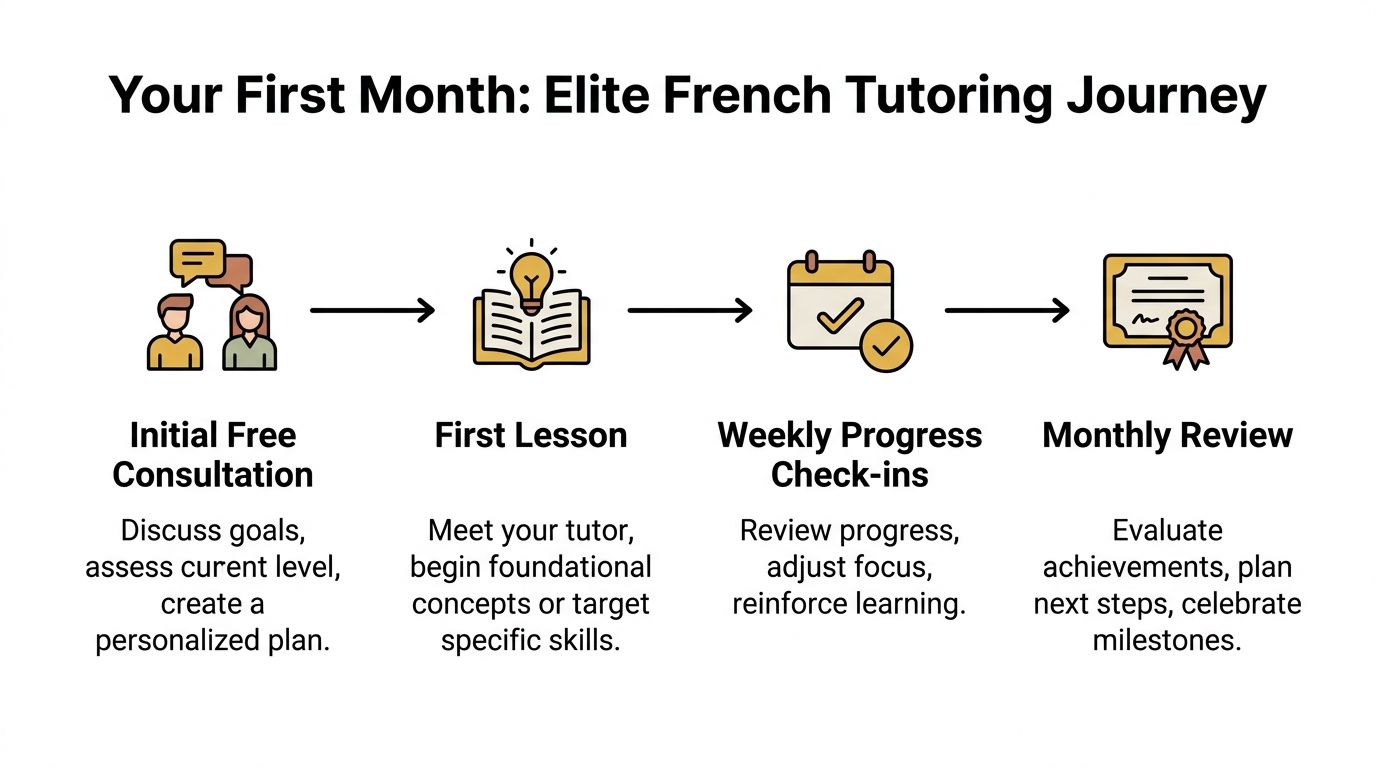
The first month tells you almost everything about whether a tutoring relationship will work.
Good private French lessons in Los Angeles shouldn't feel random. You shouldn't leave lesson three wondering why you're doing a listening exercise that has nothing to do with your goals. In a strong program, the first month creates traction, establishes habits, and shows you how the tutor thinks.
Week one starts with diagnosis, not guesswork
I like to see a first month begin with a real intake conversation. Not just “What level are you?” Most students don't know. The useful questions are about confidence, exposure, pacing, correction preference, and what situations matter most.
For serious progress, program intensity matters too. Effective French study tied to CEFR benchmarks from A1 to C2 works best with consistent scheduling of at least 3 to 6 hours per week, and fragmented study reduces retention over time, according to the Los Angeles tutoring guidance on AmazingTalker's French tutor page (CEFR and weekly scheduling guidance). That doesn't mean every learner needs an aggressive schedule. It means inconsistency has a cost.
A strong first month often includes:
Initial assessment: speaking sample, listening check, grammar review, or writing sample depending on your goal
Priority map: what to fix first, what can wait, and what will create the fastest usable gains
Between-session work: short, focused assignments instead of vague homework
If you want a model for pacing and structure, this structured French study plan shows the kind of consistency that helps students build momentum.
What good momentum looks like by the end of month one
The best early sign isn't perfection. It's specificity.
A business learner should feel clearer during introductions and basic work exchanges. A child should show less resistance around reading, dictation, or oral participation. A DELF or DALF student should understand which task types are weakest and how practice is being targeted.
Here's a simple example from practice. An adult professional came in needing French for cross-border communication. In the first month, we didn't aim for broad fluency. We focused on greeting formulas, self-introduction, explaining role and responsibilities, asking for clarification politely, and responding without panic when the other person spoke faster than expected. That's the kind of month-one result I trust because it transfers directly into real life.
Early progress should feel usable. If your first month gives you only abstract knowledge, the program needs adjustment.
By the end of a good month, you should be able to answer three questions without hesitation:
What am I working on?
Why am I working on it now?
How will I know it's improving?
If your tutor can't make that visible, you're probably paying for lessons, not a program.
Your Checklist for Vetting a French Tutor in LA
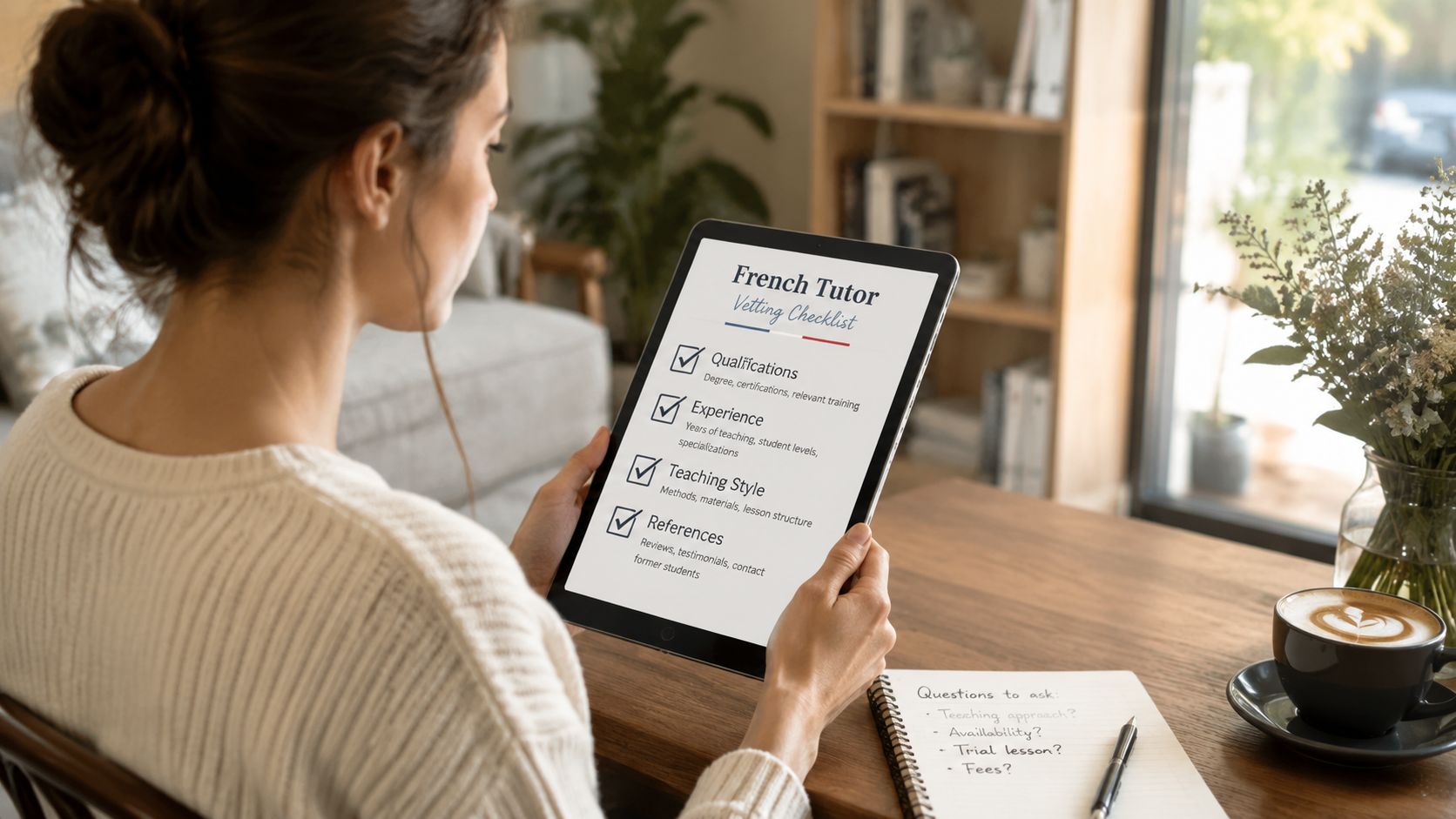
A tutor interview doesn't need to feel formal, but it should be deliberate. You're not just hiring a speaker of French. You're hiring a method, a feedback style, and a schedule you can maintain.
Questions worth asking before you book
I'd ask these before committing to a package or recurring slot:
Who do you usually teach? A tutor who mostly teaches children may not be right for executive communication. The reverse is also true.
How do you assess level and track progress? If the answer is vague, expect vague results.
What happens in a typical lesson? Listen for structure, not buzzwords.
How do you handle correction? Some tutors interrupt constantly. Others barely correct at all. Neither is automatically right.
Can you work with my materials or goals? This matters for school support, presentations, and exam prep.
If you want a clearer sense of starting level before that conversation, a formal or informal French placement test can help you ask better questions.
How to judge value, not just price
Price matters, but price without context is misleading.
On the premium end of the Los Angeles market, Wyzant lists French tutors at an average range of $40 to $65 per hour, which usually reflects a more specialized tier of expertise and demand (Wyzant French tutors in Los Angeles). That doesn't mean every higher-priced tutor is better. It means you should expect a clearer rationale for what you're paying for.
Here's how I'd evaluate value:
| What to check | Why it matters |
|---|---|
| Specialization | Relevant experience saves time and avoids generic lessons |
| Lesson design | Structured sessions usually outperform improvised conversation-only tutoring |
| Responsiveness | Scheduling, follow-up, and material sharing affect consistency |
| Chemistry | You need enough ease to speak, make mistakes, and keep going |
One more thing. Trial lessons are useful, but only if you treat them like an interview. Don't leave asking, “Did I like them?” Leave asking, “Did they understand my goal, show a plan, and teach in a way that makes me want to come back next week?”
Common Questions About Private French Lessons
How long does it take to become conversational
It depends on your starting point, your consistency, and what you mean by conversational. Ordering coffee and introducing yourself come much sooner than handling nuanced work conversations or exam tasks. I tell students to define the specific situations they want to manage first. That makes progress measurable and keeps expectations realistic.
Do I need in-person lessons in Los Angeles
Not always. In-person can be useful for children, some beginners, and learners who focus better face to face. But many adults do better online because it removes commute friction and makes regular attendance easier. If the tutor is organized and the lessons are interactive, online instruction can work very well.
Can lessons fit a busy work schedule
Yes, if the scheduling is built for real life rather than ideal life. Some Los Angeles-area French programs offer evening classes, including 80-minute sessions from 6:00 to 7:20 pm and 7:35 to 8:55 pm, which shows how after-hours scheduling can work for professionals and parents (Los Angeles evening French class schedule example).
What should I prepare before booking
Come in with three things: your goal, your time constraints, and an honest picture of your current habits. If you've studied before, say what worked and what didn't. If you're comparing private French lessons in Los Angeles, ask each tutor how they would structure your first month and why.
If you're close to booking, the next smart move is simple. Compare a few lesson formats, ask sharper questions, and choose the tutor whose program fits your actual goal, not just the profile that looks good on a marketplace page.
If you want a low-pressure next step, review your lesson options and book a consultation with a tutor who can explain how your program would be built around your school, work, or exam goal.