Skip to content
You're probably here because you've already hit the frustrating part. You searched for French lessons in Philadelphia, found a mix of group classes, tutor directories, school pages, and apps, and still don't know which option will fit your life. That's normal. Often, individuals don't need “French classes.” They need the right kind of French support for a specific outcome.
I've seen this decision go wrong in predictable ways. A parent signs up for a general tutor when their child needs curriculum-aligned support. A professional joins a weekly group class when they need targeted speaking practice for meetings. An exam candidate wastes months on conversation practice without a structured DELF or DALF plan. The lesson format wasn't the problem. The mismatch was.
Philadelphia gives you real options, but it's still a market where you need to choose carefully. The Alliance Francaise de Philadelphie in Center City has long been part of the local scene, and the city's French-speaking community is widening with newer hubs like the Centre Francophone de Philadelphie, launched in 2021 to connect speakers from Africa, Europe, and Haiti, as noted in this local Philadelphia language discussion. That's good news. It means you can find French in Philadelphia. It does not mean every lesson option is right for you.
Table of Contents
Your Guide to Learning French in Philadelphia
You book a French class because the schedule works, the location looks convenient, or the price feels reasonable. Three weeks later, you realize it was the wrong buy. The pace is off, the teacher is too general, and the lessons have nothing to do with the meeting, exam, or school requirement that pushed you to start in the first place.
That happens all the time in Philadelphia.
The problem is not a lack of options. The problem is that local listings often present very different services as if they solve the same need. They do not. A casual evening group class, a freelance tutor from a marketplace, and a targeted private program might all appear under "french lessons philadelphia," but they serve completely different outcomes.
French also holds a steady place in the U.S. according to this overview of French in the United States. That helps explain why demand stays consistent for serious instruction, not just hobby learning. In Philadelphia, though, French programs are less visible than larger language categories, so buyers often have to sort through mixed-quality choices without much guidance.
Why buyers get stuck
Philadelphia learners usually fall into three high-pressure groups. Professionals who need usable French for work. Students who need support tied to school expectations. Adults who have tried before and now need a structure they will stick to.
Those groups should not shop the same way.
Local search results still blur together:
Institutional group classes built for fixed schedules and broad-level instruction
Marketplace tutors whose teaching style, planning, and consistency can vary a lot
Apps and online platforms that make starting easy but often leave serious learners without accountability
My advice is simple. Buy for the consequence, not the convenience.
If you want light exposure before a trip, a flexible option can work. If you need French for a client-facing role, DELF or DALF preparation, support tied to a school curriculum, or confident speaking under pressure, you need a closer match between the teacher, the lesson format, and the deadline. Generic directories rarely help with that decision. They show availability. They do not show fit.
That is the challenge in Philadelphia. Finding French lessons is easy enough. Choosing the right kind of French lessons for a high-stakes goal is where people waste time and money.
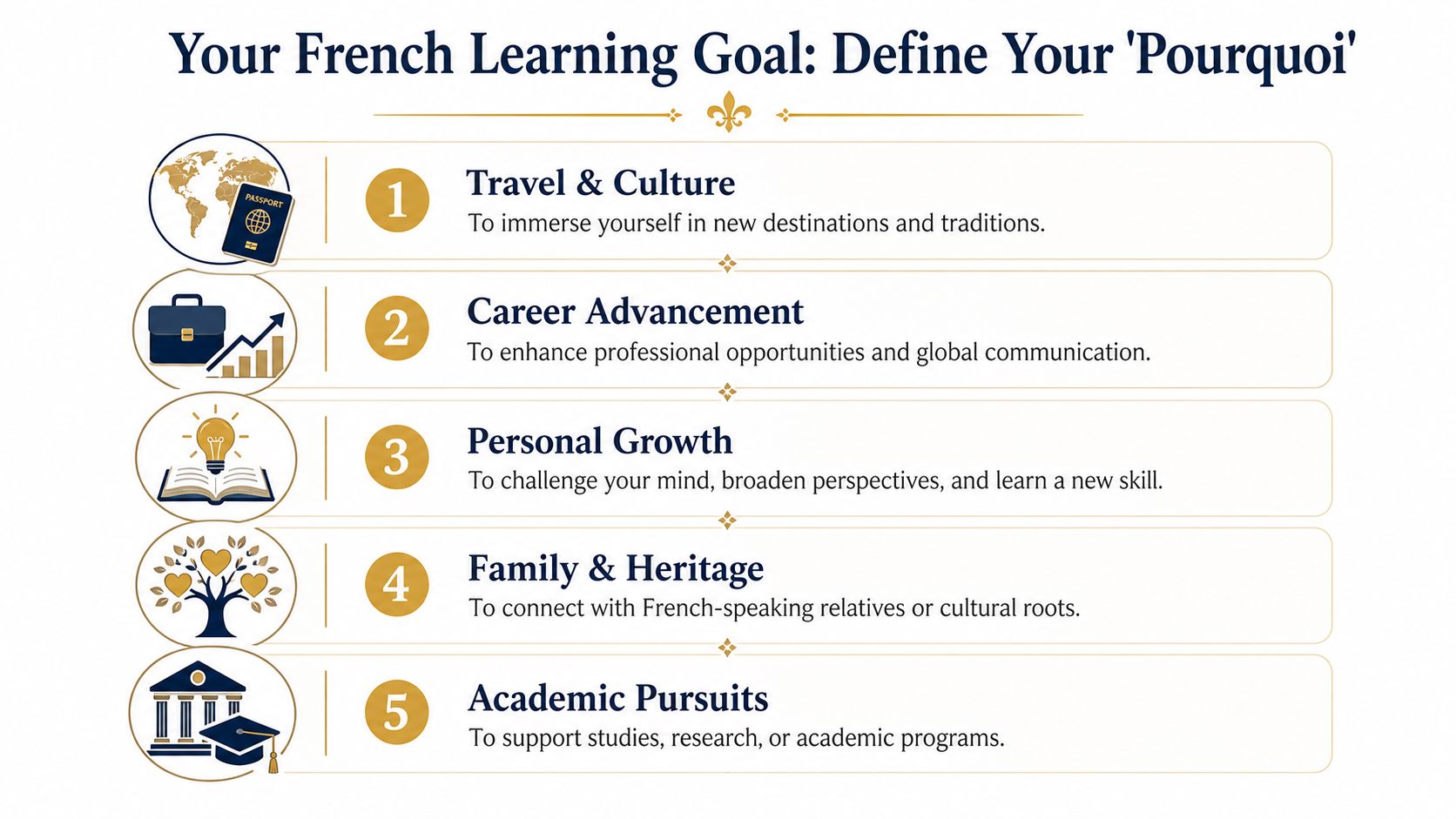
First Define Your Pourquoi Your French Learning Goal
People waste money on French lessons when they choose the format before they define the goal. If you do that, you'll almost always end up in a program that sounds good on paper and feels wrong by week three.
The better approach is simple. Start with your pourquoi. Why do you need French now, and what happens if progress is too slow?
Start with the outcome, not the format
A Philadelphia professional preparing for cross-border meetings should not shop the same way as a parent at the French International School of Philadelphia. An adult learner planning travel should not buy the same program as someone preparing for DELF or DALF. The learning goal changes everything: pace, teacher profile, homework style, scheduling, and even whether in-person matters.
I tell learners to pin down four things first:
Your use case
Work presentation, relocation, school support, travel, certification, or family connection.Your deadline
Loose goals can survive a slower format. High-stakes goals usually can't.Your tolerance for structure
Some learners want a teacher-led path. Others want flexibility with accountability.Your speaking pressure
If you need to perform live, conversation quality matters more than passive study.
If you need French for a real-world situation with consequences, generic lessons usually feel pleasant and produce uneven results.
Ask yourself these buying questions
Use these questions before you compare schools or tutors:
Do you need scheduling flexibility?
If your calendar changes every week, fixed group classes may become expensive guilt.Do you need specialized vocabulary?
Business French, legal French, exam French, and school support are not interchangeable.Do you learn better by speaking or by studying alone?
If you freeze in conversation, you need live correction, not more app streaks.Are you buying confidence or coverage?
Coverage means broad exposure. Confidence means being able to act in French when it counts.Do you want continuity?
Rotating tutors and one-size-fits-all curricula create friction fast.
A lot of buyers skip this step because they want a quick answer. I get it. But the fastest way to choose well is to slow down for ten minutes and define the mission clearly. Once you do that, the market gets much easier to read.
Comparing Philadelphia's French Lesson Formats
Philadelphia offers three practical paths: private tutoring, group classes, and self-serve online platforms or apps. None of them is universally best. One of them is usually best for you.
The biggest mistake I see is assuming lower upfront cost means better value. It doesn't. Cheap lessons become expensive when they drag on without moving you toward your goal.
For private lessons, there's a real pricing spread in this market. Private French tutoring in Philadelphia spans a wide range, from budget marketplace listings to premium expert instruction with customized curricula, direct feedback, and stronger accountability. That premium usually tracks with a diagnostic assessment, a customized plan, and a more outcome-driven approach.
French Lesson Formats in Philadelphia at a Glance
| Format | Best For | Average Cost | Personalization | Pace |
|---|---|---|---|---|
| Private tutoring | Professionals, exam candidates, school-aligned support, fast progress | Wide range; premium expert tutoring can be much higher depending on specialization and customization | High | Fast when the plan is focused |
| Group classes | Social learners, routine weekly learning, general skill-building | Varies by provider | Low to medium | Moderate |
| Online platforms and apps | Independent learners, light review, supplemental practice | Varies by platform | Low | Inconsistent unless paired with live instruction |
What I recommend for each buyer type
If you want French for general enrichment and you enjoy learning with others, group classes can work well. The Alliance Française de Philadelphie, for example, offers structured adult classes on weekdays and children's classes on Saturdays, with weekly sessions lasting 1.5 to 2 hours, detailed on its learn French program page. That's a good fit for steady, calendar-based learning.
If you need flexibility and precision, go private. That's especially true if you're juggling work, parenting, travel, or a school requirement. Higher-end tutors cost more because they aren't selling seat time. They're selling targeting.
If you're comparing private online options with self-paced study, I'd strongly separate them in your mind. One gives you live correction and accountability. The other gives you convenience. Those are not the same purchase. If you're weighing digital options, this guide on ways to learn French online is a useful companion.
Buyer advice: If your goal is time-sensitive, choose the format that gives you direct feedback every session. That's usually where progress stops being theoretical.
For most high-stakes buyers in Philadelphia, I'd rank the formats like this: private tutoring first, group classes second, apps third. Not because apps are bad, but because they rarely solve the exact problem serious learners are trying to fix.
Your 5 Point Checklist for Choosing a French Program
Before you book anything, run the provider through five filters. This will save you from polished marketing and weak teaching.
A serious French program should make it easy to answer basic questions about instructor fit, lesson design, flexibility, and what happens after the first session. If those answers are vague, move on.
What to verify before you book
Instructor credentials matter
Ask whether the teacher is a native speaker, certified, or experienced with your exact goal. A pleasant conversational partner is not automatically a strong instructor.Curriculum should match your life
You want customized materials if your goal is business communication, exam prep, or school alignment. Generic worksheets are a warning sign.Teaching style has to produce speaking
If the lesson is mostly explanation and almost no active use, progress will feel slow. You need correction, repetition, and real interaction.Scheduling has to be realistic
A perfect program that doesn't fit your calendar is the wrong program. Consistency beats ideal conditions you can't maintain.Try before you commit
In Philadelphia's private lesson market, 95% of tutors offer the first class free and 97% of private teachers on Superprof provide the first hour at no cost, according to this Philadelphia French tutor comparison page. Buyers should use that first contact to test fit, not just price.
If you want a sharper framework for evaluating tutors as an adult learner, I recommend this guide on how to find the perfect French tutor.
The red flags I wouldn't ignore
Watch for these problems:
No diagnostic conversation
If a provider doesn't assess your level and goals early, the plan probably isn't customized.One offer for everyone
The same package for kids, adults, business learners, and exam candidates is lazy design.No clarity on materials
You should know what you'll use, how progress is tracked, and what happens between sessions.Rigid attendance expectations
Some learners need structure. Busy professionals need flexibility with standards.
A good French program should feel specific to you before the second lesson, not after the tenth.
Success Story A Philadelphia Professional's Journey
One Philadelphia learner I worked with reminds me why format matters more than motivation. She was a Center City legal professional who had already done what many smart adults do first: apps, podcasts, and the occasional grammar review. She wasn't lazy. She was stuck.
Her problem wasn't lack of exposure. It was performance. She needed to speak with more confidence in meetings involving a French-speaking client, and casual study wasn't preparing her for that kind of pressure.

From scattered practice to work-ready French
We shifted her from broad study to targeted work. Every lesson focused on the situations she faced: introducing a point clearly, confirming understanding, softening direct language, and handling follow-up questions without freezing. Vocabulary mattered, but delivery mattered more.
What changed first was not grammar. It was speed of recall. Once she was practicing in live, realistic scenarios, she stopped translating every sentence in her head. That's when her confidence started to look visible, not just internal.
Her biggest breakthrough came after a stretch of consistent sessions built around role-play and corrective feedback. She told me that for the first time, she could stay present in a French exchange instead of mentally panicking over every agreement and preposition.
She didn't need more French content. She needed a lesson design that matched the moments where French actually mattered.
That's the part many directories and generic class listings miss. The right teacher isn't just someone who knows French. It's someone who can shape the lesson around the pressure point in your life.
Specialty French for Professionals and Students
Philadelphia has a clear gap in the market. Plenty of visible options cover general learning. Far fewer address high-stakes needs well.
That matters because some learners can absorb a slower, broader approach. Others can't. If French affects your work, your exam outcome, or your child's school performance, specialized support isn't a luxury. It's the practical choice.
Corporate French needs a different setup
For professionals, fixed weekly group classes often miss the mark. They assume stable schedules and broad learning goals. But executives, diplomats, international staff, and client-facing professionals usually need on-demand, one-on-one instruction built around real communication tasks.
That gap is visible in the local market. Current content around French lessons in Philadelphia leans heavily toward institutional group classes and doesn't clearly address customized private tutoring for high-stakes corporate or diplomatic needs, while the Alliance Française de Philadelphie does offer formal corporate French classes for businesses and professionals. If you need schedule flexibility and targeted speaking outcomes, that distinction matters.
For buyers comparing premium private options, I'd focus on whether the teacher can build lessons around presentations, negotiations, meetings, and cross-cultural communication. If business use is your goal, this page on French for business is worth reviewing alongside local options.
Exam prep and school support aren't general tutoring
Exam candidates need a structured framework. In Philadelphia, tutors who specialize in DELF, DALF, TEF, and TCF use a progressive approach centered on phonetics, listening comprehension, and thematic fluency, described on this Philadelphia exam tutor page. That is different from casual conversation tutoring.
The same is true for families. Parents looking for support aligned with the French national curriculum often struggle to find clear guidance in local search results, even though the city has a dedicated French International School of Philadelphia. A tutor who understands the school's academic expectations is solving a different problem than a general language coach.
Here's my blunt recommendation:
For corporate learners: choose flexible private instruction over broad group sequencing.
For DELF or DALF prep: choose an exam specialist, not a general tutor who “also helps with tests.”
For school support: choose curriculum alignment first, personality second.
Those buyers don't need more options. They need better fit.
Your Next Step to Speaking French Confidently
If you've read this far, you probably don't need more inspiration. You need a decision.
Choose your French lessons in Philadelphia based on the pressure point. If your goal is casual and social, group classes can serve you well. If your goal is professional, academic, or time-sensitive, private instruction is usually the cleaner path. If you mainly want exposure between sessions, apps can support the plan, but they shouldn't be the plan.
I'd keep your next step simple:
Write down your exact goal
Set a realistic schedule
Shortlist only providers who match that goal
Use a consultation or trial to test fit
Commit to the format you can sustain
Private language tutors in Philadelphia often sit in a broad market range, as shown on Wyzant’s Philadelphia language tutor page, but premium, highly personalized instruction can run well above that, including rates like $125 per hour for expert one-on-one support. Don't just ask what it costs. Ask what kind of problem it's built to solve.
The best French program is the one that fits your deadline, your learning style, and the real situation where you need to use the language.
If you want a low-pressure way to sort through your options, book a conversation with a provider that starts with goal-matching rather than a generic package. At Elite French Tutoring, we offer a free 20-minute consultation to assess your level, clarify your objective, and recommend the right path. If pronunciation is one of your sticking points, you can also review this practical guide to French pronunciation for English speakers before you book.
If you're comparing French lesson options in Philadelphia and want a personalized recommendation, a short consultation is often the fastest way to avoid the wrong program and choose one that fits.