

You're probably staring at a dozen tabs right now. One platform shows endless tutor profiles. Another promises “personalized” lessons. A local program looks solid, but the schedule may not fit your life. If you're searching for French classes in San Jose, the main problem isn't lack of options. It's that most listings don't tell you what predicts success.
I'll be direct. Hourly rate is the worst place to start. The hidden factors matter more: whether the teacher is qualified for your specific goal, whether the curriculum has structure, and whether the trial lesson shows a real teaching method instead of casual conversation dressed up as instruction. That's where people waste months.
Table of Contents
Feeling Lost in the Search for French Classes
The San Jose market overwhelms people fast. Preply's San Jose listings show 5,902 online tutors available to local learners in its 2026 directory. That volume is convenient, but it also creates the exact problem I see over and over. Too many choices, too little clarity.
The typical response goes like this: They compare profile photos, hourly rates, and vague promises like “fun lessons” or “native speaker.” Then they book a trial with someone who seems nice, have a pleasant chat, and assume they've found the right fit. A month later, they're still stuck.
What actually goes wrong
The biggest mistake is treating all French instruction as interchangeable. It isn't.
A parent looking for support tied to a school curriculum needs something different from an engineer preparing for meetings with colleagues in France. A student aiming for DELF or DALF needs even more rigor. If the tutor can't map lessons to the goal, the learner drifts.
Practical rule: If a program can't explain how it will move you from your current level to your target outcome, keep looking.
I also think people put too much trust in marketplaces. A large platform is good at helping you browse. It isn't automatically good at helping you choose well. The burden of evaluation still falls on you.
A smarter way to shop
When I advise clients on French classes in San Jose, I tell them to screen for three things first:
Goal fit: Does this teacher handle your exact use case, such as business French, K to 12 support, or exam prep?
Program structure: Is there a plan, or are you paying for disconnected sessions?
Trial lesson quality: Does the first session reveal diagnostic skill, correction style, and next steps?
That framework cuts through noise fast.
You don't need more options. You need a filter that eliminates weak ones.
First Define Your Goal Then Find Your Class
If you skip this step, you'll choose badly. That sounds harsh, but it's true. “I want to improve my French” is not a buying decision. It's a vague wish. Good programs aren't built around vague wishes.

The right first question isn't “Who's the best tutor?” It's “What do I need French to do for me?” Once you answer that clearly, the search becomes manageable.
The three common buyer profiles I see
Some learners need professional communication. In San Jose, that usually means someone in tech, finance, research, or an international role who needs meetings, presentations, email language, and confidence under pressure. That learner should prioritize a tutor who can handle formal speaking, role play, and industry vocabulary.
Others are parents buying support for a child or teen. That's a different service entirely. The tutor needs patience, age-appropriate pacing, school alignment, and the ability to reinforce classroom expectations without turning lessons into more homework.
Then there are exam-driven learners. If DELF, DALF, AP French, or another official target is involved, the class can't be loose. It needs measurable progression, exam-style tasks, and clear feedback.
For a more structured community option, Alliance Française Silicon Valley offers learning centers in Los Gatos and Palo Alto, with classes and cultural programming for different ages and levels. That format can work well if you want a traditional class environment rather than a fully customized one.
Define success before you compare prices
Write your goal in one sentence. Be specific.
For professionals: “I need to participate comfortably in work calls and speak clearly with French-speaking colleagues.”
For parents: “My child needs personalized support that matches what they're learning in school.”
For exam candidates: “I need a program aligned with my target exam and current level.”
If you're unsure how to frame your level, it helps to review the CEFR proficiency levels used in French learning. That gives you a practical language for discussing ability and progress.
A tutor can improve your French. A well-matched program can solve your actual problem.
That's the difference buyers miss.
Comparing French Learning Formats in San Jose
You narrow the search to three options. One looks cheap, one looks polished, and one promises flexibility. Six weeks later, the true difference shows up somewhere else entirely. The tutor cannot handle business role-plays, the group class moves too slowly, or the trial lesson feels pleasant but directionless.
That is how San Jose learners waste time.
Format matters because it shapes four things: how specifically the teacher can address your goal, how structured the curriculum is, how much feedback you get, and whether the trial lesson gives you real evidence of fit. Hourly rate comes after that.
French Learning Options in San Jose
| Feature | Private Tutoring (e.g., Elite French Tutoring) | Group Classes (e.g., Alliance Française) | Online Marketplaces (e.g., Preply, Superprof) |
|---|---|---|---|
| Customization | High. Lessons can target business French, school support, or exam preparation | Moderate. Everyone follows the same class path | Variable. Depends on the tutor, not the platform |
| Scheduling | Usually flexible | Fixed schedule | Often flexible |
| Curriculum structure | Can be built around a clear progression and measurable goals | Usually organized by level and session dates | Often inconsistent unless the tutor uses a defined system |
| Feedback quality | Direct, frequent, and specific | Limited by class size and shared pace | Uneven. Some tutors correct well, others mostly chat |
| Trial lesson value | Strong if the tutor diagnoses your level, asks good questions, and outlines a plan | Limited. You usually join an existing structure | Mixed. Some trial lessons are real assessments, others are sales calls |
| Best for | Professionals, exam candidates, and students who need targeted results | Learners who want routine, community, and lower pressure | Buyers willing to screen carefully and test several tutors |
| Main risk | Paying premium rates for a tutor without a real method | Getting stuck in a pace that does not match your needs | Confusing polished profiles with proven teaching ability |
My recommendation is simple. If your French needs to work in a meeting, on an exam, or in school, private instruction usually gives the best return. Group classes fit learners who want consistency and social motivation. Marketplaces are only worth it if you know how to screen hard.
What matters more than posted rates
San Jose has options at several price levels, but price alone is a weak filter. A lower rate often means you are paying for less structure, less specialization, or less accountability. That tradeoff is fine for casual learners. It is a bad bet for anyone with a deadline or a specific communication problem to solve.
Care.com's San Jose French tutor listings are useful for seeing the broad local range and the mix of independent tutors available. Indeed's San Jose French tutor job listings show another part of the market, where schools, families, and private employers look for help. ZipRecruiter's French tutor listings in San Jose also make one thing clear. The market spans everything from lower-cost remote roles to more specialized private instruction.
That spread is exactly why buyers should stop comparing hourly rates in isolation.
Compare the teaching model instead. Does the tutor have credentials that match your purpose? Is there a defined sequence for grammar, speaking, correction, and review? Does the trial lesson include a level check, diagnosis, and next-step recommendation? If those pieces are missing, the cheaper option usually becomes the expensive one because progress slows down.
If you plan to learn remotely, choose a provider that treats online teaching as its main delivery model, not as a backup. Strong online French classes with personalized structure and flexible scheduling tend to outperform casual video sessions that rely on conversation alone.
My recommendation by use case
Choose private tutoring if you need French for work, DELF or DALF preparation, school support, or a time-sensitive goal.
Choose group classes if you want routine, cultural exposure, and a shared classroom pace.
Choose marketplaces only if you are prepared to test several tutors, reject weak trial lessons, and ask direct questions about curriculum and credentials.
Convenience is not quality. In San Jose, the best format is the one that gives you the right teacher, the right structure, and a trial lesson that proves both. For learners who want a more personalized path, Elite French Tutoring offers private instruction with a clear diagnostic approach.
How to Evaluate Tutors and Programs Like an Expert
A key distinction separates smart buyers from frustrated ones. Don't ask only “How much do you charge?” Ask questions that reveal quality.
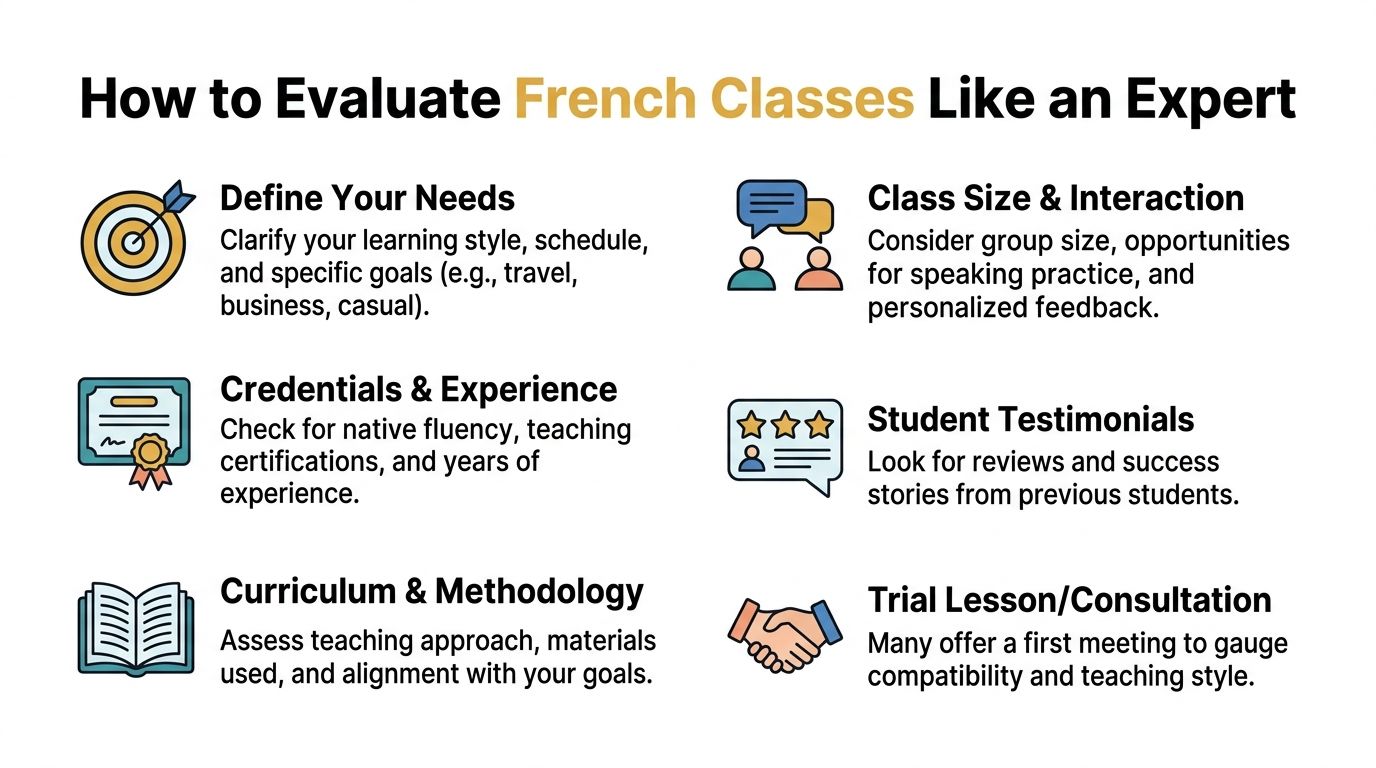
Check credentials for your exact goal
General fluency is not the same as instructional fit. A tutor may speak excellent French and still be the wrong choice for business communication, school support, or exam prep.
This is especially important for professionals. Language Trainers' San Jose French courses page cites a survey showing 74% of Bay Area professionals prioritize native fluency and business certification, yet only 9% of San Jose tutors on popular platforms publicly disclose credentials such as DALF C2 or a corporate French teaching certificate. That's a serious trust gap.
Ask direct questions:
For corporate learners: What experience do you have with business French, meetings, presentations, and professional writing?
For exam candidates: Have you taught DELF or DALF preparation in a structured way?
For parents: How do you align lessons with a child's school curriculum and learning style?
Don't reward vague answers. Specific learners need specific proof.
If you want more screening criteria designed for adult learners, this guide on finding the right French tutor for adult goals is worth reviewing before you book anything.
Inspect the curriculum, not just the personality
A lot of trial lessons feel pleasant because the tutor is personable. That's not enough. You're not buying an hour of conversation. You're buying progress.
Look for signs of structure:
| Evaluation point | What a strong answer sounds like | Red flag |
|---|---|---|
| Level assessment | “I'll assess speaking, comprehension, grammar, and goals before mapping lessons” | “We'll just talk and see how it goes” |
| Materials | “I use selected materials based on your target and level” | “I don't really use materials” |
| Progress tracking | “We'll review milestones and recurring errors regularly” | “Progress happens naturally” |
| Correction style | “I correct selectively so fluency and accuracy improve together” | “I usually don't interrupt” or “I correct everything constantly” |
A strong program has a method. It may be flexible, but it isn't random.
Use the trial lesson strategically
Treat the first lesson as an interview.
Bring a short list of questions and notice how the tutor responds. Do they diagnose your needs quickly? Do they explain what they observed? Do they adapt in real time? Do you leave with a sense of direction?
Here's the simplest checklist I give buyers:
Ask for a recommendation: What frequency of lessons do you suggest, and why?
Request a sample roadmap: What would the first month look like for my goal?
Test relevance: Can we role-play a real situation I care about?
Notice correction: Did the tutor improve my output in a way I could use?
A good trial lesson doesn't just feel encouraging. It reveals how the tutor thinks.
That's what you're paying to discover.
From Hesitant Speaker to Confident Communicator A Success Story
A recent client I'll call David came to this process the hard way. He's a software engineer in San Jose who needed French for collaboration with a team in Lyon. He had prior exposure to the language, but under professional pressure he froze.
He'd already tried several tutors from a large online platform. The sessions were friendly. They were also unfocused. He got conversation practice, but no systematic work on business vocabulary, meeting flow, or speaking under deadline.

What changed
He started evaluating programs differently. Instead of asking who was available soonest, he asked who could teach the kind of French his job required. During consultations, he brought real scenarios: leading project calls, clarifying technical issues, and handling follow-up questions without panicking.
That shift mattered more than people realize.
Superprof's San Jose French listings report a 97% success rate for first-hour trials, but the same source says only 30% of advertised courses include certified DELF/DALF curriculum alignment. I'm not claiming David needed DELF alignment specifically. The larger point is that a trial lesson can feel successful even when the underlying program lacks structure. That's exactly what happened to him earlier.
The result that mattered
Once he chose a program built around his actual use case, his confidence changed. He stopped trying to “speak more French” in a vague way and started practicing the specific language patterns his work demanded. Role-play became useful. Corrections became memorable. Meetings got easier.
I won't invent a dramatic metric. What I can say is that he moved from avoiding French in professional settings to participating with control and much less hesitation. That's a real outcome, and it's the one serious adult learners usually want.
If you like concrete stories of focused language progress, this client journey about going from beginner to confident French speaker gives another example of what a customized plan can look like.
Your Next Step to Speaking French Confidently
You narrow the search to three French classes in San Jose, book a trial, and every option sounds decent for the first 20 minutes. That is where many learners make the wrong call. They choose the lowest rate or the friendliest conversation, then realize a month later that nobody built a plan for their actual goal.
Use a stricter filter. Choose the program that can show clear tutor-fit for your purpose, a structured path from lesson one onward, and a trial lesson that ends with a specific recommendation instead of vague encouragement.
That is how serious learners save time.
Price still matters, but it belongs lower on your checklist. A cheaper lesson with weak correction, no progression plan, and no specialization for business French or DELF prep usually costs more because it delays results. San Jose learners who need French for work, school, relocation, or exams do better with a teacher whose background matches the job.
My closing advice
Use this shortlist before you commit:
Match the tutor to the outcome: corporate communication, academic support, conversation building, or exam preparation all require different strengths.
Ask to see the curriculum: a good program should explain what you will cover over the next few weeks, not just offer open-ended lessons.
Judge the trial by diagnosis: the teacher should identify your gaps, explain priorities, and recommend a path.
Pay for precision: the right teacher with a clear method beats a cheaper option that leaves you repeating the same basics.
If you want a personalized recommendation rather than another hour of browsing, a practical next step is to book a free 20-minute consultation with Elite French Tutoring. It gives you a direct way to clarify your goal, pressure-test your options, and see what a customized French plan should include.