You're staring at a French family tree on a placement test, and one word is stopping you: cousin. Does it mean cousin, cousin germain, or petit cousin? Then the exercise adds beau-père, sa sœur, and maman, and a simple vocabulary question becomes a test of family structure, gender, possession, and register.
That's why French family relationships are more than a list of translations. English speakers often expect one English word to match one French word, but French distinguishes gender, marriage and stepfamily connections, formal and familiar speech, and the grammar that links every relationship to its owner. These terms appear in beginner listening exercises, personal interviews, school conversations, and advanced discussions about family life in France.
I'll take you through the vocabulary in layers, then show how son, sa, ses, beau- and belle-, and register choices carry the meaning. At the end, you'll have a practical way to decide whether you need general conversation lessons, exam preparation, or a curriculum-aligned program.
Table of Contents
- Why French Family Relationships Trip Up English Speakers
- Core French Family Vocabulary From Nuclear to Extended
- The Grammar That Carries Family Terms
- How Modern French Families Actually Work
- Example Sentences, a Family Tree, and Practice Prompts
- Using Family Vocabulary in DELF and DALF Tasks
- Bringing It All Together With the Right Support
Why French Family Relationships Trip Up English Speakers
The first difficulty is that French family vocabulary divides relationships more precisely than many English learners expect. Cousin is masculine, cousine is feminine, and cousin germain identifies a first cousin. The phrase petit cousin can refer to a more distant cousin, so translating each word separately can lead you in the wrong direction.
Marriage creates another layer. Oncle means uncle, while beau-père may mean stepfather or father-in-law. Belle-mère may mean stepmother or mother-in-law. The surrounding sentence, rather than the word alone, tells you which relationship the speaker means.
Practical rule: Learn each family noun with one complete sentence, not as an isolated flashcard.
Register matters, too. Mère and père are standard terms. Maman and papa sound warmer and more familiar. A child might say Ma maman habite à Nantes, while a formal written response might use ma mère. Neither is automatically more correct. The situation decides.
This distinction becomes useful beyond a vocabulary quiz. A learner describing childhood in a DELF interview needs to move naturally between mes parents, ma mère, and mon frère. A learner writing about social change needs terms such as famille monoparentale and famille recomposée. Cultural context can also affect how you interpret a family conversation, as the discussion of differences between French and American culture shows.
Three questions to ask
When you meet a new family term, check:
- Who is related to whom? Is the connection biological, created by marriage, or created by remarriage?
- What is the gender of the person? French nouns and many related words require masculine or feminine agreement.
- Who is speaking to whom? Maman suits familiar conversation, while mère is more neutral or formal.
This approach prevents word-by-word translation. It also gives you a useful buying decision. If you only need holiday conversation, a general vocabulary lesson may be enough. If you're preparing for an exam, you need practice combining family nouns with possessives, listening recognition, and formal writing.
Core French Family Vocabulary From Nuclear to Extended
Build the vocabulary in three passes. Start with the people in a household, add grandparents and relationships created by marriage, then expand into the wider family network. This order gives you usable French quickly without losing precision.
Tier one for the immediate family
The essential household terms are:
- le père, father
- la mère, mother
- le fils, son
- la fille, daughter
- le frère, brother
- la sœur, sister
- le mari, husband
- la femme, wife
- le conjoint, male partner or spouse
- la conjointe, female partner or spouse
In familiar speech, papa and maman are common. Frérot means little brother or brother in a familiar way, while sœurette is a familiar form of sister. These variants are useful for understanding family dialogue, but they aren't always the best choice in a formal exam response.
Say the noun with its article: un frère, une sœur, un fils, une fille. The article trains your ear and helps you remember gender before you add an adjective or possessive.
Tier two for grandparents and in-laws
Next come:
- les grands-parents, grandparents
- le grand-père, grandfather
- la grand-mère, grandmother
- le beau-père, stepfather or father-in-law
- la belle-mère, stepmother or mother-in-law
- le gendre, son-in-law
- la bru, daughter-in-law
The beau- and belle- family requires special care. Beau-père isn't just “beautiful father.” The prefix marks a relationship connected to marriage or a blended family, and context identifies the exact role.
Tier three for the extended family
Complete the network with:
- l'oncle, uncle
- la tante, aunt
- le cousin, male cousin
- la cousine, female cousin
- le neveu, nephew
- la nièce, niece
- les petits-enfants, grandchildren
A cousin germain is a first cousin. Petit cousin can indicate a more distant cousin, so listen for the full expression rather than assuming that petit means a young person.
| French Term | English Meaning | Register |
|---|---|---|
| père, mère | father, mother | Standard |
| papa, maman | dad, mum or mom | Familiar |
| frère, sœur | brother, sister | Standard |
| frérot, sœurette | brother, sister | Familiar |
| beau-père, belle-mère | stepfather or father-in-law, stepmother or mother-in-law | Standard |
| cousin germain, petit cousin | first cousin, more distant cousin | Standard |
| gendre, bru | son-in-law, daughter-in-law | Standard, with bru less common in everyday speech |
For a DELF response, choose standard terms unless the prompt clearly asks for a personal or conversational voice. A guide such as this practical approach to improving French vocabulary is most useful when it helps you turn recognition into sentences you can say.
The Grammar That Carries Family Terms
Family nouns become clear when you track three things: who owns the relationship, whether the noun is singular or plural, and whether beau- or belle- signals a marriage or blended-family connection. These patterns help you build accurate sentences instead of translating each word directly from English.
Possessives agree with the family noun
French possessives agree with the person or people possessed, not with the owner. Son goes with a masculine singular noun, sa with a feminine singular noun, and ses with a plural noun.
- sa sœur means his sister or her sister because sœur is feminine.
- son frère means his brother or her brother because frère is masculine.
- ses parents means his or her parents because parents is plural.
For example, Paul parle de sa sœur, Paul is talking about his sister. Claire parle de son frère, Claire is talking about her brother. Léa présente ses cousins, Léa introduces her cousins.
The owner may change, but the possessive follows the family noun. This matters in speaking and writing because English his and her can tempt you to choose the wrong French form.
Beau- and belle- show agreement and context
The first part of these compounds changes with gender and number:
- beau-père, stepfather or father-in-law
- belle-mère, stepmother or mother-in-law
- beaux-parents, parents-in-law or stepfamily parents
- belles-sœurs, sisters-in-law or stepsisters
The surrounding situation supplies the precise meaning. Mes beaux-parents arrivent samedi could describe in-laws or a partner's parents in a blended family. Ask which relationship the speaker means before selecting an English translation. This distinction matters in conversation, exams, and lessons because one French term can cover more than one English role.
Pronunciation creates another trap. In mes beaux-parents, the final s of mes links to the vowel sound of beaux, /mez‿o/. In mon oncle, the n of mon links to the vowel of oncle. Listen for the link rather than pronouncing every word separately.
Plurals change the full expression
Parents usually means parents, although context can give it a broader meaning. Notice the forms les grands-parents, un grand-père, une grand-mère, and mes petits-enfants. In grands-parents, both elements mark the plural, while grand-père is singular.
Memorise the whole phrase, not only the final noun:
Ma sœur habite à Lyon. Ses beaux-parents sont très accueillants.
This example combines sa, ses, and a plural compound term. Practice with French sentence structure to connect family vocabulary to complete sentences. That grammar focus can also guide your next purchase: conversation lessons, exam preparation, or a curriculum-aligned program should practise these forms in context, not only test isolated lists.
How Modern French Families Actually Work
A family vocabulary lesson can easily teach an outdated picture if it assumes every child lives with a married mother and father. French official statistics describe traditional, single-parent, and blended families, and the current distribution makes all three essential for learners.
In 2023, 67% of underage children lived in a traditional family, 23% lived in a single-parent family, and 10% lived in a stepfamily, according to INSEE's data on children's family living arrangements. The same source reports that the share of children living with only one parent rose to 30%. These figures make terms such as famille monoparentale, famille recomposée, beau-père, belle-mère, and demi-frère practical vocabulary, not rare exceptions.
| Family Type | % of Households (approx.) | Key Vocabulary | Register Note |
|---|---|---|---|
| Traditional family | 67% of underage children | parents, père, mère, enfants | Neutral and standard |
| Single-parent family | 23% of underage children | famille monoparentale, mère seule, père seul | Neutral, suitable for formal writing |
| Stepfamily | 10% of underage children | famille recomposée, beau-père, belle-mère, demi-frère | Neutral and increasingly necessary |
The table describes children's living arrangements, not every household in France. That distinction matters because official French definitions measure a family within the household. A family includes either a couple living together, with or without children, or one adult living with one or more children. INSEE's definition of a family and a child of the family also limits “child” to a person who lives in the household, is single, and has no spouse or children there.
Why the wider network matters
French family relationships also extend beyond the two parents after separation. Government guidance recognises a child's right to maintain relationships with grandparents, siblings, and even a former step-parent, whether the parents live apart or together. The official guidance on a child's relationships with grandparents is especially useful for expat and bilingual families because it explains a part of family life that basic custody vocabulary often leaves out.
For learners, the grammar follows the structure. In a listening exercise, sa belle-mère may mean her stepmother, while ses demi-frères identifies multiple half-siblings. You need the family model and the agreement together.
Example Sentences, a Family Tree, and Practice Prompts
Start with a short exchange. Notice how the relationship word, possessive, and register work together.
Camille: Bonjour, oncle Marc, tu viens dimanche ?
Oncle Marc: Oui, j'apporte le dessert.
Camille: Super. Ma sœur Élise sera là avec son cousin Hugo.
Oncle Marc: Alors, toute la famille sera réunie.
Camille uses tu with her uncle because this is a familiar family conversation. In a formal written exercise, she could still describe the same people with standard nouns and carefully controlled grammar.
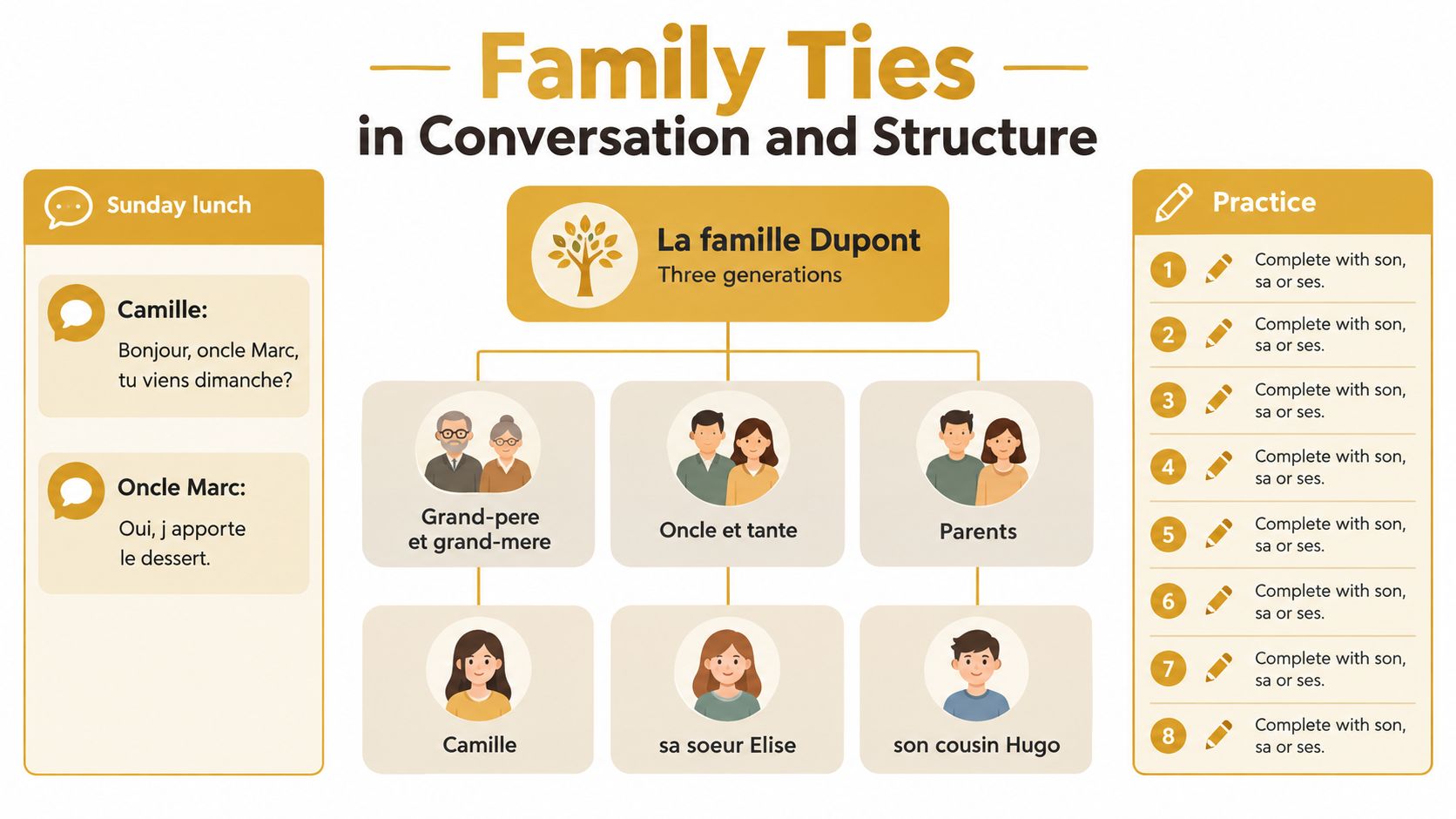
The Dupont family in three generations
La famille Dupont includes the grandparents, Paul et Jeanne, their son Marc, and Marc's sister Sophie. Sophie is Camille and Élise's mother. Marc is their uncle, and Hugo is their cousin. Camille can say mes grands-parents, ma mère, mon oncle, ma sœur, and mon cousin.
Here are sentences you can read aloud:
- Ma mère s'appelle Sophie.
- Mon père travaille à Lille.
- Camille présente sa sœur Élise.
- Son frère habite avec ses parents.
- Mes grands-parents viennent déjeuner dimanche.
- Mon oncle Marc apporte le dessert.
- Sa belle-mère habite dans une autre ville.
- Ses beaux-parents sont très accueillants.
- Hugo est mon cousin germain.
- Je téléphone à ma grand-mère chaque semaine.
The sentences deliberately alternate ma, mon, sa, son, ses, and mes. Don't ask a child or self-study partner to translate all ten first. Read them aloud, underline the family noun, and then identify why the possessive has that form.
Same-day practice
Try these exercises in one sitting:
- Rewrite the owner: Change Paul parle de sa sœur so that Claire talks about her brother. Answer: Claire parle de son frère.
- Choose the possessive: Complete ___ cousine habite à Toulouse with ma or mon. Answer: ma cousine.
- Resolve the context: Translate ma belle-mère once as “my stepmother” and once as “my mother-in-law,” then write a sentence that makes each meaning clear.
- Build a family tree: Describe your family aloud in under ninety seconds. Use at least one grandparent, one sibling, one possessive, and one relationship by marriage.
- Switch register: Change Ma maman et mon papa vivent à Paris into a more neutral sentence: Ma mère et mon père vivent à Paris.
The point isn't to memorise a diagram. It's to produce accurate relationships without pausing over every noun. For speaking practice that includes family topics, use French conversation practice with a partner who can correct agreement immediately.
Before the final practice round, listen for how the same terms sound in connected speech:
Using Family Vocabulary in DELF and DALF Tasks
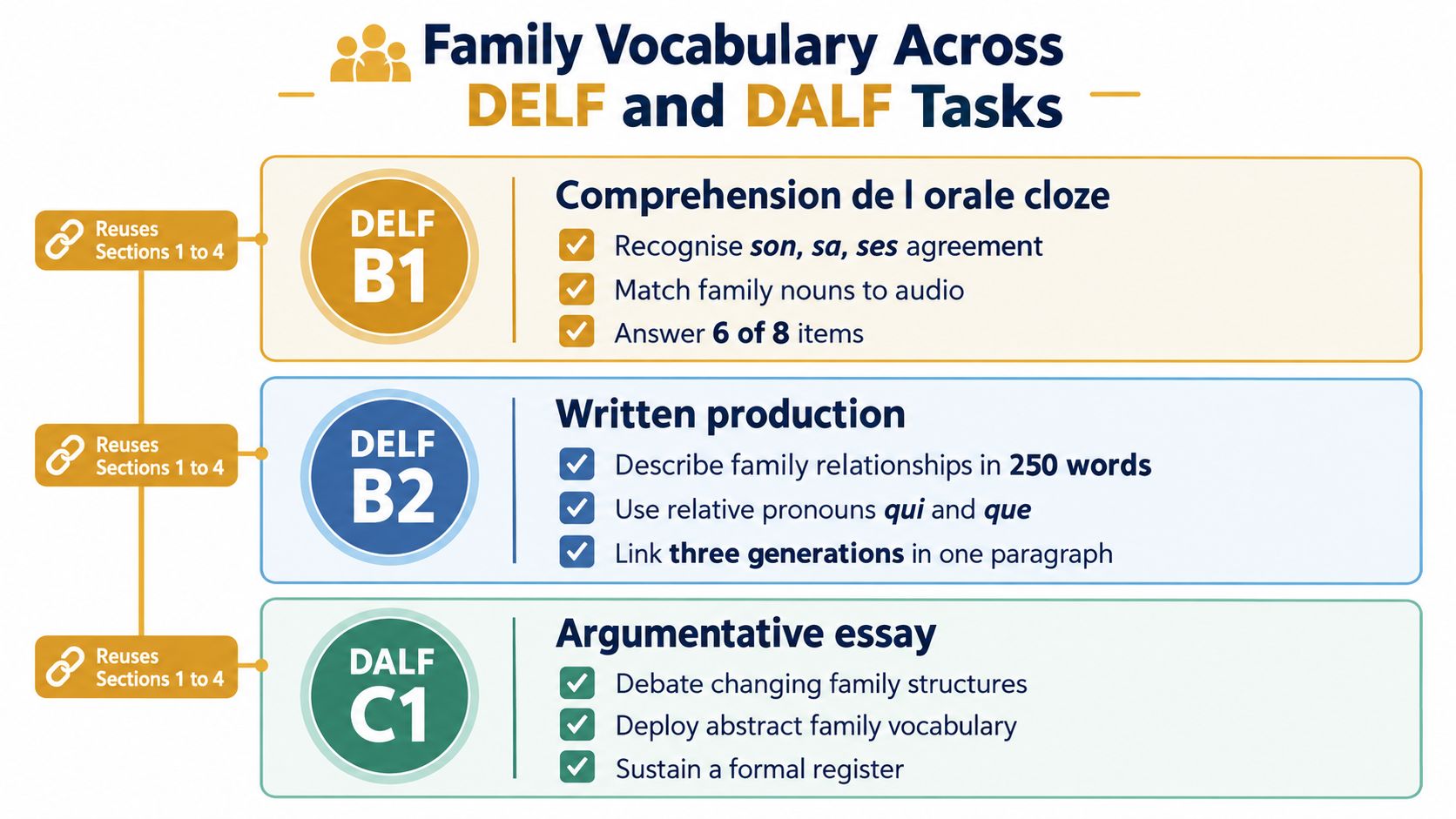
Family vocabulary becomes valuable when it connects to an exam task. At DELF B1, you may need to recognise a family noun in an audio passage and select the correct possessive. At DELF B2, family change can support a structured written response. At DALF C1, the same topic can become an argument about la place de la famille recomposée.
Match the language to the level
- DELF B1: Focus on son, sa, ses, immediate family nouns, and listening recognition. You should understand who belongs to whom before you worry about complex argumentation.
- DELF B2: Add famille monoparentale, famille recomposée, beaux-parents, and connectors such as cependant, en revanche, and par conséquent. A response about family evolution needs a clear position, examples, and logical links.
- DALF C1: Use an abstract register to discuss family structures, social expectations, separation, and wider family relationships. Distinguish personal examples from general arguments and sustain formal phrasing.
A focused ten-day routine
- Days one to five: Review vocabulary with spaced repetition. Put the noun, article, possessive, and one sentence on each card.
- Days six and seven: Complete timed listening cloze exercises. Write the answer first, then explain why it is son, sa, or ses.
- Days eight and nine: Write short responses about a traditional, single-parent, or blended family. Edit every agreement and connector.
- Day ten: Record one mock oral. Describe a family structure, give an opinion, and respond to a follow-up question without translating in your head.
Exam insight: A family topic tests more than vocabulary. It tests whether you can identify relationships, control agreement, and adjust register under pressure.
A structured tutoring program can turn this routine into a placement-based module. Choose one that checks whether you need general conversation, DELF preparation, or DALF-level argumentation before assigning materials.
Bringing It All Together With the Right Support
A learner who knows beau-père and belle-mère but still confuses them in writing doesn't need another long vocabulary list. They need targeted practice with family-role scenarios, possessive agreement, register, and spoken correction.
I can't responsibly invent a named student case study or claim a measured result that isn't documented. The practical lesson is still clear: a tutor can diagnose the exact point where recognition breaks down, then rehearse the same relationship in a message, conversation, listening task, and exam response.
For a concrete next step, Elite French Tutoring offers a free 20-minute placement check and can propose a 6- or 12-week plan aligned with DELF or DALF goals. Its options include group classes, 1:1 lessons, curriculum-aligned materials, and bundled exam-preparation sessions. Book the consultation to identify your family-vocabulary gaps and choose the support that will move you from correct recognition to confident spoken French.
If you're preparing for an exam or supporting a child at a French or bilingual school, book the free placement check and bring one recent writing or listening exercise. You'll leave with a clearer level recommendation and a practical plan for using French family relationships accurately.