You've rehearsed the words in your head, opened a message to a French friend, and then stopped because “I love you France” doesn't feel quite right in French. The problem isn't only vocabulary. You need to know whether you're expressing romantic affection, admiration for the country, or a deep connection with French culture, and each intention calls for a slightly different phrase.
Table of Contents
- What Does I Love You France Mean in French
- Pronunciation and Speaking the Phrase Naturally
- Key Variations and When to Use Each One
- Cultural Context Behind Loving a Country in French
- Real Examples of Using the Phrase in Conversation
- Next Steps to Speak French with Confidence
What Does I Love You France Mean in French
A learner once told me she wanted to write “I love you, France!” under a photograph from her first trip to Paris. She knew je t'aime meant “I love you,” but she wasn't sure whether adding la France would make the sentence sound romantic, patriotic, or just strange.
The most natural choice depends on what you're trying to say:
- J'aime la France. This means “I love France” or “I like France.” It's the clearest everyday sentence for expressing admiration for the country, its scenery, culture, history, or way of life.
- Je t'aime, France ! This means “I love you, France!” Here, France is being addressed directly, almost like a person in a poem, song, caption, or emotional speech.
- Je t'aime la France may be understood, but it isn't the smoothest standard construction for ordinary conversation. French generally uses j'aime la France when the country is the object of affection.
The distinction matters because je t'aime is primarily directed at a person or another being you address personally. It can express romantic love, family affection, or intense closeness. With a country, the phrase becomes deliberately personified.
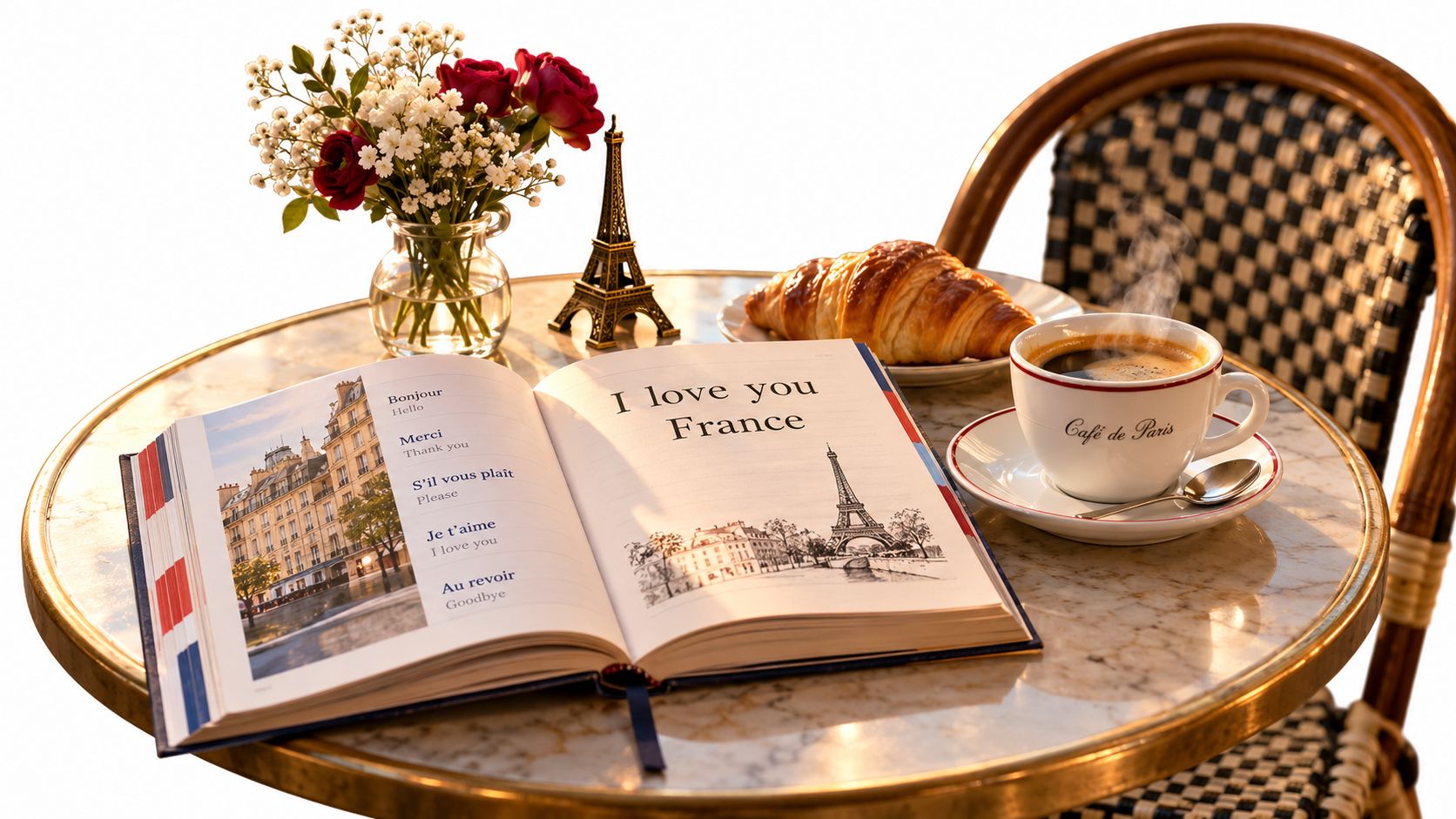
If you're writing a travel caption, ordering a lesson around French expressions, or speaking with a French friend, J'aime la France is usually the safest option. You can find more examples in this guide to famous French expressions.
Practical rule: Use j'aime la France for a clear statement about the country. Use je t'aime, France ! when you intentionally want a poetic, emotional, or person-to-person effect.
Pronunciation and Speaking the Phrase Naturally
Correct words can still sound unnatural if you pronounce them as separate English-style blocks. French connects sounds, reduces unstressed vowels, and gives the phrase a much smoother rhythm.
For je t'aime, the standard pronunciation is /ʒə tɛm/ or /ʒə t‿ɛm/. The liaison links the final sound of t’ to aime, so the phrase flows as one compact unit rather than sounding like isolated words. You can practise with this French pronunciation guide for English speakers.
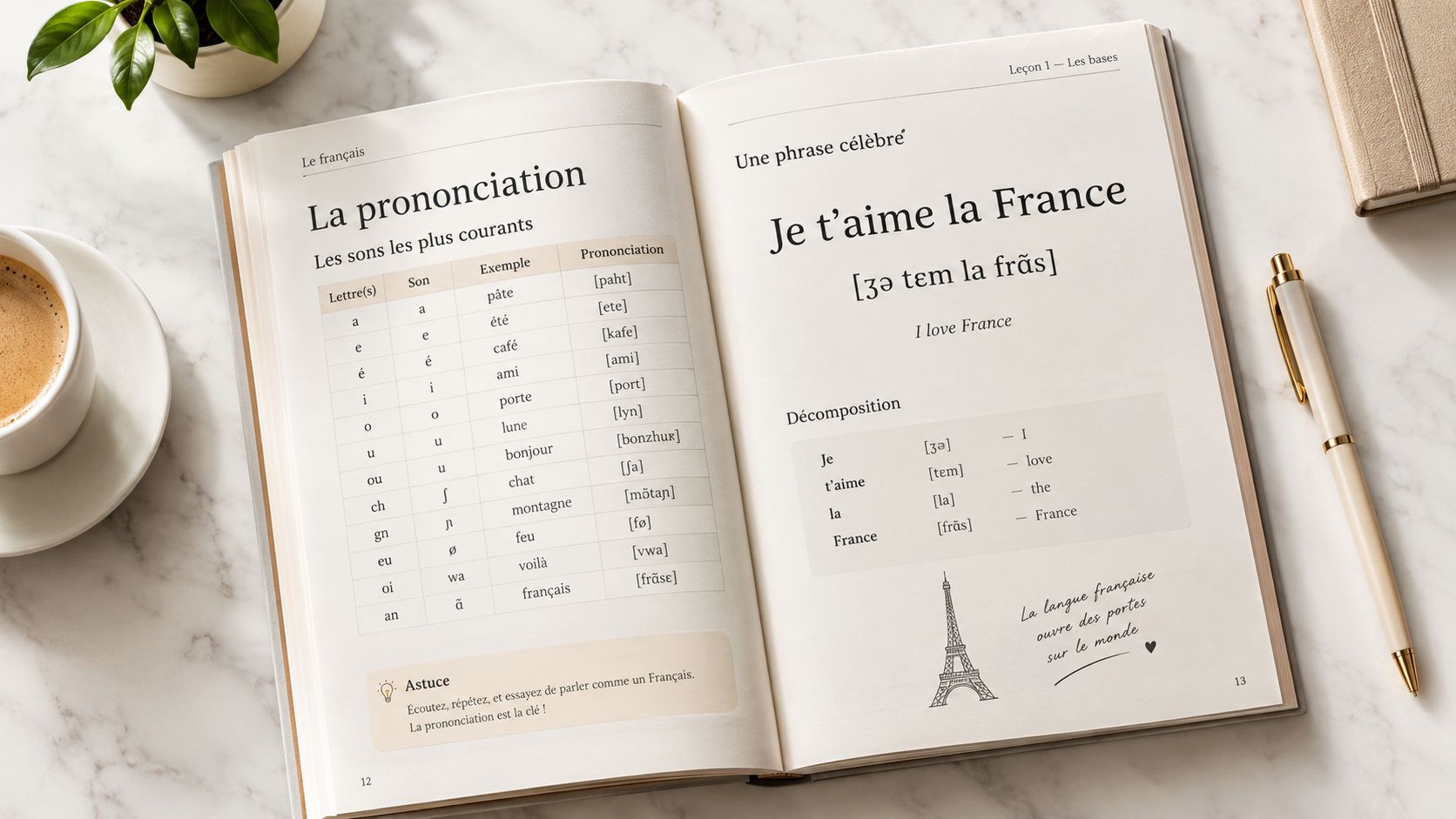
For the complete phrase Je t'aime, France !, a useful pronunciation guide is:
zhuh tem, lah frahnss
That isn't a replacement for listening to a native speaker, but it gives you a starting point. Keep je light. The French /ʒ/ sound resembles the middle sound in the English word “measure” or “vision.” Your tongue stays close to the roof of your mouth, while your voice vibrates gently. Don't turn it into a hard English “j.”
A simple practice sequence
- Start with je. Say a short, relaxed “zhuh.” The vowel in the middle is weak, and you shouldn't stress it.
- Move directly into t'aime. Avoid a pause between t’ and aime. The result should feel closer to “tem” than “tee aim.”
- Add la France. Keep la brief, then practise the nasal vowel in France. Don't pronounce the final e as a separate vowel.
- Join the whole phrase. Say it with one gentle rhythm: zhuh-tem lah frahnss.
Try not to over-enunciate every letter. English speakers often pronounce je t'aime la France with four equally strong beats, but French gives the phrase a more connected shape. The final consonant in France is pronounced, while the vowel before it has a nasal quality that takes practice.
Record yourself saying the phrase slowly, then at a natural conversational speed. A tutor can also correct whether your /ʒ/, liaison, and nasal vowel are working together. That kind of feedback is especially useful if your goal is confident travel conversation rather than silent reading.
Key Variations and When to Use Each One
The right phrase depends on your relationship with France in that moment. A learner posting a photograph, a visitor thanking a host family, and a person making a formal speech might all express affection, but they won't necessarily choose the same wording.
| French variation | Meaning | When to use |
|---|---|---|
| J'aime la France. | I love France. | Use it for everyday conversation, travel reflections, personal opinions, and clear written statements. |
| Je t'aime, France ! | I love you, France! | Use it for a poetic caption, a song-like statement, a speech, or deliberate personification of France. |
| J'adore la France. | I adore France. | Use it for enthusiastic but uncomplicated admiration of the country, its food, places, or culture. |
| La France me plaît beaucoup. | I like France very much. | Use it when you want a softer, less emotionally intense expression. |
| Je suis amoureux de la France. / Je suis amoureuse de la France. | I'm in love with France. | Use it for a personal, expressive statement. The adjective changes according to the speaker's gender. |
| Je vous aime. | I love you, formally, or I love you all. | Use it only when addressing a group or in a strongly formal or literary context. It isn't the normal choice for saying you love France. |
The most important decision is between j'aime la France and je t'aime, France ! The first treats France as a country you admire. The second speaks to France as though it were a person listening to you.
Be careful with je t'aime by itself. If you say it to a French person, they may understand romantic love or deep personal affection, depending on the relationship. If you mean “I really like you” in a friendly way, je t'aime bien can be more appropriate, although context still matters.
For a text message, jtm is a shortened form of je t'aime, but I wouldn't use it for a first declaration or a thoughtful message. Abbreviations can sound casual, youthful, or emotionally underdeveloped. If the feeling matters, write the full phrase.
Cultural Context Behind Loving a Country in French
Saying J'aime la France can communicate much more than a preference for a holiday destination. It may reflect family heritage, a love of literature, an attachment to regional food, a political ideal, or just the feeling that French sounds like home. Context gives the sentence its meaning.
French also has an unusually broad international role. The Cité internationale de la langue française reports 300 million French speakers worldwide, use of French in 106 countries and territories, and 132 million learners of and in French. It also describes French as the only language, alongside English, spoken on five continents, with 59% of daily French speakers in Africa.
That reach changes the emotional scope of a phrase such as I love you, France. You might be connecting with Parisian culture, Quebec French, a Francophone African community, a family tradition, or the language you encountered at school. French affection for France doesn't belong to one narrow experience.
History adds another layer. French became the official language of the state in 1539 under King François I, as described in this historical overview of French-speaking communities and language history. That history doesn't make every modern expression political, but it helps explain why French can carry strong associations with education, public life, cultural identity, and national belonging.
A grammatically correct phrase can still feel incomplete if it ignores the person, place, or memory behind it.
For that reason, I encourage learners to add a small detail when they can. J'aime la France pour sa cuisine means “I love France for its cuisine.” J'aime la France et sa diversité means “I love France and its diversity.” Those additions make your affection more personal and reduce the chance that the sentence sounds like a slogan without context. For a broader cultural perspective, you can explore why French is often associated with romance in this discussion of the language of love.
Real Examples of Using the Phrase in Conversation
You don't need a dramatic speech to use these expressions well. Most successful French communication happens in small moments, where the sentence matches the relationship and the setting.
After a first trip
Friend: Alors, tu as aimé ton voyage en France ?
“So, did you enjoy your trip to France?”
You: Oui, j'ai adoré. J'aime vraiment la France.
“Yes, I loved it. I really love France.”
Here, j'aime vraiment la France sounds natural because you're describing your experience. You're not addressing France directly. You're telling another person how you feel about the country.
In a travel caption
Je t'aime, France ! Merci pour les souvenirs.
“I love you, France! Thank you for the memories.”
This works because a caption can be expressive and slightly theatrical. The comma matters in writing. It shows that France is being addressed directly, like a person receiving your thanks.
At a dinner with French friends
J'aime beaucoup la France, surtout les petits villages et les marchés.
“I love France, especially the small villages and markets.”
This version gives your listeners something to respond to. They might ask which village you visited, what you bought at the market, or which region you prefer. Specific details turn a declaration into a conversation.
In a more formal setting
La France occupe une place importante dans ma vie.
“France has an important place in my life.”
This is often better than Je t'aime, France ! in an interview, application, presentation, or professional conversation. It communicates attachment without sounding theatrical.
If someone responds warmly, you can continue with Qu'est-ce que vous aimez en France ? meaning “What do you like about France?” If you're speaking to a friend, use Qu'est-ce que tu aimes en France ? The choice between vous and tu matters because it signals formality and closeness.
The phrase also works as a bridge into a richer exchange. You can explain that you're learning French, ask for a correction, and invite the other person to share their own connection to the country. That's how a memorized sentence becomes a genuine human moment.
Next Steps to Speak French with Confidence
Memorizing J'aime la France gives you a useful starting point, but confidence comes from saying it in several situations and receiving precise feedback. Practise the sentence in a travel conversation, a voice note, a caption, and a longer explanation of what you love about France.
Immersion-style practice can be especially valuable for speaking. Independent research on a three-week domestic French immersion program found that students made their greatest gains in oral fluency, even though both groups had a similar number of classroom instruction hours. The result supports a practical lesson: speaking-focused practice can develop oral ability more effectively than spending the same amount of time only studying traditional classroom material. You can read the research on French immersion and oral fluency.
A separate longitudinal study followed 18,000 elementary students learning French. Students who had visited France during instruction showed more positive attitudes toward France and learning French, and they achieved higher levels in both spoken and written French than students who hadn't travelled. That's a real learner outcome, and it shows why language study becomes more memorable when students connect it with lived experience. The study on travel and French learning outcomes offers useful evidence for families choosing between isolated practice and experience-linked learning.
Choose support that matches your goal
- Travel conversation: Prioritize pronunciation, questions, listening, and practical exchanges.
- Family learning: Look for patient correction, age-appropriate materials, and regular speaking opportunities.
- DELF preparation: Choose structured support across listening, reading, writing, and speaking. Each DELF diploma corresponds to exactly one CEFR level, remains valid for life, and is scored across four skills, with each skill marked out of 25 for a total of 100, as explained in this DELF preparation overview.
- Professional communication: Practise the vocabulary, register, and situations you'll encounter at work.
For personalized speaking practice, Elite French Tutoring offers private online and in-person French lessons, including conversation, travel, children's instruction, professional communication, and DELF or DALF preparation. A free consultation can help match your objectives and current level with an appropriate lesson format. You can also compare learning approaches in this guide to ways to learn French online.
If you're ready to say more than J'aime la France, book a French lesson or consultation that gives you structured speaking practice, pronunciation feedback, and conversations built around your real goals. Start with the phrase you already care about, then use it as your first step toward speaking French with greater ease.