Skip to content

You're at a Parisian brasserie on the second day of your trip. The menu is unfamiliar, the waiter's waiting, and you're wondering whether to start on the bread. The good news: French dining etiquette isn't a test of perfect manners. It's a way to show respect for the people sharing the meal, the staff serving it, and the pace of the table.
Get a few practical habits right and you'll feel comfortable from the first “bonjour” to asking for the bill. That matters whether you're ordering lunch at a neighborhood café or joining a formal business dinner.
Table of Contents
- What French Dining Etiquette Actually Expects From You
- Why French Meals Move as a Coordinated Sequence
- Reading the Place Setting and Using Cutlery the French Way
- Ordering, Courses, and the Phrases That Carry the Meal
- Tipping in France Without Overspending or Offending
- Modern Etiquette for Allergies, Substitutions, and Tap Water
- A Student Story When Etiquette Got in the Way of Dinner
- Quick Recap and How to Sound Like You Have Done This Before
What French Dining Etiquette Actually Expects From You
Start with the greeting. Before asking for a table, a menu, or water, look up and say “Bonjour” at lunch or “Bonsoir” in the evening. Add “monsieur” or “madame” if it feels natural. That small pause recognizes the person before making a request, and it makes the interaction warmer right away.
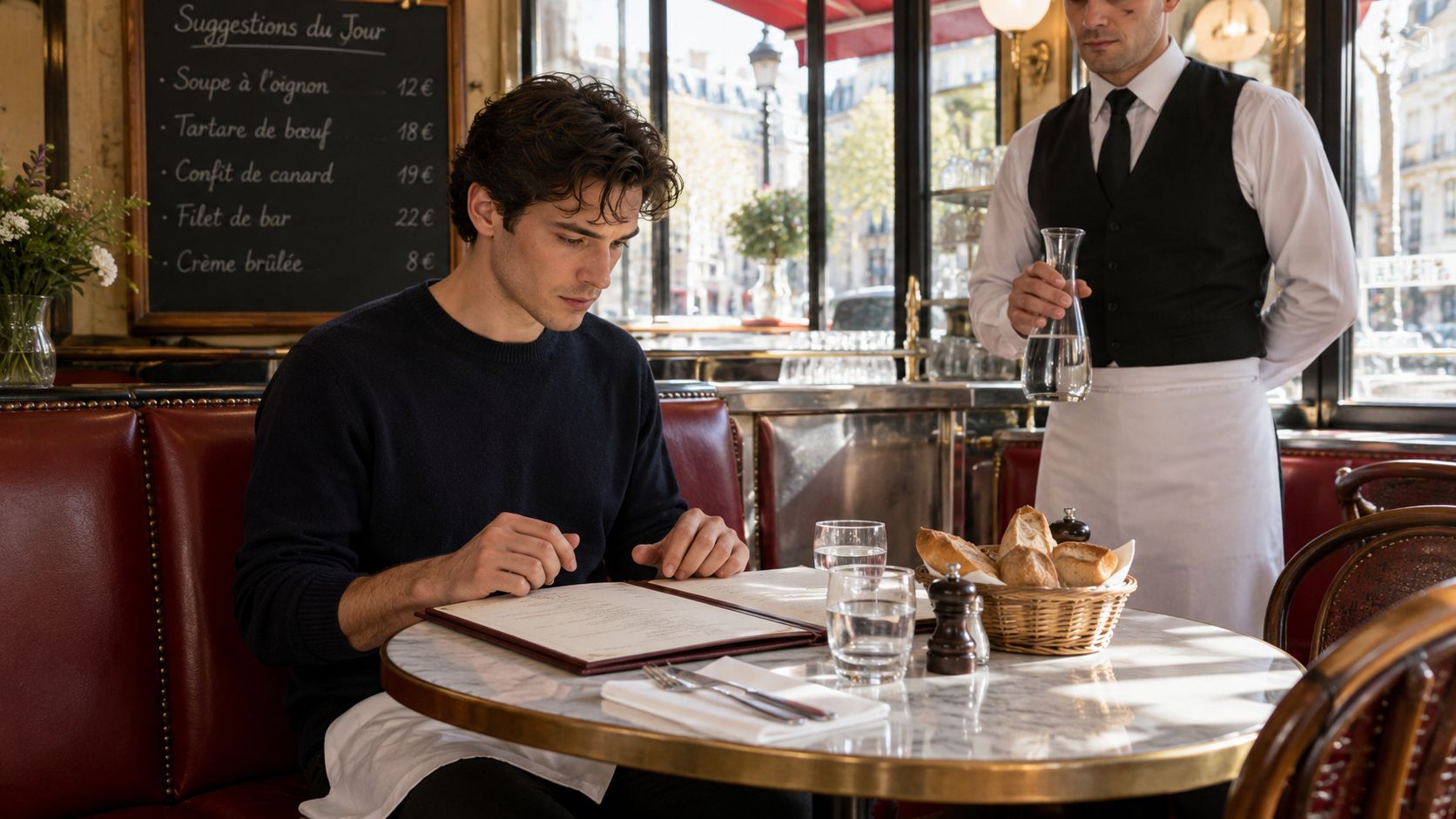
Next, settle into the meal's pace. French dining isn't a race between courses, and the server may not check on you as often as you're used to. Take time to read the menu, order when you're ready, and let conversation fill the gaps. If you need something, catch the server's eye and ask politely rather than calling across the room.
Then, read the room before you act. Is the table waiting for everyone to be served? Are other diners taking their time with bread? Has the host started eating? Follow the group's lead. At a hosted meal, wait until everyone has been served and let the host set the pace.
The useful rule: Be attentive, not anxious. A considerate guest notices the people around them and adjusts.
That's the heart of French dining etiquette: not memorizing a hundred tiny rules, but showing that you're present and respectful. If you're also navigating different expectations around small talk, personal space, or directness, this guide to differences between French and American culture can help you read the room beyond the menu.
Why French Meals Move as a Coordinated Sequence
The unhurried rhythm at a French table has historical roots. During the 17th century, the French court developed service à la française: multiple dishes from the same course appeared at once, arranged in prescribed positions, with a meal unfolding across three or four successive services. That display of abundance and symmetry spread through Europe in the 18th century, then gave way in the first half of the 19th century to service à la russe, where dishes arrive sequentially around each diner's place. That second model won, and it fixed the expectation you still feel at any Paris table: courses come in an intentional order, and you wait for the host or server before starting. (Historical overview of French table service)
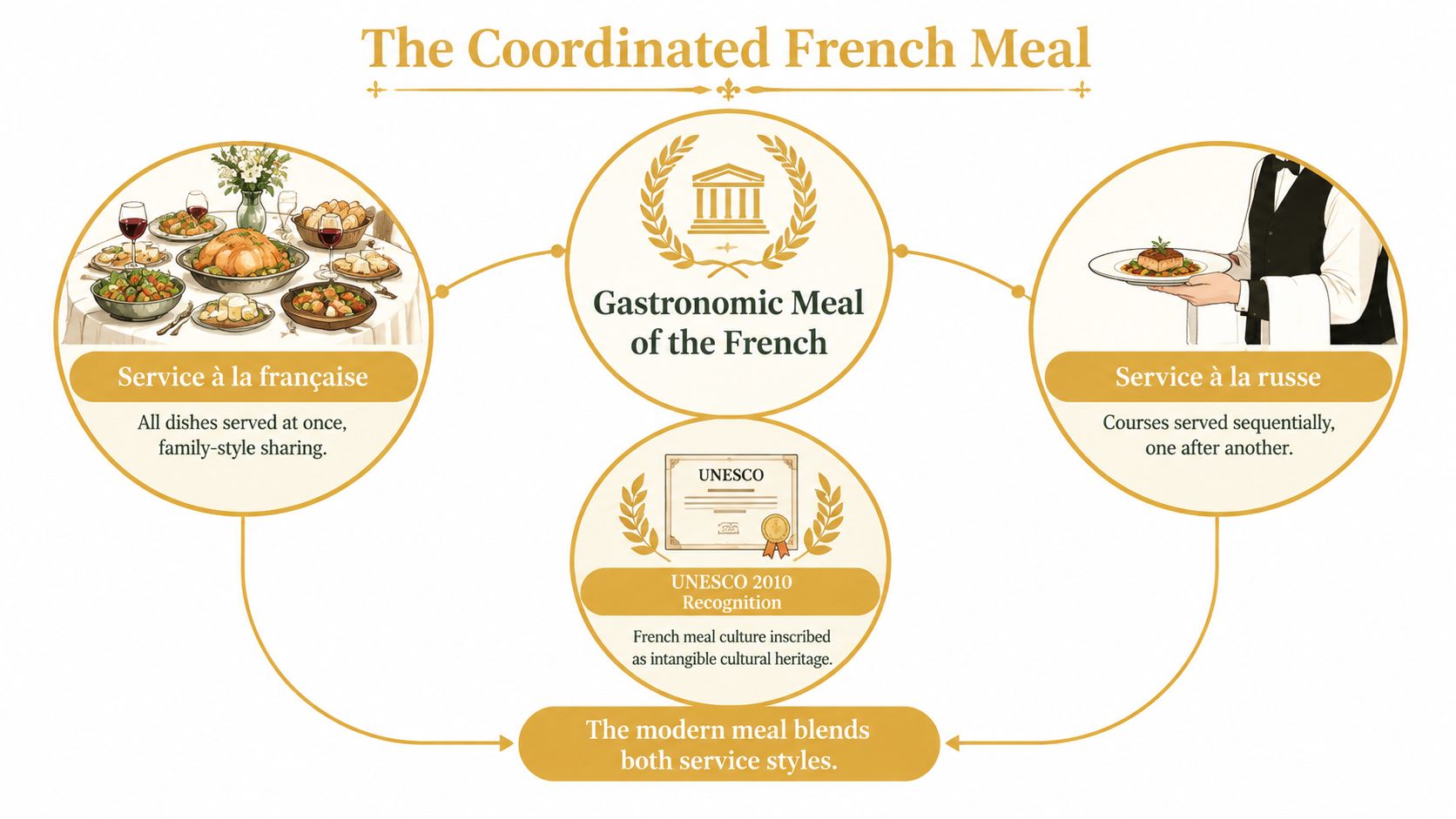
France treats that shared meal as culture worth protecting. In 2010, UNESCO added the "gastronomic meal of the French" to its Representative List of the Intangible Cultural Heritage of Humanity, recognizing the practice of choosing quality ingredients, pairing food and wine, setting the table, following a course sequence, and talking together over all of it. (UNESCO-related press dossier on the tables of power)
The rhythm matters more than the script: people wait, courses arrive in turn, and conversation belongs to the meal. You can watch it at any ordinary bistro, no banquet required. Research on eating behavior in the Paris metropolitan area describes a common three-meal schedule, with lunch and dinner organized within defined time windows, while also noting that routines vary by household and workplace. (Research on meal patterns in the Paris metropolitan area)
The same patience covers the modern wrinkles too. When a card terminal flashes a tip prompt or you need to flag a food allergy, the sequence still holds, and a calm, polite request fits inside it.
My advice for a business meal: plan for conversation and courses rather than squeezing dinner into a rushed meeting slot. For more context on the food itself, explore what the French eat and how their meals are structured.
Reading the Place Setting and Using Cutlery the French Way
Your fork stays in your left hand and your knife in your right for the entire meal. Diners who switch the fork after cutting give themselves away instantly; the continental grip never changes hands, and a week of practice at home fixes it. Work from the outside inward as courses arrive, since the utensils furthest from the plate serve the first course. (French place-setting and utensil guidance)
Then learn the silent signals. Resting your fork and knife on the plate, angled apart, tells the server you are still eating. Lay them side by side across the plate and the course can be cleared. One hard rule: used cutlery never goes back on the tablecloth.
Napkin: Unfold it onto your lap as soon as you sit. Keep your elbows off the table.
Bread: Tear off a small piece by hand. In a café or brasserie, it usually sits on the table beside the plate, on the left, rather than on the plate itself. A formal setting may add a small bread plate, and lacking one is no mistake. (Bread placement and table etiquette)
Pacing: Bread accompanies the food, it does not open the meal. Skip the basket while you wait.
When cheese arrives, tear a small piece of bread, take a little cheese with it, and use your utensils where they fit. Spreading across a whole slice like a sandwich marks you as a visitor. If someone asks for bread, pass the basket instead of handing over a single piece. (Bread and passing food politely)
Ordering, Courses, and the Phrases That Carry the Meal
A French meal may be simple, but its sequence helps everyone understand what comes next. The familiar structure is starter, main course, and dessert. A more extended meal may begin with an apéritif, include cheese before dessert, and end with a digestif. The exact order depends on the setting and menu, so follow the host or ask your server if you're unsure.
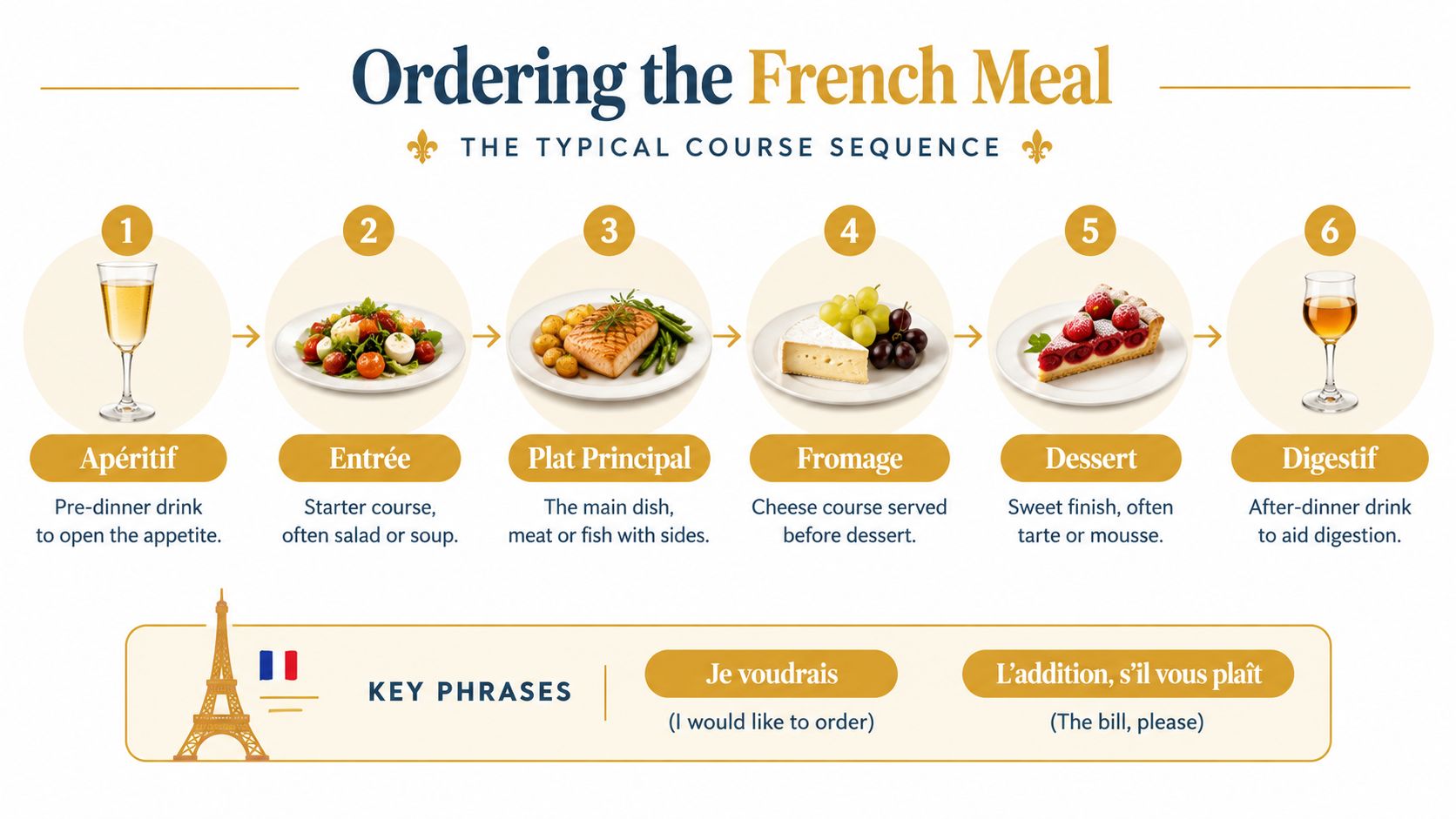
You don't need elaborate French. A polite greeting and a clear request will carry you through most meals. If you need more time, say “Je n'ai pas encore choisi” (“I haven't chosen yet”) or “Une minute encore, s'il vous plaît” (“One more minute, please”). For your order, “Je voudrais…” means “I'd like…” and “Je vais prendre…” means “I'll have…”. For water, ask for “une carafe d'eau” if you want tap water.
| Stage | Café | Restaurant | Hosted dinner |
|---|---|---|---|
| Arrival | “Bonjour, une table pour deux, s'il vous plaît.” | “Bonsoir, j'ai une réservation au nom de…” | Greet the host and wait to be shown where to sit. |
| Choosing | “La carte, s'il vous plaît.” | “Je n'ai pas encore choisi.” | Ask the host if you're unsure how the meal will unfold. |
| Ordering | “Je vais prendre le plat du jour.” | “En entrée, je voudrais…” or “Pour le plat, je vais prendre…” | Let the host or others begin the ordering conversation. |
| Water | “Une carafe d'eau, s'il vous plaît.” | “Une carafe d'eau, s'il vous plaît.” | Accept what's offered, or ask politely for water. |
| Bill or thanks | “L'addition, s'il vous plaît.” | “L'addition, s'il vous plaît.” | Thank your host; don't treat the end of dinner like a restaurant checkout. |
When you're ready to leave a restaurant, ask for “l'addition, s'il vous plaît” rather than waiting for the bill to appear. For a more practical vocabulary refresher, review these French phrases for working in a café.
Tipping in France Without Overspending or Offending
The awkward moment often comes after an otherwise lovely coffee. The card terminal turns toward you and offers tip options. You don't need to panic or pick a percentage just because the screen asks.
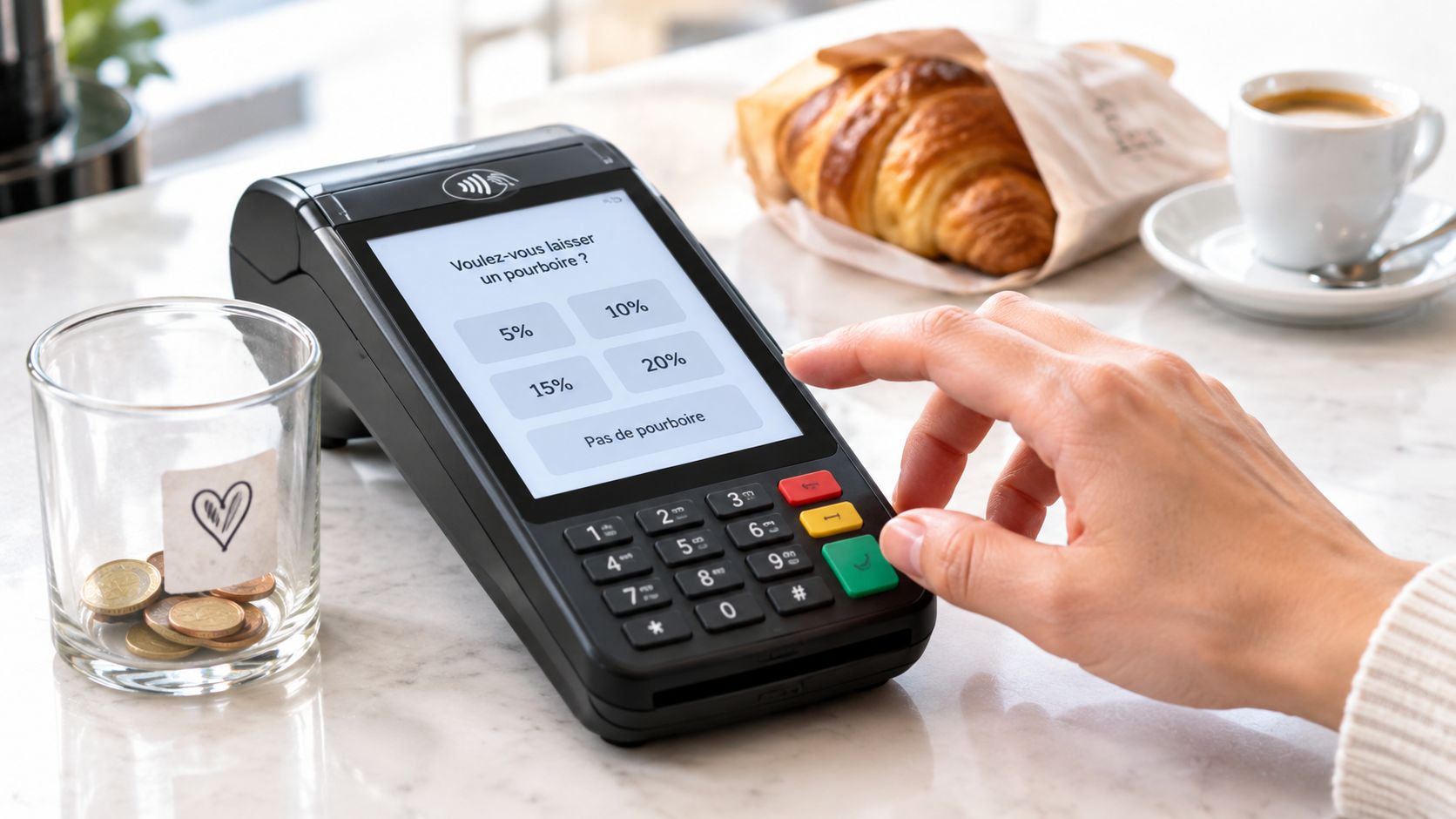
Traditional French guidance treats service as included in the menu price. An additional pourboire is discretionary, not an automatic percentage. If the service was especially attentive, leaving a small amount is a gracious gesture. Don't import a U.S.-style tipping habit into every café transaction, and don't let a digital prompt make the decision for you.
| Situation | Clear recommendation |
|---|---|
| Café counter or takeaway | Decline the prompt without fuss. A tip isn't required just because a jar or screen is there. |
| Brasserie table service | Tip only if you want to recognize particularly good service. Keep it modest. |
| Fine dining | A discretionary extra can acknowledge attentive service, but it isn't an obligation. |
| Group dinner | Decide whether anyone wants to leave a small shared tip. Don't assume the machine's preset amount is the expected choice. |
| Card prompt | Choose no additional tip if that's your preference. The screen is a payment option, not a social command. |
If you're unsure, ask “C'est déjà compris, n'est-ce pas ?” (“It's already included, isn't it?”). If you're paying cash and want to leave the change, “Gardez la monnaie” means “Keep the change.” These phrases let you make your choice calmly without turning the moment into a debate.
The newer digital prompts create a visible tension with the traditional service compris convention, particularly when a machine requests a percentage for counter service. The sensible response is the same as at the table: decide based on the service you received, not on pressure from a screen.
Modern Etiquette for Allergies, Substitutions, and Tap Water
Good etiquette isn't pretending you have no dietary needs. It's communicating them clearly and giving the restaurant room to tell you what's possible. A kitchen may not be able to alter every dish, but a respectful question is not a breach of manners.
For an allergy, be direct and specific. You can say “Je suis allergique à…” (“I'm allergic to…”) and name the ingredient. If the allergy is serious, contact the restaurant before you arrive so staff can check what the kitchen can safely prepare. Don't rely on hints or assume a server will infer the risk from what you leave uneaten.
Vegetarian, religious, or other dietary requests deserve the same clarity. Ask whether a dish can be adapted rather than demanding a change: “Est-ce possible de préparer ce plat sans… ?” (“Is it possible to prepare this dish without…?”). The answer may be no. Accept it graciously and choose another option.
Good manners work both ways: Explain what you need, ask rather than insist, and respect the kitchen's answer.
For tap water, ask for “une carafe d'eau”. That's a clear, ordinary request, not a special accommodation. If you need a smaller portion for a child, want to understand the serving size, or hope to take leftovers away, ask politely and let the restaurant tell you what it can offer.
Restaurant expectations are also shifting toward health, sustainability, affordability, local sourcing, waste reduction, and more plant-forward food. That doesn't mean every restaurant will meet every need. It does mean the old idea that a considerate diner must never ask a question is too rigid. Clear communication, flexibility, and courtesy are the better standard.
A Student Story When Etiquette Got in the Way of Dinner
A student preparing for a business trip to Lyon told me about a dinner that went wrong before the main course arrived. He sat down, ordered quickly, cut his bread, and moved straight into business talk while the rest of the table was still settling in. Nobody reprimanded him. The room became harder to join.
The problem wasn't that he lacked polish. He was trying to be efficient, and he assumed speed would signal competence. At that table, it did the opposite. His colleagues were treating dinner as shared time, while he treated it as a meeting with food attached.
We worked on a few practical habits before his next dinner. He practiced greeting the staff, waiting for the host's lead, and using “Je vais prendre…” without rushing through the menu. He also rehearsed a neutral pause phrase, “Une minute encore, s'il vous plaît,” so he could take his time without feeling awkward.
At the second dinner, he let the conversation breathe and followed the table's pace. He waited before starting, tore his bread by hand, and asked a colleague for a recommendation instead of ordering the first familiar dish. The difference wasn't a flawless performance. He was more attentive, and the conversation opened up.
That's what preparation is for. You don't need a script for every course; you need a handful of phrases and the confidence to use them at the right moment. A short practice session can make the rules feel less like a checklist and more like natural social habits.
Quick Recap and How to Sound Like You Have Done This Before
Keep this short list in mind when you sit down:
Greet first: Say “Bonjour” or “Bonsoir” before making a request.
Wait and watch: Let the host set the pace, and don't begin before the table is ready.
Use your cutlery consistently: Fork left, knife right. Work from the outside inward.
Treat bread as an accompaniment: Tear it by hand, and skip it while you wait for the first course.
Ask clearly: Use “Je voudrais…” to order, “une carafe d'eau” for tap water, and “l'addition, s'il vous plaît” when you want the bill.
Make tipping your choice: A terminal prompt doesn't obligate you to add a tip.
State dietary needs politely: Explain the need, ask what's possible, and accept the kitchen's answer.
The most useful skill is speaking calmly when you need something. A simple phrase, delivered with a greeting and a “s'il vous plaît,” is better than staying silent and hoping the server guesses. You don't have to sound like a native speaker to come across as considerate.
Before your next trip, practice the phrases aloud until they feel easy to retrieve at the table. You can compare private French lesson options and choose a format that fits your travel plans, whether you want focused speaking practice online or in person.
Book a free 20-minute consultation with Elite French Tutoring to talk through your goals and find a lesson format that suits you. A little guided practice can make the next brasserie lunch or business dinner feel far more natural.