Skip to content


You're standing outside a classroom after a school tour, holding a fee sheet and wondering whether your child could manage science in French. The admissions team sounded confident. Your child liked the playground. But the other school you visited also called itself bilingual, and its timetable looked completely different.
Table of Contents
- The Decision Most Parents Underestimate
- What Counts as a French Bilingual School
- Curriculum, Assessment, and What Students Walk Away With
- The Real Benefits and the Honest Trade-Offs
- Admissions Timelines, Total Cost, and the Questions That Matter
- Supporting Your Child at Home and Knowing When to Add Help
- A Real Family Story and Your Next Step
The Decision Most Parents Underestimate
The expensive mistake isn't choosing a school with less French. It's choosing a school whose version of bilingual education doesn't fit your child's starting point, learning needs, or next move.
I'd rather see a family choose a modest-looking program with clear teaching expectations than an impressive campus with vague answers about language support. A confident admissions presentation isn't evidence that a child will understand a history textbook or learn to write an argument in French.
The brochures can make different offers look interchangeable.
Start With the Child's Next Transition
Before booking another tour, decide what you're buying. Is it continuity with a French curriculum, sustained bilingual literacy within your local education system, or preparation for a possible relocation?
Those are different priorities. A child likely to transfer into French-medium secondary education needs a different preparation plan from a child whose family wants French alongside a long-term English-language school pathway.
- For a likely international move, prioritize curriculum compatibility and written transfer expectations.
- For long-term local schooling, investigate whether French-medium subjects continue through secondary school.
- For a child needing accommodations, examine the support agreement before weighing enrichment activities.
- For a late entrant, ask how the school distinguishes missing French vocabulary from missing subject knowledge.
My buying rule: Choose the program your child can grow within, not the label you'd most like to put on an application.
Define Success Before Comparing Offers
I recommend writing a short family decision statement: the academic pathway you want to preserve, the language abilities you value, and the support you can realistically provide at home.
Then test each school against it. If your household can't supervise French homework, don't build a plan that depends on that supervision. If another move is plausible, don't accept an admissions answer that stops at the next school year.
The right fit includes the timetable, the exit route, and the help available when things become difficult. Tuition buys access to a program. It doesn't remove the need to check whether that program suits your child.
What Counts as a French Bilingual School
For school-shopping purposes, I use French bilingual schools to mean schools providing sustained academic instruction in French alongside another instructional language. That's broader than schools following the French national curriculum, and narrower than schools offering French only as a language subject.
France's Ministry for Europe and Foreign Affairs reported that, in 2019, roughly 2 million students in about 50 countries participated in French bilingual programs, while a specifically identified network comprised 393 streams across 58 countries, serving nearly 130,000 students. Those are different populations, not competing estimates, as the ministry's overview of French teaching and bilingual education explains.
Three French Bilingual School Models at a Glance
Treat this table as a way to classify offers, not as a substitute for an individual school's timetable.
| Model | Governing Curriculum | Typical French Allocation | Exit Qualification |
|---|---|---|---|
| French national curriculum abroad, including Lycée Français pathways | Official French curriculum; verify the specific school and grades | Ask which subjects use French and how the other language is integrated | Confirm the French examination pathway offered |
| One-way French immersion within a local school system | Host-system curriculum | French used for designated academic subjects; request the actual schedule | Confirm local diploma requirements and any additional certification |
| Dual-language school | The school's declared national or international curriculum | Subjects or instructional periods distributed across French and another language | Depends on the governing curriculum and examination route |
A French-curriculum school isn't automatically the strongest bilingual choice. Equally, an immersion program isn't a less demanding version of French schooling. Curriculum and instructional language are separate purchasing decisions.
Check Who Is Accountable
Ask who approves the curriculum, who inspects the school, and which recognition applies to your child's actual grade. Then separate that from funding: what does the public authority cover, what does the school charge, and what remains the family's responsibility?
For a formal example, the ministry describes LabelFrancÉducation as recognizing qualifying bilingual programs that follow the host country's curriculum while providing enhanced French instruction and teaching a non-language subject in French. It isn't a reason to assume that every French-speaking school follows the French national program.
If immersion is on your shortlist, compare French immersion program options against the school's subject timetable. Count academic instruction, not French-themed activities.
Curriculum, Assessment, and What Students Walk Away With
Ask admissions to show you a marked piece of student work. A timetable tells you when French happens; assessed work tells you what teachers expect children to do with it.
I'd compare reading comprehension, written reasoning, and subject vocabulary before comparing language-exam badges. A child may participate comfortably in conversation yet need explicit help interpreting a science question or organizing a literature response.
Compare the Academic Route
| Model | Curriculum and Assessment to Verify | Exit Route to Confirm | Family Profile I'd Prioritize |
|---|---|---|---|
| French national curriculum | French academic expectations, written work, subject assessments, and examination preparation | Relevant French qualifications and transfer eligibility | Families seeking continuity with French schooling |
| Local-system immersion | Host-curriculum coverage and separate reporting of French development | Local qualifications plus any optional language examinations | Families remaining in the local system |
| Dual-language | Coherent subject coverage and assessment expectations in both instructional languages | The school's specific diploma and certification pathway | Families wanting sustained instruction across both languages |
The visual below offers useful comparison prompts, but its labels shouldn't be treated as universal program rules.
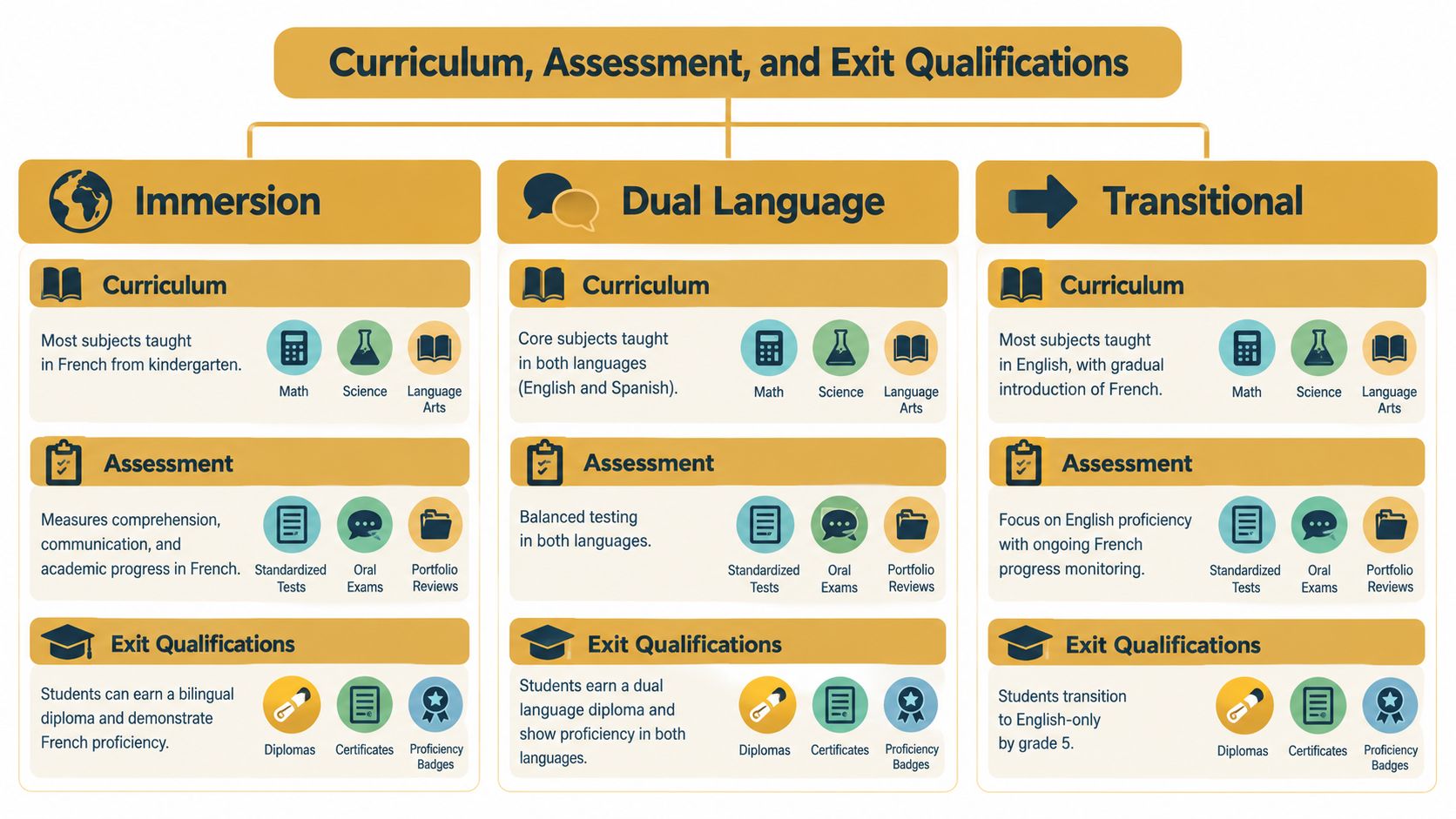
In particular, don't assume that every immersion school teaches the same subjects in French, or that every transitional program changes language at a fixed grade. Obtain the school's own progression map.
Buy Evidence of Progress
Research on children learning French alongside another language found that bilingual experience didn't undermine French literacy: stronger or balanced language competence supported the strongest French reading outcomes, and home-language use wasn't itself a barrier, according to research published in Applied Psycholinguistics.
My recommendation is to request grade-specific expectations for:
- Reading, including unfamiliar texts and comprehension.
- Writing, including explanations, argument, and revision.
- Listening, including classroom instructions and subject discussion.
- Academic vocabulary, especially when a subject changes instructional language.
For DELF or DALF preparation, ask what the proposed examination adds to your child's goals rather than treating it as a replacement for school assessment. Families considering a younger learner's certification route can review DELF Prim preparation considerations.
An examination goal and a curriculum goal need separate plans. Have the school identify formal assessment points in writing rather than assuming they're identical across programs.
The Real Benefits and the Honest Trade-Offs
The strongest reason to consider immersion is sustained access to academic learning through French, not a promise that bilingualism automatically makes every child a stronger student.
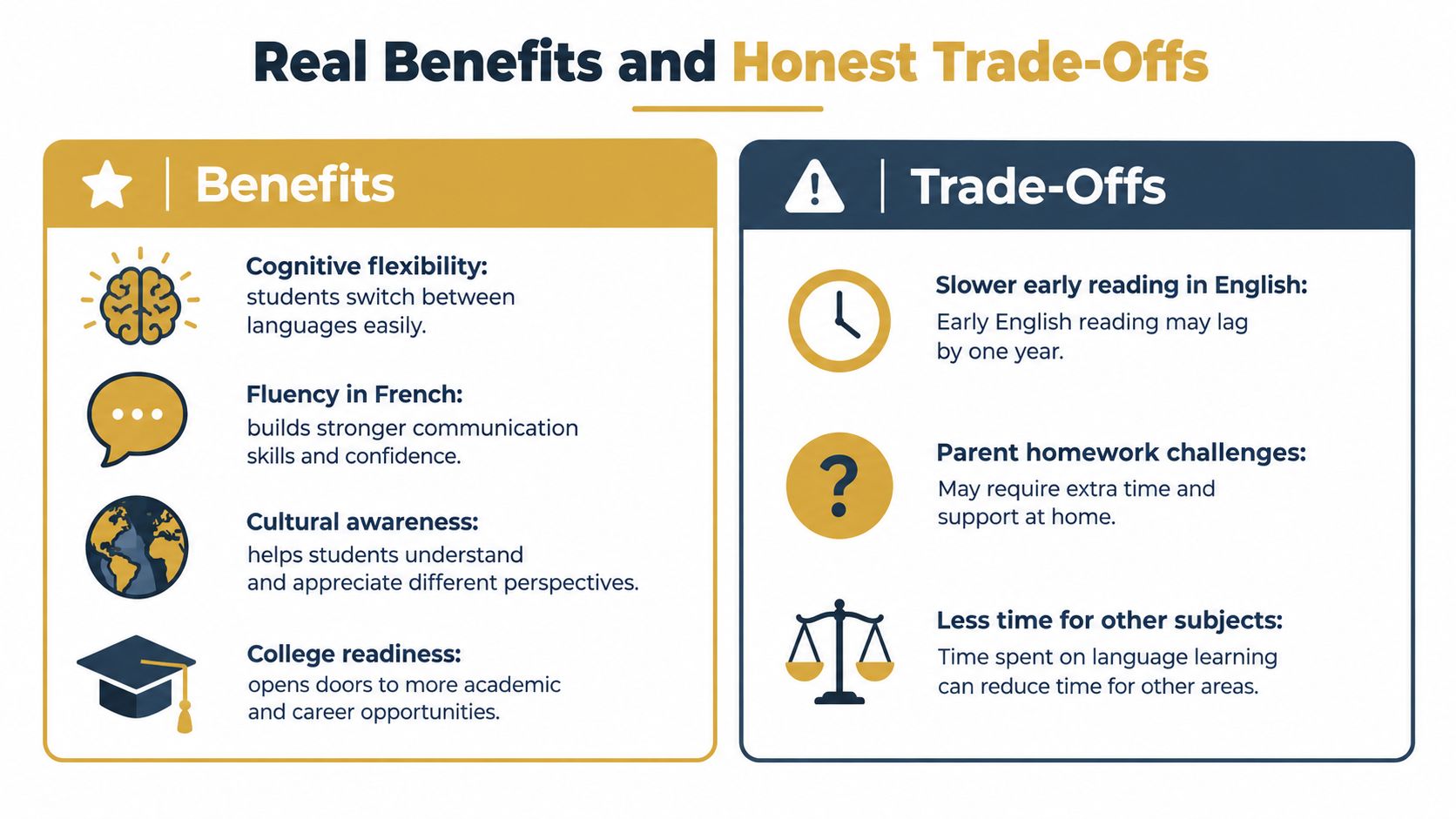
Use the following graphic as a discussion starter, not a forecast. In particular, I wouldn't accept a fixed prediction about English-reading delay without evidence from the school and an assessment of the child.
What the Outcome Evidence Supports
A large district evaluation found advantages for French-immersion students over statistically matched peers ranging from approximately 6 percentage points in Grade 3 English-language arts to 38 in Grade 8, alongside 14–39 points in mathematics and 9–25 points in science, according to the Prince George's County French-immersion evaluation.
That's a documented student-success story at cohort level: children learning academic content through French also performed strongly in other assessed domains. It's meaningful evidence against assuming that French necessarily displaces English or subject learning.
It isn't a guarantee for another school. The evaluation was not proof that every immersion design produces the same results, and program quality and selection still matter.
A promising result earns a school more questions, not an automatic enrollment deposit.
Where the Promise Can Break Down
A Population Europe digest about bilingual children's educational trajectories in France reports poorer educational outcomes after controlling for major confounding factors, with disadvantage widening through schooling. That concerns bilingual learners' trajectories, not a direct trial showing that all bilingual schools underperform.
The practical conclusion is clear: don't confuse a child's bilingual background with the effectiveness of a particular school model. Ask whether the school can show outcomes for learners entering with circumstances similar to your child's.
This video can support a family conversation, but it shouldn't replace school-specific evidence.
I'd weigh the benefits of bilingual education against workload, continuity, and access to help. A program that requires your child to struggle unsupported isn't a better investment because its French allocation looks impressive.
Admissions Timelines, Total Cost, and the Questions That Matter
Compare the cost of attending, not just the cost printed beside “tuition.” Application charges, entry fees, assessment fees, and learning support can change the decision before lessons begin.
Don't assume admissions calendars match. Request each school's application deadline, assessment window, decision date, deposit deadline, and withdrawal terms before paying a non-refundable charge.
Published Cost Comparison Across Three French Bilingual Schools
The comparison below includes schools relevant to a French bilingual search, but their fee schedules don't establish identical language models. Confirm the specific stream before treating them as equivalent offers.
| School | Application Fee | Entry Fee | Primary Tuition | Secondary Tuition |
|---|---|---|---|---|
| French International School of Hong Kong, published 2026–27 schedule | HK$2,200 per stream; bilingual-class assessment adds HK$1,000 per stream | Confirm separately | CP–CM2: HK$150,226 annually | Collège: HK$159,228; lycée: HK$192,589 annually, per the published Hong Kong fee schedule |
| Ermitage French Bilingual School, published 2026–27 schedule | €300 for new students | €600 for new students | Petite Section–CM2: €7,500 annually | 6ème–2nde: €7,600; Première–Terminale: €8,300 annually, per the Ermitage fee document |
| International School of Paris, published 2025–26 schedule | €1,000 | €10,000 for new students in Grades 1–12 | Grades 1–5: €30,440 annually | Grades 6–9: €35,440; Grades 10–12: €37,860; additional learning support is €2,750 for Level A1 or €3,800 for Level A2, per the Paris fee schedule |
These are published schedules for their stated academic years, not interchangeable current quotations. Request a personalized written offer and don't compare different currencies as though they represented equivalent household costs.
Ask What the Quotation Actually Includes
Ermitage's cited document includes the official French national program, mandatory bilingual immersion, and mandatory subject-specific Baccalauréat preparation for the relevant upper-secondary students. The Hong Kong schedule identifies its application charge as non-refundable and non-transferable.
Those details matter more than an admissions claim that a school offers “full support.”
- Before applying, ask whether language assessment determines admission, placement, or a support requirement.
- Before accepting, request all compulsory charges, refund conditions, and payment obligations.
- Before budgeting for help, distinguish included classroom support from separately billed services.
- Before a curriculum transition, get the expected entry skills and the school's response if your child hasn't reached them.
- Before comparing offers, ask both schools to price the same circumstances, including your child's grade and identified needs.
Budget advice: Don't build an affordable-school calculation around support that admissions hasn't confirmed in writing.
I'd also ask whether recommended outside tutoring is genuinely optional. If a placement is only workable with continuing private help, include that dependency in your decision.
Supporting Your Child at Home and Knowing When to Add Help
You don't need to become your child's French teacher. You need a manageable home routine, understandable school communication, and a clear route to help.
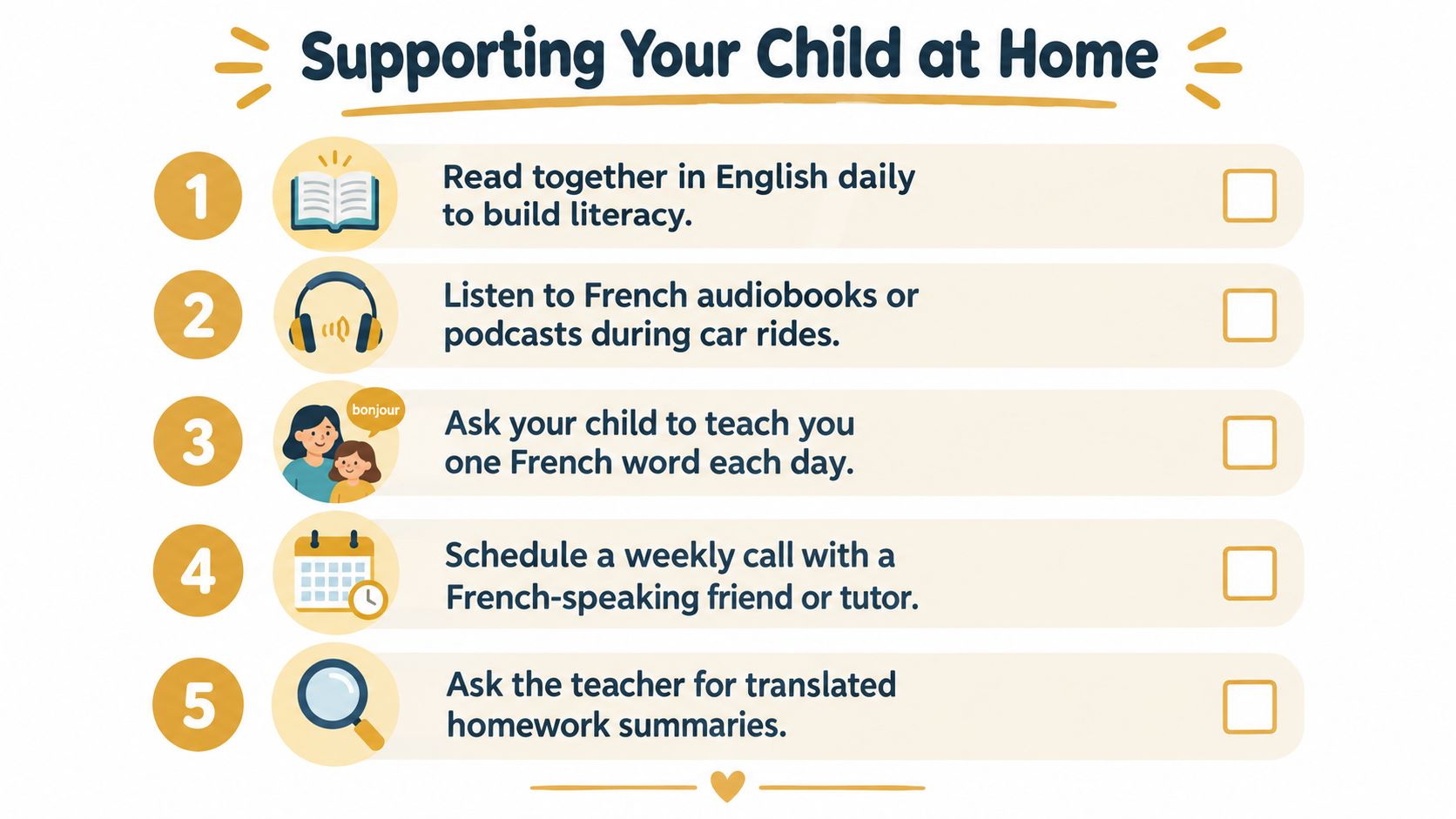
Start with activities you can sustain rather than a second school day after dinner. Use this checklist selectively, adapting the reading language and communication arrangements to your household.
Make the Work Visible Without Taking It Over
Ask your child to explain the assignment's purpose in the language you share most comfortably. Then look at the teacher's feedback together: was the difficulty understanding the concept, decoding the instruction, selecting vocabulary, or constructing the answer?
I'd use those distinctions when deciding whether to purchase tutoring. “Needs more French” is too vague to justify an ongoing expense.
- Textbook difficulty, bring the actual passage and the child's attempted response.
- Falling subject marks, ask the teacher whether language or subject understanding is the main obstacle.
- Writing frustration, compare an oral explanation with the written version.
- Exam anxiety, identify the task causing difficulty before buying general conversation lessons.
For certification preparation, bring the proposed DELF or DALF goal into the discussion alongside schoolwork. Don't let practice for an external examination consume time needed for an immediate classroom problem.
Require an Inclusive Support Plan
An Ontario French-immersion literature review identifies barriers for neurodiverse immigrant learners, including insufficient teacher training, inadequate accommodations, misinformation, and financial burdens. It also discusses research connecting low parental French proficiency and inaccessible school communication with reduced parental autonomy and competence.
The answer isn't to blame the home language or expect parents to compensate without speaking up. Ask who coordinates accommodations, how an individualized education plan is implemented in French-medium classes, and how teachers communicate with non-French-speaking caregivers.
School-based help, a specialist where appropriate, and private tutoring are different options. Elite French Tutoring offers individualized lessons and curriculum-aligned academic support; families can consider French support for school alongside the school's own provision.
My standard for any tutor is concrete: use current classroom materials, identify a specific obstacle, teach the missing skill, and show the family what the student can increasingly do independently.
A Real Family Story and Your Next Step
The most useful success story isn't always the neatest one. A credible account needs a starting point, an identifiable intervention, and an outcome that somebody documented.
I wouldn't base your enrollment decision on an anonymous story about a child transferring into a Lycée Français, struggling before the Brevet, and recovering through tutoring unless those details were documented. The district cohort discussed earlier supplies real evidence of student success; it doesn't establish that particular family narrative.
What a Transfer Story Must Show
If your family is considering a similar move, ask the receiving school or prospective tutor for a documented, appropriately anonymized example. You need more than “the student became confident.”
- Starting point, what could the student already understand, read, and write?
- Curriculum gap, was the difficulty literary analysis, historical explanation, subject vocabulary, or something else?
- Support delivered, what did the teacher or tutor teach?
- Evidence of progress, what changed in assessed work or independent performance?
- Limits, what continued to require accommodations or help?
That's how I'd evaluate a real family's experience without assuming your child will follow the same path. A success story should clarify a service, not substitute for an assessment.
Don't Treat Inclusion as an Exception
French international schooling serves far more than French expatriate households: a network overview reports more than 392,000 students across 580 schools in 139 countries, with approximately 65%, or about 255,000 students, being non-French citizens, in the French international-school network summary.
That international composition makes it especially important to ask how a school handles different language histories. I'd expect direct answers about newcomers, midstream transfers, neurodivergent learners, and caregivers who can't read French.
Support should be part of the placement decision, not a rescue plan discussed only after a child struggles.
Your next move is practical: tour contrasting programs, request their written language-allocation and assessment plans, and compare complete entry costs. Bring your child's recent work and any accommodation documentation into the conversation before committing.
If your shortlist is ready but the support plan isn't, request a free 20-minute consultation through the publisher's school-support service. We'll discuss your child's current level, learning style, and goals before recommending a program, so you can judge whether individualized lessons belong alongside the school's provision.