Skip to content


You can absolutely spend six months “studying” French remotely and still freeze when someone asks you a simple question on Zoom. I see this all the time with busy professionals, parents, and exam candidates. They download an app, join a class, maybe watch a few videos, then wonder why French never becomes usable.
The fix is not more content. It's a system. If you want to learn French remote in a way that sticks, you need three things working together, who teaches you, how you practice, and how you verify progress. UNESCO's remote-learning data made the problem obvious during school closures, when online platforms reached only about one-quarter of students globally and distance learning failed to reach at least 500 million students, so access alone clearly didn't produce outcomes (UNESCO distance-learning assessment). French works the same way. A platform can deliver lessons, but only a designed routine turns those lessons into speech.
Table of Contents
- Why Remote French Needs a System, Not a Stack of Apps
- Choosing the Right Remote Format for Your Goals
- Setting Up Your Tech and Platforms the Right Way
- A Weekly Study Rhythm That Actually Fits a Real Life
- Immersive Practice Techniques That Transfer to Conversation
- Tracking Progress and Planning Around CEFR Milestones
- Remote DELF and DALF Preparation That Performs on Test Day
Why Remote French Needs a System, Not a Stack of Apps
Remote French fails when learners confuse activity with progress. A calendar full of flashcards, videos, and occasional classes feels productive, but it often produces very little speaking confidence. If your French lives in disconnected tools, your brain never has to retrieve it under pressure.
Start with the real goal, not the tool
If you're a parent, you probably want your child to speak with a teacher without panic. If you're a diplomat or executive, you need controlled, professional French in meetings, not passive recognition of vocabulary. If you're preparing for DELF or DALF, you need test-day execution, not just familiarity with app exercises.
That's why I push learners to think in systems. First, choose a live instructor or program that forces real interaction. Second, build a practice loop that recycles vocabulary and grammar until production becomes easier. Third, verify whether the skill survives outside the lesson room.
Practical rule: if a French task can't be used in a live conversation, a timed exercise, or a recorded check-in, it's probably not moving your fluency forward fast enough.
French is a large, distributed language with official status across continents, so remote instruction makes sense for people who can't relocate to a francophone city. But remote convenience only works when you create accountability around it. That's the operating system this guide follows, not a shopping list of apps.
Choosing the Right Remote Format for Your Goals
The best format depends on what you need French to do. A private lesson, a group class, and self-study all have a place, but they don't do the same job. The wrong choice isn't always obvious until you've wasted a few months.
Remote French Formats Compared
| Format | Accountability | Speaking Time | Flexibility | Best-Fit Learner |
|---|---|---|---|---|
| Private tutoring | High, because one person is responsible for your correction and follow-through | High, because you're speaking most of the session | High, if scheduling is consistent | Busy professionals, teens, exam candidates, families, relocation prep |
| Group online classes | Moderate, because progress is shared and attention is divided | Lower, because turns are shared | Moderate, because you follow a fixed class time | Learners who need peer energy and can tolerate slower correction |
| Self-study | Low unless you build your own structure | Very low unless you add live practice | Very high, but easy to drift | Strongly self-directed learners using it as a supplement |
Private tutoring belongs at the center if you need accountability and correction. Group classes work when you want social exposure, but they usually under-deliver on speaking time. Self-study should support the program, not carry it.
A Stanford National Student Support Accelerator review found that high-impact tutoring depends on frequent sessions, small student–tutor ratios, and sustained tutor relationships, not the remote-vs-in-person channel alone (Stanford NSSA tutoring review). That's the core principle here. If your French matters for work, school, or an exam, the center of gravity should be a live, accountable instructor.
For a deeper comparison of lesson options, I'd start with this breakdown of online French lessons. It's the kind of decision support busy adults need before they pay for anything.
My blunt recommendation by learner type
- Busy professionals: choose private tutoring first, then add occasional group conversation if you want more speaking variety.
- K–12 students: choose private tutoring or a tightly structured small group only if homework and school alignment are built in.
- DELF candidates: choose private tutoring with timed oral and written checks.
- Expat parents: choose a format with fixed weekly appointments and clear follow-up, because family schedules change fast.
- Corporate teams: choose a live, instructor-led program that matches business scenarios, not generic beginner conversation.
The right remote format doesn't just feel convenient. It keeps you visible to another human who notices when you drift.
Setting Up Your Tech and Platforms the Right Way
Most remote French frustration comes from bad setup, not bad teaching. Choppy audio, glare from a window, and a weak backup plan can ruin a strong lesson. Learners blame the class when the actual problem is the room.
The minimum setup I insist on
You do not need a studio. You do need a stable routine for sound and visibility.
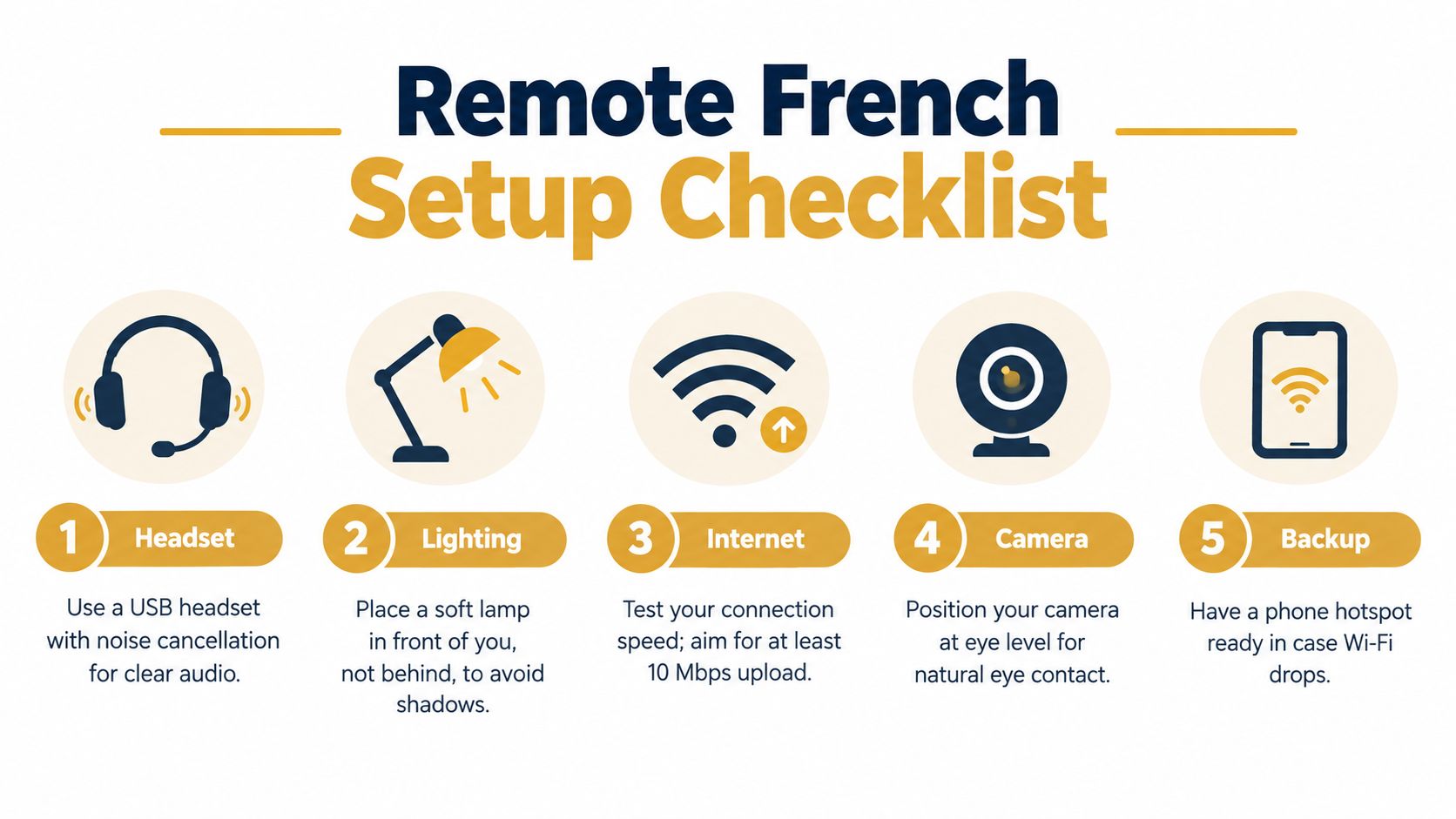
- Use a USB headset. It cuts echo and makes pronunciation correction much easier.
- Put a lamp in front of you. Backlighting makes lip reading and facial cues harder.
- Keep a second device nearby. A phone or tablet can save a session if your laptop acts up.
- Check your camera height. Eye-level placement creates more natural conversation.
- Have a backup connection. A hotspot can rescue a lesson when Wi-Fi drops.
A study of online language learning at South Ural State University found that learners preferred BigBlueButton, while some switched to Discord and Google Meet after technical problems, and most preferred scheduled lesson times (South Ural State University study). That matters because it shows a simple truth. Platform choice is only part of the issue, reliability and scheduling matter just as much.
What to ask before you pay for a program
Ask whether the platform supports stable video and audio. Ask whether the instructor has a backup channel if the call fails. Ask how missed sessions are handled. Ask whether lessons are scheduled at fixed times or shifted constantly.
If a tutor can't explain the backup plan in one sentence, I wouldn't commit yet.
The best remote lessons don't feel improvised. They feel easy because the structure is boring in the right way. You log in, you speak, you get corrected, and the session ends without technical drama.
A Weekly Study Rhythm That Actually Fits a Real Life
One of my corporate clients had a problem I see constantly. She wanted French for travel and work, but her week moved between New York, Paris, and Nairobi. She didn't need more motivation. She needed a rhythm that survived airports, calendar chaos, and time zones.
What changed her progress
She moved from scattered effort to a fixed weekly pattern: two private lessons, one group conversation slot, a short daily spaced-retrieval block, and one longer immersive input session with a podcast, show, or news clip. That combination gave her structure without trapping her in an unrealistic routine.
By her ninth month, she was handling everyday and professional exchanges with much more confidence. I'm calling that a success story because it was repeatable, not because it was magical. She didn't “find more time,” she protected a few recurring blocks and stopped renegotiating them every week.
The reason this works lines up with the tutoring evidence above. Frequent sessions and sustained tutor relationships do the heavy lifting. Remote French gets shaky when lessons are too random or too sparse.
A rhythm you can actually keep
Use this as a model, then adjust it to your life.
- Two live sessions each week. One can focus on correction and one on production.
- One speaking outlet. A group class, language exchange, or conversation slot keeps your voice active.
- Ten to fifteen minutes daily of retrieval. Keep it short enough that you won't skip it.
- One longer input block. Use French media you can mostly follow, then pull out phrases you want to reuse.
If you want a cleaner structure for this, I'd point you to our structured French study plan, because the big mistake is treating every week like a new experiment.
How I adapt this by learner type
A K–12 student needs shorter live sessions, more routine, and homework alignment. A DELF candidate needs one weekly timed writing or speaking simulation. An expat parent usually needs a fixed lesson time that won't get swallowed by family logistics. A professional needs one session tied to work scenarios, not just general conversation.
French progress depends less on intensity than on repeatability. If the schedule falls apart after two weeks, it wasn't a schedule. It was a wish.
Immersive Practice Techniques That Transfer to Conversation
If you only recognize French, you're not really learning it yet. You're just getting better at spotting it. The goal is production, the moment when a phrase comes out of your mouth fast enough to matter.
The vocabulary evidence is clear on this point. In a controlled study, learners tested one week later recalled 64.28% of items after spaced practice versus 45.35% after massed practice, an 18.93 percentage point advantage (spaced-practice study). That's not an abstract learning theory. It's a practical warning against cramming and rereading.
Turn vocabulary into usable French
Here's the workflow I recommend.
- Introduce 8 to 15 new words or phrases in full French sentences.
- Test them without showing the answer.
- Revisit them on a spread-out schedule.
- Force each item into a spoken or written response.
- Check whether it survives in a new context.
The key is to organize vocabulary by function, not by neat English-to-French pairs. Phrases like avoir besoin de or il faut que belong in a sentence, not a list. A business learner should drill meeting language. A parent should drill school and scheduling language. A teen should drill classroom and social phrases.
Build transfer, not recognition
Shadowing helps, but only if the learner speaks along with the audio. Short writing prompts help, but only if they get corrected. Role-plays help most when they copy real life, like a hotel problem, a missed deadline, or a school issue.
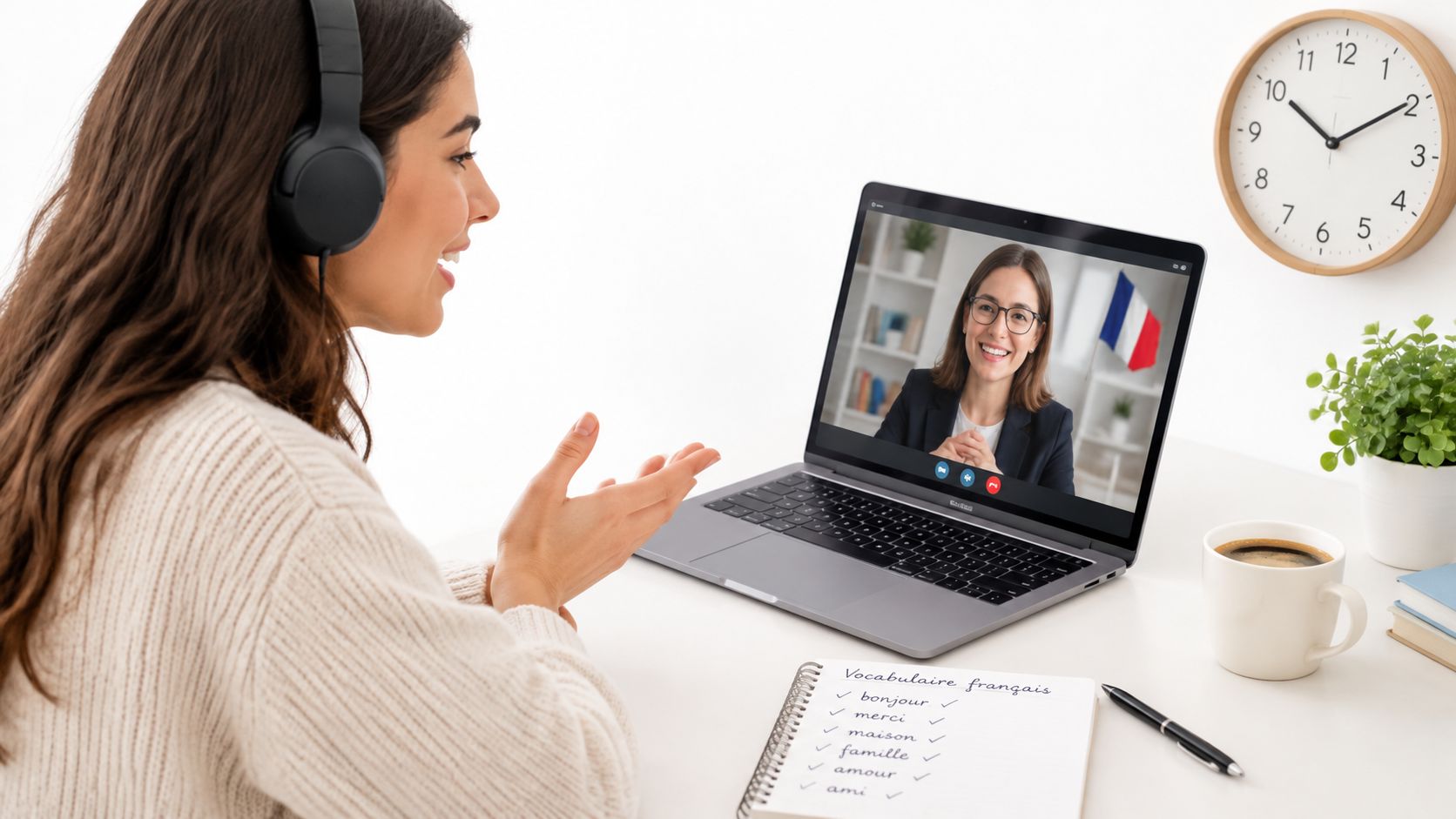
Strong habit: if you can't say the phrase aloud without looking at it, you don't own it yet.
The trap is simple. Recognition feels like mastery, but live conversation demands retrieval. Remote lessons should recycle the same target phrases across speaking, listening, correction, and writing until the learner can use them without help.
Tracking Progress and Planning Around CEFR Milestones
Remote French becomes frustrating when nobody defines "progress." If your only evidence is that you finished modules, you still don't know whether you can speak. CEFR gives you a better way to measure what's happening.
Use hours as planning, not as fantasy
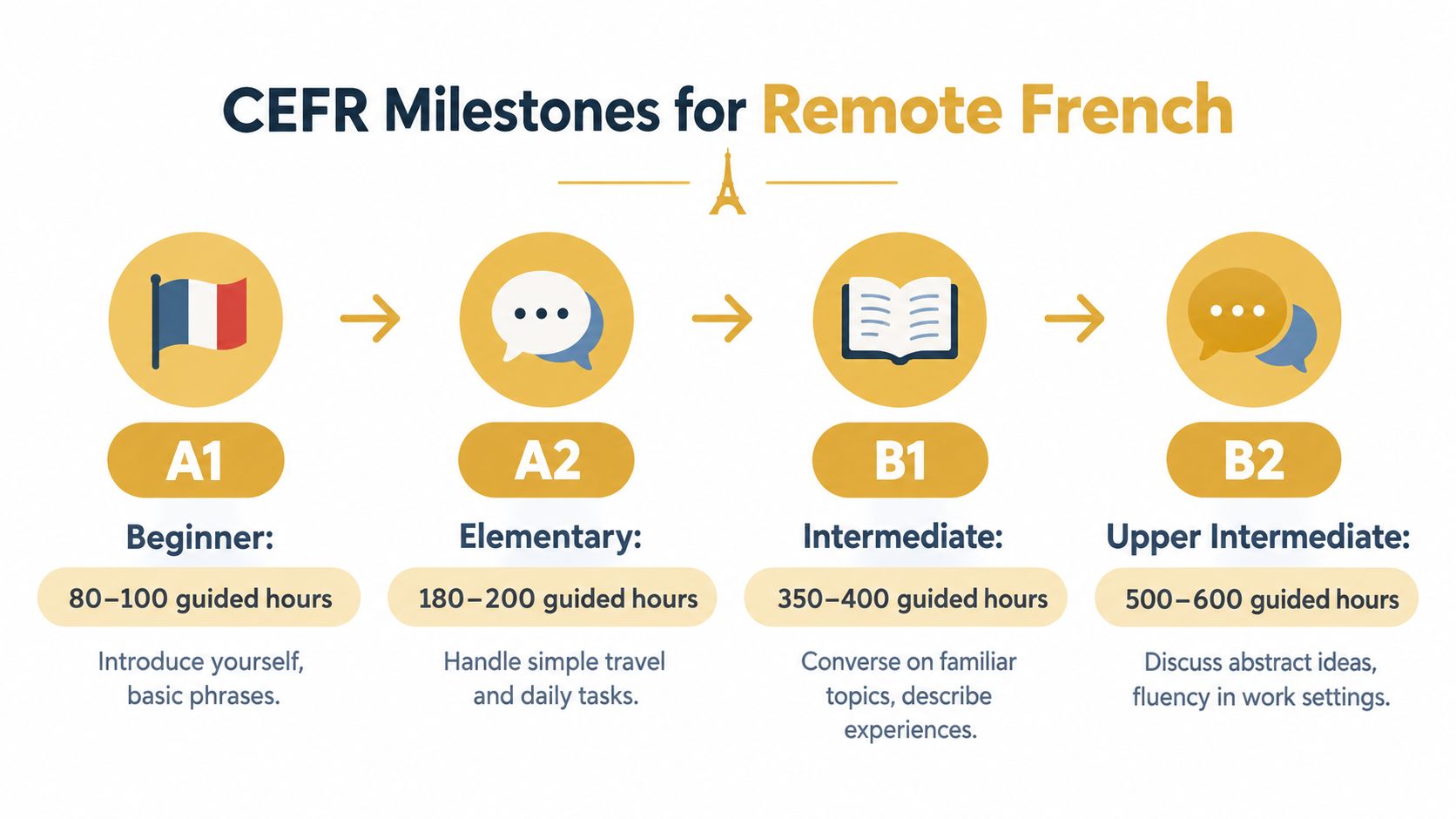
Published hour benchmarks estimate roughly 80 to 100 cumulative guided hours for A1, 180 to 200 for A2, 350 to 400 for B1, and 600 to 650 for B2 (CEFR hour benchmarks). At 5 guided hours per week, a zero-to-B1 path implies about 16 to 18 months. At a faster pace, the timeline shortens, but only if attendance and practice are consistent.
That's why I like to anchor the work to a target task. At A2, can you handle travel problems? At B2, can you participate in professional discussions? That framing keeps the learner focused on performance instead of lesson count.
Verify transfer, not completion
Use monthly recorded speaking samples. Use timed listening tasks. Use CEFR-aligned rubrics. Use role-play simulations under pressure. Those checks tell you whether the skill survives outside the lesson.
- Monthly recording: capture a short speaking sample and compare it to the last one.
- Timed listening: verify comprehension under real speed, not slow replay.
- Rubric-based feedback: make the correction visible, not vague.
- Role-play under exam-like conditions: test whether the learner can respond when they're slightly stressed.
I'd also recommend this CEFR guide for French levels if you want a cleaner way to map targets to outcomes. The point is simple. A program without milestones turns into busywork.
Remote DELF and DALF Preparation That Performs on Test Day
DELF and DALF candidates need more than practice materials. They need a plan that turns remote work into exam performance. That means readiness checks, timed output, and familiarity with the format, not just repeated exercises.
France Éducation international and CNED both offer digital preparation resources, but recent format changes for A1 to B2 mean candidates now face more multiple-choice questions and more documents than older practice sets reflect (France Éducation international DELF/DALF resources). That matters because a candidate who only rehearses old-style materials may walk into a newer test pattern unprepared.
How I prepare remote candidates
I start with a diagnostic. Can the learner speak at the target level without losing control? Can they write within the time limit? Can they handle clarification if the examiner pushes back?
Then I build around three checks.
- Timed writing: no endless drafting, because the exam won't allow it.
- Recorded speaking: the candidate needs to hear their own pacing and hesitation.
- Mock interview: turn-taking, reformulation, and recovery from misunderstanding have to be rehearsed.
Those are the skills official resources can't fully enforce on their own. A candidate can complete digital exercises and still struggle on test day if they've never practiced live pressure.
Exam rule: if the candidate hasn't done full mock speaking under time pressure, they're not ready yet.
For learners who want a structured remote path to certification, this DELF B2 preparation option is worth comparing alongside the official materials. It's especially useful for busy adults who need feedback, scheduling, and a clear finish line.
If you're ready to learn French remotely with a real plan instead of a pile of apps, book a free 20-minute consultation and let's map your level, your target, and your weekly availability into a program you can keep.