You can have the prettiest dress, the right flowers, and a perfect dinner plan, then freeze the moment the mairie official asks for a response in French and everyone turns to you. I've seen couples rehearse their vows and still miss the one phrase that matters most, the legal one. That's why french for wedding in France isn't really about romance first, it's about getting through the civil ceremony, the paperwork, the witness moments, and the vendor conversations without panic. If you want a warm, practical refresher on French etiquette and language expectations, I also recommend this guide to French language rules and etiquette.
When couples tell me they're nervous, they usually mean the same thing. They don't want to sound perfect, they want to sound clear enough for the town hall, the witnesses, and the people coordinating the day. That's a smart goal, because in France the wedding language problem is rarely about poetry. It's about legal words, names, dates, documents, and making sure your meaning survives a noisy room, a formal official, and a packed schedule.
Table of Contents
- Introduction Why Your French Matters More Than You Think
- How French Weddings Actually Work and Why Language Is Legal
- Essential French Vocabulary for Every Wedding Moment
- Choosing Your Language Support From Phrasebook to Private Tutoring
- Real Scripts and Dialogues for Ceremony Reception and Vendors
- Rehearsal Plan to Sound Confident on the Day
- Your Next Step to a Smooth and Joyful Wedding in France
Introduction Why Your French Matters More Than You Think
A bride once told me that her Provence mairie appointment felt calm until the official started speaking quickly, her witness looked confused, and she realized she'd prepared “sweet” French instead of useful French. She knew how to say mon amour, but not how to answer questions about identity, witnesses, or the family booklet. By the time she got to the ceremony itself, she felt like she was memorizing lines instead of marrying the person she loved.
That's the difference with a wedding in France. The most beautiful phrases don't help much if you can't follow the legal rhythm of the room. The words that matter are the ones that help you confirm, submit, understand, and respond.
What couples usually get wrong
Guests often start with romantic phrases because they're easier and more fun. I understand that instinct, but I also know where it breaks down. The mairie does not care whether you can compliment a vineyard. It cares whether you can handle the civil ceremony and the paperwork around it.
Practical rule: learn the words that control the day first, then add the pretty ones afterward.
That simple shift changes everything. Instead of building a list of random phrases, you start building confidence for the actual moments that decide whether the day feels smooth or stressful.
If you're planning a wedding in France, this is the point where we stop treating French as an accessory. We treat it as part of the wedding logistics, just like the venue, the timing, and the guest list. For a closer look at the cultural side of French ceremonies, you can also browse French traditions.
How French Weddings Actually Work and Why Language Is Legal
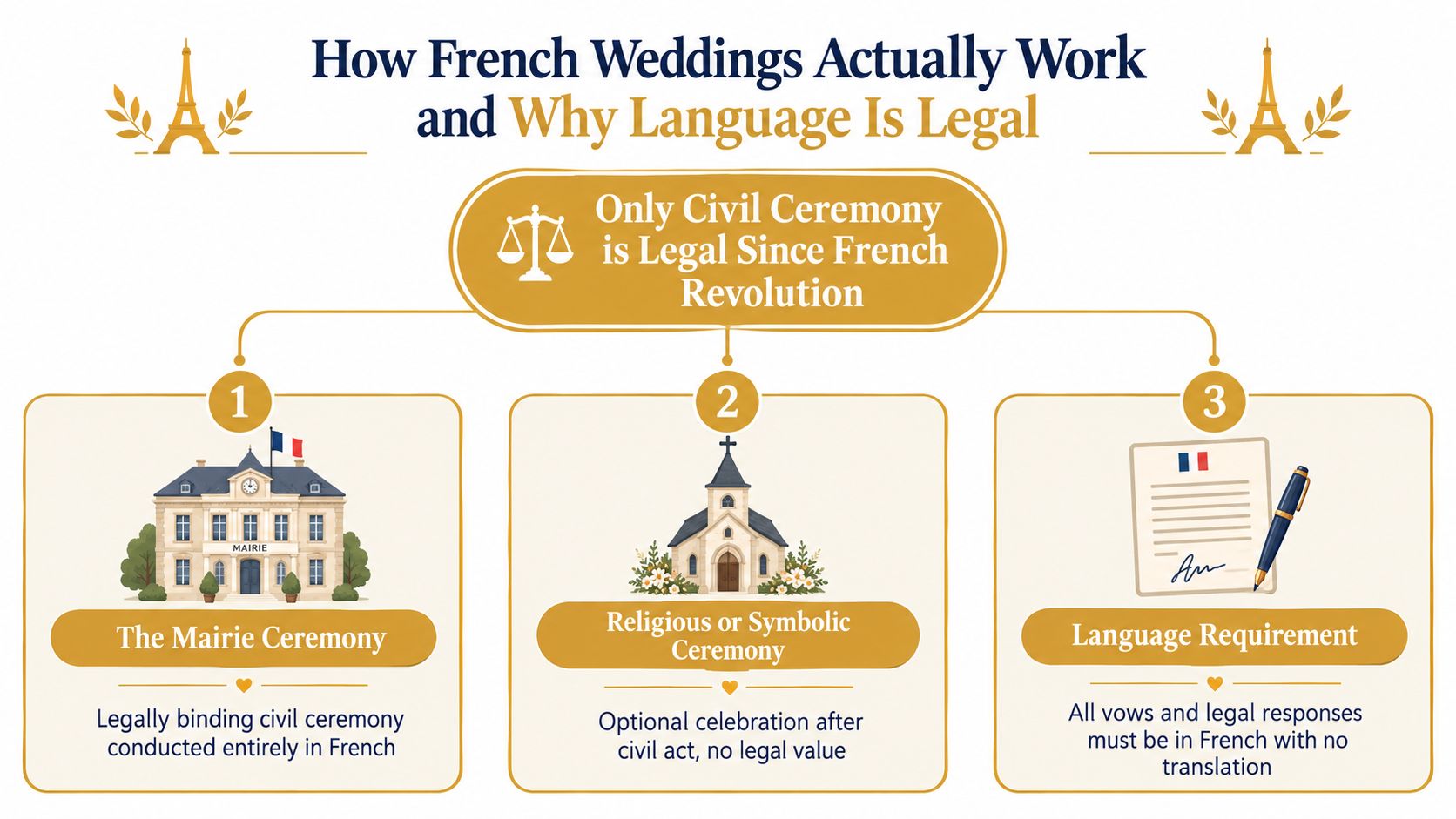
French weddings are built around a civil ceremony, not a romantic free-for-all. Since the French Revolution, a religious ceremony on its own has not been legally valid, and couples must complete the civil marriage to be officially married. That means the mairie is not just another stop in the day. It's the legal center of the whole process.
Civil wedding first, everything else after
I explain it to couples like this. Think of the day as having two different layers. The first layer is the mariage civil, which makes the marriage legal. The second layer can be a religious or symbolic celebration, which may be meaningful but doesn't replace the civil act.
The language rule follows from that legal setup. The civil ceremony is conducted in French, and there's no legal requirement for translation. In practice, that means couples and guests who need support should arrange real-time interpretation rather than assuming the venue will handle it. For foreign-language documents, sworn translation can also become part of the process, which is why the paperwork side matters so much to mixed-language couples. Official destination-wedding guidance makes that French-language requirement clear.
Why timing pressure makes language more important
French marriage planning is also highly seasonal. In 2019, 225,000 weddings were celebrated in France, and 60% took place from June to September. The share of Saturday weddings also rose from 68% fifty years ago to 82% in 2019, which makes weekends especially competitive for venues and services. Those figures come from INSEE's wedding timing data. Add that to the fact that marriage in France remains tied to the mairie, and you can see why language support can't be left for the last minute.
Weddings here move on a municipal clock, not a casual tourist clock.
That matters for your French, because the busiest planning moments often happen under pressure. The appointment, the dossier, the witness confirmation, and the ceremony itself all rely on communication that sounds formal, not decorative. For couples who need extra help with mixed-language planning, civil ceremony guidance is useful because it focuses on the legal language burden rather than just vocabulary lists.
Essential French Vocabulary for Every Wedding Moment
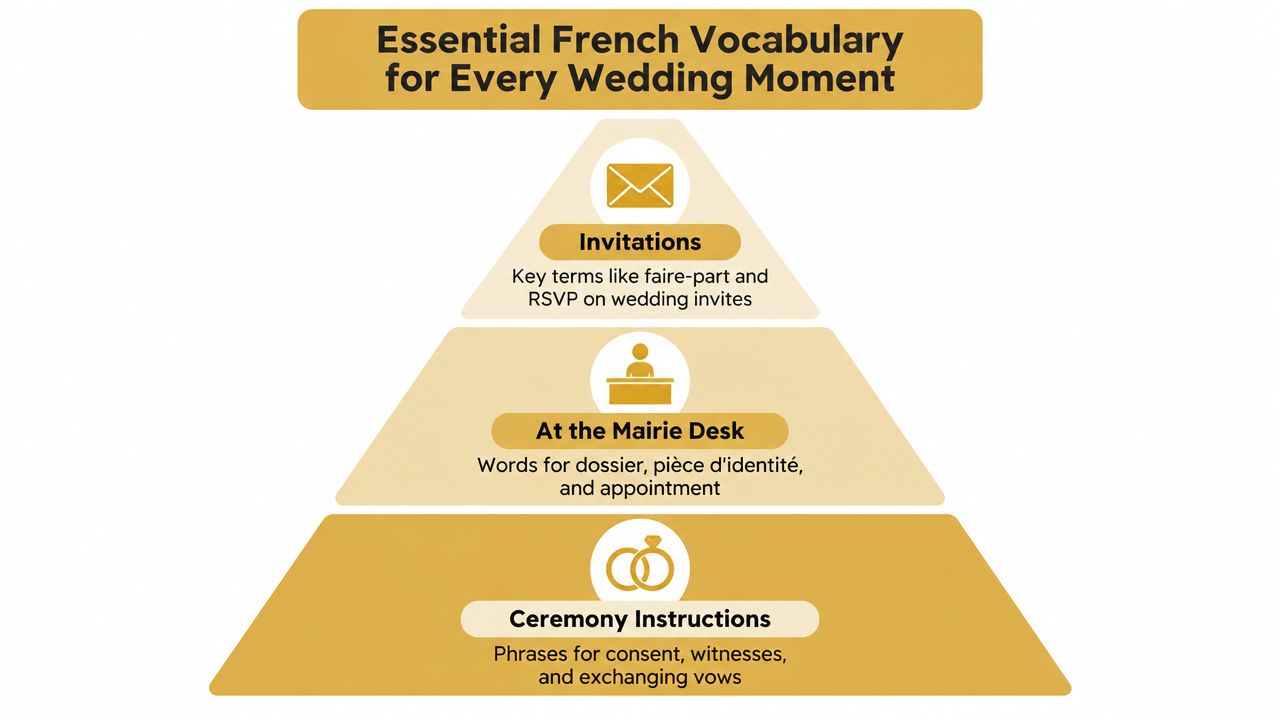
You do not need to learn every wedding-related word in French. You do need to learn the words that appear on invitations, at the mairie desk, and in ceremony instructions. That's the difference between feeling lost and feeling ready.
The words that actually show up
mairie means the town hall, and it's where the civil ceremony happens.
mariage civil means the legal wedding.
mariage religieux means the religious wedding, if there is one afterward.
témoins are the witnesses.
livret de famille is the family booklet.
les alliances are the wedding rings.
These are not pretty extras. They're the terms that shape the paperwork, the seating, and the ceremony instructions. If you hear témoins, you need to know that the room is talking about official witnesses, not random helpers. If someone says livret de famille, they're talking about an official family document, not a keepsake album.
Where each term appears
On invitations, you'll often see the more social side of wedding French, but at the mairie the language gets more administrative. That's why I tell couples to separate their vocabulary into two piles: the words you'll read on paper, and the words you'll hear in the room.
A simple rule helps:
- Invitation language tells guests when and where to show up.
- Mairie language tells the couple what documents and responses are needed.
- Ceremony language tells witnesses and spouses when to speak.
If you want a broader travel-friendly vocabulary foundation, this French phrase guide for travelers can help you recognize basic rhythm and pronunciation before you tackle the wedding-specific terms.
A few phrases worth rehearsing aloud
Où doit-on signer ? means “Where do we sign?”
Nous avons rendez-vous à la mairie. means “We have an appointment at the town hall.”
Voici nos documents. means “Here are our documents.”
Pouvez-vous répéter, s'il vous plaît ? means “Can you repeat, please?”
These are the phrases that save time and reduce embarrassment. Pronounce mairie like “meh-ree,” and témoins like “teh-mwahn.” I always suggest reading them out loud twice in a row, because the second try is where the sentence starts to feel usable instead of memorized.
Choosing Your Language Support From Phrasebook to Private Tutoring
There are three practical ways to handle French for a wedding in France. You can rely on a phrase list, hire help for the day, or work with a tutor on the exact situations you'll face. The right choice depends on how much paperwork you must handle, how much speaking pressure you expect, and how much confidence you want before travel.
Which option fits your planning style
| Support Option | Best For | Covers Paperwork French | Covers Ceremony French | Confidence Level |
|---|---|---|---|---|
| Phrasebook or self-study list | Couples with simple needs and lots of time | Limited | Limited | Modest |
| Interpreter for the day | Couples who mainly need live support during official moments | Good for understanding | Good during the event | High in the moment |
| Tailored private tutoring | Couples who want to rehearse forms, appointments, and live speaking | Strong | Strong | Highest over time |
A phrasebook is the cheapest and fastest option to start, but it usually stays surface-level. It helps with recognition, not performance. You'll know words like mairie and témoins, but you may still freeze when the official asks a follow-up question.
An interpreter can solve the day-of language issue, especially for ceremony comprehension. But it doesn't train you to speak for yourself during the dossier stage, vendor calls, or witness coordination. That's a real difference, because the stress often begins before the ceremony starts.
Private tutoring sits in the middle, and for many couples it's the most practical route. A program can focus on the exact French you need for the appointment, the documents, and the rehearsal. Elite French Tutoring offers fully customized private lessons built around the student's objective, level, and deadlines, so this kind of support can be shaped around a wedding timeline without wasting time on unrelated material.
How to decide without overthinking it
If you're only attending a symbolic celebration, a phrase list may be enough. If you're handling legal steps in French, you probably need more than that. If you want to walk into the mairie with less anxiety and more control, tutoring gives you the chance to practice the lines before they matter.
For couples comparing support options, this guide to finding the right French tutor is useful because it helps you judge whether a lesson plan matches your use case.
My rule of thumb: choose the option that helps you speak when you're under pressure, not just when you're relaxed at home.
Real Scripts and Dialogues for Ceremony Reception and Vendors
The most useful French for a wedding in France is not elegant. It's repeatable. I coach couples to rehearse short scripts for the mairie, because the right sentence at the right moment is more valuable than a long list of pretty expressions.
At the mairie desk and dossier submission
French: Bonjour, nous avons un rendez-vous pour le dossier de mariage.
Pronunciation: bon-zhoor, noo za-vong un ren-day-voo poor luh do-see-ay duh ma-ree-ahzh
Meaning: Hello, we have an appointment for the marriage file.
French: Voici nos pièces d'identité et notre justificatif de domicile.
Pronunciation: vwa-see no pyess dan-tay-day and no-truh zhoos-tee-fee-kah-teef duh doh-mee-seel
Meaning: Here are our ID documents and proof of address.
That second line matters because French marriage guidance asks each spouse to provide original ID plus proof of domicile or residence dated more than one month old, such as a lease, rent receipt, utility bill, tax notice, or employer attestation, according to the French public service guidance on marriage documents. I keep that phrase in the script because paperwork French is often the part that people forget to practice.
During the ceremony and with witnesses
French: Nous le voulons.
Pronunciation: noo luh vool-ohng
Meaning: We want to.
French: Oui, je le veux.
Pronunciation: nwee, zhuh luh vuh
Meaning: Yes, I do.
French: Nos témoins sont ici.
Pronunciation: no tay-mwahn son see-see
Meaning: Our witnesses are here.
Keep your tone formal. Use vous with officials, even if the conversation feels friendly.
If a witness doesn't understand enough French, the situation can get awkward fast. Some communes may refuse a witness role if the French is insufficient, so I always tell couples to check that detail early instead of hoping it won't matter. For mixed-language ceremonies, that's not a small issue, it's a legal and logistical one.
Reception and vendor coordination
French: À quelle heure arrive le traiteur ?
Pronunciation: ah kel ohr ah-reev luh tray-teur
Meaning: What time does the caterer arrive?
French: Pouvez-vous placer les alliances ici, s'il vous plaît ?
Pronunciation: poo-vay voo plah-say lay za-lee-ance ee-see, seel voo play
Meaning: Can you place the rings here, please?
French: Merci, tout est confirmé.
Pronunciation: mer-see, too tay kon-feer-may
Meaning: Thank you, everything is confirmed.
A student I worked with, Anna and Theo, used this exact style of script before their mairie appointment. We rehearsed the paperwork phrases, the witness confirmations, and one short toast for the reception. They told me later that the biggest difference was not memorizing more words, it was knowing exactly what to say when someone looked at them for a response.
Rehearsal Plan to Sound Confident on the Day
Confidence comes from repetition, not from hoping the words will show up on their own. I like short daily drills because they keep the material fresh without overwhelming busy couples.
A simple practice routine
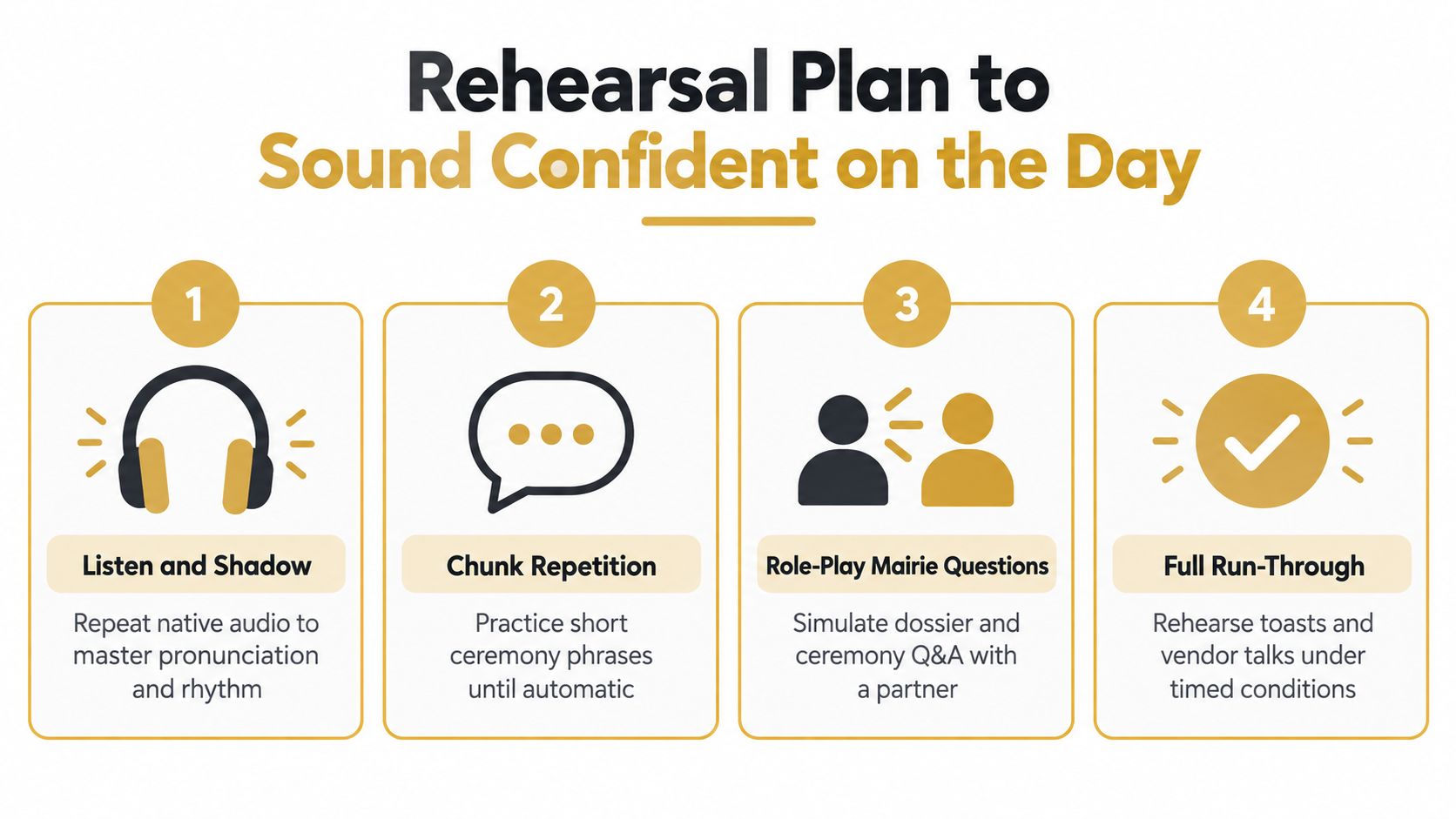
- Listen and shadow. Play a short native French clip and repeat it immediately, matching the rhythm.
- Chunk the phrases. Break lines like Nous avons rendez-vous à la mairie into small pieces, then put them back together.
- Role-play the questions. Have your partner act as the official, witness, or vendor, and answer out loud.
- Do one full run-through. Say the key lines in order, from greeting to documents to closing thanks.
What to do in the final week
I tell couples to keep their French practice light but consistent. Ten or fifteen minutes is enough if the material is targeted. Review the mairie greeting, the document words, the witness names, and one polite way to ask for repetition: Pouvez-vous répéter, s'il vous plaît ?
A strong final-week checklist looks like this:
- Paperwork words: ID, address proof, dossier, witness names.
- Ceremony words: oui, je le veux, témoins, alliances.
- Social words: thank you, congratulations, please repeat.
- Logistics words: appointment time, room, and arrival details.
That last layer matters because nerves tend to erase vocabulary. If you've rehearsed the same few lines out loud, your mouth already knows the path. If you haven't, even a simple question can feel bigger than it is.
Repeat the sentence until your breathing stays calm. That's the point where it's ready.
Your Next Step to a Smooth and Joyful Wedding in France
The couples who feel calm at the mairie aren't necessarily the ones who know the most French. They're the ones who practiced the right French for the exact moments that matter. That's why the work starts with the civil ceremony, the paperwork, and the witness language, not with decorative phrases.
One couple I coached came in worried about the paperwork, the French responses, and their witness's comfort level. We built their lessons around their actual appointment, and by the time they arrived, they knew how to greet the official, submit the documents, and answer the key questions without scrambling. They didn't become fluent overnight. They just became prepared in the right way.
Timing still matters, too. French weddings are seasonal, Saturday slots are heavily sought after, and the marriage dossier has to be handled in advance, so early language practice saves stress later. If you want a plan built around your wedding date, your confidence level, and your exact mairie needs, I'd be glad to help you map that out.
Book a free 20-minute consultation with us at Elite French Tutoring, and we'll build a custom French program for your wedding in France, focused on the phrases, documents, and rehearsal lines you'll need on the day.