
You're in the exact spot I see most often: a francophone client is waiting, the file is live, and you know your general French won't carry you through a contract review, a client intake, or a courtroom exchange. At that moment, French for lawyers stops being a language goal and becomes a business decision, because the wrong training wastes time and the right one changes how confidently you can serve clients.
French has been a language of law for centuries, and that legal weight still matters. France's 1539 Ordinance of Villers-Cotterêts required legal and notarized documents to be written in French rather than Latin, then later milestones in 1992 and 1994 reinforced French in public, legal, and commercial life (historical overview). If you work in a bilingual market, that history shows up in the present, in drafting conventions, court language, and the way legal precision is judged.

For lawyers, the core question isn't whether French matters. It's whether you need enough French to handle a client call, enough to draft safely, or enough to appear fully competent in hearings and negotiations. If you're choosing training now, that's the decision that determines whether you get a useful return or a drawer full of vocabulary notes you'll never use. Read why legal language matters in practice
Table of Contents
- Why French for Lawyers Matters Right Now
- How to Diagnose Your Legal French Needs Before You Start
- How to Choose the Right Legal French Training Option
- Your Legal French Learning Roadmap From Vocabulary to Courtroom
- How to Measure Progress With Oral and Written Assessments
- Putting Your Legal French Plan Into Action
Why French for Lawyers Matters Right Now
I've watched lawyers waste months on generic French because they started with the wrong question. They ask, “How do I become fluent?” The key question is, “Can I handle this francophone client, this contract, or this filing without making costly mistakes?”
That distinction matters because legal French is not conversational French with a few extra terms attached. A lawyer who chats easily at lunch may still struggle to phrase a reservation in a contract, reply to a legal email in the right register, or conduct a precise intake in French. The language has to hold up under pressure, not just in casual conversation.
The market reward is practical, not theoretical
In Canada outside Quebec, the bilingual legal market makes this plain. A 2015 demographic analysis counted 72,175 lawyers, with 2,975 francophones, 17,505 able to hold a conversation in French, 4,115 using French often at work, and about 16,195 using French at least regularly on the job. Among legal professionals outside Quebec who could converse in French, roughly 39.1% used French at least regularly at work (Canadian legal-language analysis).
That gap is what many lawyers miss. Capability alone does not create value, usage does. If your work touches francophone clients, bilingual courts, immigration files, or cross-border transactions, legal French becomes a service line, not a side skill.
Practical rule: buy training for the legal tasks you actually perform, not for the level of French you wish you had.
The client side is just as clear. In Canada, the same research found that among lawyers with French as a first language, francophone clients represented about 40% of clientele on average, and about 46% of those clients requested judicial or legal services in French. If you work face to face with clients, that is real demand, not a niche curiosity.
Read why legal language matters in practice
How to Diagnose Your Legal French Needs Before You Start
The fastest way to waste money is to buy a general course before you know what kind of legal French you need. I don't start with grammar. I start with the file, the jurisdiction, and the output.
French-for-specific-purposes training works best when it follows a five-step methodology, namely needs analysis, learner needs analysis, data collection, data analysis, and activity design (course-design methodology). That isn't academic fluff. It's the difference between a program that helps you draft and a program that merely teaches legal nouns.
Build your own brief before you book anything
Start with your practice reality, not your wish list.
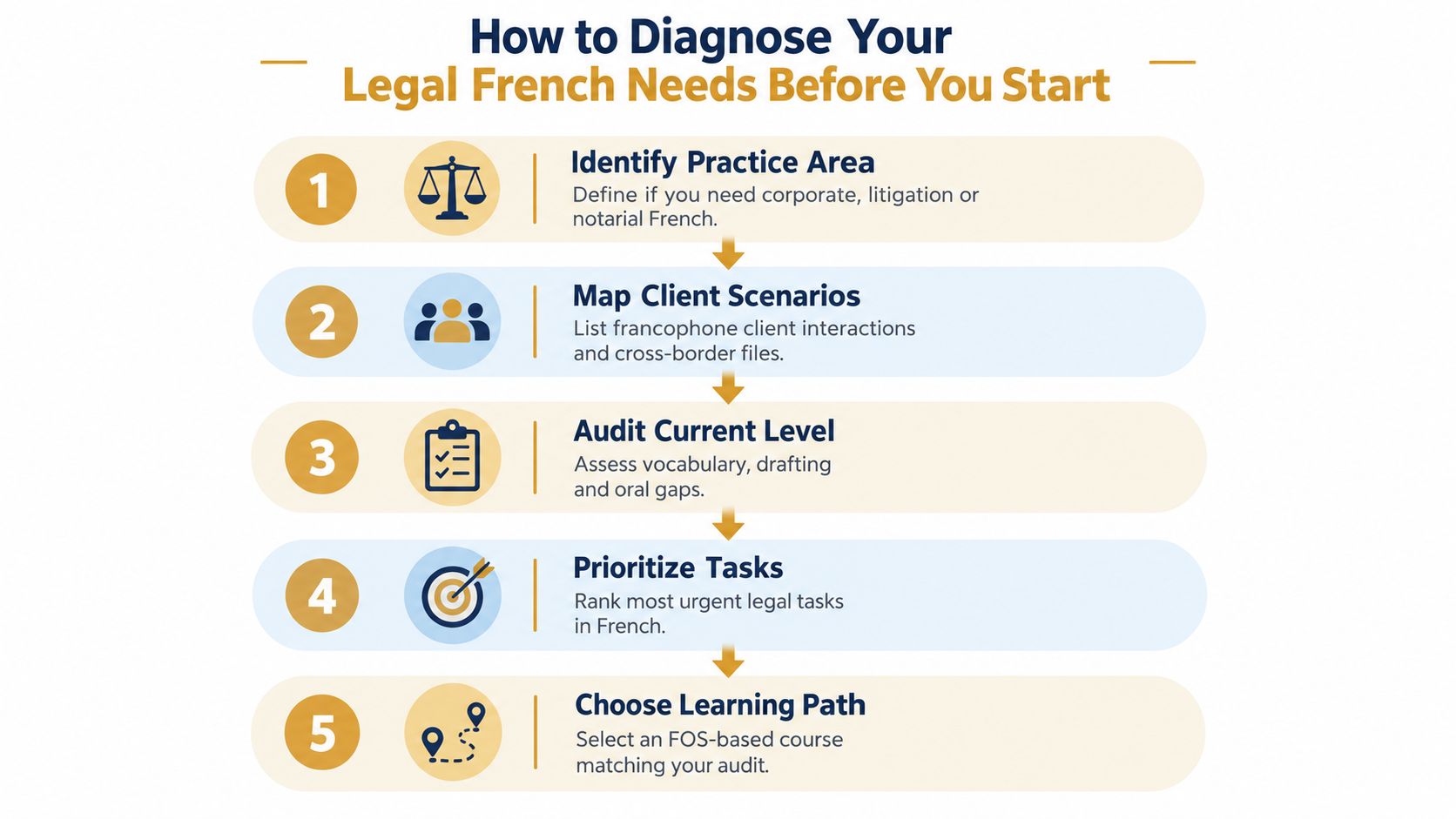
- Identify your practice area. Are you handling corporate work, litigation, notarial tasks, employment matters, or international files? The language changes with the file type.
- Map client scenarios. List the moments where French matters, such as intake calls, document review, negotiation, hearings, or email follow-up.
- Audit your current level. Don't just ask whether you “know French.” Check whether you can speak, write, and understand legal material without drifting into English.
- Prioritize urgent tasks. If you need contracts next month, courtroom French can wait. If you have a hearing, oral performance comes first.
- Choose the path that matches the audit. A tutor, group class, or certification track should fit the work, not the other way around.
Authentic materials matter here. Bring in the kinds of documents you already handle, contracts, pleadings, court decisions, client emails, or government forms. If you train from your own work, your tutor can build exercises that map directly to your caseload instead of giving you generic legal vocabulary that looks impressive and helps nobody.
Use a placement test before you commit to a course if you want a clearer starting point. A placement result is useful only when it's tied to your legal output, though, so don't treat it like the whole diagnosis. I'd rather see a modest placement score plus a clear task list than a polished level label with no practical direction.
My blunt advice: if a program doesn't ask about your jurisdiction, documents, and deadlines, it's not customized enough for legal work.
How to Choose the Right Legal French Training Option
I see this mistake all the time. Lawyers buy the prettiest course page, the cheapest group class, or a self-study app that promises convenience, then wonder why the training never touches their actual work. Those options are not bad by default. They solve different problems, and you need to choose the one that matches your files, deadlines, and risk level.
| Training Option | Best For | Customization Level | Key Tradeoff |
|---|---|---|---|
| Private customized tutoring | Lawyers with urgent tasks, mixed skill levels, or a specific practice area | High | Higher cost, but the training tracks your files |
| Group legal French course | Lawyers who want structure, peers, and a fixed syllabus | Medium | Less flexibility, and the content may not match your practice |
| Self-study resources | Lawyers who need exposure, review, or light maintenance | Low | Cheap and flexible, but feedback is limited |
| Certification-focused prep | Lawyers who need a formal benchmark such as DELF or DALF | Medium to High | Good for proof of level, but not always task-specific |
The best comparison point is the Institut Français course structure, which breaks legal French into concrete domains across three terms, including the legal system, business and company law, employment law, European and international law, human rights, arbitration, family, and succession law (course structure). That model works well when you need breadth across several practice areas. It falls short when your immediate goal is practical output, like a contract review or a client interview.
What to ask before you pay
A serious consultation should give you clear answers.
- Will you work from my documents? If the answer is no, the program is too generic.
- How do you handle feedback? Lawyers need correction on register, structure, and precision, not just pronunciation.
- Do you align with certification goals? If you need proof of level, the program should fit that target.
- Can you cover my practice area? Litigation French and corporate French are not interchangeable.
- Will sessions fit my calendar? Legal work gets busy. If the schedule is rigid, the program will break down.
If you need help comparing providers, compare lesson options before you enroll. That keeps you focused on fit, not marketing.
My blunt advice is simple. Choose private tutoring if your work is urgent or specialized. Choose a group course if you need rhythm and peer pressure. Choose self-study only if you already have structure and feedback elsewhere. If a program does not ask about your jurisdiction, documents, and deadlines, it is not built for legal work.
Your Legal French Learning Roadmap From Vocabulary to Courtroom
The right sequence is boring in the best possible way. You start with what appears most often in your practice, then you turn that language into usable output, and only then do you push toward more stressful tasks like oral advocacy and hearings.
A common mistake is trying to “learn all the words” before speaking or drafting. That never ends well. A better approach is to build from the high-frequency legal domains first, then layer in the speaking and writing behaviors your job requires.
Start with the language that shows up in your files
If contracts are your daily reality, focus there first. If you work with clients, put intake, email tone, and interview questions before advanced doctrine. If you're in dispute work, courtroom and negotiation language need earlier attention because they force quick, exact responses.
The strongest programs I've built for attorneys use authentic legal materials, not textbook drills. A clause from a live contract, a court judgment, or a government form gives you vocabulary, syntax, and register at the same time. That's much more efficient than learning disconnected word lists.
Use a sequence that matches the way lawyers work
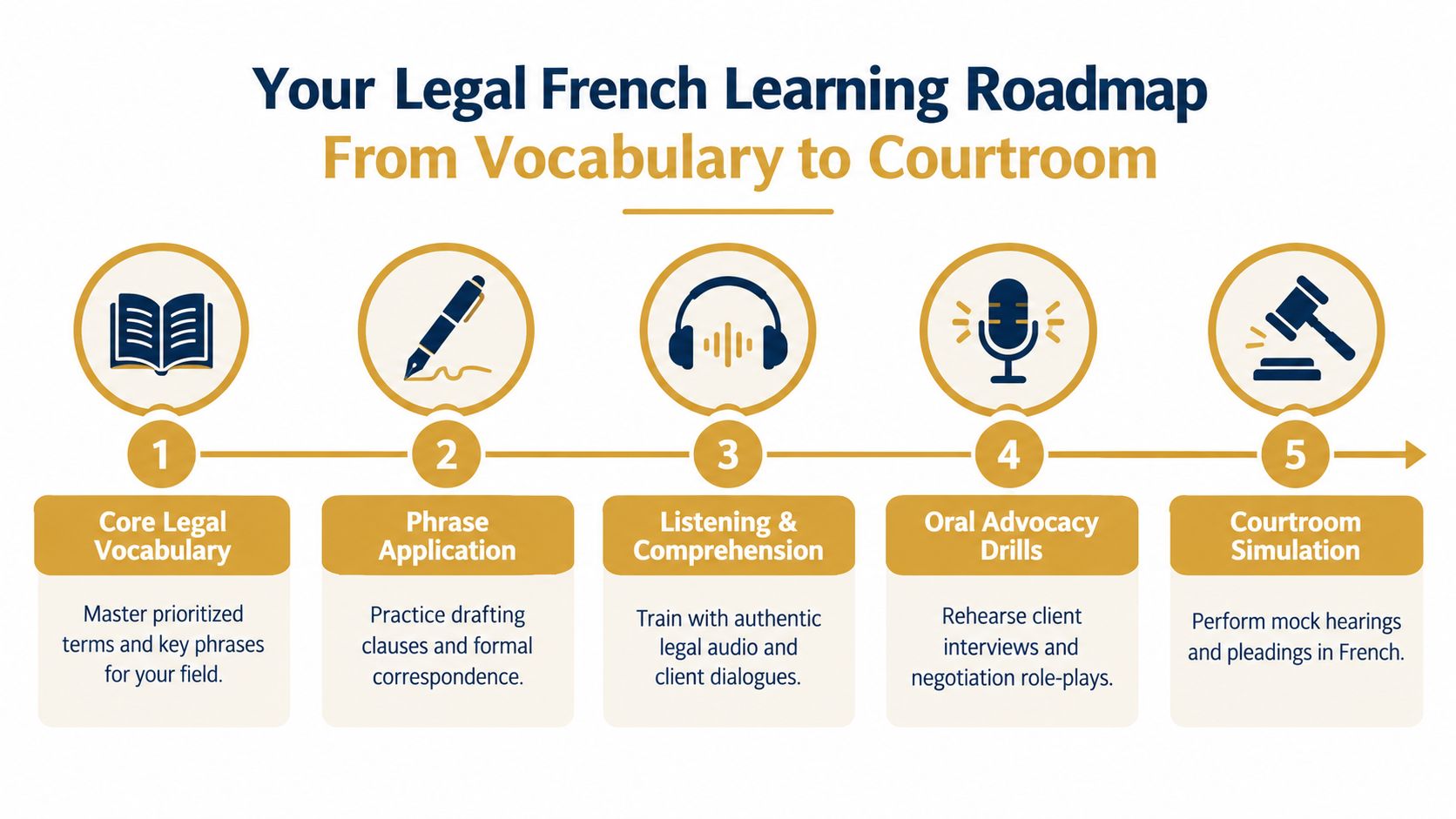
- Core legal vocabulary. Learn the nouns, verbs, and fixed phrases that recur in your area.
- Phrase application. Put those terms into clauses, letters, and formal correspondence.
- Listening and comprehension. Train with legal audio, interviews, or hearings so you can follow French at natural speed.
- Oral advocacy drills. Rehearse client interviews, negotiation, and explanation of risk.
- Courtroom simulation. Practice pleadings and mock hearings in French when your role demands that level.
This sequence also fits the way modern legal work is changing. Many French lawyers still spend a large share of their time on repetitive administrative tasks, which is exactly where AI tools are now being used to shift the burden. That means your French learning should focus less on memorizing every possible term and more on supervising outputs, checking nuance, and handling high-stakes human interaction. I'd rather a lawyer be excellent at reviewing AI-assisted drafts in French than weakly “fluent” in a thousand words they never use.
My rule for busy lawyers: memorize the language that protects you, then practice the language that gets you hired back.
Keep the weekly rhythm simple. One session should target drafting, one should target speaking, and one should target comprehension or review. If your schedule is brutal, even short but consistent task-based practice beats long passive study blocks that disappear after a week.
How to Measure Progress With Oral and Written Assessments
You cannot improve what you never test. For lawyers, the question is simple: can you do the work in French without losing precision?
Formal benchmarks help, but only if you treat them as a starting point. DELF and DALF give you a useful ladder, with DELF covering A1 through B2 and DALF covering C1 and C2. Use that as a reference, then tie it to the tasks that matter in your practice. If you need help choosing the right checkpoint, Review certification pathways before setting your target before you commit to a training plan.
Oral competence should sound calm and exact
For oral work, I test the moments lawyers get exposed.
- Client interview fluency. Can you handle intake questions clearly in French?
- Negotiation clarity. Can you state terms without drifting back into English?
- Pronunciation accuracy. Can you say legal terms cleanly and without hesitation?
A lawyer who can describe a file in French but cannot ask a precise follow-up question is not work-ready. I use recorded mock interviews and timed role-plays because they reveal hesitation, weak vocabulary, and grammar that breaks under pressure. That is the level I care about.
Written competence has to be legible, not decorative
Written work needs a different standard.
- Drafting precision. Can you produce accurate contracts and letters?
- Comprehension checks. Can you summarize French case law correctly?
- Work-ready validation. Can you complete a legal task without outside rescue?
Use authentic documents every time. A memo built from a real judgment tells me more than a worksheet ever will. If the French reads smoothly but the legal meaning is off, that is a failure, not progress.
Progress is real when you can survive the task, not when you can describe the task.
Putting Your Legal French Plan Into Action
The best legal French plan is the one that respects your workload and your practice. Start with diagnosis, choose training that matches your files, and measure progress by task performance, not by how much vocabulary you've collected.
I've seen this work especially well for a U.S. attorney who came to me with one clear need, she had to manage francophone client conversations and review legal documents without delay. We built her program around her actual documents, kept the speaking tasks tight, and focused on the exact phrases she needed for intake, correspondence, and review. She stopped treating French like an academic project and started using it as a practical work tool.
That's the win with French for lawyers. You don't need endless general study. You need a program that fits your jurisdiction, your deadlines, and your next file.
Skip the common mistakes, buying a course before you know your level, choosing broad topics over immediate tasks, and confusing conversational ease with legal accuracy. If you want a private, task-based plan, book a free 20-minute consultation with Elite French Tutoring, and we'll map the right level, the right format, and the right next step for your practice.