You studied French for years, arrive at Montréal–Trudeau, order a coffee on Saint-Catherine Street, and hear a reply that seems to come from a different language. The grammar is familiar, but the rhythm is quicker, the vowels move differently, and local expressions leave you searching for context.
That moment doesn't mean your French has failed. It means you prepared for French in general instead of French for Quebec, where pronunciation, vocabulary, register, and institutional expectations all shape how successfully you communicate. Quebec remains strongly francophone: in 2021, 93.7% of Quebec residents could conduct a conversation in French, and French was the first official language spoken for 82.2% of the population (Statistics Canada's language results).
I've coached relocating professionals, families, and exam candidates, and my advice is consistent: train for the pathway you need. By the end of this guide, you'll know how Quebec French sounds, which vocabulary changes matter, how to choose a useful register, and whether you need exam preparation, school support, workplace coaching, or regular conversation practice.
Table of Contents
- Arriving in Quebec and Hitting the Language Wall
- What Makes Quebecois French Its Own Language
- Phonetic Lexical and Grammatical Differences at a Glance
- Choosing the Right Register for the Right Moment
- Matching Your Pathway to the Right Test and Vocabulary
- Practical Learning Strategies and Phrases You Can Use This Week
- How Customized Tutoring Turns Goals into Real Results
- Your Next Step and a 30-Day French for Quebec Plan
Arriving in Quebec and Hitting the Language Wall
She had studied Metropolitan French, passed interviews in France, and felt comfortable reading newspapers. Then she landed at Montréal–Trudeau and stopped at a café near Saint-Catherine Street. She ordered carefully, expecting a familiar response. Instead, the server answered quickly, with vowel sounds and expressions she hadn't practiced.
She recognized individual words but missed the meaning of the whole sentence. That distinction matters. Understanding written French doesn't automatically prepare you for Quebec listening, especially when casual speech, local pronunciation, and background noise combine.
The same thing happens at a pharmacy, a school office, a bank, or a workplace meeting. A learner may know formal grammar yet freeze when someone says a regional expression, shortens a phrase, or shifts from neutral French into a distinctly Montréal style.
The problem isn't simply “the accent”
Quebec French has systematic phonological features, including affrication of /t/ and /d/ before high front vowels, diphthongization of long vowels, laxing of high vowels in closed syllables, and a preserved contrast between /a/ and /ɑ/ (research on Quebec French phonology). These patterns affect both production and comprehension.
Quebec also has a language environment shaped by policy. The Charter of the French Language, adopted in 1977 as Bill 101, established French as the normal language of work, instruction, commerce, communications, and business in Quebec (Quebec's Charter of the French Language). French isn't a decorative advantage. It often determines how smoothly you handle school, administration, employment, and community life.
Practical rule: Prepare for the conversations that control your next milestone, not for an imaginary version of “general fluency.”
This guide is for someone moving to Quebec, supporting a child in a French-language school, preparing for a Quebec-related professional goal, or trying to participate confidently in Montreal life. The right program should combine regional listening, accurate written French, functional vocabulary, and deliberate practice in the register each situation requires.
For relocation planning, use this guide to studying abroad in Quebec as a practical starting point, then build your language plan around your destination, deadline, and daily responsibilities.
What Makes Quebecois French Its Own Language
Quebecois French is a regional variety with its own sound system, vocabulary, expressions, and social history. It developed from the French brought to New France, including colloquial and regional varieties, and later evolved in North America with influences from Indigenous languages and contact with English. It isn't “incorrect France French,” and treating it that way makes listening practice harder.
The most useful comparison is British English versus American English. Speakers share a written standard and understand one another, but pronunciation, rhythm, vocabulary, idioms, and some grammar differ. Quebec French and Metropolitan French work much the same way. A learner who expects every sentence to sound Parisian will misinterpret normal Quebec speech as careless or distorted.
Listen for the system
Start with rhythm. Quebec speech often gives learners a different impression of timing and emphasis than the French they studied in textbooks. Don't try to copy every casual feature at once. First, train your ear to identify the boundaries between words and the stressed syllables that carry meaning.
Then focus on vowels. Quebec French can diphthongize certain long vowels, and the distinction between vowel qualities can affect recognition in fast speech. The preserved /a/ and /ɑ/ contrast is another feature that can make familiar words sound less familiar.
Consonants deserve focused practice too. The affrication of /t/ and /d/ before high front vowels can make a sequence such as ti sound closer to “tsi” to an English-speaking learner. That isn't random slang. It's a regular pronunciation feature.
Respect the social history
Quebec French also carries expressions and forms that reflect its North American development. Contact with English has shaped some vocabulary and informal speech, while Indigenous language influence is especially visible in place names and selected terms. Historical continuity matters because learners often hear older expressions preserved in Quebec that aren't common in contemporary Metropolitan French.
The informal pronoun tu also deserves careful handling. In Quebec, casual address can feel direct and natural in situations where a learner trained in France might expect more distance. That doesn't mean you should use it with everyone immediately. Listen first, then match the relationship and setting.
Quebec French is a complete regional system. Learn its patterns with the same respect you'd give any established variety of a language.
Your goal isn't to erase your existing French. It's to add the pronunciation, listening flexibility, and local vocabulary that let you understand people without asking them to switch into your textbook.
Phonetic Lexical and Grammatical Differences at a Glance
The fastest way to make Quebec French practical is to separate three issues: how words sound, which words people choose, and how speakers construct everyday sentences. Learners often combine all three into “the accent,” then practice without knowing what they're missing.
| Feature | Quebec French | Metropolitan French |
|---|---|---|
| Affrication | /t/ and /d/ may become affricated before high front vowels, so ti can sound closer to “tsi” | The same consonants are generally not realized with this Quebec pattern |
| Long vowels | Long vowels may show diphthongization | Vowel realization follows Metropolitan patterns |
| Open vowels | The /a/ and /ɑ/ contrast is maintained in relevant contexts | The contrast is less broadly maintained in contemporary speech |
| Rhythm | Learners may hear stronger regional timing and vowel duration patterns | Learners encounter the rhythm associated with contemporary France |
| R sound | Speakers may use a uvular French r, while individual regional and social pronunciations vary | The uvular r is also common, with different regional and social patterns |
| Car | char | voiture |
| To bother | enweyer may appear in informal Quebec speech | ennuyer |
| Girlfriend | blonde can mean girlfriend in Quebec usage | blonde commonly refers to a woman with fair hair |
| Not at all | pantoute is an informal Quebec expression | pas du tout |
| Informal address | tu is common in familiar settings, but context still controls politeness | tu and vous follow Metropolitan conventions |
| Spoken negation | j'ai pas is common in everyday speech | j'ai pas also occurs informally, while formal speech and writing retain fuller structures |
| Question pattern | tu veux-tu can occur in colloquial Quebec speech | Metropolitan French generally uses a different question structure |
| Narrative past | Written narratives may use the passé simple | The passé simple is also primarily associated with formal written narrative |
| Everyday past | The passé composé dominates ordinary conversation | The passé composé dominates ordinary conversation |
The phonetic rows are the ones I prioritize first with new arrivals. If a learner can't segment a sentence because the vowels and affricated consonants sound unfamiliar, adding more vocabulary won't solve the immediate problem. Regional listening drills should come before an ambitious slang list.
Vocabulary needs equal care. Char is useful in Quebec, but using blonde casually with the wrong meaning can create confusion. Expressions such as pantoute and enweyer belong to informal listening and conversation practice. Learn them so you can recognize them, but don't force them into every sentence.
Grammar is more subtle. J'ai pas may sound ordinary in conversation, yet formal workplace writing still requires careful sentence construction. Likewise, tu veux-tu is a recognizable colloquial pattern, not a universal replacement for standard question forms.
For targeted pronunciation work, pair regional listening with French pronunciation lessons for English speakers. The useful question isn't “Can I sound Quebecois?” It's “Can I hear the pattern, produce clear French, and adjust my speech when the situation calls for it?”
Choosing the Right Register for the Right Moment
Register decides whether your French sounds polished, natural, or misplaced. Quebec listeners can usually tell when a newcomer has memorized formal French but hasn't learned how people speak in shops, schools, offices, and social settings.
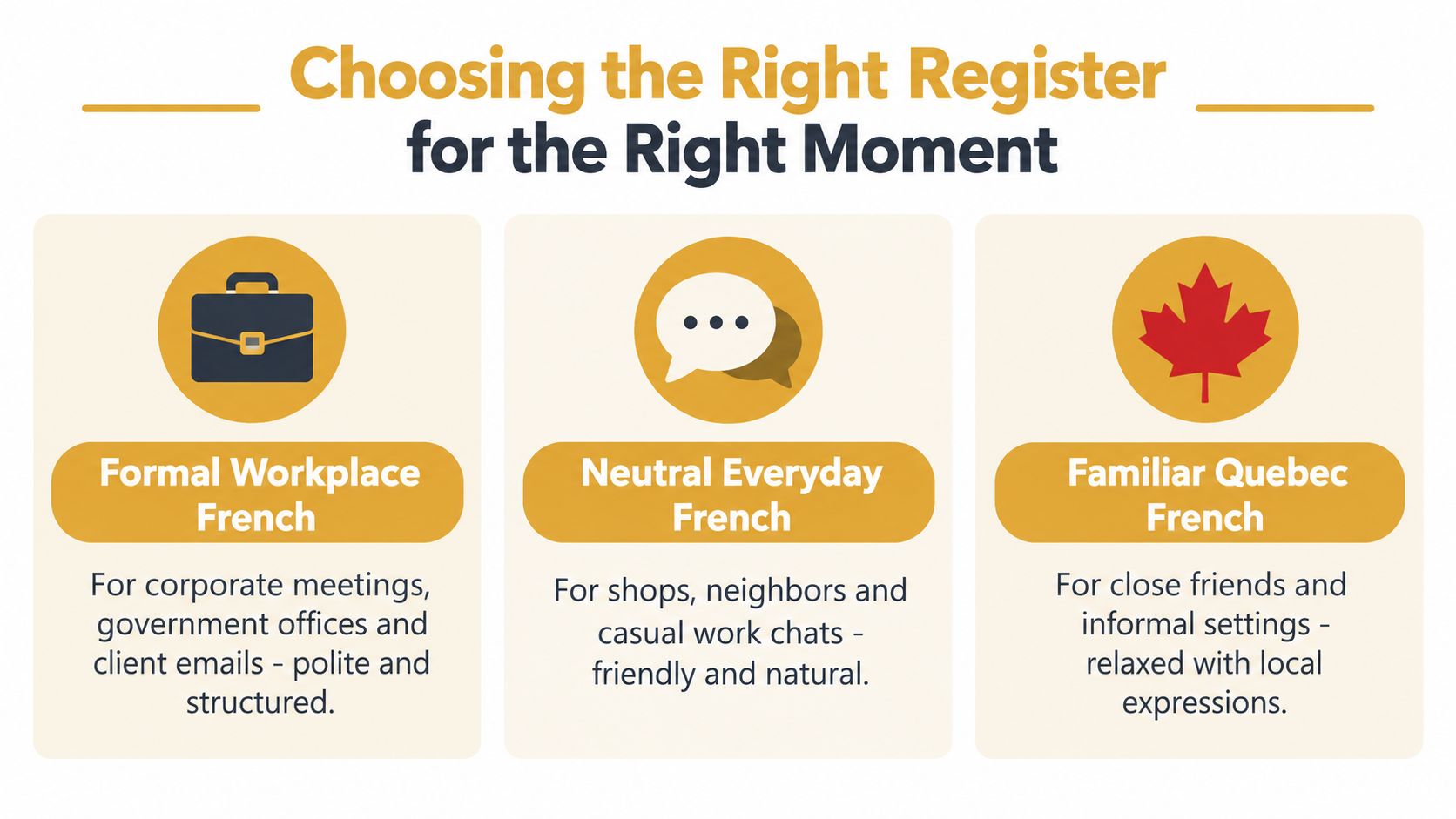
Use three zones as your working map:
- Formal workplace French belongs in corporate meetings, government offices, official correspondence, and client emails.
- Neutral everyday French fits customer service, parent-teacher meetings, medical appointments, neighbors, and ordinary work conversations.
- Familiar Quebec French belongs with close friends, informal gatherings, bars, sports conversations, and social media.
Hear one request in three ways
Suppose you need a colleague to repeat a deadline.
In a formal meeting or government context, say:
Pourriez-vous me confirmer l'échéance retenue?
In a neutral workplace or school conversation:
Est-ce que vous pouvez me confirmer la date limite?
With a close colleague or friend:
C'est quoi la date limite?
All three communicate the same need. The difference is your relationship with the listener, the setting, and the level of formality expected.
Casual Quebec speech may include joual, local expressions, and anglicisms such as checker. Fin de semaine also feels natural in Quebec conversation. Those forms can help you understand local speech and connect socially, but they can weaken your credibility in a formal email or a client presentation if you use them indiscriminately.
Read the room before changing style
Start more neutrally than casually. Observe whether people use vous or tu, how directly they make requests, and whether the conversation includes slang. Then adjust gradually.
A parent-teacher meeting calls for warmth and clarity, not stiff bureaucratic phrasing. A government office calls for precise vocabulary and complete sentences. A group of friends may welcome local expressions, but only after you understand what they mean and how strong they sound.
My guide to French language rules and etiquette can help you build that situational awareness. The goal isn't to perform an accent. It's to sound appropriate, capable, and easy to understand.
Matching Your Pathway to the Right Test and Vocabulary
Don't buy a French course until you know which institution, test, or daily task will judge your language. Quebec pathways overlap, but their proof requirements and vocabulary priorities don't. Official Quebec guidance lists accepted exams including TCF-Québec, TCF-Canada, DELF, DALF, TEFAQ, TEF Canada, and TEF (Quebec's accepted French tests and requirements).
| Learner Profile | Recommended Test | Priority Vocabulary | Best Study Method |
|---|---|---|---|
| Relocation candidate | Confirm whether TCF-Québec, TCF-Canada, TEFAQ, TEF Canada, or another accepted test applies to your pathway | Housing, banking, immigration paperwork, school enrollment | Timed listening, reading, writing, and speaking drills |
| Business professional | DALF C1 or an employer's internal assessment, depending on the role | Negotiation, contract review, meetings, compliance terminology | Mock meetings, presentations, email editing, role-play |
| DELF or DALF student | DELF or DALF at the level required by the school or program | Academic writing, argumentation, oral defense | Past papers, rubric-based correction, oral coaching |
| School-support family | Usually no single universal test, unless a school or pathway specifies one | Curriculum terms, parent councils, homework, teacher communication | Weekly reading, guided conversation, school-scenario practice |
Relocation candidates
Immigration learners need more than conversational confidence. Practice explaining your work history, discussing housing, completing forms, describing your finances, and answering questions under time pressure. Before booking an exam, verify the current requirement for your exact Quebec pathway instead of assuming that a federal test automatically serves a provincial purpose.
Professionals
Business learners should practice the language they use under pressure. That means clarifying a contract clause, disagreeing diplomatically, summarizing a meeting, and asking for a deadline. If your workplace falls under Quebec's language rules, vocabulary and written accuracy become operational concerns, not optional polish.
Students and families
DELF and DALF preparation requires exam-specific correction. A general conversation app won't show why an oral response lacks structure or why a written argument misses the expected register. Families supporting school-age learners should build a weekly reading routine and practice the vocabulary used in homework instructions, school communications, and parent meetings.
Use this French language certification guide to compare certification routes, then choose preparation that mirrors the assessment rather than studying disconnected grammar chapters.
Practical Learning Strategies and Phrases You Can Use This Week
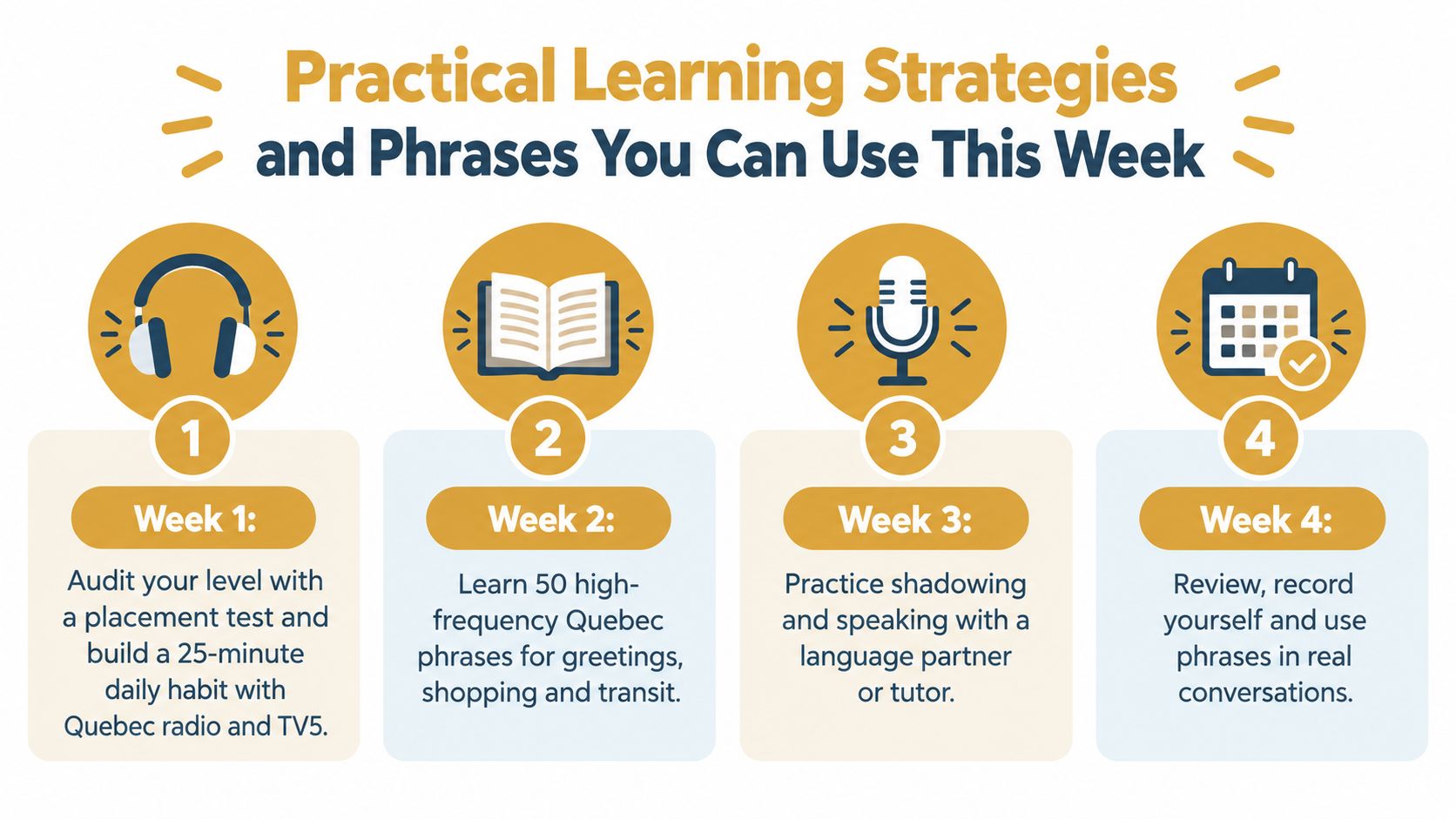
Start with a routine you can repeat, not an elaborate curriculum you abandon. A useful 30-day starter plan begins with a level check, adds local input, requires spoken output, and ends with a realistic task.
Week one builds your listening base
Take a free placement test and write down what you can do without help. Then create a daily 25-minute input habit using Quebec radio, TV5, or clips from Tout le monde en parle. Don't listen passively. Replay short sections, mark reduced sounds, and imitate the speaker's rhythm.
Week two adds usable expressions
Practice high-frequency phrases with audio rather than memorizing a silent list:
- Greetings: Bonjour, comment ça va?, bienvenue
- Conversation: On jase, c'est correct, bonne fin de semaine
- Service encounters: Je voudrais…, j'aurais besoin de…, pouvez-vous répéter?
- Workplace: Je vais vérifier, on se reparle, quelle est la date limite?
Shadow each phrase immediately after hearing it. Your aim is to connect sound, meaning, and mouth movement.
Weeks three and four force production
Write five short texts during week three. Use one for a workplace email, one for a school message, one for a service request, one for a personal update, and one for your actual pathway. Record voice memos reading them, then ask a tutor or language partner to identify pronunciation, register, and grammar problems.
During week four, simulate a real event. Visit an SAQ in role-play, conduct a parent-teacher call, rehearse a job interview, or complete a timed exam task. Keep a journal of every unfamiliar anglicism and joual expression you hear. Record the sentence, the setting, and a neutral alternative.
A short demonstration can help you hear how regional speech fits into active practice:
Don't turn every local expression into a phrase you must produce. Recognition comes first. Clear, appropriate French remains more valuable than forced slang.
How Customized Tutoring Turns Goals into Real Results
Generic apps teach broad French. They rarely diagnose why a relocating professional understands a written form but freezes at the SAQ counter, or why a student can speak comfortably yet loses accuracy in written work.
A customized first session should identify the pathway, test both comprehension and production, and expose register gaps. For a newcomer, that may mean an immigration interview or an administrative appointment. For a student, it may mean a DELF oral task. For a parent, it may mean explaining a homework concern to a teacher.
A real learner profile
One software engineer I coached had fluent Metropolitan French after relocating from Lyon to Montreal. His main weakness wasn't grammar. He struggled with Quebec listening tasks because local pronunciation, informal expressions, and fast workplace exchanges made familiar words difficult to recognize.
We spent six weeks on accent retraining, joual listening drills, and OQLF interview rehearsal. He passed his francization test and reported feeling confident in meetings afterward. The improvement came from practicing the exact bottleneck, not from completing another general vocabulary course.
Choose the format that matches the pressure
Relocation candidates often benefit from weekly one-on-one lessons built around appointments, interviews, housing, and work. DELF candidates need intensive blocks before exam sessions, with correction tied to the official task demands. Parents supporting school-age learners need a program that combines student practice with guidance they can reinforce at home.
Elite French Tutoring offers private online French lessons and begins with a free initial assessment. For a Quebec-bound learner, ask directly whether the proposed curriculum includes Quebec listening, regional vocabulary, and the test or institutional requirement attached to your goal.
The service matters less than the design. Your tutor should use regional audio, pathway-specific role-play, written correction, and repeated feedback so every lesson prepares you for a real Quebec outcome.
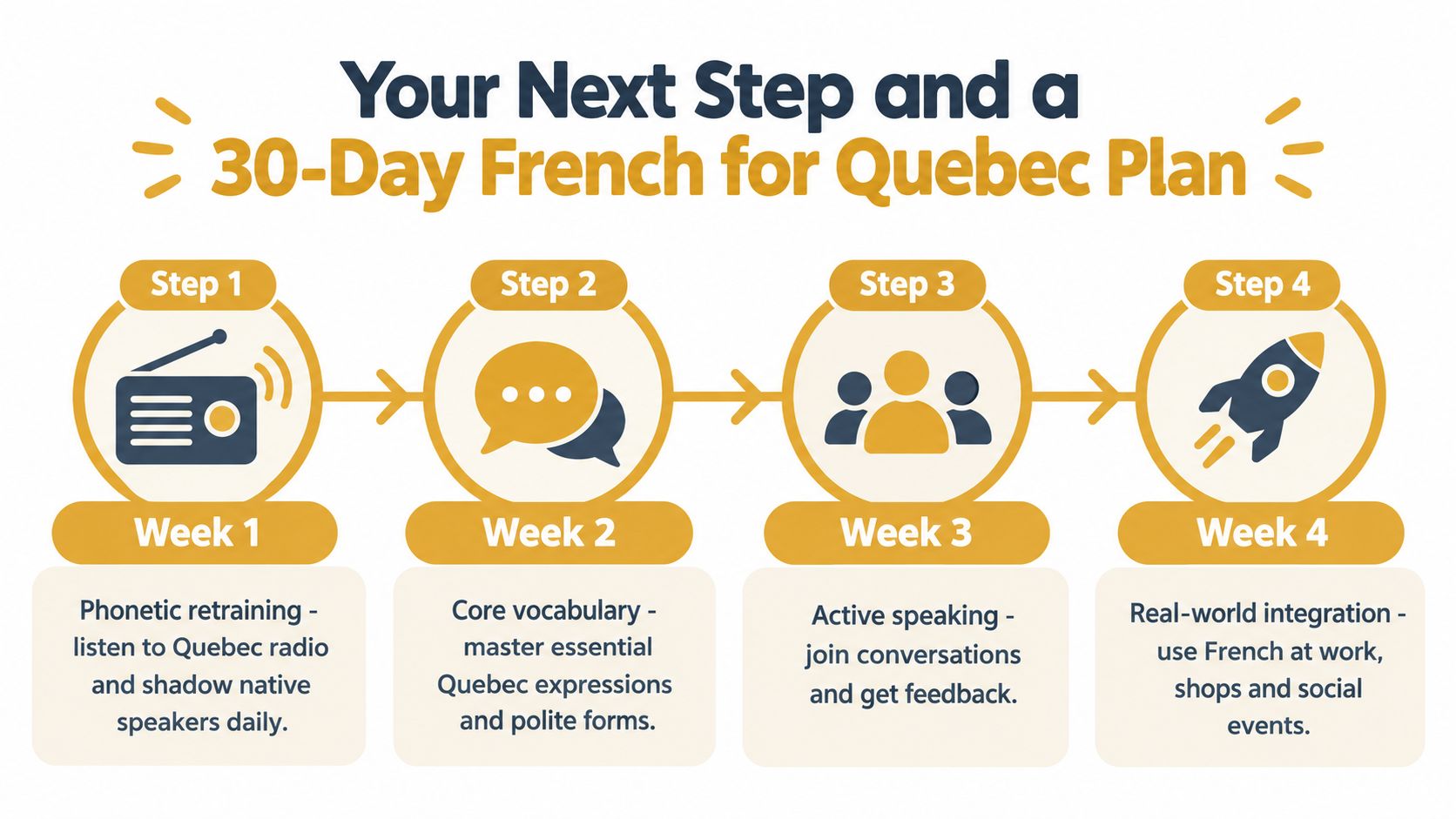
Your Next Step and a 30-Day French for Quebec Plan
Choose your pathway today, then run this checklist:
- Week one: Listen to Quebec radio daily, shadow pronunciation, and isolate the vowel patterns that block comprehension.
- Week two: Learn regional vocabulary and joual expressions through podcasts and Quebec-produced shows, while recording neutral alternatives.
- Week three: Practice switching between formal, neutral, and familiar speech in workplace, school, and service scenarios.
- Week four: Complete one full pathway task, such as an OQLF interview, a DELF writing prompt, or a parent-teacher call.
Small daily repetitions in the right accent will take you further than occasional marathon sessions in the wrong one. Identify the outcome that matters most, book a free consultation to confirm your starting level, and ask a tutor to build the next 30 days around the Quebec situation you need to handle.