You're staring at a draft that would be perfectly fine in English: “Hi, following up on the file. Can you send it today? Thanks.” Then you translate it into French and suddenly it looks curt, clumsy, and faintly rude.
That reaction is correct.
I've spent years coaching professionals who work with French clients, schools, administrations, and multinational teams, and this is the mistake I see most often. People assume French email etiquette is just vocabulary plus a few polite formulas. It isn't. It's a decision system. You're signaling distance, hierarchy, familiarity, and intent before the recipient even reaches your request.
Most guides stop at phrase lists. That's not enough if you're writing to a hiring manager, a mairie, a bilingual school teacher, or a Paris-based colleague who switches between Slack and email all day. What matters in 2026 isn't memorizing the fanciest closing. It's choosing the right level of formality for the relationship in front of you.
Table of Contents
- Why a French Email Is Not Just a Translated English Email
- The Six Building Blocks of Every French Professional Email
- Choosing the Right Register for First Contact and Beyond
- Ready Templates You Can Send Today
- Rules the 2026 Workplace Has Quietly Updated
- Eight Mistakes That Still Trip Up Fluent Speakers
- Your 60-Second Pre-Send Check and Practice Drill
Why a French Email Is Not Just a Translated English Email
A procurement lead sends this in English: “Hi Martin, we need confirmation on the revised delivery date by Thursday. Please send the updated schedule.” Clean, efficient, normal. Translate it line by line into French, and the tone shifts. What sounded brisk in English now reads abrupt, and in some contexts, disrespectful.
That shift matters because French email is not built on the same social logic as English email. French readers judge the relationship first, then the request. They notice how you open, how directly you ask, and how carefully you close. If your wording ignores hierarchy, distance, or first-contact formality, the message feels off even when every verb is correct.
French email signals your position before your request
English business writing often rewards brevity on its own. French professional email rewards calibration. The question is not “What is the French translation?” The question is “How formal does this relationship need to be, and what does the recipient expect from someone in my position?”
That is the decision point many phrase-list guides miss.
A parent writing to a bilingual school, a brand manager emailing a supplier, and a resident contacting a mairie should not use the same opening. In 2026, French colleagues at multinational firms may accept a lighter tone after rapport is established. Administrations usually will not. First contact still demands more structure than many English speakers expect.
Greetings are not filler
The opening formula does real work. “Bonjour” can be enough with a colleague you already know. “Bonjour Madame Dupont” is safer for first contact, external contacts, and any situation involving status or distance. Dropping straight into the request saves five seconds and creates avoidable friction.
Use the greeting to show that you understand the relationship.
Bad:
- Bonjour,
- J'écris pour faire un suivi.
Better:
- Bonjour Madame Dupont,
- Je me permets de vous contacter au sujet de la livraison prévue cette semaine.
The second version does three things at once. It identifies the recipient correctly, states the topic, and softens the approach without sounding weak.
Direct English habits often read as pushy in French
English speakers often carry over habits like “just following up,” “can you send this today,” or “thanks in advance.” In French, those moves can feel blunt if you have not framed the request first. You do not need old-fashioned flourishes. You do need enough context and enough politeness to show control.
My rule is simple. If the email is first contact, external, or even slightly sensitive, slow down the first two lines. If it is an internal exchange with an established colleague, you can tighten the message once the relationship allows it.
That is why broader French business culture norms for hierarchy, formality, and workplace tone matter here. Email etiquette reflects those norms. It does not sit apart from them.
Closings still carry more weight in French
Many English-language professionals treat the final line as an afterthought. In French, the closing confirms the register of the whole message. End too casually and the email feels unfinished. End too stiffly with a close colleague and you sound theatrical.
Good judgment beats memorized phrases. A multinational teammate may be fine with “Bien cordialement.” A school administrator or public office may expect a more formal close. The point is not to sound ornate. The point is to give the reader a consistent signal from first line to last.
Treat French email as a relationship-setting tool, not a translated task note. That is how you avoid sounding rude, dated, or strangely aggressive while saying something perfectly ordinary.
The Six Building Blocks of Every French Professional Email
A buyer opens your message between meetings. In five seconds, they decide whether you sound reliable, careless, too familiar, or unnecessarily stiff. That judgment happens before they finish the first paragraph. In French, structure drives that judgment.
A professional French email usually follows six parts: subject line, opening salutation, context, body, closing formula, and signature, as outlined in this formal French email guide. The point is not ceremony. The point is control. Each block answers a specific decision: what this email is about, how much distance to keep, what action is needed, and how formal the relationship should feel.
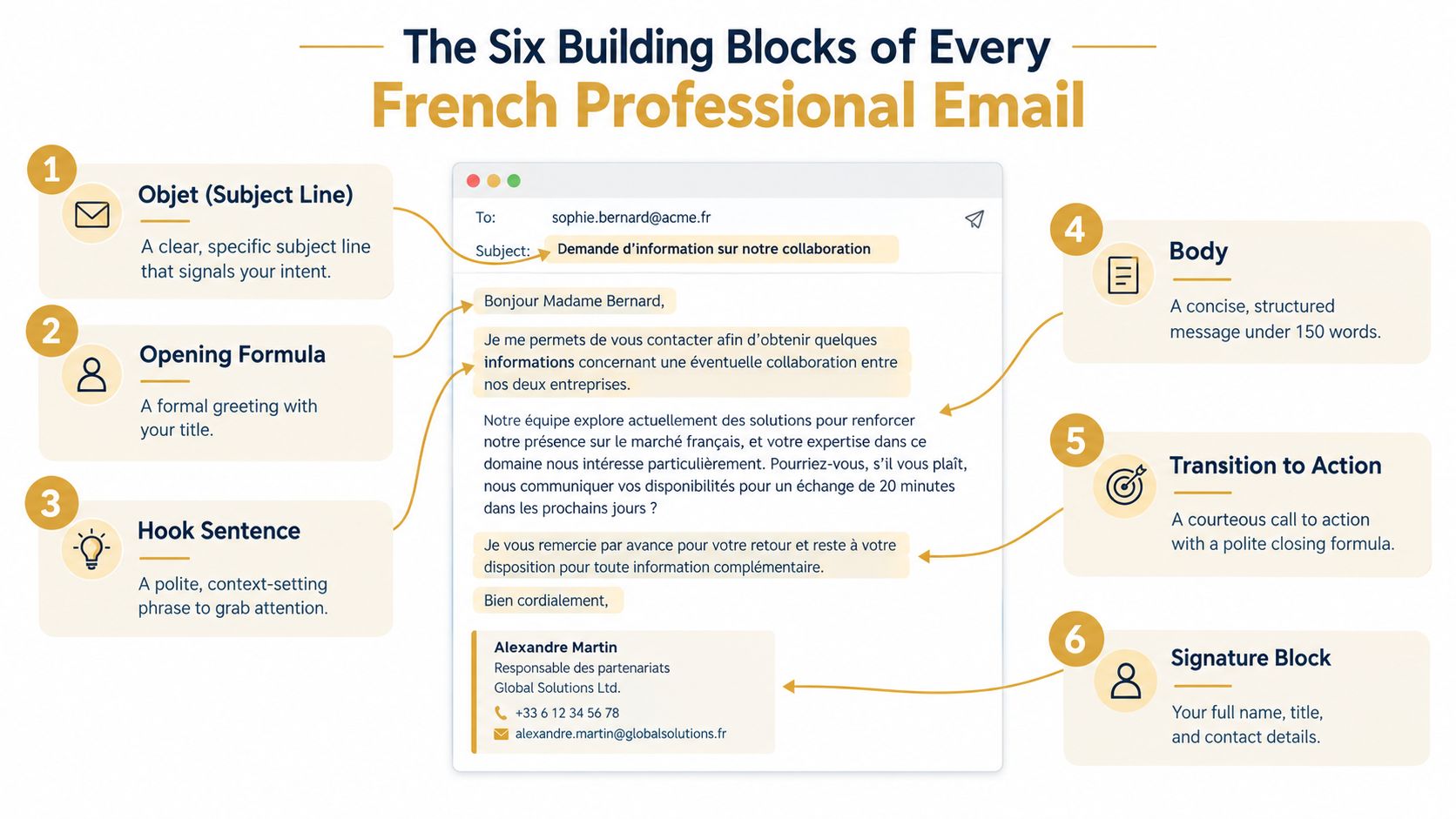
One annotated example
Use a real-world case. An account manager at a cosmetics group needs to tell a retail buyer that a shipment will arrive late.
Objet: Retard de livraison. Commande du 12 mars
Bonjour Madame Martin,
Je me permets de vous contacter au sujet de la commande expédiée le 12 mars.
Nous avons été informés ce matin d'un décalage logistique affectant la livraison prévue. La réception de la marchandise est désormais estimée pour lundi.
Nous vous prions de bien vouloir nous excuser pour ce contretemps. Pourriez-vous nous confirmer si cette nouvelle date convient à votre planning de réception ?
Cordialement,
Camille Bernard
Responsable grands comptes
[Téléphone]
[Email]
That email works because every line does one job. Nothing rambles. Nothing sounds translated from English.
What each block does
Subject line
The subject line must name the topic plainly. French readers expect that. “Question,” “Urgent,” or “Besoin d'aide” tells them almost nothing and makes you look disorganized.
Good subject lines:
- Objet: Demande de rendez-vous
- Objet: Suivi de candidature
- Objet: Documents manquants pour votre dossier
For an administration, be even more specific. Add a reference number, date, or dossier name if you have one. For a multinational team, shorter is fine, but still make the topic scannable.
Opening salutation
The salutation sets the distance. Get this wrong and the rest of the email has to recover.
Use Bonjour Madame Martin or Bonjour Monsieur Durand for first contact, external communication, schools, and anything remotely sensitive. That is the safest professional default in 2026. It sounds competent, not cold. Save looser openings for people who already write to you that way.
Context line and body
Your first line should explain why the reader is opening this email now. Then give the key information in a clean order. One topic per paragraph. One clear request.
This is the block where English speakers often flatten the tone. They jump straight into the ask and skip the framing line. In French, that can read as abrupt, especially with clients, school administrators, and public offices. Clear structure fixes that. This guide to French business writing is useful if you need more practice turning direct English wording into French that still sounds professional.
A good body also reflects audience. A bilingual school parent may want warmth plus clarity. A procurement contact at a multinational usually wants speed and clean formatting. A mairie or prefecture wants precision, references, and no casual shortcuts.
Closing formula and signature
The closing formula should match the relationship and the request. If you need confirmation, ask for it before the sign-off. Do not hide the action in the final line.
Then sign properly. Full name, role, and contact details. That matters more in French than many English-language professionals expect. A thin signature can make a serious message feel unfinished.
As noted in this professional email formulas guide, the combination of precise subject line, title-based salutation, concise body, and appropriate closing reduces ambiguity and signals that you understand the reader's context.
A French professional email is not just six pieces stacked together. It is six choices, each tied to register, audience, and action. That is the part older phrase lists usually miss.
Choosing the Right Register for First Contact and Beyond
They don't need more phrases. They need better judgment.
The safest default for first contacts or unknown recipients is vous plus title-based address. Informal tu and slang are best avoided unless you know the person well, as summarized in this guide to writing and signing off emails in French.
Register Shifts Across Four French Email Contexts
| Context | Greeting | Closing |
|---|---|---|
| First cold contact | Bonjour Madame Dupont, | Cordialement, |
| Existing client relationship | Bonjour Madame Dupont, | Bien cordialement, |
| Academic exchange with a professor | Bonjour Monsieur le Professeur, | Je vous prie d'agréer, Monsieur le Professeur, l'expression de mes salutations distinguées. |
| Informal internal team message | Bonjour Claire, or Salut Claire, if rapport is established | Bien à toi, or simply Merci, |
What changes and why
Cold outreach
Older guides love “Madame, Monsieur,” and yes, it still works when you don't know who will read the message. But if you do know the name, use it. “Bonjour Madame Dupont” feels professional without sounding bureaucratic.
Bad:
- Madame, Monsieur,
- Je souhaite vous contacter concernant nos services.
Better:
- Bonjour Madame Dupont,
- Je me permets de vous contacter au sujet de votre développement retail en Allemagne.
That small shift sounds less robotic.
Existing client relationship
Once you've exchanged several messages, your close can soften. “Cordialement” is perfectly solid. “Bien cordialement” adds a little warmth without dropping standards.
Academic correspondence
Universities still reward precision and hierarchy. Stay with vous. Use titles carefully. Don't improvise friendliness if the relationship hasn't earned it.
Internal messages
Inside French teams, register can collapse quickly. Email inside a familiar team often starts with “Bonjour” plus first name. In more relaxed environments, “Salut” is fine once the relationship clearly permits it.
If you're training for real workplace exchanges rather than textbook exercises, structured French for business coaching is usually the fastest way to stop overthinking every greeting.
Your greeting and closing are status markers. They tell the reader how you think this relationship works.
Ready Templates You Can Send Today
Most readers need help. Not theory. Copy you can adapt without embarrassing yourself.
French Email Template Comparison by Context
| Context | Greeting | Sign-off | Register Level |
|---|---|---|---|
| Corporate outreach | Bonjour Madame Dupont, | Cordialement, | Formal |
| Administrative request | Bonjour Madame la Directrice, | Je vous remercie par avance de votre retour. Cordialement, | Very formal |
| Parent to teacher | Bonjour Madame Martin, | Bien à vous, | Formal with warmth |
| Internal colleague message | Salut Thomas, | À plus, | Informal |
Corporate outreach to a new prospect
Objet : Prise de contact concernant votre stratégie de distribution
French
Bonjour Madame Dupont,
Je me permets de vous contacter au sujet de votre développement sur le marché américain. Nous accompagnons actuellement plusieurs marques sur des enjeux de distribution et de visibilité retail.
Seriez-vous disponible pour un échange la semaine prochaine afin de voir si une discussion serait pertinente ?
Cordialement,
[Nom]
[Fonction]
English gloss
Hello Ms. Dupont,
I'm reaching out regarding your development in the U.S. market. We are currently supporting several brands on distribution and retail visibility issues.
Would you be available for a conversation next week to see whether a discussion would be relevant?
Kind regards,
[Name]
[Title]
Why this works:
- “Je me permets de vous contacter” softens first contact.
- “Seriez-vous disponible” is direct enough for business, polite enough for France.
- “Cordialement” keeps the tone clean.
Administrative request to a mairie or préfecture
Objet : Demande d'information concernant mon dossier
French
Bonjour Madame la Directrice,
Je vous contacte afin d'obtenir des précisions concernant l'état d'avancement de mon dossier. À ce jour, je n'ai pas encore reçu de retour relatif aux documents transmis.
Pourriez-vous m'indiquer si des pièces complémentaires sont nécessaires ?
Je vous remercie par avance de votre réponse.
Cordialement,
[Nom]
[Référence dossier]
English gloss
Hello Director,
I am contacting you to obtain clarification regarding the status of my file. To date, I have not yet received a response concerning the documents submitted.
Could you let me know whether any additional documents are required?
Thank you in advance for your reply.
Kind regards,
[Name]
[File reference]
Why this works:
- Use the role title when institutional hierarchy matters.
- Skip “Chère Madame.” It often sounds wrong in administrative writing.
- Keep the request explicit.
Parent to teacher in a bilingual school context
Objet : Absence de Lucas jeudi matin
French
Bonjour Madame Martin,
Je vous écris pour vous informer que Lucas sera absent jeudi matin pour un rendez-vous médical. Il sera de retour en classe dans l'après-midi.
N'hésitez pas à me dire s'il y a des devoirs ou documents à récupérer.
Bien à vous,
[Nom]
English gloss
Hello Ms. Martin,
I'm writing to let you know that Lucas will be absent Thursday morning for a medical appointment. He will return to class in the afternoon.
Please let me know if there is any homework or any documents to collect.
Best regards,
[Name]
Why this works:
- “Bien à vous” suits school communication better than colder corporate closings.
- The tone is respectful but not ceremonial.
Informal message to a French colleague on Teams or Slack-adjacent email
Objet : Réunion de demain
French
Salut Thomas,
Je viens de voir que nous avons un chevauchement demain matin. On décale notre point à 14 h ?
Merci,
[Nom]
English gloss
Hi Thomas,
I just saw that we have a scheduling conflict tomorrow morning. Shall we move our meeting to 2 p.m.?
Thanks,
[Name]
Why this works:
- “Salut” only works after rapport exists.
- “On décale” is natural in internal communication.
- Don't use this register with clients or institutions.
If you're also preparing formal applications, interview emails, or school correspondence, a good companion resource is this page on French cover letter support, since the same register issues show up there too.
Rules the 2026 Workplace Has Quietly Updated
You send a perfectly polite email in English, translate it into French, and still get a stiff reply. The problem is rarely grammar. It is calibration. In 2026, French email etiquette still cares about hierarchy, but the essential question is simpler: how formal does this audience need you to be, and where can you shorten without sounding careless?
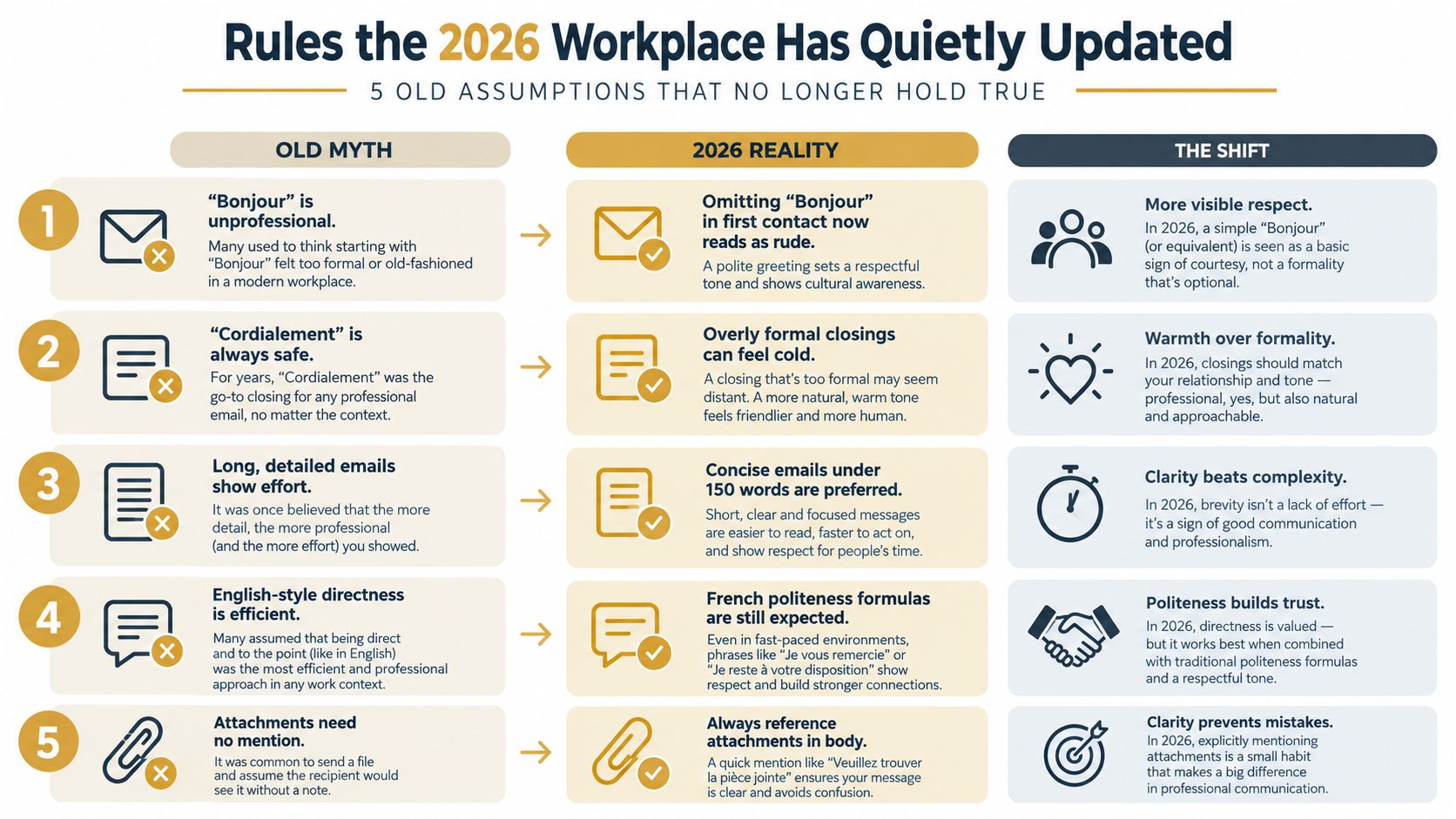
Older guides often treat every message like a letter to a ministry. That is bad advice for multinational teams, school parents, and internal company mail. The better approach is to tie each choice to a decision point: first contact or ongoing exchange, institutional reader or peer, French-only audience or bilingual one.
Five rules I'd update immediately
Use “Bonjour” freely in professional email. “Bonjour Madame,” “Bonjour Monsieur,” and “Bonjour Claire,” are standard, polite, and current. For first contact, they work better than cold openings and better than overdone ceremonial phrasing. With French administrations, keep the surname and title. With colleagues and bilingual school contacts, first name plus “Bonjour” is usually right.
Keep the closing short unless the institution expects more. “Cordialement” still does the job. “Bien cordialement” is slightly warmer. Long closing formulas belong in formal complaints, legal matters, public administration, and a few traditional sectors. For ordinary business email, long sign-offs waste space and can sound theatrical, as reflected in this guide to current French email etiquette.
Abbreviations are audience markers. Internal messages between colleagues may use “cdt” or other shortcuts. Do not copy that into first contact, client communication, or anything involving HR, schools, or administration. The rule is simple: if the reader could judge your professionalism from that email alone, write the full form.
Get to the point faster than older etiquette books tell you to. French professionals still expect politeness, but they no longer want a long runway before the actual request. State the purpose in the first lines, then add the necessary context. This matters even more in multinational teams where people scan fast and read on mobile.
English corporate shorthand still dates badly in formal French. “ASAP,” “FYI,” and “No worries” are common in chat and cross-border teams. They look lazy in polished French email. If you are writing to a French client, a school, or an administration, use plain French instead.
One rule matters more than the others. Formality is no longer a fixed national standard. It is a reader-based choice.
A parent writing to a bilingual school can sound respectful without sounding bureaucratic. A manager at LVMH emailing an internal regional team can be concise and still fully French in tone. A message to a mairie, prefecture, notaire, or university office still needs more distance, cleaner structure, and fewer casual shortcuts.
That is the shift many phrase lists miss. They give you correct language, but not the decision behind it. In 2026, strong French email etiquette means choosing the right level of formality for the specific audience, then staying consistent from greeting to sign-off.
Eight Mistakes That Still Trip Up Fluent Speakers
Fluent speakers often make worse email mistakes than beginners because they trust their instincts too much. Spoken fluency doesn't automatically produce professional register.
Common French Email Errors and Quick Fixes
| Common Mistake | Corrected Version | Reader Perception |
|---|---|---|
| Using tu in first contact | Use vous throughout | Actively off-putting |
| Writing Bonsoir in a morning email | Use Bonjour | Mildly awkward |
| Signing a new client email Amitiés | Use Cordialement or Bien cordialement | Actively off-putting |
| Burying the request in long context | Put the ask in paragraph one or two | Mildly awkward |
| No subject line or vague subject | Write a specific Objet | Neutral to mildly awkward |
| Sending a wall of text | Break into short paragraphs | Mildly awkward |
| Writing Merci pour le retour in a formal context | Prefer Merci pour votre retour | Mildly awkward |
| Dropping accents or lowercase sloppiness in names and labels | Respect accents and capitalization | Mildly awkward |
The register mistakes
The worst errors aren't grammatical. They're relational.
A first-contact email that says “Salut Julien, tu peux m'envoyer le contrat ?” may be understandable, but it tells the reader you either don't know the norms or don't care about them. Neither interpretation helps you.
Another frequent miss is false warmth. “Amitiés” to a client you met once at a trade fair sounds socially confused.
The structure mistakes
French readers want to identify the purpose quickly. If you hide the ask after three paragraphs of background, you're making the recipient work too hard.
Use this sequence instead:
- name the topic
- state the reason for writing
- make the request
- close politely
The English contamination mistakes
This one catches high-level professionals constantly. They import English rhythm into French and produce messages that are grammatically fine but socially off.
Examples:
- “Merci pour le retour” can sound clipped in formal writing
- missing accents in names looks careless
- random shorthand borrowed from English business culture rarely improves a French formal message
A useful reminder from recent commentary on this topic is that many guides still disagree on finer points such as when “Cher Monsieur / Chère Madame” is appropriate and whether “Bonjour” is acceptable in professional contexts, which is exactly why learners need decision rules, not just phrase banks, as argued in this discussion of practical French email formality.
Your 60-Second Pre-Send Check and Practice Drill
Before you send, stop trying to make the email elegant. Make it correct, clear, and properly pitched.
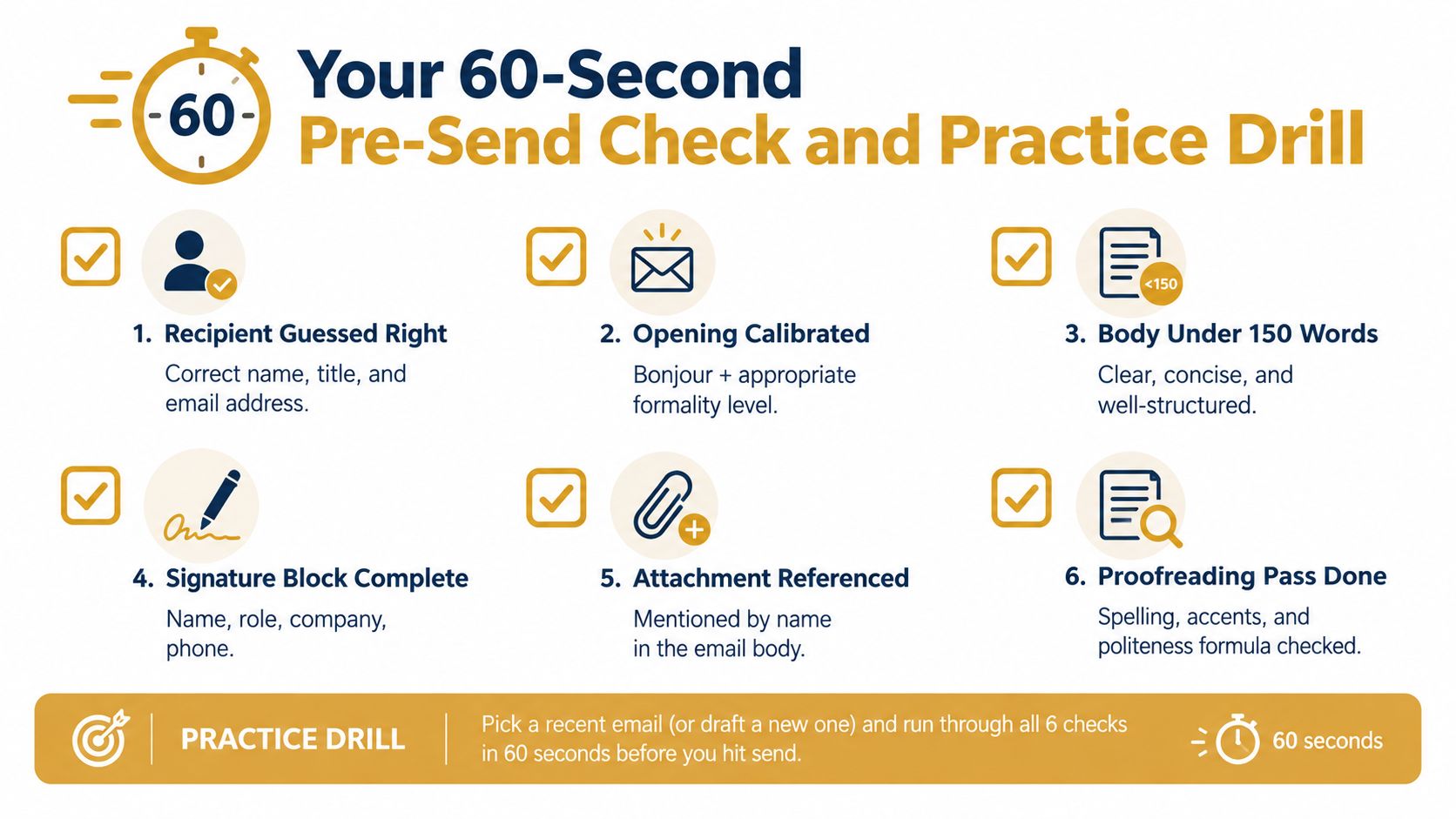
The checklist
Recipient guessed right
Did you use the correct name, title, and level of distance?Opening calibrated
Is it “Bonjour Madame Dupont,” rather than something too blunt or too intimate?Body kept tight
Is the purpose obvious fast? If this is first contact, concise is safer.Request made clearly
Did you ask for the thing, or did you imply it and hope?Closing chosen on purpose
“Cordialement” for neutral professionalism. “Bien cordialement” for slight warmth. Not “Amitiés” unless the relationship supports it.Proofread for accents and tone
Check names, politeness formulas, and whether you accidentally switched from vous to tu.
A short practice drill
Draft these three messages before your next real send:
Client reply
You missed a meeting with a client at BNP Paribas and need to apologize and propose a new time.University request
You need to ask a Paris university registrar for a deadline extension.Internal chat follow-up
A colleague joked on Slack after your team lost an internal prediction game. Reply in French without sounding wooden.
Write each draft, then run the checklist above. You'll spot the same weak points quickly. Usually it's the greeting, the request line, or the closing.
One option if you send French emails every week is to work with a coach who corrects your real outgoing drafts and helps you build a house style for your role. Elite French Tutoring offers customized private French lessons for professionals, families, and students, including business communication practice and real-world email calibration. If you're comparing options, I'd look for a program that works on your actual messages, not just textbook exercises.
If your next step is practical rather than academic, compare a few private lesson options and choose one that includes business writing feedback. That's the fastest way to make French email etiquette feel automatic instead of stressful.