Skip to content
You open three tabs during lunch, save two more for later, and end the day no closer to choosing a French lesson in Charlotte. One program looks polished but rigid. Another is affordable but light on speaking time. A private tutor sounds promising, yet it is hard to tell who can effectively teach versus who only speaks French.
I've vetted these options the way I would for a client who wants results without wasting months in the wrong format. The right choice depends on your goal first, then your schedule, learning style, and budget. A busy professional usually needs flexibility and targeted conversation practice. A parent may need structure, patience, and accountability. An exam student needs correction, consistency, and a clear progression plan.
That trade-off matters more than marketing copy. Group classes can lower the cost and build momentum, but they often move at a fixed pace. Private lessons cost more, yet they usually produce faster gains in speaking confidence because the learner gets more time on task.
This guide is built to help you choose, not just browse. I'll compare seven Charlotte-area options side by side, point out where each one fits best, and give you a simple decision framework you can use before you book anything. I'll also share a real student success story so you can see what progress looks like in practice. For readers who want a stronger screening process before committing, this guide on how to find the perfect French tutor for adult learners is a useful starting point.
Charlotte has good options. The challenge is matching the format to the outcome you want.
Table of Contents
- 1. Elite French Tutoring Best for Personalized Results
- 2. Alliance Française de Charlotte Best for Community and Culture
- 3. Language Academy of the Carolinas Best for Local Group Classes
- 4. Queen City French Best for Social and Boutique Learning
- 5. Central Piedmont Community College Best Budget-Friendly Option
- 6. UNC Charlotte School of Professional Studies Best for University-Branded Courses
- 7. Language Trainers Best for On-Site Corporate Training
- Charlotte French Lessons, 7-Provider Comparison
- Making Your Choice How to Pick the Right French Lesson
1. Elite French Tutoring Best for Personalized Results
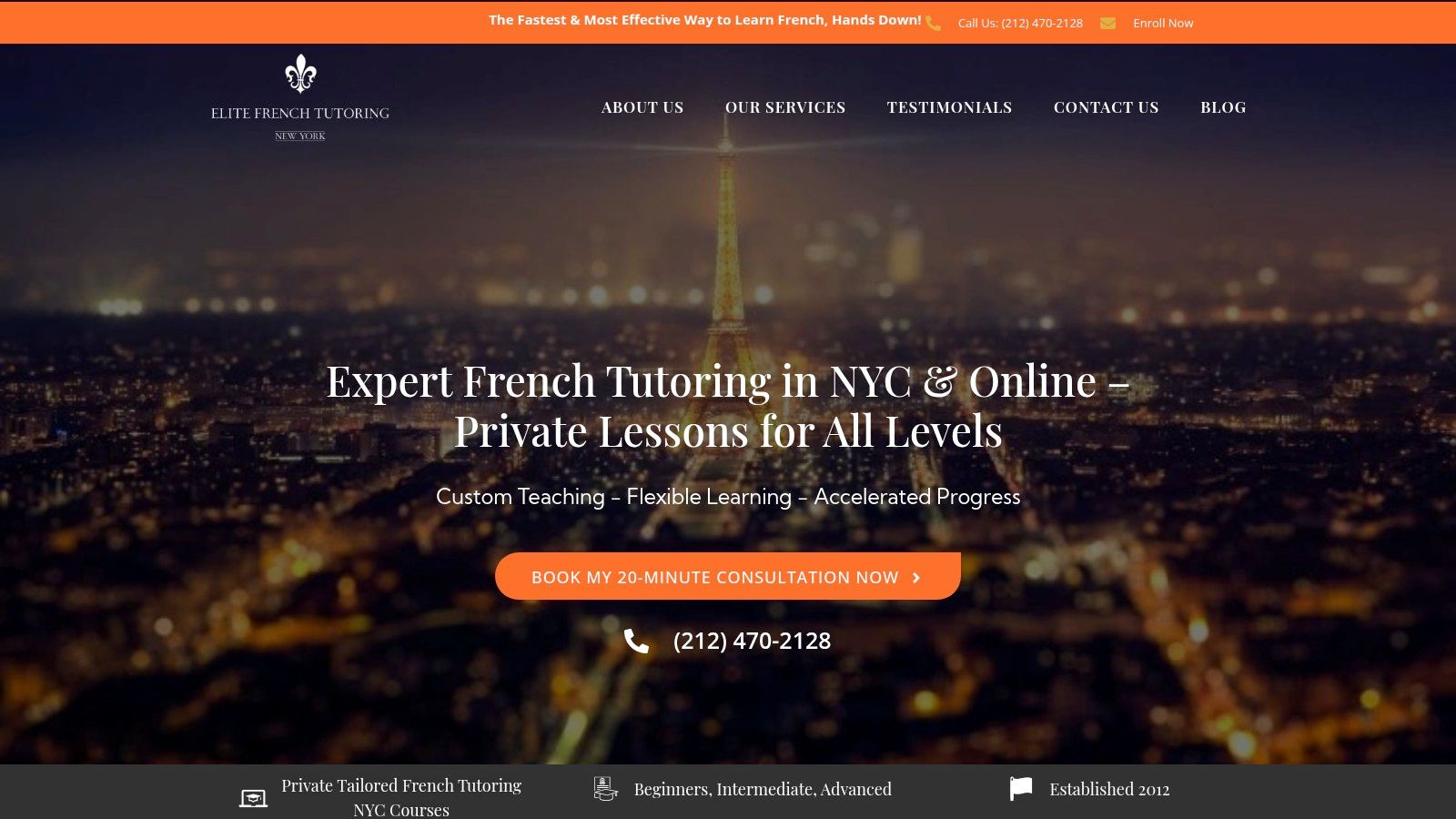
If you want French lessons in Charlotte that adapt to you instead of forcing you into a preset class track, Elite French Tutoring is the strongest pick. Their model is built around private instruction, and for Charlotte learners the key advantage is access to a high-touch online program that's flexible enough for executives, parents, students, and exam candidates.
The starting point matters. Every engagement begins with a complimentary consultation, which is exactly what serious learners need. A strong teacher shouldn't guess your level, your pace, or your reason for learning. Elite French Tutoring builds from that initial assessment and then shapes the curriculum around conversation, business communication, exam prep, or school support.
Why it stands out
This is the option I'd put in front of anyone with a specific outcome in mind. If you need DELF or DALF preparation, business French, support for a child in a bilingual program, or a plan that works around a packed schedule, private coaching eliminates the drag that group classes create.
A real success story backs up that approach. In a verified case study, Sarah made measurable fluency gains after her tutor at Elite French Tutoring started with a detailed level assessment and then designed a customized curriculum around her strengths and weak areas.
Practical rule: If your goal has a deadline, choose a tutor who can customize sequence, homework, corrections, and pacing from day one.
Elite French Tutoring also has depth. Since 2012, the team has helped thousands of learners, including CEOs, UN staff, Ivy League professors, doctors, and busy families. That matters because advanced adult learners often need polish, not generic beginner content.
Best fit and trade-offs
The upside is clear.
- Best for targeted outcomes: Adults pursuing career goals, students preparing for exams, and families who need precise support usually get more value from a custom plan.
- Best for busy schedules: Online delivery removes commute friction and opens up more scheduling flexibility.
- Best for nuanced instruction: Feedback can be adjusted to your preferences, which is more important than many learners realize. One student reflecting on 200 tutoring sessions found that clearly defining lesson mechanics, such as receiving corrections after the session instead of during speech, improved confidence and flow.
The trade-offs are also real. Pricing isn't listed publicly, so this sits in the premium category. And if you specifically want weekly in-person lessons inside Charlotte, this isn't their core local format.
If you're comparing providers and want a sharper framework first, their guide on how to find the perfect French tutor for adult learners is worth reading before you book.
2. Alliance Française de Charlotte Best for Community and Culture
A common Charlotte scenario looks like this. An adult starts French with real enthusiasm, attends a few lessons, then loses momentum because French never becomes part of weekly life. Alliance Française de Charlotte solves that problem better than a tutor-only setup because it gives learners both instruction and a community to return to.
I've vetted this option for students who need more than curriculum. Alliance Française de Charlotte has been part of the local French-learning scene for decades, and that history shows up in the experience. You are not joining a loose directory of teachers. You are stepping into an organization built around classes, events, conversation, and Francophone culture.
Where Alliance Française works best
This is a strong fit for adults who stay consistent when the language shows up in multiple ways during the week. A class gives structure. A cultural event or conversation group gives repetition without making everything feel like homework. For many learners, that mix is what keeps motivation alive long enough to produce real progress.
It also stands out for students with formal goals. Alliance Française serves as an official DELF and DALF testing site, which matters if you want a recognized credential and prefer to study in the same environment where certification is taken. That setup removes some friction and gives exam preparation a clearer path.
The trade-offs are practical. Group classes run on fixed schedules, so this option is less forgiving if your work hours change often or you travel regularly. Private and semi-private lessons can help, but membership requirements and organizational structure still make this feel less flexible than independent coaching.
I usually recommend Alliance Française to three types of learners. Professionals who want French to become part of their routine. Parents who want cultural exposure, not just grammar drills. Exam-bound students who value an established testing ecosystem.
If you are a beginner and want help building consistency before you commit, this guide on how to start beginner French classes and stay motivated pairs well with this option.
For learners who value culture as much as curriculum, Alliance Française is hard to beat. If you want a complementary cultural read while comparing options, I also like this French culture blog.
3. Language Academy of the Carolinas Best for Local Group Classes
A lot of Charlotte adults start French with good intentions, then stall because solo study is too easy to postpone and private lessons feel too intense or too expensive to sustain every week. Language Academy of the Carolinas fills that middle ground well. I've found that this type of school works best for learners who want a real class structure without committing to a full college-style program.
The biggest strength is the group format. In-person classes are kept small, and the online groups are smaller still, which gives students more chances to speak, make mistakes, and recover in real time. That matters. In language learning, regular speaking turns usually do more for progress than sitting through a larger class where only the most confident students participate.
This provider is a strong fit for people who benefit from a calendar they can plan around. A published session schedule, a defined level structure, and placement testing solve a practical problem that many learners underestimate at the start. They reduce the odds of ending up in a class that feels painfully slow or discouragingly advanced.
There are trade-offs. Session-based enrollment is less flexible than private coaching, so this is not the best pick if your travel schedule changes often or you need to accelerate quickly for a job interview, relocation, or exam date. Private lessons may be available, but the clearest value here is the local group model.
I usually point three kinds of learners toward this option. Busy professionals who need external accountability. Parents who want a stable weekly class outside the home. Beginners who are more likely to stay consistent when other students are progressing alongside them.
- Choose this if: You want structure, peer energy, and regular speaking practice in a small class.
- Skip this if: You need a highly customized plan or your schedule changes from week to week.
- Use it well: Treat the class as your anchor, then add short speaking and review sessions between meetings to keep momentum.
If you're still deciding whether a beginner group class is the right starting point, this guide on how to start beginner French classes and stay motivated will help you choose more confidently.
4. Queen City French Best for Social and Boutique Learning
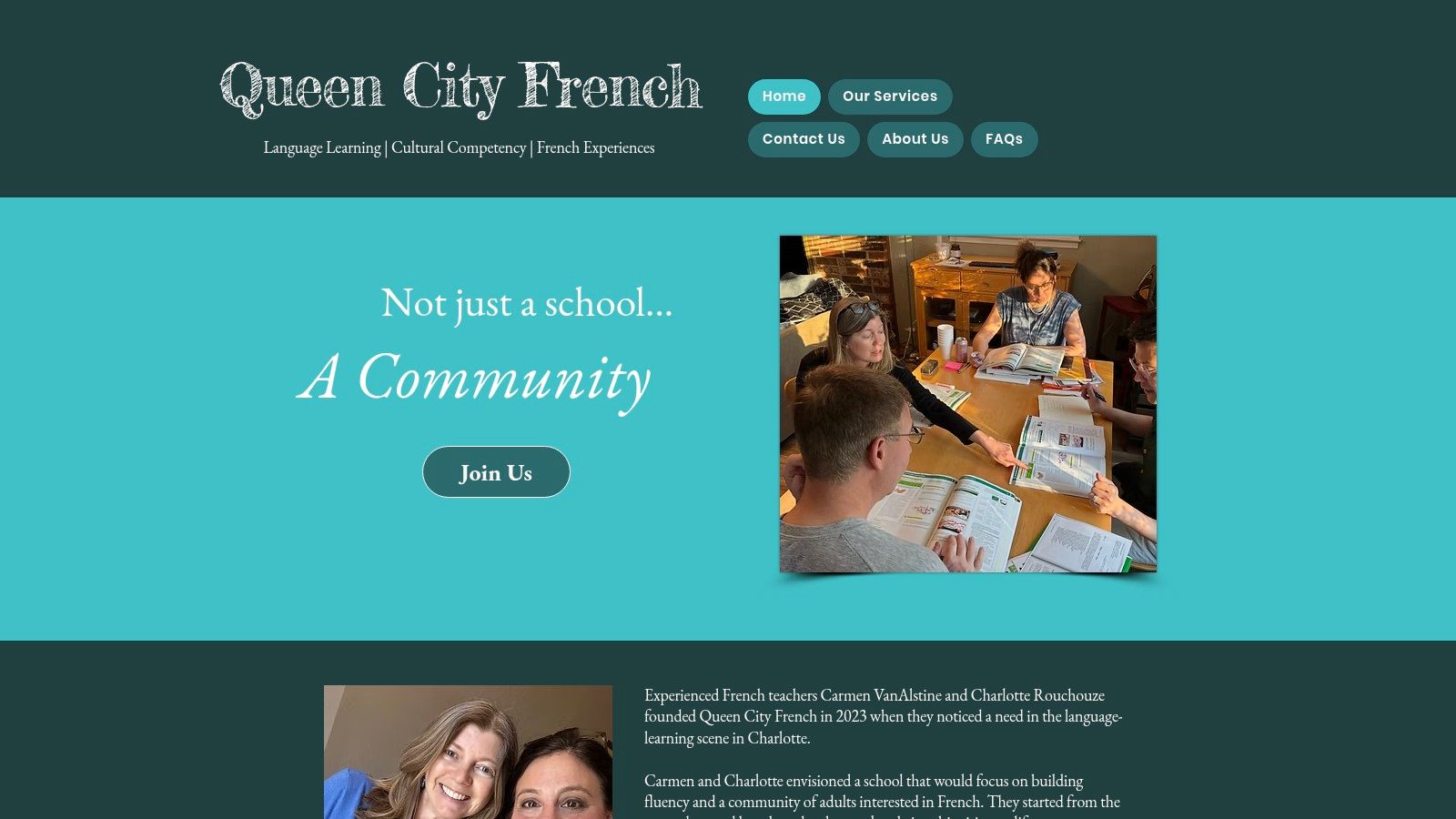
Not everyone wants a formal classroom. Some adults want French lessons in Charlotte to feel social, local, and low-pressure. Queen City French fits that mood better than the larger institutions.
Its boutique scale is the selling point. Small group courses, private lessons, and community events create a more intimate learning environment, and the relaxed settings can lower the anxiety that keeps adults from speaking up.
Where the boutique model helps
I like this option for learners who are motivated by connection. If your ideal class feels more like joining a smart social circle than attending school again, Queen City French will likely feel more natural than a college course or a rigid institutional program.
The main caution is scope. Because it's a smaller, newer school, the menu of specialized tracks may be narrower than what you'd find at a larger provider or a premium private tutor. That matters if you need a very specific outcome, like formal exam prep or school curriculum alignment.
The local market around this kind of provider is competitive. In Charlotte, Superprof lists 80 available native French tutors at an average hourly rate of $27, and 95% offer the first class for free. That tells you two things. First, trial access matters. Second, boutique schools need a strong learner experience to stand out.
A trial lesson is useful for chemistry, not for judging long-term curriculum quality. Ask what happens after week three, not just whether the first session was enjoyable.
Queen City French is strongest when your priority is consistency through community. If that's what keeps you engaged, it can be a smart buy.
5. Central Piedmont Community College Best Budget-Friendly Option
Central Piedmont Community College Continuing Education is the practical option for learners who want structure and affordability over customization. I'd point beginners here when they want a classroom experience and don't need premium coaching.
The biggest advantage is cost positioning. Community college continuing education tends to appeal to hobby learners, cautious starters, and adults who want to test their interest before committing to private lessons. That's often a smart move.
When CPCC makes sense
This works best if you want a straightforward introduction and don't mind learning on the institution's calendar. You get a recognizable academic setting, published term schedules, and a low-pressure environment.
The weakness is momentum. These classes depend on enrollment cycles, and availability can be inconsistent. If your timing is urgent, or you need lessons built around a work trip, school requirement, or certification date, waiting for a course to open can slow you down.
A broader language-learning context supports why budget options remain popular. The global online language tutoring market is projected to reach $12.7 billion by 2032, growing at a 20.2% CAGR from 2025 to 2032. That growth reflects demand for flexible learning, but it also means many learners are now comparing traditional institutions against online tutoring more directly than before.
- Best for beginners: Good fit for first exposure to conversational French.
- Best for cautious spenders: Easier to try than a premium custom program.
- Less ideal for high-stakes goals: Not my first choice for exam deadlines, business communication, or school-specific support.
If your main priority is keeping costs controlled while starting French, CPCC is one of the most sensible places to check first.
6. UNC Charlotte School of Professional Studies Best for University-Branded Courses
UNC Charlotte School of Professional Studies is a narrower option, but still worth watching. When conversational French appears in the catalog, it gives adult learners a university-affiliated way to study without jumping into a full degree track.
This kind of course appeals to people who trust recognizable institutions. That's a real buying factor, especially for professionals who prefer established brands over independent providers or tutor marketplaces.
Good choice for cautious starters
I see this as a “check current availability and move fast if it fits” option. The brand credibility is useful, and the practical beginner focus can suit adults who want something serious but not overly intense.
The challenge is consistency. These courses aren't always available, and session details can vary. That makes UNCC less dependable as a year-round plan than a private provider or a dedicated language school.
This is also where I'd be careful if you need niche support. In Charlotte, a significant unmet need exists around bilingual school support. Only 15% of private French tutors in Charlotte advertise curriculum-aligned support for bilingual schools, while 78% of parents of K-12 students at French schools report tuition-mismatched tutoring as their top stressor. A general university conversation course usually won't solve that problem.
For adults who want a reputable entry point, UNCC can be a solid fit. For parents or learners with precise goals, I'd compare it against more specialized providers before enrolling.
7. Language Trainers Best for On-Site Corporate Training
For companies and professionals who want lessons brought to them, Language Trainers fills an important gap. They offer face-to-face French lessons on-site in Charlotte, whether that's at an office, home, or another agreed location.
That delivery model changes the buying decision. You aren't just purchasing teaching. You're purchasing convenience and implementation. For busy teams, that can matter more than a social community or a fixed classroom schedule.
Strong option for teams and professionals
Language Trainers makes the most sense for corporate use, small group workplace training, or professionals who won't reliably commute to a school. Their curriculum can be customized for general French or business-focused needs, which is important in Charlotte's professional market.
And that need is more serious than many listings reflect. In Charlotte, 68% of corporate clients seeking French training cite business vocabulary as their primary goal, but only 8% of local tutors offer business French specialization. That's exactly why a provider with corporate delivery and a business-oriented option deserves a place on this list.
I'd still note two limitations. In-person pricing is quote-based, so comparison shopping takes more effort. And this isn't the option I'd pick if you want a built-in community or lots of local cultural programming.
If your company is paying, ask for a curriculum outline before approving the package. “Business French” can mean anything from polite greetings to industry-specific communication.
For professionals comparing options, this page on French for business is also useful as a benchmark for what a more specialized business program should include.
Charlotte French Lessons, 7-Provider Comparison
| Program | Implementation Complexity 🔄 | Resource Requirements ⚡ | Expected Outcomes ⭐ | Ideal Use Cases 💡 | Key Advantages 📊 |
|---|---|---|---|---|---|
| Elite French Tutoring: Best for Personalized Results | High customization workflow (initial consult + bespoke plan) | Premium cost; native expert tutors; online tech required | Rapid, measurable progress; exam & professional readiness | Busy professionals, exam prep (DELF/DALF), individualized goals | Bespoke curriculum; proven results with high‑profile clients |
| Alliance Française de Charlotte: Best for Community and Culture | Structured programs with membership and scheduled sessions | Moderate cost; in‑person facilities; volunteer/staffed events | Strong cultural immersion; formal certification pathway | Learners seeking community, cultural events, DELF/DALF certification | Official testing center; rich Francophone programming |
| Language Academy of the Carolinas: Best for Local Group Classes | Session-based scheduling; placement testing for levels | Published pricing; small in‑person cohorts; multiple locations | Steady conversational improvement in class cohorts | Local learners preferring regular, small group classes | Small class sizes; conversational focus and local reputation |
| Queen City French: Best for Social and Boutique Learning | Low‑bureaucracy, boutique delivery (flexible venues) | Transparent pricing; small instructor team; café/online spaces | Improved conversational confidence in social settings | Adults wanting intimate, social learning and networking | Strong community feel; social events and flexible locations |
| Central Piedmont Community College: Best Budget-Friendly Option | Standard academic schedule; term‑based enrollment | Low cost; campus resources; institutional support | Basic conversational foundation; pathway to credit courses | Beginners or hobbyists on a budget | Most budget‑friendly; structured academic environment |
| UNC Charlotte SPS: Best for University-Branded Courses | Short, session‑based extension courses when offered | Variable cost; university‑backed instructors; limited frequency | Practical conversational skills with university affiliation | Learners who value accredited/university branding | University reputation; practical, short‑format courses |
| Language Trainers: Best for On-Site Corporate Training | Moderate logistical coordination for on‑site delivery | Quote‑based pricing; local native instructors; corporate scheduling | Tailored business French and team readiness | Companies needing on‑site or team training | High location flexibility; fully customizable corporate curricula |
Making Your Choice How to Pick the Right French Lesson
A Charlotte parent wants after-school help for a middle school student. A bank analyst needs business French before a Montreal trip. An adult learner wants to order confidently in Paris next spring. Those three people should not buy the same kind of lesson, even if all of them type "french lessons charlotte" into Google.
I've vetted these options with one question in mind: what format gives you the best return for your specific goal? Start there, because the wrong format wastes months. A good teacher in the wrong setup can still produce slow progress.
Use this decision filter.
If you need targeted results, such as exam preparation, school support, accent correction, or fast conversational improvement, choose private instruction. You get a curriculum built around your gaps, your schedule, and your pace. The trade-off is cost. You also need to show up prepared, because private lessons expose weak spots quickly.
If you stay motivated through structure and other people, choose a group program. Alliance Française de Charlotte and other community-based formats tend to work well for adults who want consistency, conversation, and cultural connection. Progress is usually steadier than fast, but many learners stick with it longer because the class becomes part of their routine.
If price is your top concern, start with CPCC or another institution-led option. That route usually gives you clear scheduling and lower tuition. The trade-off is flexibility. You adapt to the course calendar rather than the other way around.
Parents should screen more carefully than adult hobby learners. A child who needs help with French immersion, IB, AP, or a specific school curriculum often needs more than a fluent speaker. Ask how the teacher handles reading development, writing correction, and age-appropriate accountability. Fit matters more than simple availability.
For working adults, I usually narrow the choice to one question. Do you need accountability, or do you need flexibility? Weekly group classes help learners who benefit from a fixed appointment and external structure. Private coaching fits professionals with travel, variable hours, or a deadline tied to work performance.
One of my students came to me after trying apps, occasional conversation meetups, and a low-cost online tutor. Nothing was wrong with any one option. The mix did not match her goal, which was a B1 exam score for a relocation plan. Once we switched to focused private lessons, reduced materials to one grammar spine and one listening routine, and tracked weekly speaking targets, her progress became measurable. That is the pattern I see again and again. Clarity beats variety.
The provider comparison above should make your shortlist easier. Now test each option against four practical questions: your goal, your schedule, your budget, and the amount of guidance you need between lessons.
Book the trial, consultation, or intake that gives you a clear next step. If a provider cannot explain how they would teach someone with your exact objective, keep looking.