Skip to content

You're probably doing what most Seattle learners do first. You type “French lessons Seattle,” open six tabs, compare hourly rates, and immediately get stuck. One tutor looks cheap but vague. One school looks polished but generic. One profile says “native speaker,” which sounds promising until you realize that being French and teaching French are not the same thing.
I'll save you time. Don't choose based on price first. Choose based on fit for your goal, teacher quality, and method. If you want real speaking progress, school support for your child, or serious exam prep, the wrong format will waste months.
Seattle does have a real French-learning ecosystem. The city's francophone community includes multigenerational families and newcomers, and local institutions such as Alliance Française de Seattle and Seattle Languages International continue to support French learning through classes, workshops, and private instruction, as noted in this overview of French in Seattle. That's the good news. The harder part is choosing well.
Table of Contents
Starting Your Search for French Lessons in Seattle
Most adults don't start looking for French lessons because they suddenly care about grammar charts. They start because they're tired of freezing when it's time to speak. They've taken classes before, used apps, maybe even traveled to France or worked with French-speaking colleagues, and they still don't feel comfortable opening their mouth.

That instinct is exactly right. Speaking confidence is the outcome that matters for most adults shopping for private lessons. According to independent language education industry data from the American Councils for International Education, 78% of adult French learners who enroll in private tutoring cite “speaking confidence” as their primary commercial motivation (ACTFL). That matches what I see every week. People don't want more passive exposure. They want to speak clearly, respond faster, and stop second-guessing every sentence.
Why the Seattle search feels messy
Seattle gives you a mix of community schools, university options, tutor marketplaces, and private instructors. That sounds like abundance. In practice, it creates noise. A low hourly rate can hide weak lesson structure. A friendly conversation partner can lack correction skills. A polished website can still offer a one-size-fits-all program.
My rule: if a provider can't explain how they move you from hesitant speech to confident conversation, keep looking.
A better search starts with one question: What do I need French for right now? Career growth, school support, travel, certification, relocation, or family language maintenance all require different lesson design. If you want a practical starting point, compare the options through a service-focused lens such as these French language classes in Seattle, then narrow by goal instead of by marketing claims.
What to ignore first
Don't let three things make the decision for you:
Cheap rates: Low cost often means low structure, limited prep, or weak follow-up.
“Native speaker” alone: Native fluency helps. Teaching skill matters more.
Broad promises: “All levels welcome” tells you almost nothing about outcomes.
If you shop for French lessons in Seattle the way you'd hire any serious specialist, the field gets much clearer very fast.
Your Checklist for Vetting High-Quality Tutors
Before you compare rates, screen for quality. Seattle has plenty of French tutors, but serious learners need more than availability and a profile photo.
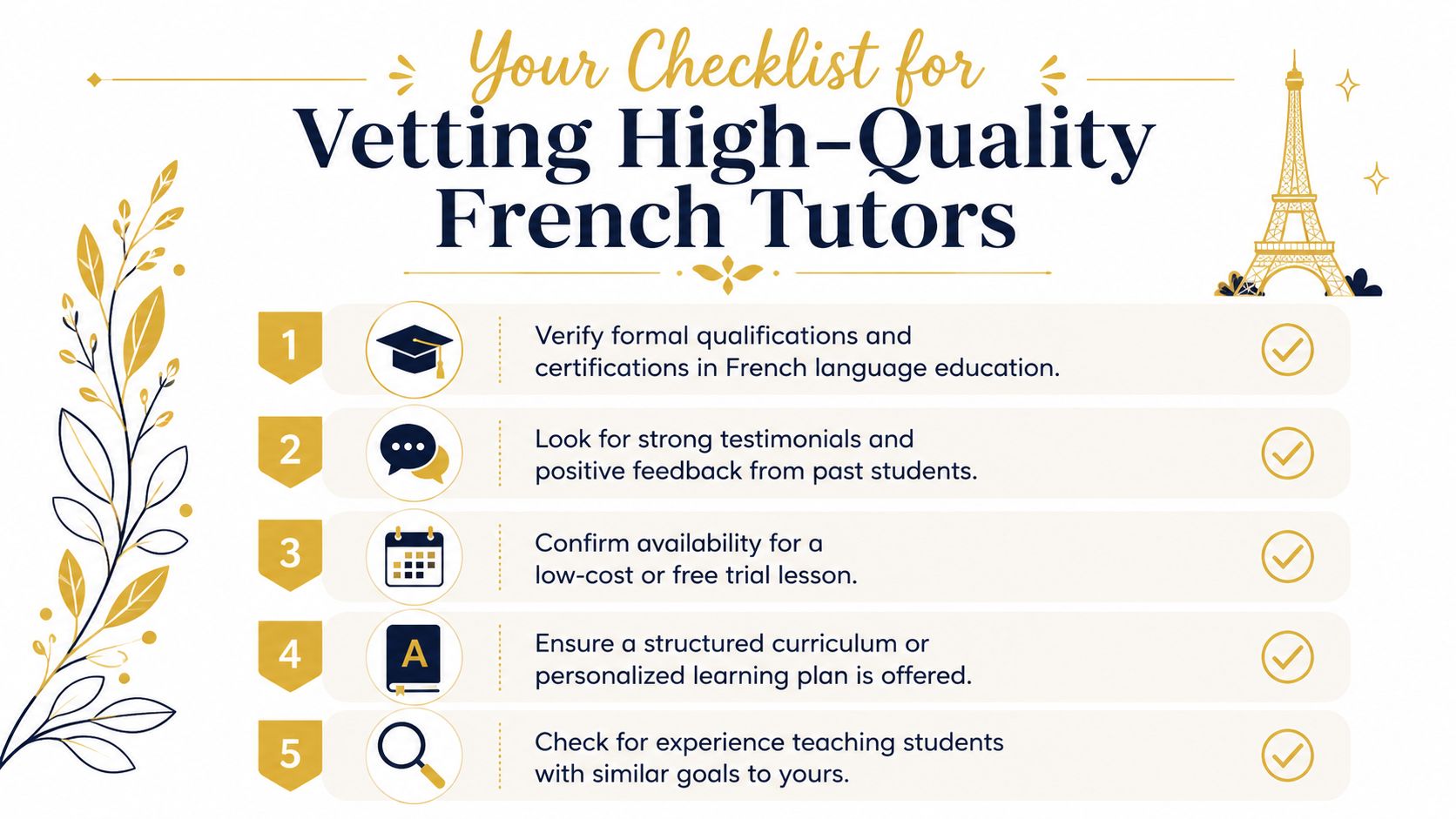
Recent data from tutoring marketplaces shows over 69 French tutors available in Seattle, but very few offer transparent, vetted credentials for native expertise or specializations like corporate or DELF/DALF training, creating a significant quality gap for serious students (Superprof Seattle French tutors). That gap is why two tutors with similar prices can produce completely different results.
Check qualifications before personality
A warm teacher is nice. A qualified teacher gets you somewhere.
Ask direct questions:
What formal training do you have in teaching French?
What kinds of students do you teach most often?
How do you correct speaking mistakes without killing confidence?
How do you plan lessons for my goal?
A good answer sounds specific. You should hear about level assessment, lesson objectives, correction style, and progression. A weak answer sounds casual. “We just talk and see what you need” is not a plan. For learners who want structured, personalized French instruction, Elite French Tutoring is one option to consider.
Look for methodology, not just friendliness
A strong tutor has a teaching system. Not a rigid script, but a repeatable method. Good lessons usually include guided conversation, targeted correction, active recall, listening work, and follow-up tasks that fit your real life.
A tutor who can't describe their method usually doesn't have one.
That matters because adults often confuse enjoyable lessons with effective lessons. The best sessions are usually both. You speak a lot, but the teacher is steering. They're choosing vocabulary, recycling structures, noticing patterns, and adjusting in real time.
For adult learners, I like providers who can articulate how they personalize lessons. A useful reference point is this guide on how to find the perfect French tutor for adult learners, especially if you've been disappointed by generic classes before.
Test the fit in a trial lesson
If there's one step you shouldn't skip, it's the trial lesson or consultation.
Use it to evaluate five things:
Clarity: Does the tutor quickly understand your level and your goal?
Structure: Does the session feel intentional or improvised?
Correction style: Do they help you improve without constant interruption?
Energy: Do you leave feeling more capable, not more confused?
Specificity: Do they suggest a path forward that fits your situation?
Match experience to your use case
A common pitfall is hiring the wrong person. A tutor can be excellent for travel conversation and completely wrong for a child in a bilingual school. Another can be perfect for beginners and weak for C1-level business French.
Here's the filter I'd use:
| What you need | What good looks like |
|---|---|
| Adult conversation | Guided speaking practice, pronunciation work, confidence-building correction |
| Kids and teens | Curriculum alignment, parent communication, age-appropriate pacing |
| Business French | Industry vocabulary, role-plays, presentation practice |
| DELF/DALF prep | Exam familiarity, scoring criteria, timed practice |
If you can't see a clear line between the tutor's experience and your goal, don't assume they'll figure it out later.
Comparing Seattle's French Tutoring Models
Not all French lessons in Seattle are selling the same thing. That's why comparing providers by name alone doesn't help much. You need to compare models.
Some people need community and consistency. Others need speed, accountability, and a highly personalized plan. Those are different purchases.
Comparison of French Lesson Models in Seattle
| Provider Model | Best For | Instructor Vetting | Personalization Level | Typical Price Range | Key Trade-off |
|---|---|---|---|---|---|
| Community language school | Adults who enjoy structured group learning and cultural programming | Usually institution-led, varies by instructor | Moderate | Package-based tuition | Less individual speaking time |
| College or university program | Learners who want an academic framework | Formal academic setting | Low to moderate | Tuition-based | Slower pace for practical speaking goals |
| Tutor marketplace | Budget-focused learners willing to search | Inconsistent, profile-dependent | Varies widely | Low to mid | Quality control is weak |
| Independent private tutor | Learners who find a strong individual match | Depends entirely on the tutor | High if the tutor is experienced | Mid to high | Harder to evaluate before booking |
| Boutique tutoring service | Professionals, families, exam candidates, goal-driven adults | Usually strongest vetting and specialization | High | Mid to high | Higher upfront investment |
When group programs make sense
Seattle's established institutions matter. Alliance Française de Seattle offers general French classes, specialized courses, workshops, and reviews in both online and in-person formats, while Bellevue College continues to support French learning through its world languages programming, as noted in this Seattle-area overview of French education. If you want routine, peer interaction, and a broader cultural environment, these can be good choices.
The trade-off is straightforward. Group classes usually can't revolve around your schedule, your speaking gaps, or your specific professional or academic demands.
When marketplaces help, and when they don't
Marketplaces are useful if you're flexible, price-sensitive, and willing to do your own vetting. They're less useful if your goal carries consequences, such as exam certification, school performance, or business communication.
Cheap tutoring is expensive when you have to start over with someone better three months later.
When specialized tutoring is worth it
If your goal is narrow and important, private, specialized instruction usually gives the best return. That includes business French, DELF/DALF prep, and curriculum-aligned support for children.
This is also where online learning deserves more respect. Strong online tutoring often beats mediocre in-person tutoring because quality matters more than zip code. If you're comparing formats, this overview of the best online French lessons is a useful benchmark for what high-quality remote instruction should include.
The right model depends less on where the lesson happens and more on whether the teaching is focused, accountable, and built around your actual objective.
Finding the Right Fit for Your Specific Goal
A strong French program starts with the learner's real-world pressure point. I see three common ones in Seattle: school support for kids, business communication for adults, and exam preparation for ambitious students.

For parents of bilingual and French-school students
Parents often come to tutoring after trying to solve the problem with more homework, more apps, or more exposure at home. That usually isn't enough. Children in bilingual and French-school environments need targeted support that matches what's happening in class.
Seattle has a real gap here. Most local French lesson options focus on general tutoring or group instruction, while parents looking for curriculum-aligned support for Lycée Français or bilingual school students remain underserved. One local provider states there are zero dedicated programs in Seattle matching this niche, and notes that national 2025 trends show 42% of French-immersion families need personalized tutoring outside school hours to maintain grade-level proficiency (North Seattle French School).
What parents should ask for:
Curriculum alignment: Can the tutor work from your child's classroom materials?
Literacy support: Can they help with reading, writing, and oral expression?
Parent communication: Will you get updates on what was covered and what still needs work?
Age-appropriate pacing: A child who shuts down is not learning.
For professionals who need business French
Business French is not “regular French plus a few formal phrases.” It requires precision, speed, and the ability to handle meetings, presentations, negotiation, and social nuance.
If you need French for work, ask whether the tutor can build lessons around your actual context. That might mean product demos, client calls, investor meetings, or relocation prep. You need role-play, correction, and vocabulary in context.
A common mistake is hiring a pleasant general tutor and hoping business language will emerge naturally. It won't. Professional learners need targeted scenarios and repeated practice under pressure.
If your work requires French, your lessons should sound like your work.
For DELF and DALF candidates
Exam prep is its own category. I'm blunt about this because too many students waste time with general tutors. DELF and DALF success depends on familiarity with the exam tasks, timing, scoring expectations, and feedback on production.
You want an instructor who can tell you why a response would score well, where you're losing points, and how to train for each part of the exam. “Let's just improve your overall French first” is often code for “I don't know the exam well enough.”
A real student story
One Seattle parent came to me after months of frustration with general homework help for her middle-schooler in a bilingual program. The child was bright, motivated, and still falling behind in written French because the support they'd hired wasn't aligned with school expectations. The tutor was kind, but each session drifted.
We rebuilt the approach around the student's class materials, weekly writing tasks, oral practice tied to school themes, and steady parent updates. Within a short stretch, the child stopped dreading French assignments and started participating more confidently in class. That's the kind of change families are really buying. Not “extra practice,” but the right kind of practice.
What a Great French Lesson Actually Looks Like
A private lesson should never feel random. If you're paying for personalized instruction, you should be able to see the architecture of the hour.
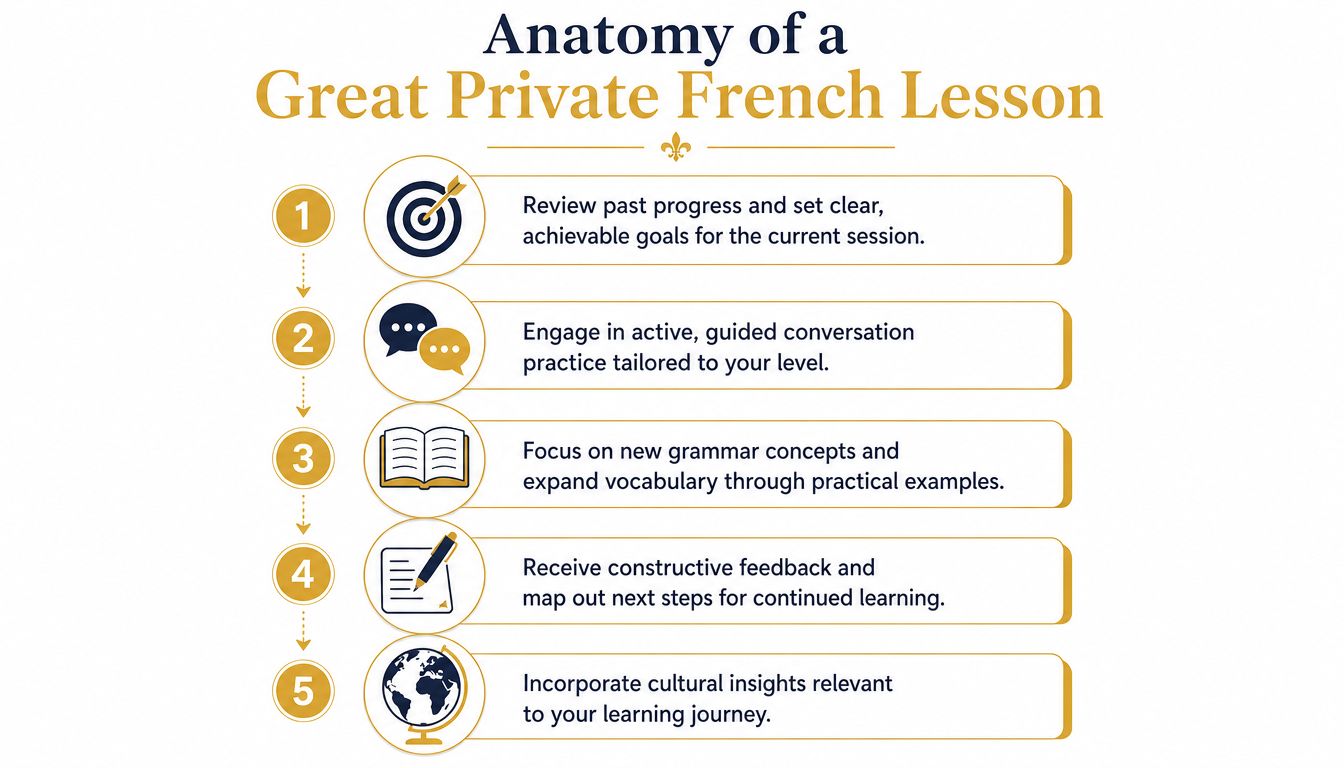
The first part sets direction
The first minutes are not filler. They establish continuity.
In a strong 60-minute lesson, the tutor starts by checking retention from the last session, reviewing your real-world practice, and setting one clear target for the hour. Maybe it's past tense narration. Maybe it's handling a restaurant interaction smoothly. Maybe it's speaking more naturally in a meeting simulation.
A good tutor also gets you speaking early. Not with a pop quiz, but with guided conversation that warms up your ear and your mouth.
The middle of the lesson does the heavy lifting
Most of the progress occurs in this focused period. You should spend the core of the lesson actively producing language.
That usually includes a mix of:
Guided conversation: speaking at length, not one-word answers
Targeted input: short explanations of grammar or usage only when needed
Role-play: practical scenarios tied to your life
Pronunciation work: correction that improves clarity
Recycling: using the same new structures several times in different ways
The lesson should feel alive, but not chaotic. Every activity should connect back to the session goal. If you want a useful benchmark for what that structure looks like in practice, review a clear tutoring philosophy such as this French tutoring methodology.
Great tutors don't fill an hour. They engineer repetition with variation so new language actually sticks.
The final minutes create momentum
The end matters almost as much as the middle.
A strong tutor wraps by telling you what improved, what still needs work, and what to do before the next lesson. That assignment should be realistic. A short voice recording, a few targeted sentences, a reading passage, or a rehearsal task tied to your life works better than busywork.
You should leave knowing three things: what you practiced, what you can now do a bit better, and what comes next. If a lesson ends with “see you next week,” the teacher is leaving progress to chance.
Your Next Step to Speaking French Confidently
Choosing French lessons in Seattle is not about finding the lowest hourly rate. It's about buying an outcome. Better speaking confidence. Stronger school performance. Sharper business communication. Exam readiness.
The right choice is usually the one that feels most specific to you. Not the broadest promise. Not the cheapest listing. Not the tutor with the nicest profile photo. The provider who can diagnose your needs, explain their method clearly, and build lessons around your real goal is usually the one worth hiring.
"I needed to prepare for a presentation to our Paris office in three months. My tutor at Elite French built a program around my industry's vocabulary and we role-played the Q&A relentlessly. I not only nailed the presentation but felt confident during the entire trip." – David R., Engineering Manager, Seattle
If you want a program built around your schedule, level, and objective, a low-friction next step is to book a consultation with Elite French Tutoring. If you're still comparing options, start by shortlisting tutors who can show clear credentials, a real methodology, and direct experience with your exact goal.
Ready to compare serious options for French lessons in Seattle? Start with a conversation, not a package. A brief consult will tell you more than ten tutor profiles ever will.