Skip to content

You're probably staring at a dozen tabs right now. One for group classes, one for UC, three for tutor marketplaces, maybe one for a local meetup. Every option sounds promising, but that's the problem. Those seeking French classes in Cincinnati don't need more options. They need a better filter.
I've seen the same mistake over and over. A traveler signs up for an academic program they'll never fully use. A professional books casual conversation lessons when their needs are email, meetings, and presentation practice. A parent pays for a friendly tutor who can't support a child's school curriculum. The result isn't just slow progress. It's wasted money, stalled motivation, and the feeling that French is harder than it really is.
The good news is that the Cincinnati market gives you real choices. The bad news is that those choices only work if they match your goal.

If you're still deciding how to begin, this practical guide on how to start learning French is a useful first step. Then come back and use the framework below to choose a program that fits.
Table of Contents
Starting Your French Journey in Cincinnati
Typing “French classes Cincinnati” into Google feels productive. It also creates confusion fast.
One option promises community. Another promises flexibility. Another looks affordable until you realize you're comparing group tuition, university credit hours, and private hourly rates as if they were the same thing. They aren't. If you compare the wrong things, you'll choose the wrong program.
The real problem isn't motivation
Most adults I talk to are motivated enough. Parents are motivated. Professionals are motivated. Students aiming for certification are motivated. What they lack is a decision framework.
A Cincinnati parent might want after-school support for a child already learning French elsewhere. A downtown professional may need to speak with colleagues or clients in French. A traveler may just want enough confidence to manage restaurants, hotels, and small talk without freezing. Those are three completely different buying decisions.
Practical rule: Don't choose the class that sounds nicest. Choose the class built for the exact situation you're in.
That's why I don't recommend starting with “What's the best French class?” I recommend starting with, “What outcome am I paying for?”
Think like a buyer, not just a learner
When you evaluate French classes in Cincinnati like a buyer, the market becomes easier to read. You stop getting distracted by nice branding and broad promises. You start looking at fit.
Use these filters right away:
Your outcome: Travel conversation, school support, business French, or exam prep.
Your format tolerance: Group energy, academic rigor, or one-to-one personalization.
Your scheduling reality: Fixed weekly class times or flexible private sessions.
Your need for accountability: Casual enrichment or structured progress with feedback.
That shift changes everything. A strong program doesn't just teach French. It respects your time, your budget, and the reason you searched in the first place.
First Define Your Why Before Your How
A Cincinnati professional signs up for a pleasant weekly French class after work. A parent picks the tutor with the nicest profile photo. A traveler chooses the cheapest option that fits the calendar. Three months later, all three are frustrated for the same reason. They bought a format before they chose a target.
Start with the result. Then choose the class.
Match the goal to the program
Pick one primary objective and force yourself to be specific. That decision saves time, money, and a lot of avoidable trial and error.
Travel French calls for fast-response speaking, listening practice, and the kind of vocabulary you will use in airports, hotels, restaurants, and short conversations. Work-related French needs a different build entirely. You need role-specific vocabulary, clear speaking under pressure, and practice with meetings, presentations, and email. School support for a child should line up with the teacher's assignments, reading level, and grading standards. Exam prep is even narrower. It requires an instructor who knows the test structure, scoring criteria, and common weak points.
Learners in Cincinnati waste money by purchasing general conversation help when they need targeted progress.
A friendly tutor can help you practice. A goal-specific instructor usually gets you to the finish line faster.
I see one common mistake over and over. Learners stay stuck in survival French. They can introduce themselves, order coffee, and ask a basic question, but they cannot handle a work discussion, a school task, or a formal speaking prompt with confidence. General lessons often keep them there. Specialized instruction is what pushes them past it.
If you want a clearer picture of what targeted, immersion-style progress can look like, review these examples of French immersion programs. They make the difference between broad exposure and goal-driven training easier to spot.
A quick self-audit that saves money
Before you book a class, answer these four questions in plain language.
What do I need to do in French that I cannot do yet?
Skip vague answers like “be more confident.” Write the actual task. “Speak with clients for ten minutes,” “help my child with homework,” or “pass DELF B1” gives you something you can shop for.What will I practice most?
Speaking, listening, reading, writing, or test tasks. Every strong program has a center of gravity. Make sure it matches yours.What kind of pressure will I use French under?
Casual travel pressure is different from classroom pressure. Both are different from job pressure. Your practice should resemble the situation you care about.What result would make this feel worth the money in twelve weeks?
One successful work call. Better grades. A passing exam score. A trip where you stop freezing in simple interactions. Name the win.
Ignore broad promises
Be skeptical of any program that claims to suit everyone. Children, adult beginners, business professionals, and exam candidates do not need the same lesson design, correction style, or pacing.
Good French classes in Cincinnati are not the ones trying to appeal to the widest audience. They are the ones built for a clear job. Once your goal is specific, a lot of shiny options stop looking convincing. That is a good thing.
Comparing French Learning Formats in Cincinnati
You sign up for a French class, show up for a few weeks, and then realize the format is working against your goal. That mistake is common in Cincinnati because the city offers enough options to look promising, but not all of them are built for the same job.
Use a stricter filter. Pick the format that matches the result you want, the amount of feedback you need, and how fast you need progress.
One local option deserves a look if you want community along with instruction. The Alliance Française de Cincinnati is a long-running cultural organization that offers in-person and Zoom classes for different ages and levels, plus regular meetups and online events. That makes it a strong fit for learners who want French to become part of their weekly life, not just another class on the calendar.
If you want more intensive exposure than a standard weekly lesson, reviewing different models of French immersion programs helps clarify what real immersion looks like before you pay for it.
Comparison of French Learning Formats in Cincinnati
| Format | Best For | Average Cost (per hour) | Pros | Cons |
|---|---|---|---|---|
| Group classes | Social learners, casual adult learners, beginners who need routine | About $20 to $40 per hour, often sold in multi-week packages | Built-in accountability, community, lower pressure, good conversational exposure | Limited personalization, fixed pace, less efficient for narrow goals |
| University courses | Students who want academic structure, grades, and formal coursework | Often the equivalent of roughly $30 to $80+ per instructional hour, depending on tuition structure and credit load | Clear progression, strong reading and writing practice, institutional structure | Less flexible, larger time commitment, often a poor fit if you mainly want practical speaking |
| Elite French Tutoring | Professionals, exam prep, curriculum-aligned support, and confident speaking practice | $125 per hour | Personalized instruction, direct correction, flexible scheduling, confidence building. | higher price, no built-in peer community, tutor-dependent |
| Private tutoring on Superprof | Adults who want a large tutor marketplace and an easy first comparison | Often around $25 to $35 per hour | Broad selection, trial-friendly policies are common, useful for comparing specialties | You still need to screen teaching quality carefully |
| Private tutoring on Wyzant | Learners seeking experienced instructors, often for higher-stakes goals | $35 to $50 per hour on Wyzant's Cincinnati French tutor listings | Stronger instructor profiles in many cases, good option for targeted goals | Higher pricing, and a polished profile does not guarantee a strong method |
Which format makes sense for your goal
Group classes are a good buy for learners who need momentum, repetition, and a reason to keep showing up. They work best when your goal is broad. Travel French, basic conversation, cultural connection, and steady beginner progress all fit well here. If your goal is specific, such as preparing for a work presentation, repairing weak grammar fast, or passing an exam by a deadline, group classes usually move too slowly and too generally.
University courses are a better fit for students who want a formal academic path. You get structure, assigned work, and a stronger reading and writing foundation than you will in many casual programs. You also pay for that structure with time and rigidity. If you are not seeking credits, grades, or a serious academic sequence, this route can be heavier than you need.
Private tutoring gives you the most control. It also creates the most room for bad buying decisions.
Some tutors are conversation partners with decent French. Others are actual instructors who can diagnose problems, correct patterns, and build lessons around your target outcome. That difference matters more than the platform.
My advice is simple. Choose group classes for habit and community. Choose university study for academic depth. Choose private tutoring when the goal is specific, the timeline matters, or the learner needs targeted support.
If the goal is precise, the format should be precise too.
That standard saves time, money, and months of avoidable frustration.
How to Evaluate an Instructor's Teaching Method
A native speaker isn't automatically a skilled teacher. I wish more buyers understood that before they booked lessons.
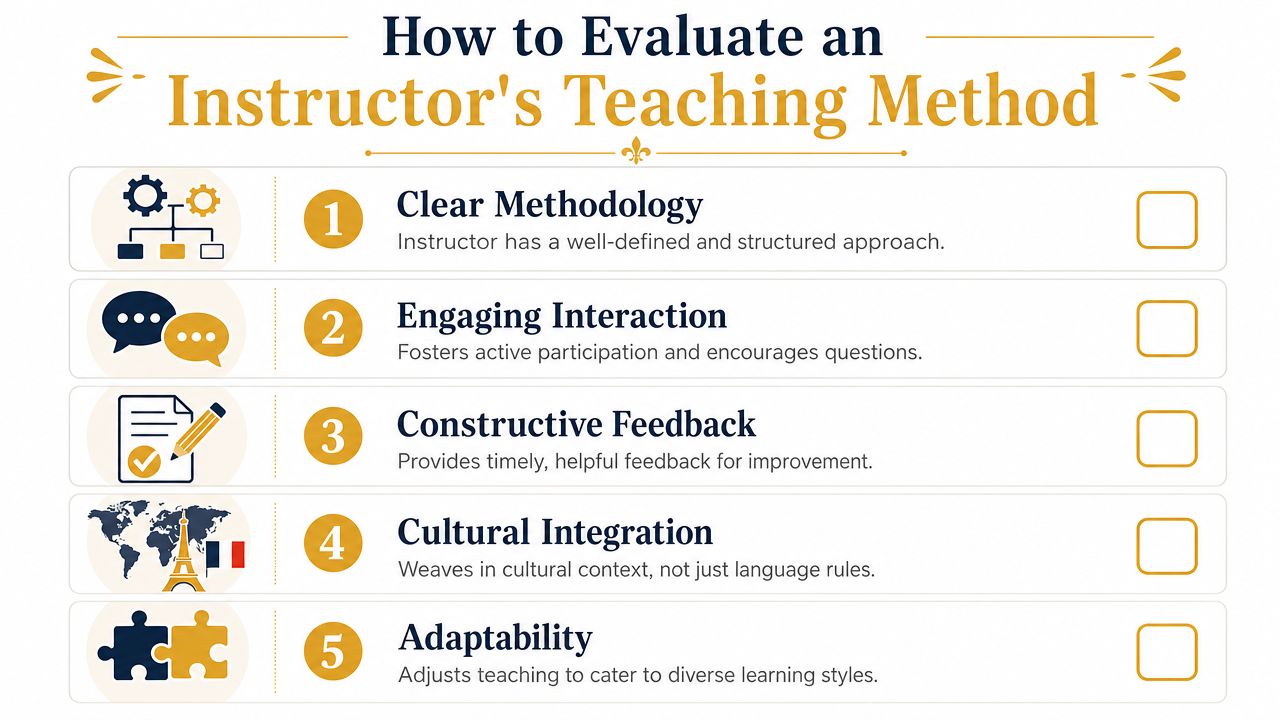
Plenty of tutors can hold a conversation. Far fewer can diagnose weaknesses, build a sequence, measure progress, and adjust instruction without wasting your time. If you're paying for lessons, you should expect a method.
If you want to see what a structured private approach looks like in practice, this overview of French tutoring methodology is a useful benchmark.
What a real teaching method looks like
The strongest benchmark I use comes from state-level curriculum design guidance. The Ohio Department of Education's French resources outline a three-phase curriculum design. First, identify learning outcomes. Second, determine evidence of mastery. Third, plan learning experiences.
That order matters.
If a tutor starts with random activities, open-ended chatting, or a textbook page of the day, they're skipping the planning logic that makes instruction efficient. You may still enjoy the lesson. You may even feel busy. But busy is not the same as well taught.
Ask yourself whether the instructor can answer these questions clearly:
Outcome clarity: What exactly should I be able to do after a month of lessons?
Progress evidence: How will you know I'm improving?
Lesson design: Why are we doing these activities instead of different ones?
Feedback style: Will you correct me in real time, after the task, or both?
Adaptation: What changes if I progress quickly or struggle with one area?
Buyer insight: If a teacher can't explain their method simply, they probably don't have one.
Questions worth asking before you pay
During a consultation, don't ask vague questions like “What's your style?” You'll get vague answers. Ask operational questions.
Try these instead:
“How do you decide what to teach first?”
A strong teacher will talk about goals, current level, and practical sequencing.“How do you track progress?”
Look for specific evidence such as writing samples, speaking tasks, correction patterns, or milestone reviews.“How do you balance grammar and speaking?”
Good instructors don't force you to choose one or the other. They connect them.“What do you do if I need French for work or school, not just conversation?”
Their answer should sound personalized, not generic.“What happens between lessons?”
Serious instruction includes some form of continuity, whether that's assignments, review notes, or guided practice.
A good instructor won't be offended by these questions. They'll welcome them. Serious teachers know that clear expectations lead to better results.
Your Trial Lesson Checklist Before You Commit
A trial lesson is not a formality. It's your audition process.
Too many people leave a consultation saying, “They seemed nice.” Nice is fine. Nice doesn't tell you whether the person can help your child catch up in school, help you prepare for a presentation, or get you beyond beginner-level comfort.
What Sarah noticed that others miss
Sarah, a corporate lawyer, needed French for a new role. She spoke some French already, but her real problem wasn't grammar in isolation. She needed to communicate professionally, and quickly.
In early consultations, she noticed a pattern. Several tutors asked about her general level. Only one asked what she needed to produce in French at work. That teacher wanted to see the kind of email she might need to write and asked how formal her interactions would be. Sarah chose the instructor who treated the lesson as a business communication problem, not just a language hobby.
That was the right instinct.
The best trial lesson feels like the beginning of a plan, not a sales conversation.
Parents should apply the same standard. A major gap in the local market is curriculum-aligned private tutoring for children in French-school programs. As noted in this local discussion of the Cincinnati market's underserved need for curriculum-aligned support for children in French-school programs, group classes exist, but families still struggle to find personalized help that matches a child's actual school syllabus.
If you're an adult learner, this guide on how to find the perfect French tutor for adult learners will help you compare trial lessons with a sharper eye.
What to check during a trial lesson
Use this checklist. Not every point needs to be perfect, but most should be present.
Goal diagnosis: Did the instructor ask what you need French for, not just what level you are?
Specificity: Did they mention concrete tasks such as conversation, writing, reading support, exam sections, or workplace communication?
Corrections: Did they correct in a way that helped you improve, or did they just let everything slide?
Structure: Did the session have a clear shape, or did it drift?
Next-step logic: Could they explain what lessons two, three, and four would likely focus on?
Also notice what they don't ask.
If a tutor never asks about deadlines, school materials, workplace context, or the situations where you need French, they're missing the core of the job. That doesn't mean they're a bad person. It means they may be the wrong hire.
A soft next step is enough here. Book one or two trial lessons, compare them side by side, and write down what each instructor did. The comparison will tell you more than the sales copy ever will.
Take Your First Real Step to French Fluency
The strongest decision you can make isn't choosing the most famous option. It's choosing the option that fits your goal, your schedule, and the kind of accountability you need.

A better way to choose
If you've made it this far, you already know more than most buyers do. You know not to compare every format as if it delivers the same thing. You know to watch for the survival-French plateau. You know a trial lesson should reveal method, not just personality.
That gives you an advantage.
French fluency doesn't start with a perfect long-term plan. It starts with one good decision. Pick the program that matches the job you need French to do. Then commit long enough for the method to work.
For learners who want a personalized program built around clear outcomes, a consultation is the smartest next move. You can schedule a complimentary 20-minute consultation with Elite French Tutoring to compare your options, clarify your goals, and see whether customized private instruction is the right fit.
A short look behind the scenes can help too.
If you're choosing between group classes, private lessons, or a more targeted plan, start by booking the option that gives you the clearest diagnostic conversation. That first conversation usually tells you whether you've found a real path forward.