Skip to content
You're probably doing what most Chicago learners do at first. You open ten tabs, compare a few tutors, look at one class in the Loop, another in Lincoln Park, maybe an app, maybe Zoom, and then stall because every option sounds “good” and none of them tell you whether it fits your real life.
I get it. I've seen people waste months in the wrong format. The problem usually isn't motivation. It's mismatch. A parent at Lycée Français needs something very different from a consultant who wants client-ready business French, and both need something different from an adult who just wants to stop freezing in conversation.
Chicago has real demand for serious French instruction. Approximately 11,000 people in Chicago speak French at home, which tells me this city has a meaningful French-speaking base and a real market for strong instruction, not just casual hobby classes, according to Language Loop's Chicago French language overview. That's good news for you. It means there are options. The bad news is that many of them still aren't built around your schedule, your goals, or your pressure points.
Table of Contents
Finding the Right French Lessons in Chicago
Those searching for French lessons in Chicago don't need more options. They need a filter.
I've watched learners bounce between group classes, online platforms, and private tutors without ever asking the question that matters most: what exactly are you trying to fix? If your issue is confidence, you need speaking reps and better feedback. If your issue is school performance, you need curriculum alignment. If your issue is work, you need vocabulary and role-play that matches real meetings, not textbook dialogues about train tickets.
Chicago makes this harder because the city offers a little of everything. You can find adult classes, independent tutors, online programs, exam prep, and conversation groups. But “available” isn't the same as “right.”
Start with the problem, not the format
I tell students to define the pain point first.
If you keep forgetting what you studied, your lessons probably aren't interactive enough.
If you understand French but can't speak smoothly, you likely need live correction and targeted conversation work.
If your child is in a bilingual program, generic French classes won't cover school writing, grammar, or assigned reading.
If your schedule changes every week, fixed-term classes will become frustrating fast.
Practical rule: Don't buy lessons until you can say, in one sentence, what the lessons need to do for you.
That one sentence saves people a lot of money.
What a smart search looks like
A good search for French lessons in Chicago should narrow quickly. I'd compare lesson formats, ask how progress is assessed, and look for evidence that the teacher can adapt to your actual goal. If you're an adult learner trying to sort through that decision, this guide on how to find the perfect French tutor for adult learners is worth reading before you book anything.
My blunt advice is simple. Don't choose based on neighborhood, branding, or the prettiest website. Choose based on fit. The right program feels focused from the first conversation.
Choosing Your Path Private Group and Online Lessons
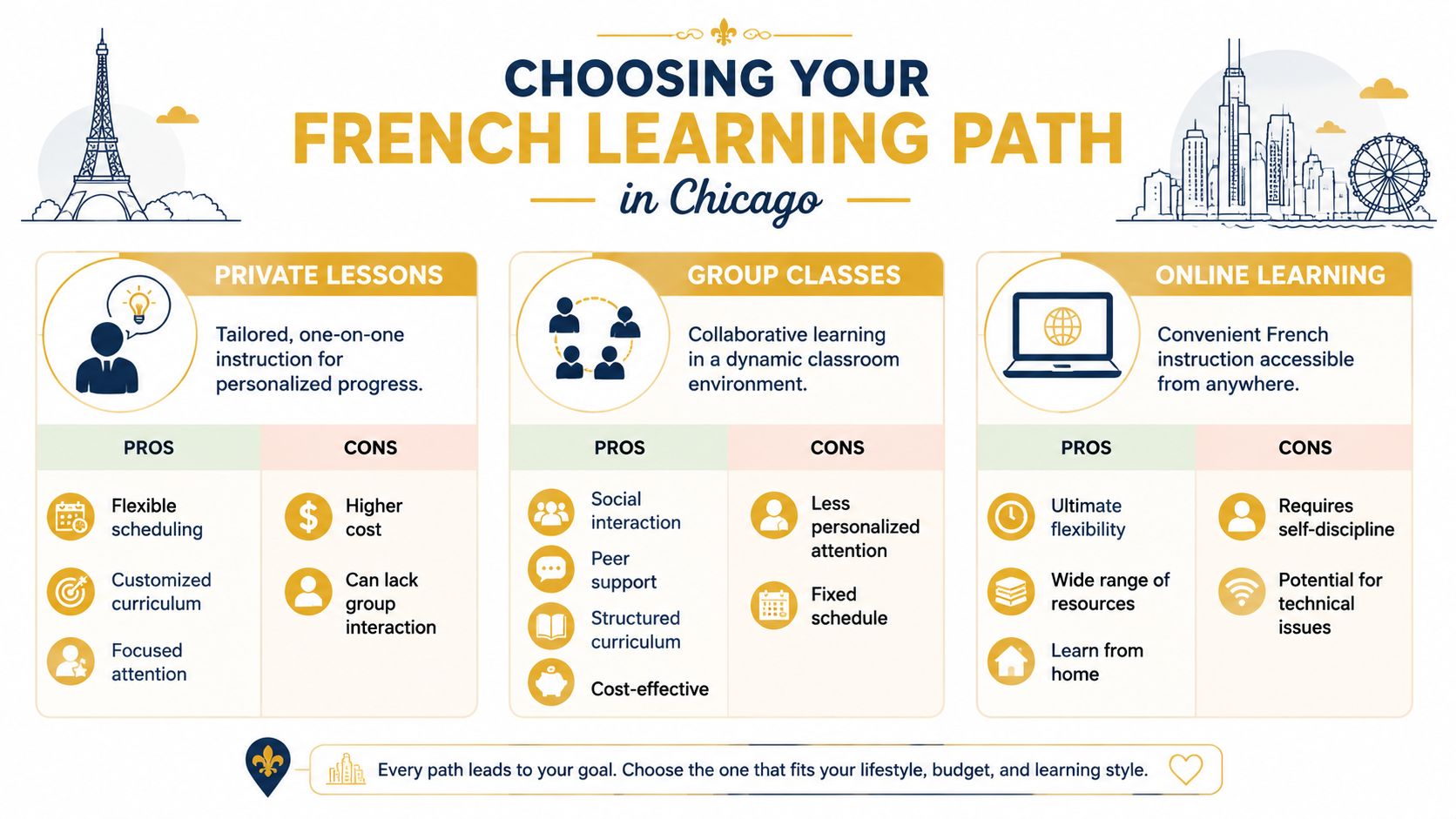
The three real lanes are private lessons, group classes, and online learning. None is automatically better. One is just better for you.
Private lessons for speed and precision
Private tutoring is what I recommend when the goal is specific and the timeline matters. That includes business French, school support, exam prep, relocation, and confidence issues that need direct correction.
The upside is obvious. You get focused attention, custom pacing, and immediate adjustment when something isn't clicking. The downside is also obvious. It costs more.
Group classes for structure and social energy
Group classes work best for learners who like routine and don't mind moving at a shared pace. If you enjoy hearing other people's mistakes and learning from them, group settings can be energizing.
They're often a reasonable fit for beginners who want accountability but don't need a custom curriculum yet. The problem starts when your level drifts away from the rest of the room. Then progress slows, and students stay polite about it for too long.
Online lessons for flexibility
Online French lessons have become a serious option, not a backup plan. For many Chicago professionals, they're the most realistic choice because they remove commute friction and open up more instructor options.
They do require discipline. If you cancel often, multitask during sessions, or rely on motivation instead of routine, online learning can become background noise. But with the right teacher and a clear schedule, it's efficient. If that format is on your shortlist, compare a few strong online French lesson options before you commit.
Quick comparison
| Lesson Type | Best For | Main Advantage | Main Drawback |
|---|---|---|---|
| Private | Busy professionals, exam candidates, school support | Personalized feedback | Higher cost |
| Group | Social learners, casual adult study | Structure and peer interaction | Less individual attention |
| Online | Busy schedules, remote access, wider tutor pool | Convenience | Requires consistency |
Group classes are good when your goal is broad. Private lessons are better when your goal is specific.
My recommendation by situation
If you want my opinion after years of watching students switch formats, here it is:
Choose private lessons if you need results tied to work, school, or an exam.
Choose group classes if you want affordable structure and don't mind a shared pace.
Choose online lessons if your life is busy enough that convenience will decide whether you stick with it.
People often try to save money by starting with the wrong format. Then they pay twice. Pick the format that matches your goal the first time.
French Lessons for Every Chicagoan
Chicago learners don't need one big list. They need a match.
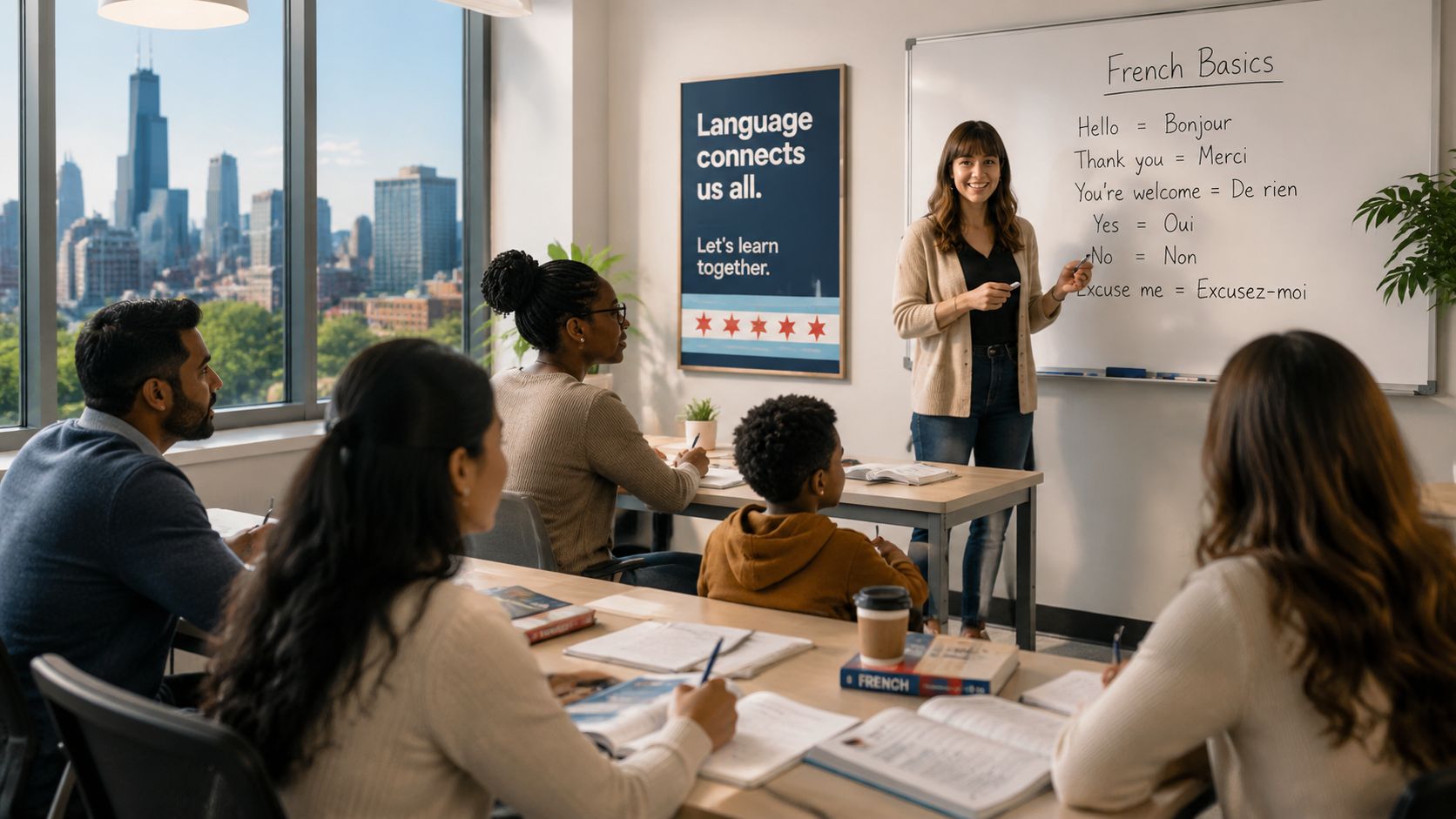
Data shows that 51.7% of French speakers in Chicago are in the 25-34 age group, which tells me a huge part of this market is made up of young professionals who need practical, career-focused instruction, based on Start.io's audience snapshot of French speakers in Chicago. That tracks with what I see on the ground. A lot of adults here aren't learning French for vague cultural reasons. They want it for work, mobility, relationships, or a very specific next move.
For parents at bilingual schools
This is one of the biggest unmet needs in Chicago.
If your child attends a French or bilingual school, you already know the issue. School moves fast. Teachers assign writing, grammar, reading, and oral work at a level that can overwhelm even bright students. General French classes don't solve that because they aren't tied to your child's curriculum.
I'd look for tutoring that can handle:
School-specific writing support for essays, dictées, grammar, and reading responses
Native-level correction on syntax, spelling, and phrasing
Curriculum alignment with what your child is studying that week
If that's your situation, you need support closer to academic coaching than casual language instruction. This kind of French tutoring for school is usually a better fit than adult-style conversation classes.
For working professionals
Chicago has plenty of adults who want French for client work, international teams, relocation, or credential building. For them, the wrong course is usually too broad and too slow.
A professional should ask for lessons built around actual use cases:
client calls
presentations
networking and small talk
email tone
industry vocabulary
If your teacher can't pivot into your world, you'll spend too much time on material you won't use.
Good business French instruction doesn't sound academic. It sounds like your actual workday.
For exam takers and serious adult learners
If you're preparing for DELF, DALF, or TCF, stop choosing teachers based only on personality. You need someone who can identify gaps, correct efficiently, and structure practice around exam output.
That also applies to adults who are “serious but rusty.” Many of them don't need to restart from zero. They need a program that diagnoses what survived from prior study and rebuilds confidence around it.
For adults who need flexibility more than theory
Chicago still has a gap for adults who want accessible, beginner-friendly French without locking into rigid long sessions. I hear this from people with irregular work hours, long commutes, or family schedules that blow up every calendar plan.
If that's you, be realistic. Don't sign up for a format you already know you won't attend consistently. Better to take fewer, better-targeted lessons than enroll in something you'll resent by week two.
Chicago French Schools and Tutors at a Glance
Price in Chicago tells you something, but not everything. The big mistake is assuming all French instruction is interchangeable.
Premium providers command rates like $125/hour due to diagnostic consultations, guaranteed native proficiency, and customized curriculums, a stark contrast to the $25-$35 average for independent tutors, as outlined in Elite French Tutoring's Chicago lesson pricing page. That gap looks dramatic until you understand what you're paying for.
Comparison of French Lesson Options in Chicago 2026
| Provider | Best For | Typical Price | Key Feature |
|---|---|---|---|
| Independent tutor | Casual conversation, budget-conscious learners | $25 to $35 per hour | Lower cost, variable teaching quality |
| Premium private provider | Professionals, exam prep, curriculum-aligned support | $125 per hour | Diagnostic consultation and customized program |
| Group language school | Adults who want structure and peers | Varies by program | Fixed schedule and shared curriculum |
| Online coaching program | Busy learners who need flexibility | Varies by format | Learn from home with easier scheduling |
Why the cheapest option often becomes the expensive one
A lower hourly rate looks attractive if all you compare is the session itself. But a budget tutor who can't assess level clearly, doesn't correct effectively, and follows a generic workbook can waste months.
By contrast, a premium setup usually starts with stronger filtering. You know the teacher's background, the level is mapped more carefully, and the curriculum is built around a concrete target. That's why the sticker price alone is a weak decision tool.
My buying advice
If you're shopping in Chicago, sort options by outcome, not by hourly rate. For learners who want a more tailored approach, Elite French Tutoring is one option worth considering.
For conversation confidence: test the teacher's ability to keep you speaking.
For school support: ask how they handle writing and curriculum alignment.
For business French: ask what workplace scenarios they use.
For exams: ask how they correct speaking and writing under test conditions.
One option in this market is Elite French Tutoring, which offers private one-on-one lessons and online coaching for Chicago learners with a diagnostic-first approach. That won't fit every budget, but it does fit learners who need a personalized plan rather than generic exposure.
How to Evaluate a French Program or Instructor
Most buyers ask the wrong first question. They ask, “Are you a native speaker?” That matters, but it's not enough.
A mediocre native speaker can still waste your time. A strong instructor knows how to diagnose problems, structure sessions, and correct without shutting the student down. That balance matters more than people think.
Questions I'd ask before booking
Ask these directly in a consultation or trial lesson.
How do you assess my level? If the answer is vague, that's a problem.
How will lessons change based on my goal? You want specifics, not “we'll tailor it.”
How do you handle corrections during conversation? This affects confidence and fluency immediately.
What do you expect from me between sessions? Good programs create continuity.
How do you track progress over time? If nothing is measured, drift happens.
Buyer check: If the instructor can't explain their process clearly, they probably don't have one.
The correction issue matters more than most people realize
One of the most useful student insights I've seen came from a learner who reflected after 200 tutoring sessions that progress improved when feedback timing was negotiated clearly, and when the teacher kept the conversation alive instead of interrupting momentum, as described in this detailed Reddit post on long-term French tutoring. I agree with that completely.
Some students want immediate correction. Others speak better when the teacher notes patterns and reviews them after the session. There isn't one universal right answer. There is a right answer for you.
Red flags I wouldn't ignore
Here's where I get blunt. Walk away if you see these.
No real plan: The teacher says you'll “just talk” and hopes that's enough.
One-size-fits-all materials: Every student gets the same pages regardless of level or goal.
Rigid teaching ego: They won't adjust pacing, topics, or correction style.
No listening to your use case: You mention work, school, or travel, and they circle back to their favorite textbook.
Weak session management: Long tangents, no recap, no structure.
A good instructor doesn't just know French. They know how to make your brain use it under pressure.
A Chicago Success Story From Assessment to Fluency
You finish a French class in Chicago feeling productive, then freeze the next time you need to speak. I see that pattern constantly. Adults with solid grammar knowledge still stall in meetings, parents can help with homework until the assignment gets more complex, and students at bilingual schools can read well but hesitate out loud.

A typical Chicago learner in that spot usually is not starting from zero. She has taken classes, used apps, maybe even traveled. The problem is mismatch. Her French study has not matched the situations where she needs to perform, whether that is a client call in the Loop, a conversation with relatives, or support for a child at Lycée Français.
What changed for this kind of learner
Start with a clear example. A professional with intermediate French can often recognize grammar, follow part of a conversation, and remember vocabulary lists, yet still struggle to respond smoothly under pressure. I would not send that person back into another generic class. I would map the breakdown points first, then build lessons around the exact moments where speech slows down, accuracy drops, or confidence disappears.
That shift matters because it stops wasted effort. Instead of reviewing material she already half-knows, we work on active recall, faster sentence building, and topic-specific speaking that reflects real life in Chicago.
Why this worked
Progress came from sequence and fit.
First, identify where communication breaks. Then practice those weak points in realistic speaking tasks. Then correct in a way that keeps the student talking. That approach works far better than broad exposure alone, especially for busy professionals who need flexible lessons and for families who need support that lines up with school expectations.
I have seen the same pattern with children and teens. A student at a bilingual school might need help with dictée, reading comprehension, or oral presentation skills, not general beginner French. An adult in consulting, medicine, or hospitality might need meeting language, pronunciation cleanup, and faster listening skills. Chicago learners do better when lessons match the pressure they are under.
A student gets fluent by working on the right obstacle, repeatedly, until speaking feels automatic.
That is the success story here. Not a polished testimonial. A method that fits the learner, the city, and the reason they need French in the first place.
Your Next Step to Speaking French Confidently
The right French lessons in Chicago aren't the flashiest option. They're the one that matches your goal, your schedule, and the way you learn.
If you're a parent, don't settle for generic classes when your child needs school-aligned support. If you're a professional, don't waste time on broad lessons that never touch your real work. If you're an adult learner with an unpredictable schedule, don't buy a rigid plan you already know won't hold.
My advice is simple. Choose a program that can explain how it will assess you, how it will adapt, and how it will keep you progressing when motivation dips. That's what separates a pleasant lesson from a useful one.
If you want a low-friction next step, compare a few providers and book the consultation that gives you the clearest plan. You can also sharpen one of the biggest confidence blockers by reviewing this guide to French pronunciation for English speakers. For many learners, pronunciation is the point where speaking starts to feel easier.
The city has options. Your job is not to try everything. Your job is to choose the format and instructor that fit your real life, then stick with it.
If you're actively comparing providers, the smartest move is to shortlist two or three options and book the one that offers the clearest diagnostic conversation before lessons start. That's usually where you'll see who's listening.