Skip to content

You're probably looking at a dozen tabs right now. One has Alliance Française. Another has a tutoring marketplace with hundreds of profiles. A third has a private tutor who sounds promising but costs more than you expected. If you searched for French lessons in Houston, the hard part usually isn't finding options. It's figuring out which option fits your goal, your schedule, and your budget without wasting a month on the wrong format.
That's a common point of difficulty. A parent at a bilingual school needs something very different from an engineer preparing for a francophone client meeting. A beginner who wants conversational confidence before a trip won't benefit from the same setup as a DELF or DALF candidate. In Houston, the “best” class isn't one school or one tutor. It's the right match between learner type and lesson type.
Table of Contents
Finding Your Perfect French Class in Houston
Most Houstonians start with the wrong question. They ask, “Who offers the best French lessons in Houston?” A better question is, “What kind of lesson will work for me?”
That small shift changes everything. I've seen adults lose momentum in group classes that moved too slowly for them. I've also seen families overspend on premium tutoring when a lighter online support model would have handled weekly homework and oral practice just fine.
Start with your real goal
Before you compare providers, decide which of these sounds most like you:
Parent needing school support: Your child needs help with reading, writing, speaking, or class assignments tied to a bilingual or French curriculum.
Professional learner: You need meetings, emails, presentations, or relocation support, not generic travel phrases.
Exam taker: You need structured correction, oral drills, and task-based preparation for DELF or DALF.
Adult beginner or returning learner: You want to speak comfortably and stay consistent without turning French into another stressful obligation.
Those goals point to different buying decisions. Parents usually need consistency, curriculum alignment, and scheduling that works around school and activities. Professionals need relevance and speed. Exam candidates need correction and structure. Beginners need a format they'll stick with.
Practical rule: If your goal is specific, your lesson format should be specific too.
Match the format before you compare brands
A simple filter works well:
Choose your format first. Group, private, or platform-based online tutoring.
Set your absolute priorities. Budget, schedule, child-friendly teaching, exam expertise, or business French.
Only then compare providers. Otherwise every website sounds good and none of them are easy to judge.
A lot of frustration comes from buying a class based on reputation instead of fit. Houston has strong options, but they serve different kinds of learners well.
What usually works and what usually doesn't
What works is honest matching. A shy child often does better with one-on-one support than in a lively group. A social beginner may love the energy of a class. A busy executive usually needs a tutor who can adapt week by week.
What doesn't work is forcing the cheapest option to do a premium job, or expecting a premium option to solve a motivation problem by itself.
Group Classes vs Private Tutors vs Online Platforms
Your first big choice is format. In Houston, most French learners end up in one of three lanes: group classes, private tutoring, or online tutoring platforms. Each can work. Each can also be the wrong fit.
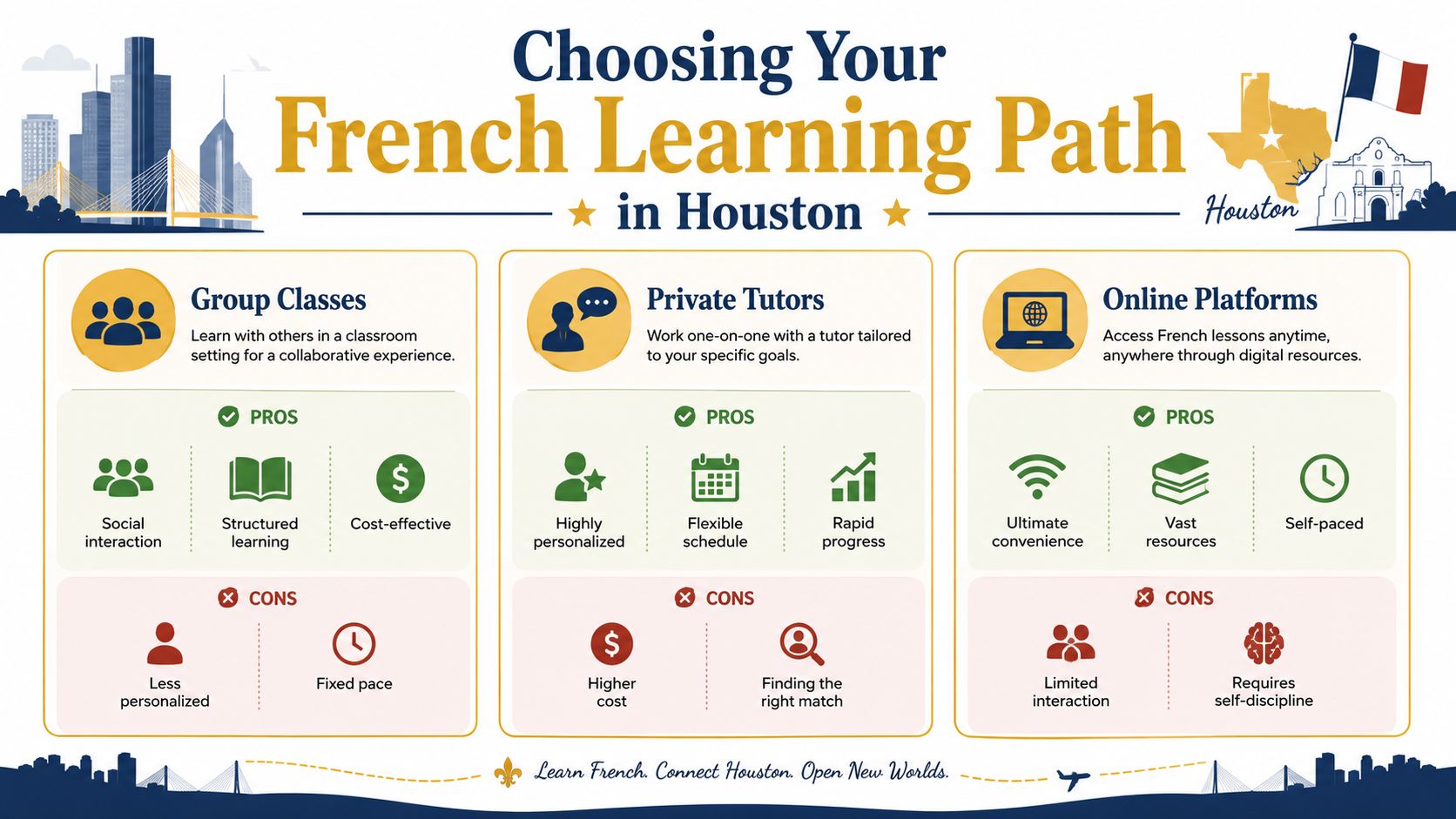
Group classes
Group classes suit learners who like structure and don't need much customization. They're often a comfortable entry point for beginners who enjoy learning with other people and like having a fixed routine.
The trade-off is pace. If the class moves too fast, some students fall behind unnoticed. If it moves too slowly, stronger students coast and stop engaging.
Good fit: adults starting from scratch, social learners, people who want a classroom feel.
Weak fit: exam candidates, business learners, children needing school-specific support.
Private tutors
Private tutoring is usually the cleanest solution when the goal is narrow or the timeline matters. You can focus on pronunciation, school assignments, interview prep, business vocabulary, or speaking confidence without losing time on material that doesn't serve your objective.
Houston's pricing range reflects how varied this market is. On Preply, the average hourly rate for private French tutoring in Houston is about $22, with entry-level tutors starting as low as $3 per hour on the Houston French tutor marketplace at Preply. That spread tells you something important. You're not just buying “French lessons.” You're buying a mix of fluency, teaching skill, specialization, and lesson design.
If you're comparing tutors, this guide on how to find the perfect French tutor for adult learners is useful because it pushes you to look beyond profile photos and hourly rates.
The right tutor isn't the person with the nicest bio. It's the person who can teach your exact problem.
Online platforms
Platforms are a marketplace, not a method. That distinction matters. They give you access to many tutors, price points, and schedules, which is excellent if you want flexibility or you're still testing what kind of teaching style you prefer.
But platforms also require buyer discipline. You need to screen carefully, define your goal clearly, and notice when a low-cost conversational tutor isn't equipped for exam prep or school alignment.
Here's the simplest way I'd break it down:
| Format | Best For | Main Upside | Main Limitation |
|---|---|---|---|
| Group classes | Social beginners | Structure and community | Less personalization |
| Private tutors | Specific goals | Fast, targeted progress | Higher cost at the top end |
| Online platforms | Flexible shoppers | Wide choice and convenience | Quality varies a lot |
For most Houston learners, the choice comes down to this. If your goal is broad and relaxed, group can work. If your goal is specific, private usually wins. If your budget is tight but your schedule is messy, platforms can be a smart middle path.
Comparing Top French Lesson Providers in Houston
Once you know your format, the provider list starts making sense. Houston has a mix of community-based programs, independent tutor marketplaces, premium academic services, and specialized private instruction.
Here's the quick buyer's view first.
Houston French Lesson Options at a Glance 2026
| Provider | Best For | Price Range (per hour) | Format | Key Feature |
|---|---|---|---|---|
| Alliance Française Houston | Social learners, families who want a classroom setting | Varies by program | In person group classes | Community-based class environment |
| Preply | Budget-conscious learners and schedule-flexible adults | Starts as low as $3/hour, average around $22/hour in Houston | Online private lessons | Large marketplace with wide tutor selection |
| Superprof | Shoppers comparing many independent tutors | Average French class cost is $28/hour, and 95% of tutors offer the first class free | Online and in person | Broad local tutor supply and trial-friendly profiles |
| General Academic | Families seeking premium private support | From $80/hour | Private tutoring | Premium in-home or academic support model |
| Elite French Tutoring | Professionals, exam takers, families needing customization | Custom pricing | Private online and in person where available | Customized lessons built around learner goals |
How to read the table like a buyer
If you want affordability and choice, marketplaces stand out. On Superprof, the average cost of a French class in Houston is $28 per hour, and 95% of local tutors offer their first class for free according to Houston French tutoring listings on Superprof. That makes trial-and-error easier, especially if you're still figuring out whether you want conversation, grammar, or school support.
If you're considering a premium provider, price should connect to a concrete outcome. At General Academic in Rice Village, post-paid hourly rates for private French tutoring begin at $80 per hour, which places it well above the citywide average referenced in the General Academic private tutoring page for Houston. For some families, that may be worth it if they need in-home convenience or more academic oversight.
For online shoppers, I also like this review of the best online French lessons because it helps you compare format quality, not just names.
Which provider fits which learner
For parents of K through 12 students
Look closely at whether the tutor can align with school materials, reading lists, oral assessments, and writing expectations. General academic support and French tutoring aren't always the same thing.
For professionals
You need relevance more than variety. A platform can work if you find the right tutor, but many professionals do better with a private setup suited for meetings, presentations, and email communication.
For casual adult learners
Group classes are often the easiest way to start if motivation comes from routine and community. If your calendar is unpredictable, marketplace tutoring usually fits better.
For exam candidates
Choose the teacher, not the brand. DELF and DALF prep depends heavily on correction quality, oral practice, and familiarity with exam tasks.
What to Expect From Your First French Lesson
You book a lesson after work, log in or walk into a Houston classroom, and wonder whether you are about to be judged on everything you forgot from high school French. A good first lesson does the opposite. It shows you whether the format fits your goal and whether the teacher knows how to teach your type of learner.
The first 10 to 15 minutes usually tell me almost everything. A child who needs help with school French needs structure, pace, and age-appropriate correction. A professional often needs useful speaking right away, with less time spent on workbook-style drills. An exam student needs tight feedback and clear task criteria from day one.
Your first few minutes should feel specific
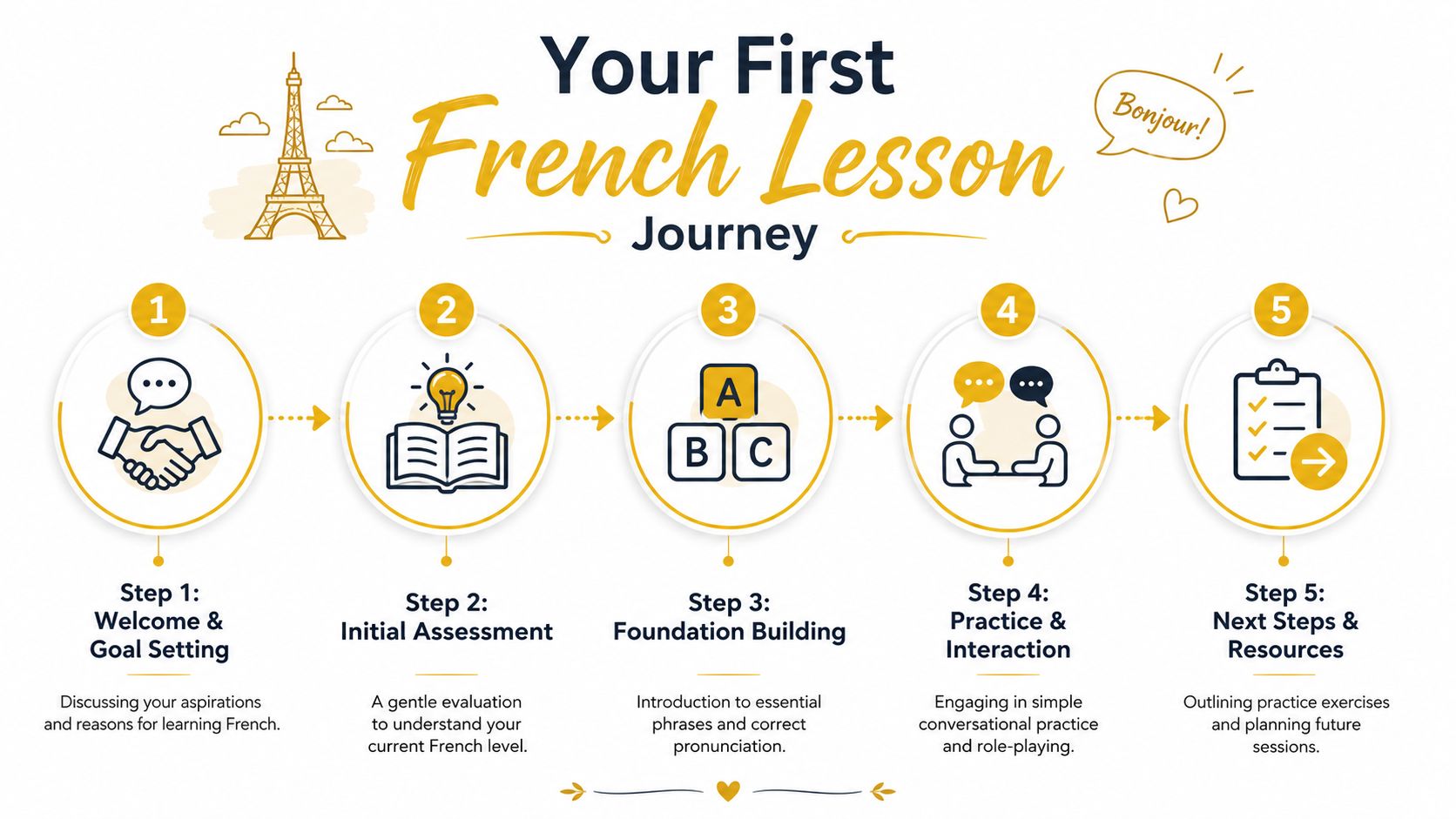
In a strong first lesson, the teacher gets practical fast. The conversation should cover your reason for learning, your current level, your deadline if you have one, and the kind of practice you will stick with in Houston traffic, work schedules, and family life.
That part matters more than many students expect.
I have seen adults choose group classes when they really needed private speaking practice, and I have seen parents pay for one-on-one lessons when a small group would have given their child better consistency and motivation. The first lesson should help sort that out, not hide it.
What usually happens in a well-run first session
The details vary by format, but the session should feel organized and purposeful.
A short level check. This may be spoken, written, or both. Good teachers keep it calm and quick.
Pronunciation and survival language. Beginners often start with greetings, sounds that cause trouble, and a few phrases they can use immediately.
A task tied to your goal. Kids may describe pictures or answer school-style questions. Professionals may practice introductions or meeting language. Exam candidates may try a mini speaking prompt.
Corrections you can use. You should hear exactly what to change and how to practice it.
A plan for lesson two. Good teachers leave you with a clear next step, not a vague promise to “keep improving.”
For brand-new learners, this guide on getting started with French classes and staying motivated sets realistic expectations for the early stage.
What changes by lesson type
A first group class often spends less time on your personal goals and more time getting everyone into the same routine. That is normal. It works well for casual adult learners and some teens, but it can feel slow if you need French for work or an exam.
A first private lesson should be more customized. If it still feels generic after 30 minutes, that is a warning sign.
A first online lesson needs one extra test. The tech should be easy enough that it does not eat half the session. Screen sharing, audio quality, and note-taking matter more than flashy platform features.
Green flags to watch for
A capable teacher adjusts quickly. They do not force every learner through the same opening script.
Look for these signs:
The examples match your life
The teacher corrects without interrupting every sentence
You leave with notes you can review
The pace feels challenging but manageable
You understand why you are doing each activity
The best first lesson leaves you with direction. You should know what kind of learner you are, what kind of lesson fits you, and whether this teacher can get you where you want to go.
Real Results A Houston Student Success Story
A lot of Houston learners come to me with the same pressure point. They do not need French in some distant, academic sense. They need it for a real situation that already has a date on the calendar.
One case that stays with me involved a project manager in Houston's energy sector. He was preparing for work connected to Senegal and needed functional French for use in meetings, emails, and professional introductions.

Why the usual options were a poor fit
His issue was not motivation. It was fit.
A standard group class would have asked him to follow the pace of the room, even though his goal was narrow and time-sensitive. A marketplace tutor might have been flexible on scheduling, but that still left a bigger question. Could that tutor handle business communication, cross-cultural nuance, and the kind of language used in a professional setting tied to West Africa?
Once we defined the job clearly, the right lesson type became obvious. He needed private lessons built around specific work tasks, not a general course and not a casual conversation class.
His plan centered on three things:
Introducing himself and his project with confidence
Writing and replying to professional emails in clear French
Handling formal meeting language and business etiquette
What made the progress real
We did not spend the first stretch of lessons wandering through grammar topics in textbook order. We worked from his calendar and his responsibilities.
That changed the tone of every session. Instead of memorizing vocabulary lists he might never use, he practiced project updates, opening remarks, polite follow-ups, and the kind of phrasing that sounds professional rather than translated. Grammar still mattered, but it served the task.
That trade-off is important. Group classes often give broader coverage. Private lessons usually give faster job-specific progress. For a professional with a deadline, breadth is often less useful than immediate function.
By the end of that focused run, he was not trying to pass as fully fluent. He was doing what many adult professionals need. He could introduce a project, contribute in meetings, and write correspondence without freezing every time he had to hit send.
The biggest shift was not vocabulary size. It was confidence under pressure.
Why this result matters for Houston learners
This kind of outcome is why I always match the learner to the lesson format before talking about any school or tutor. A child who needs structure may do well in a small group. An exam taker often needs correction and accountability. A working adult with a deadline usually gets better value from targeted private lessons.
That is also why success stories only matter when the goal matches yours. If you want a second example of a personalized path, this story about how one student went from zero to fluent in six months shows what consistency can do when the plan fits the person.
The lesson is simple. In Houston, the best French lessons are usually the ones built for the job you need French to do.
Your Next Step to Speaking French Confidently
By this point, the decision usually gets clearer. Some learners need a classroom. Some need a flexible tutor. Some need a hybrid setup that supports school, travel, exams, or work without adding more friction to an already busy week.
That's also why personalized French lessons keep gaining traction. The broader language learning market is projected to grow at a compound annual growth rate greater than 17.67%, reaching USD 188.70 billion by 2030 from a 2024 base of USD 68.87 billion, and the analysis notes that flexible, on-demand learning models are driving much of that growth, according to Mordor Intelligence's language learning market report. In practice, that lines up with what Houston learners ask for every day. Convenience matters, but relevance matters more.

The best next move depends on your urgency
If your need is casual, start with a trial class or a lower-commitment tutor and see whether you enjoy the rhythm.
If your need is specific, don't spend weeks comparing every option in the city. Shortlist providers based on fit, ask direct questions, and choose the format that matches the job.
Here's the filter I'd use:
Choose group classes if you want community and can work within a fixed pace.
Choose a marketplace tutor if budget and scheduling flexibility matter most.
Choose a custom private program if you need targeted speaking results, exam prep, or school alignment.
What serious learners should ask before booking
Before you commit, ask:
How is progress measured
Can lessons adapt to my exact goal
What happens between sessions
How much correction and speaking practice will I get
Those questions cut through marketing language very quickly.
If you're comparing French lessons in Houston and want a clearer sense of what a custom path could look like, a short consultation is often the easiest next step. It gives you a real recommendation instead of another generic sales page.
If you're ready to narrow your options, book a French lesson consultation or compare providers with your exact goal in mind. That usually saves more time than trying three random classes and hoping one clicks.
Frequently Asked Questions About Houston French Lessons
Are online French lessons as effective as in-person lessons
A Houston professional squeezing French between meetings needs a different setup than a seven-year-old after a full school day. Online lessons can work very well, but only when the format matches the learner.
For adults, especially busy professionals in the Energy Corridor, Downtown, or the Med Center, online lessons often make attendance easier. That matters more than many people admit. A well-run online lesson with screen sharing, live correction, and frequent speaking turns usually beats an in-person lesson that gets canceled because traffic or scheduling got in the way.
For children, I look at attention span first. Younger learners usually need movement, visual prompts, faster transitions, and some parent support outside the lesson. Online works when the lesson is built for the screen. It breaks down when a teacher moves an in-person method onto Zoom without adapting it.
What's the best option for a child in a bilingual school
In most cases, private support works better than a general group class. Children in bilingual programs or French school settings usually need help with this week's reading, this month's grammar point, or an upcoming presentation. That is very different from a broad enrichment course.
I see the same mistake often. Families book a pleasant French class that has nothing to do with school demands, then wonder why grades or confidence do not improve. For school-based learners, tutoring should connect directly to class materials, teacher expectations, and the pace of the school week.
The Alliance Française Houston kids and teens class context shows the kind of age-based group structure many families consider. In practice, I usually recommend group classes for general exposure and private lessons for school alignment.
What helps most:
Use lessons to support current classwork: Reading responses, dictation, vocabulary lists, and oral prep usually deserve priority.
Send materials ahead of time: Worksheets, teacher notes, readers, and rubrics save lesson time.
Meet regularly: One or two shorter sessions each week usually work better than occasional long catch-up sessions.
How long does it take to become conversational
The honest answer depends on what you mean by conversational.
For one learner, it means ordering food, asking directions, and getting through a trip to Montreal or Paris. For another, it means speaking with a client, joining a parent conference, or handling a job interview in French. Those goals require different vocabulary, speed, and accuracy.
I tell students to define the task before they define the timeline. If your goal is narrow and practical, progress can come quickly. If your goal includes sustained conversation, strong listening skills, and fewer English fallbacks, expect a longer build.
Consistent speaking practice, clear correction, and lessons tied to a real use case usually produce the fastest progress.
How should I choose a tutor for DELF or DALF prep
Choose someone who understands the exam, not just the language. DELF and DALF prep has a structure, and that structure matters.
A good exam tutor should be able to explain the task types, correct writing in detail, and train speaking under timed pressure. Encouragement helps, but exam preparation also requires precise feedback. Students need to know why an answer works, where points are lost, and what to fix before test day.
I would look for four things:
Exam-specific knowledge: The tutor should know the format and scoring expectations.
Detailed correction: Writing and speaking need line-by-line feedback, not broad comments.
Level-appropriate French use: More French in the lesson helps once the student can follow it productively.
A weekly plan: Each session should train a skill with a reason behind it.
Is a more expensive French tutor always better
No. Price tells you something, but not enough on its own.
Higher rates make sense when the teacher is solving a harder problem. That might include bilingual school support, advanced business French, in-home lessons, or serious exam preparation. In those cases, experience, preparation time, and customization usually justify the difference.
A lower-cost tutor can still be a strong fit for conversation practice, pronunciation work, or maintaining momentum between formal lessons. The essential question is whether the tutor's strengths match your goal.
What should I ask before I book French lessons in Houston
Ask questions that reveal fit, not sales polish.
Which students do you help most often
How do you evaluate level and measure progress
Can lessons match my school, work, or exam goal
How much speaking and correction happens in a typical session
What should I do between lessons
Those answers tell me far more than a polished website or a long testimonial page. If a teacher can explain who they help, how they teach, and where they would start with you, you are usually looking at a better fit.