If you're trying to choose the best online French lessons, you're probably already stuck in the same loop I see every week. One platform promises fast fluency, another pushes cheap tutoring, and a third looks polished until you realize it won't get you talking. The result is familiar. You hesitate, open too many tabs, and still don't know which option deserves your time or money.
After more than a decade helping students through Elite French Tutoring, I've seen the pattern clearly. Busy professionals need structure that fits around work. Parents need dependable support for children and teens. Exam candidates need a plan, not motivation slogans. Casual learners often just want to speak comfortably without wasting months on tools that feel productive but don't build real conversation skills.
That's why I recommend choosing a program by goal first, then by format. The strongest options aren't all trying to do the same job. Some are built for live speaking practice. Others are better for level-based group study, daily habit-building, or exam prep. In this guide, I've ranked the online French programs I recommend most often, with clear advice on who each one suits best. If you want the best online French lessons for your specific situation, this will help you make a smart decision quickly.
Table of Contents
- 1. Elite French Tutoring
- 2. Lingoda
- 3. Chatterbug
- 4. Berlitz
- 5. French Institute Alliance Française
- 6. Coucou French Classes
- 7. Frantastique
- Top 7 Online French Lessons Comparison
- How to Choose the Right French Lesson for You
1. Elite French Tutoring
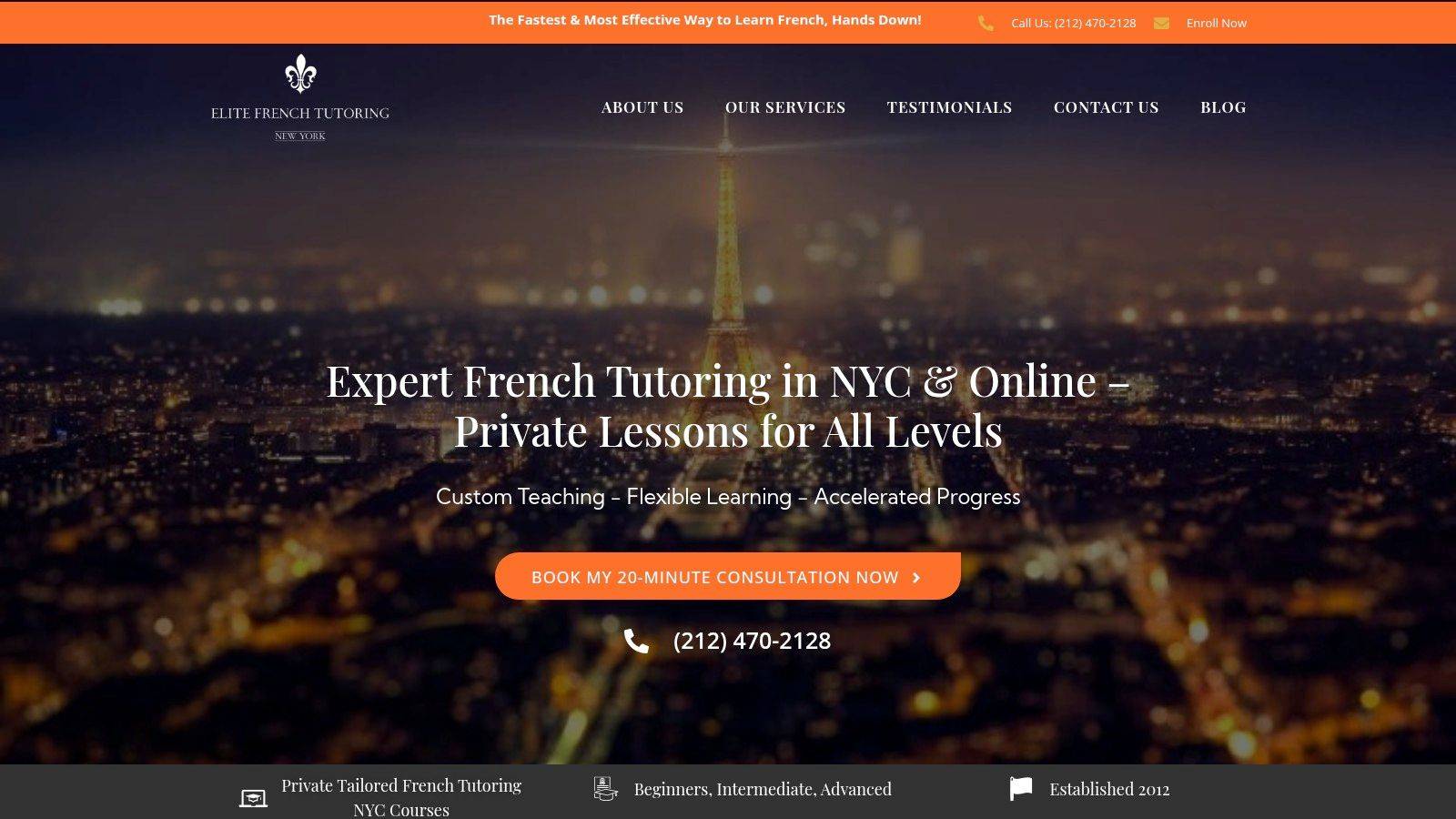
You want to speak French for a real reason. A move to France. A DELF exam date on the calendar. Client meetings. Help for your teenager before grades slip. In that situation, I would not send you to a generic course first. I would start with Elite French Tutoring.
The reason is simple. Your goal should decide the format. Elite French Tutoring works best for learners who need private guidance, fast correction, and lessons built around a specific outcome instead of a fixed curriculum. If progress matters more than bargain pricing, this is the strongest premium option in the group.
Elite French Tutoring offers private online lessons worldwide and private in-person lessons in New York, including in-home options. The process starts with a complimentary consultation and assessment, so your plan reflects your level, schedule, and objective from the first session.
Why I rank it first
I rank Elite French Tutoring first because it matches the teaching to the goal. That sounds obvious, but many online French programs still push every learner through the same sequence whether they need business fluency, school support, travel conversation, or DELF preparation.
Since 2012, Elite French Tutoring has worked with a wide range of students, including executives, UN mission staff, Ivy League professors, families, and exam candidates. That breadth matters. A provider that can help a child with school French and also coach a professional for high-stakes speaking has range that many platforms do not.
I also like the level of individual planning. If you need help choosing between private tutoring, group classes, or age-specific programs, this guide on finding the best online French classes for kids, teens, and adults gives useful context before you book anything.
Practical rule: If your French goal has a deadline or a consequence, choose instruction built around that target.
Here is the pattern I see again and again. A learner spends months on apps, recognizes a lot of vocabulary, then stalls the moment a real conversation starts. Private lessons fix that faster because the teacher can catch pronunciation issues, weak grammar patterns, and hesitation points in real time, then build the next lesson around those exact gaps.
Who it is for
Elite French Tutoring is the right pick if you want high-touch support and a plan that fits the reason you are learning French.
- Best for DELF or DALF prep: You need focused speaking, writing, and test strategy instead of broad exposure.
- Best for professionals: You need French for presentations, meetings, relocation, interviews, or client communication.
- Best for families: Your child or teen needs one-on-one support that matches school expectations.
- Best for serious adult learners: You want a teacher to direct the process, correct mistakes quickly, and keep you progressing.
For beginners who want a more personal start than app-based study, I also recommend reading how to learn French online for beginners with native speakers.
The tradeoff is clear. Pricing is not published, so you need to contact the team for a quote. If your priority is the cheapest monthly option, look elsewhere. If your priority is personalized instruction tied to a specific goal, Elite French Tutoring is the premium choice I would recommend first.
2. Lingoda
Lingoda fits the learner who wants school-like structure without commuting to a school. If you know you do better with a level-based curriculum, scheduled classes, and regular live practice, it's one of the safest choices in this category.
I recommend Lingoda most often to adults who want a middle ground between totally self-paced apps and premium private tutoring. You still get live instruction, but in a format that feels more standardized and subscription-friendly.
Where Lingoda stands out
Lingoda offers live online French classes around the clock, with small group and private options. Its curriculum is built around CEFR-style progression, which is exactly what I want to see from a structured language program. The broader online learning market has moved in this direction too, with platforms such as Coursera's French course catalog showing how remote language study now commonly spans beginner through advanced levels and covers listening, speaking, reading, and writing.
That matters because a serious learner needs more than phrase memorization. You need a path. Lingoda does a good job of giving you one.
Live lessons beat passive lessons when speaking is the goal. If you need accountability, scheduled classes do part of the work for you.
Who it is for
Lingoda works best for learners who like routine and visible progression.
- Best for structured adults: You want recurring classes and a clear level path.
- Best for steady improvers: You're willing to attend regularly and build skill over time.
- Best for learners across time zones: Around-the-clock scheduling is one of Lingoda's biggest advantages.
It's less ideal if you want highly customized instruction tied to a narrow goal like a specific oral exam, executive communication, or a child's school curriculum. Group-based systems are stronger when your needs are broad and your motivation is consistency.
If you're comparing formats for different ages and goals, this guide to finding the best online French classes for kids, teens, and adults is a useful next step.
You can review current plans and class options on Lingoda French.
3. Chatterbug
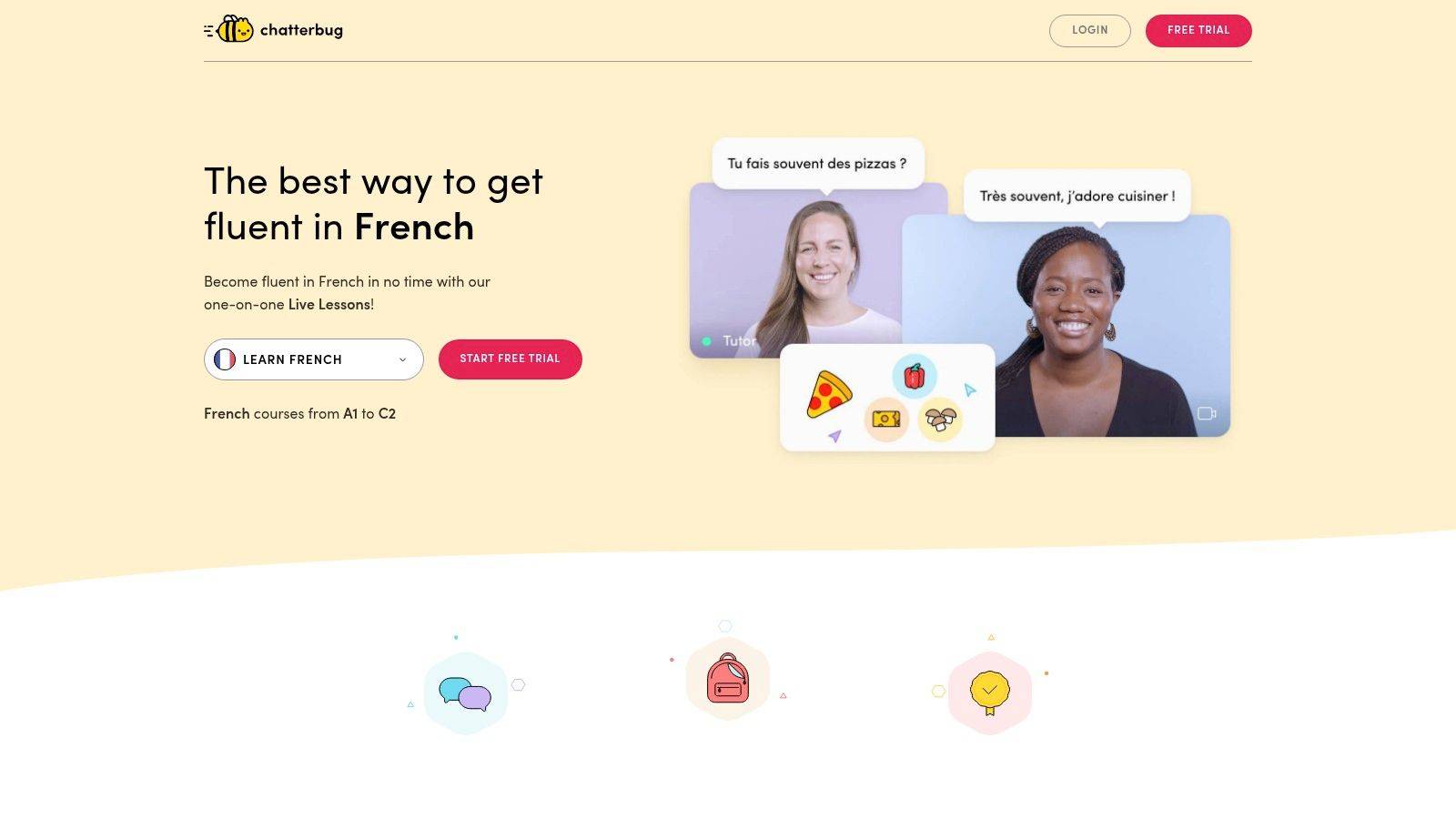
Chatterbug is one of the better picks for learners who want private lessons but still want an organized platform around them. Some students don't like pure tutoring marketplaces because they feel too open-ended. Chatterbug solves that by pairing one-to-one live lessons with in-app guided study.
That mix makes it a strong fit for self-starters who want both independence and teacher contact.
Why Chatterbug works well for structured self-starters
The main strength here is integration. You can take live lessons, then keep working inside the same ecosystem instead of bouncing between a tutor, a notebook, and an unrelated app. For learners who need a sense of order, that's helpful.
I also like that Chatterbug tracks CEFR progression through advanced levels. In my experience, level tracking works best when it doesn't replace good teaching, but supports it. Chatterbug gets closer to that balance than many app-heavy competitors.
A major buying point in the wider market is format. An independent comparison from Preply's review of online French course formats points to a real distinction: tutor-led options are better positioned for speaking practice, while content-led tools are stronger for self-study and passive skill building. Chatterbug sits between those worlds.
Who it is for
Chatterbug is a good buy if you want private lesson time and you know you'll use the study materials between sessions.
- Best for solo learners: You prefer one-on-one speaking time over group interaction.
- Best for organized learners: You want progress tracking and a built-in curriculum.
- Best for hybrid study: You like the idea of combining teacher guidance with self-paced review.
It's not the best fit if you want a social group class environment or the highest possible degree of personalization. It's more structured than a marketplace tutor experience and less bespoke than a premium private program.
You can explore lesson plans and trials on Chatterbug French.
4. Berlitz
Berlitz is the polished option for adults who want a recognizable training brand and a blended online format. I don't put it first for speaking-heavy learners, but I do think it makes sense for professionals who like established systems and want a mix of self-study and coaching.
That's really the key with Berlitz. You're not just buying lessons. You're buying a framework that feels corporate, organized, and easy to follow.
What you're really buying with Berlitz
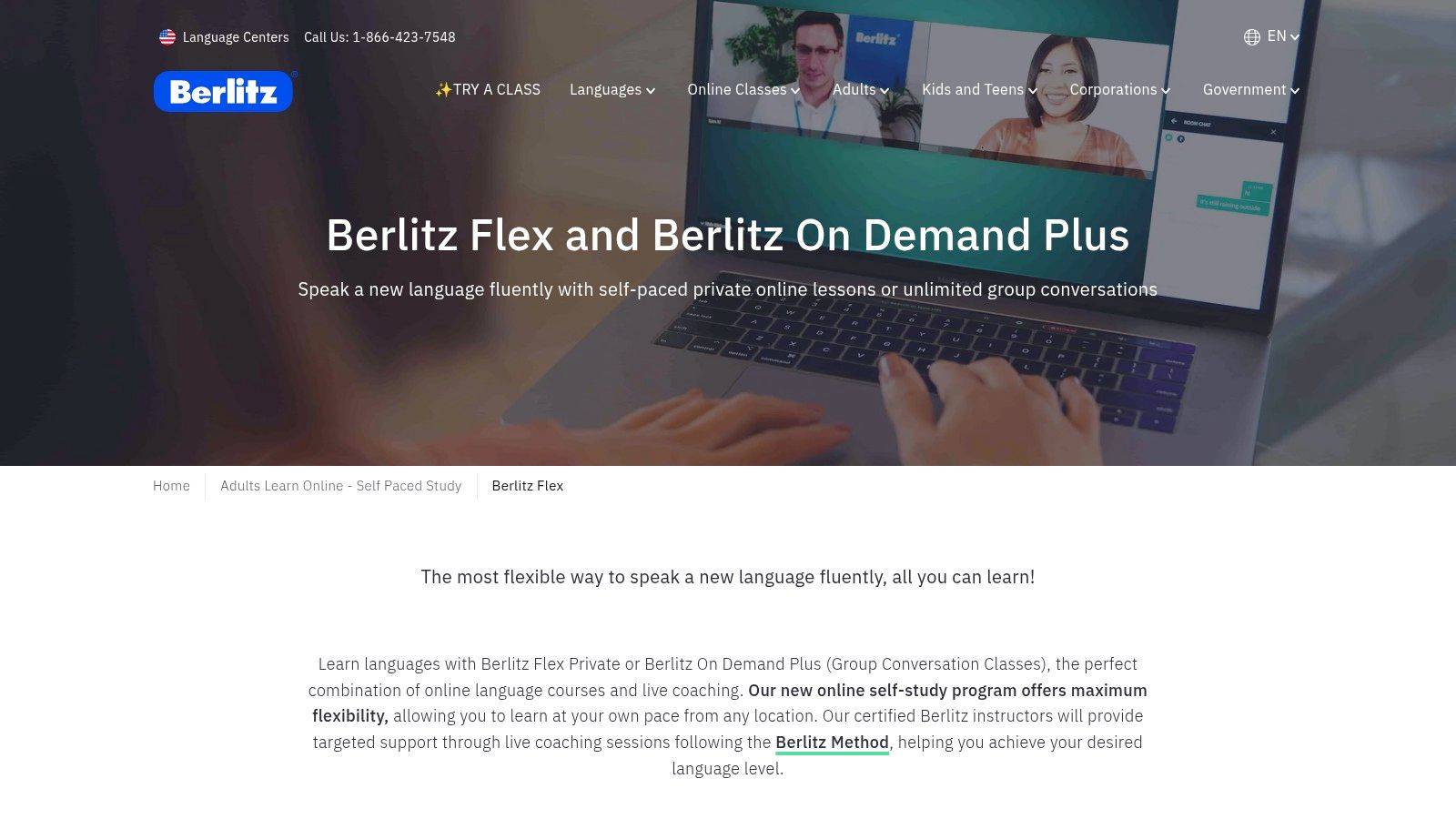
Berlitz Flex and related online formats combine self-paced content with coaching or scheduled conversation components. That makes the platform appealing if you need flexibility but know you still need some live accountability to keep going.
I especially like Berlitz for learners who don't need hand-held customization, but do want something more substantial than an app. Providers such as Berlitz and Alliance-style schools also help fill an important gap in the market. Many learners begin with scattered free resources or phrase lists, while live providers position themselves around real-time, immersive instruction, a contrast reflected in a Rick Steves community discussion about the best place for online French lessons.
If your schedule changes every week, a blended model can work better than fixed-term classes. Just make sure the live component is strong enough to keep your speaking active.
Who it is for
Berlitz is a practical choice for a certain type of buyer.
- Best for corporate learners: You want a known brand and a professional learning environment.
- Best for independent adults: You're comfortable doing self-study between coaching sessions.
- Best for flexible schedulers: You need more freedom than a term-based class usually allows.
If what you want is conversation-first learning with lots of live correction, I'd still favor a stronger private tutoring model. If you want a blend of flexibility and structure, Berlitz earns its place.
For a closer look at why live coaching matters, see the advantages when you take French lessons. You can compare Berlitz plans directly on Berlitz online French options.
5. French Institute Alliance Française
French Institute Alliance Française, often shortened to FIAF, is the best choice on this list for learners who want a traditional academic feel in an online format. It has the strongest institutional vibe of the group, and for many students that's reassuring.
If you want fixed terms, level placement, live classes, and a path that feels serious from the start, FIAF deserves your attention.
Why FIAF appeals to serious learners
What I respect most about this model is the visible commitment to level progression. L'Alliance New York publishes a CEFR-style course architecture with 10 hours for Intro to French and 120 hours each for A1, A2, B1, B2, and C1/C2. That kind of transparent level mapping is a useful benchmark because it signals curriculum depth instead of vague promises.
The same catalog also notes that virtual classes are taught live on Zoom by native French-speaking teachers and that students in a group or private class for a week or longer receive a complimentary one-year membership valued at $99. Even if you choose FIAF specifically rather than another Alliance program, that benchmark tells you what serious online French instruction should look like: live teaching, clear level structure, and support around the lessons.
Who it is for
FIAF is a strong fit if you value an institution more than platform convenience.
- Best for exam-minded learners: DELF and DALF pathways make sense here.
- Best for adults who like formal structure: You want level placement and term-based learning.
- Best for families who trust established schools: The administrative side feels stable and familiar.
The tradeoff is pace. Group terms can feel slow if you learn quickly, and private options will naturally cost more than group enrollment. Still, if you want one of the most traditional and credible online French class experiences available in the U.S., FIAF is near the top.
You can review schedules and offerings at FIAF online French classes.
6. Coucou French Classes
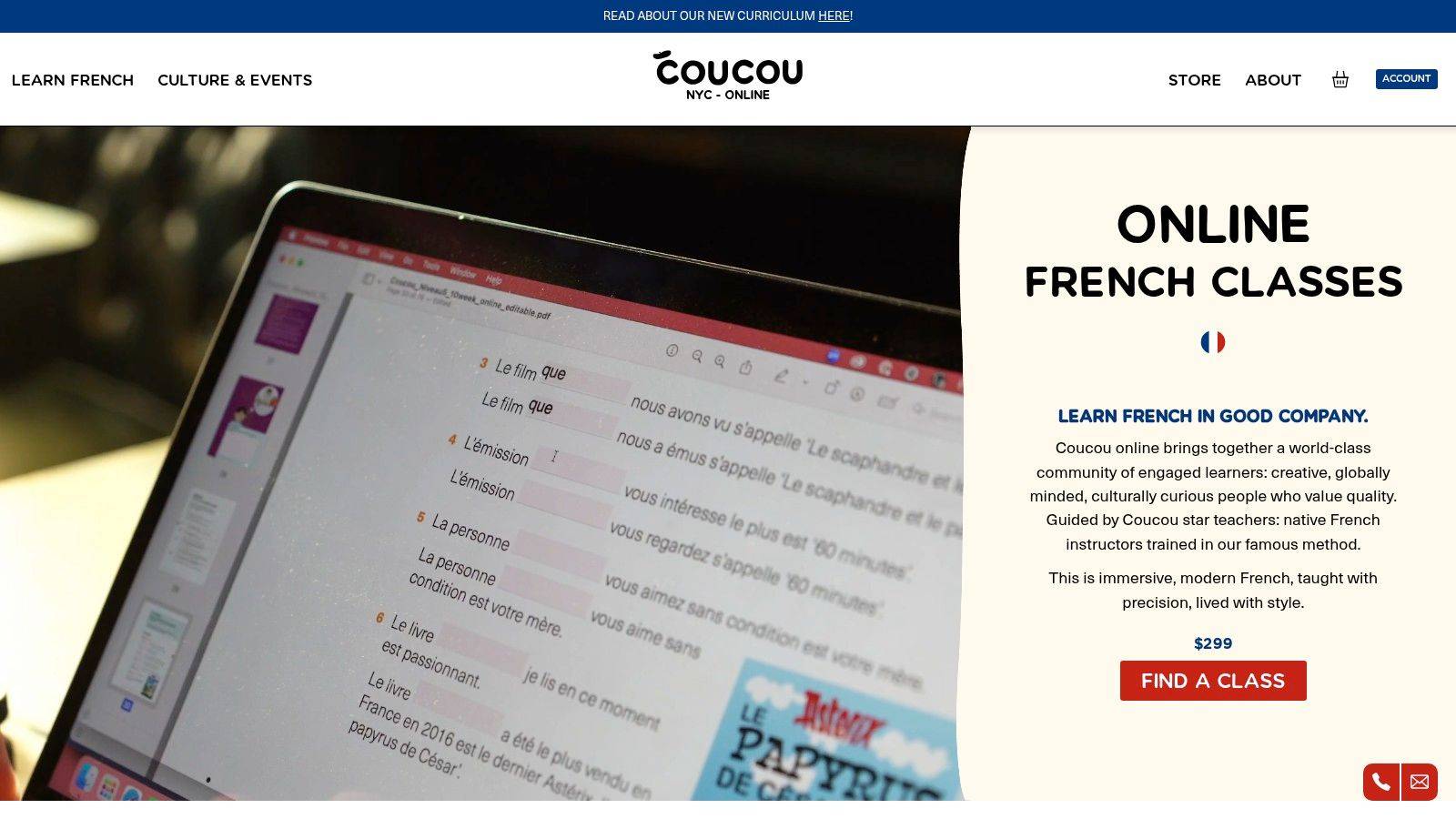
Coucou French Classes is for learners who want online French to feel lively, social, and distinctly human. Some platforms feel efficient but sterile. Coucou feels more like joining a real school community.
That doesn't mean it's casual in a weak sense. It means the experience is designed to keep people engaged, which is often what adult learners need most.
Where Coucou feels different
Coucou focuses on French specifically, and that helps. The school isn't stretching one platform across dozens of languages. Its online signature classes, conversation labs, and private lessons all support a more identity-driven experience for French learners.
I recommend it to students who know they'll show up more consistently when there's a cohort, a recognizable teacher presence, and a bit of community energy. That can make a real difference for motivation, especially if you've already abandoned self-study apps once or twice.
The best program isn't the one with the most features. It's the one you'll actually attend next Tuesday after a long workday.
Who it is for
Coucou suits learners who want a scheduled class experience without the stiffness of a formal institute.
- Best for socially motivated adults: You like cohort learning and recurring class energy.
- Best for conversational learners: Conversation labs are a natural add-on.
- Best for students who want French-specific focus: The brand stays centered on one language.
It's less ideal if you need maximum scheduling flexibility or highly individualized teaching from session one. Fixed-term classes work best when you're ready to commit to a rhythm.
You can browse current terms and formats on Coucou French Classes online.
7. Frantastique
Frantastique isn't my pick for someone who wants speaking fluency fast. It is, however, a smart purchase for busy learners who need a daily French habit and don't have room in the schedule for frequent live classes.
I think of it as a high-quality supplement first, and a standalone solution second.
When Frantastique is the smart buy
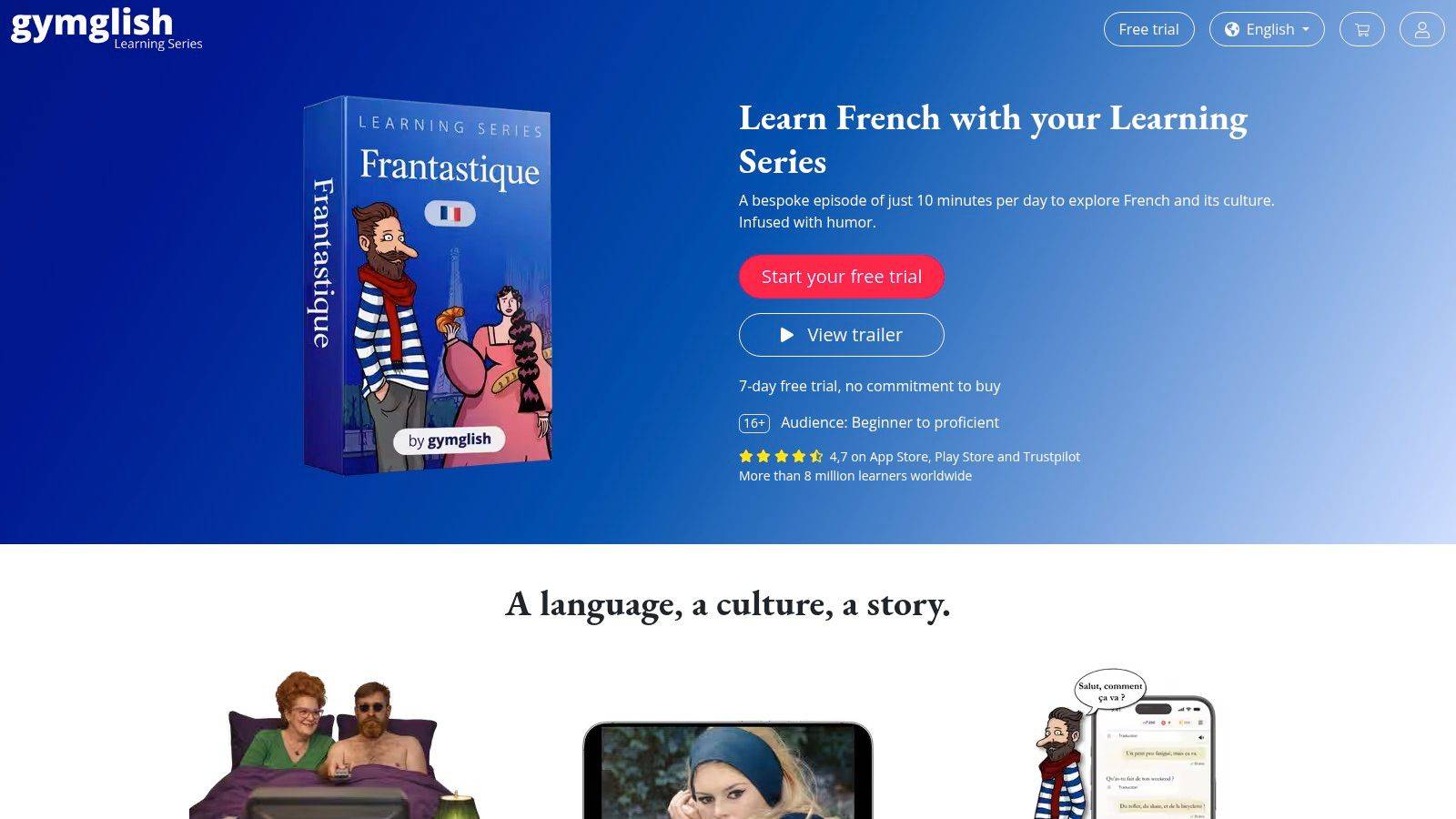
Frantastique delivers short, adaptive daily lessons with listening, pronunciation, and review built into a routine that's easy to maintain. For many adults, that's the product. Not intensity, but continuity.
I recommend it in two situations. First, when someone wants to keep French active every day between live lessons. Second, when someone isn't ready to commit to a larger program yet but wants a more guided experience than random free content.
This is also where I draw a hard distinction in the best online French lessons market. Self-study tools can support comprehension, vocabulary, and consistency, but they don't replace live conversation practice when speaking is your main target.
Who it is for
Frantastique is a good buy if your biggest problem is consistency, not access.
- Best for busy professionals: Short lessons fit into crowded days.
- Best as a supplement: Pair it with tutoring or live classes for stronger speaking results.
- Best for habit builders: You want French in your routine without heavy scheduling.
It's not the right choice if your main goal is live interaction, exam simulation, or high-touch correction. In those cases, I'd use it alongside a teacher, not instead of one.
If you're just getting started and want to build momentum, French classes for beginners and staying motivated pairs well with this kind of daily-practice approach. You can test the platform on Frantastique by Gymglish.
Top 7 Online French Lessons Comparison
| Service | Implementation complexity 🔄 | Resource requirements ⚡ | Expected outcomes 📊 | Ideal use cases 💡 | Key advantages ⭐ |
|---|---|---|---|---|---|
| Elite French Tutoring | High, bespoke onboarding, tailored lesson plans and scheduling | High, private native tutors, premium materials; possible higher cost | Rapid, measurable speaking gains and targeted exam/career outcomes | Professionals, executives, diplomats, intensive one‑on‑one exam prep | Native expert instructors; highly personalized; strong track record |
| Lingoda | Moderate, structured CEFR curriculum with scheduled classes | Medium, subscription required; frequent attendance for progress | Steady CEFR progression with clear level milestones | Learners wanting structured path, frequent 24/7 scheduling, group or private | 24/7 live classes, CEFR alignment, many time slots |
| Chatterbug | Low–Medium, integrated app plus guaranteed 1:1 lessons | Medium, monthly lesson tiers and app access | Predictable one‑to‑one speaking improvement and level certificates | Learners who prefer guaranteed 1:1 time plus guided self‑study | Combines private live lessons with in‑app practice and tracking |
| Berlitz (Flex / On Demand) | Medium, blended formats and fixed‑term pacing | Medium–High, subscription or corporate plans, scheduled coaching | Professional communication skill building and steady pacing | Corporate learners, professionals seeking branded training | Flexible blended formats, corporate experience, AI‑supported practice |
| FIAF (French Institute) | Medium, placement process and fixed weekly group terms | Medium, term fees; option for private e‑tutoring at higher cost | Academic progression with DELF/DALF exam pathways available | Learners wanting U.S. admin, cultural programming and exam prep | Reputable academic structure, cultural programming, exam support |
| Coucou French Classes | Medium, cohort‑based 10‑week terms with scheduled sessions | Medium, term commitment and cohort participation | Cohort‑paced progress with strong community engagement | Learners preferring set cohorts, French‑only immersion and community | Native instructors, French‑only focus, engaged adult community |
| Frantastique (Gymglish) | Low, daily micro‑lessons, automated adaptive flow | Low, short daily time commitment; subscription tiers | Gradual improvement in comprehension and grammar (not live speaking) | Busy learners; supplement to live tutoring or classes | Time‑efficient adaptive lessons, habit‑building, entertaining content |
How to Choose the Right French Lesson for You
You sign up for French classes, stay motivated for two weeks, then realize the format does not match what you need. That is the mistake I would avoid first. Choose by goal, then by teaching style, then by schedule.
Start with the outcome you want.
If your target is DELF or DALF, I would favor a program with structured progression, corrections, and exam familiarity, such as FIAF or a private tutor. If you need business French, presentations, meetings, or relocation support, I would choose private coaching or Berlitz because the lessons can stay focused on real professional use. If your goal is casual conversation and consistency, Lingoda or Coucou usually makes more sense. If you want a light daily habit between live sessions, Frantastique works well as a supplement.
Then look at how you learn.
Some students improve fastest when a teacher stops them, corrects pronunciation on the spot, and adjusts each lesson in real time. Others do better with a set curriculum, weekly classes, and enough repetition to build momentum. Chatterbug sits in the middle. It gives you one-to-one time plus guided practice, which suits students who want support but still like working independently between sessions.
Your schedule matters just as much. Fixed-term group courses reward consistency. They are a poor fit if your work hours change every week. Private tutoring gives you more control and usually gets you to a specific goal faster, especially if you need accountability and targeted feedback.
I would make the choice like this:
- Choose Elite French Tutoring if you want a premium one-on-one plan built around a specific result, such as exam prep, professional fluency, relocation, or support for a child or teen.
- Choose Lingoda if you want live classes, regular scheduling, and a clear path without paying for fully private instruction.
- Choose Chatterbug if you want private lessons inside a guided platform with self-study built in.
- Choose Berlitz if you want business-focused training, branded course structure, and a more corporate learning environment.
- Choose FIAF if you want an academic format, cultural credibility, and a stronger fit for exam-oriented study.
- Choose Coucou if you enjoy cohort energy, French-first teaching, and learning with the same group over time.
- Choose Frantastique if you need short daily practice to keep French active, not live speaking as your main method.
My advice is simple. Do not pick the platform with the most features. Pick the one that matches the reason you are learning French in the first place.
If you are serious about fast progress and want a personalized route, Elite French Tutoring is the premium option in this list. As noted earlier, the best next step is to book a consultation and see whether that level of support matches your goal, timeline, and budget.