Skip to content

You're probably doing what most Phoenix learners do at first. You open several tabs, compare tutors, glance at group classes, wonder whether online lessons feel personal enough, and then realize every option sounds “customized” until you ask one simple question: customized for what?
That's the key decision. A casual travel learner, a parent at a bilingual school, and a professional preparing for client calls in French should not buy the same kind of lesson. I've worked with enough adult learners, parents, and exam candidates to know that people don't struggle because they lack motivation. They struggle because they choose a format that doesn't match the job the lesson needs to do.
If you're searching for French lessons in Phoenix, use this guide as a decision tool, not a directory. The right program depends on your goal, your schedule, and how much precision you need from your tutor. If you're still at the very beginning, this overview on how to start learning French is also a useful companion.
Table of Contents
Starting Your French Journey in Phoenix
Phoenix gives you choices, but choice alone doesn't solve the problem. What matters is whether the lesson format fits the outcome you want. I've seen learners waste months in decent programs that were wrong for their goals.
If you're learning French for travel, your needs are practical. You want pronunciation help, high-frequency vocabulary, listening practice, and enough speaking repetition to handle airports, restaurants, hotels, and basic conversation. You don't need an academic track.
If you're a parent looking for support for a child, the stakes change. Homework help, reading comprehension, writing correction, and curriculum alignment matter more than casual conversation. The same is true for professionals who need presentation language, business etiquette, or industry-specific vocabulary.
Start with the outcome, not the tutor
A smart buying decision starts with three questions:
What does success look like?
Ordering coffee in Paris is different from passing an exam or supporting a child in a bilingual classroom.What type of correction do you need?
Some learners need confidence and flow. Others need detailed correction in grammar, writing, and pronunciation.How much structure will keep you moving?
Many adults say they want flexibility, but what they really need is a scheduled program with accountability.
Practical rule: If your goal has a deadline, a school requirement, or a professional consequence, don't choose a general conversation format and hope it becomes specialized later.
Common mistakes I see in Phoenix searches
The biggest mistake is buying based on proximity alone. A nearby tutor may be convenient, but convenience doesn't guarantee fit.
Another mistake is assuming all one-to-one tutoring is equally customized. It isn't. Some tutors chat. Some teach. Some diagnose weak points and build a progression. Those are very different services, even when they all use the phrase “private French lessons.”
A third mistake is underestimating the role of pacing. Learners often think a lesson is working because it feels pleasant. Pleasant matters, but progress comes from a program that builds skill in a clear sequence and keeps raising the level at the right moment.
Types of French Lessons for Every Goal
Not all French lessons solve the same problem. In Phoenix, the market includes private tutors, group classes, and more specialized options, but serious learners need to read past the labels and look at what the instruction is designed to do.

Private tutoring for targeted progress
Private lessons are usually the best fit when you need speed, personalization, or focused correction. One-to-one sessions give the teacher room to adjust the lesson in real time, slow down where needed, and spend more time on your weak points.
This format works well for:
Busy professionals who need flexible scheduling and role-specific French
Adult learners who want to improve speaking without sitting through a group syllabus
Students who need writing help, reading support, or oral exam practice
Parents who want consistent reinforcement outside school
That said, private tutoring can vary wildly in quality. A good tutor creates progression. A weaker tutor fills time with conversation that feels productive but doesn't build range.
Group classes for routine and social learning
Group classes can be a solid choice if your goal is light structure and social motivation. Some learners stay more consistent when a class time is fixed and other students are expecting them.
They tend to work best for:
Beginners who want an affordable entry point
Travel learners with broad goals
Students who like learning with peers
People who don't need much individual correction
The trade-off is obvious. Group classes usually move at one shared pace. If you're ahead, you wait. If you're behind, you scramble. That's manageable for general learning, but not ideal when the target is specific.
Specialized programs for school support and exams
Many Phoenix guides stop short. The local market may look broad on paper, but specialized needs narrow it quickly.
According to this overview of learning French in Phoenix and this description of DELF and DALF tutoring as a targeted service, despite 52 private French tutors available in Phoenix, existing content fails to address the critical gap in curriculum-aligned support for families at French bilingual schools such as Lycée Français, as local options primarily offer group classes or general conversation rather than targeted academic reinforcement for K–12 students. The same source context notes that DELF and DALF preparation is a high-intent service that requires targeted, expert instruction.
That distinction matters.
A child in a bilingual school may need:
Reading support tied to school texts
Writing correction that follows teacher expectations
Grammar reinforcement linked to what's happening in class
Oral practice that supports school performance, not just casual speech
An exam candidate needs something else:
Level-specific preparation for DELF A1 to B2 or DALF C1 to C2
Timed practice
Skill integration across reading, listening, speaking, and writing
Feedback based on exam demands, not generic fluency goals
A tutor who is excellent for travel French may be the wrong tutor for a bilingual school child or an exam candidate. The issue isn't talent. It's fit.
If you're shopping seriously, don't ask only “Do you teach French?” Ask, “Have you taught this kind of French problem before?”
Comparing Local vs Online French Lessons
A Phoenix parent often starts with the obvious option. Find someone nearby, book an hour after school or work, and hope convenience leads to progress. That works for some learners. It breaks down quickly when the goal is specific, the schedule is tight, or the student needs a teacher who can do more than hold a pleasant conversation.
The right comparison is not local versus online in the abstract. The core question is simpler. Which format gives you access to the right teacher, with the right structure, for the result you need?
Local lessons in Phoenix have clear advantages. In-person meetings can help younger students stay focused. Some adults also learn better when they leave the house, sit across from a teacher, and build that weekly routine. According to Superprof's Phoenix French tutor listings, local private lessons can also be a practical entry point on price for learners who want basic support without committing to a larger program.
That said, local availability creates trade-offs. A tutor may be nearby but not experienced with professional French, academic writing, pronunciation correction, or long-term skill building. I see this often. Students come to us after spending months with a well-meaning local tutor who gave them conversation practice, but no real plan.
Online lessons widen the pool. That is the main advantage.
For Phoenix learners, that wider pool matters most in four situations:
You need a specialist, not just a general tutor
Your schedule changes weekly because of work, sports, or family logistics
You want a program with a clear progression, homework, and feedback
You are investing for a serious outcome, such as school support, relocation, business use, or exam performance
If you want to compare formats and teaching models more closely, this guide to the best online French lessons gives a useful breakdown.
Where local lessons make sense
Local tutoring is often a reasonable first step for casual learners. It can work well if you are starting from zero, want low-pressure exposure to the language, and care more about convenience than precision.
It also suits families who want simple face-to-face accountability and do not need a teacher to coordinate with a school curriculum or a specific benchmark.
Where online programs pull ahead
Online instruction tends to produce better results when fit matters more than geography. You are not limited to whoever happens to live nearby and have an open Tuesday at 5 p.m. You can choose based on teaching range, lesson design, correction style, and experience with your exact goal.
That changes the decision.
A strong online program can match a Phoenix executive with a teacher who handles presentations and client communication. It can match a teenager with someone who knows how to teach writing, not just speaking. It can also give an adult learner regular lessons without commute time, missed sessions, or the stop-start rhythm that often slows progress.
| Feature | Local Phoenix Tutors | Premium Online Programs |
|---|---|---|
| Access | Limited to teachers in the local area | Broader access to specialists across locations |
| Scheduling | Shaped by traffic, travel time, and local availability | Easier to fit around work, school, and family demands |
| Best use case | Casual learning, beginner support, general conversation | Targeted goals, academic support, professional French, exam preparation |
| Lesson structure | Varies widely by individual tutor | More likely to follow a defined curriculum and progression |
| Convenience | In-person contact for learners who prefer it | No commute and fewer scheduling constraints |
| Tutor fit | You may need to compromise | Better chance of finding a teacher who matches the goal |
Here is the practical rule I give families and adult learners. If the stakes are low, local can be enough. If weak instruction will cost you time, confidence, grades, or a professional opportunity, choose for fit first and format second.
The best option is the one that gets you to your goal without wasted months.
What to Look For in a Quality French Program
Good French teaching is visible in the lesson design, not the branding.
After placing hundreds of students, I have seen the same mistake again and again in Phoenix. Learners choose the teacher who feels friendly in a trial lesson, then realize six weeks later that nothing is building. The conversation was pleasant. The program was thin.
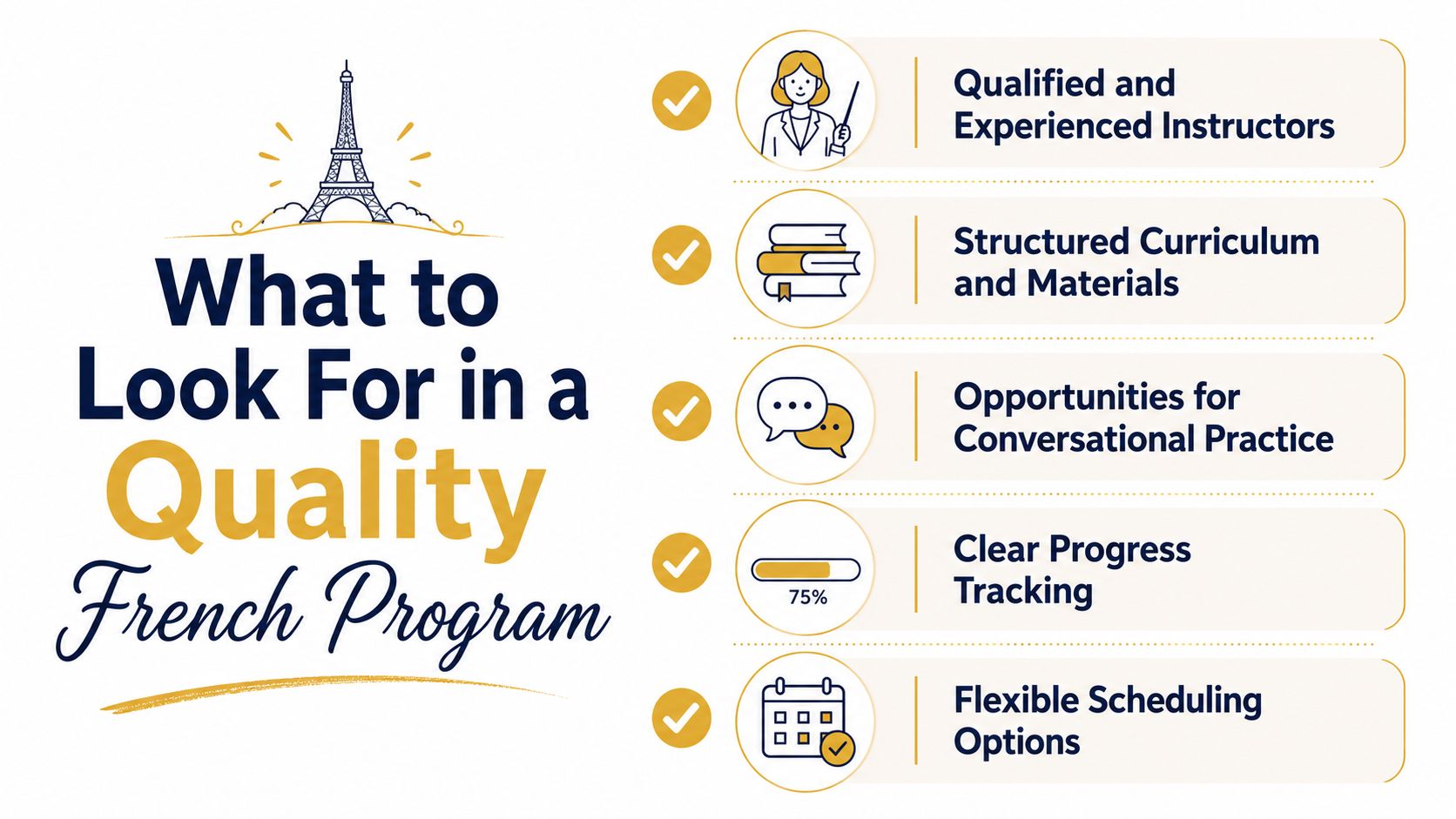
A quality French program has a clear path. It teaches pronunciation before bad habits settle in. It introduces grammar inside useful sentences, not as disconnected rules. It gives listening work with feedback, speaking tasks that go beyond introductions, and enough reading and writing to support real retention. If a tutor cannot explain how lesson one connects to lesson eight, the program is probably being improvised.
That matters even more when your goal is specific. A child in a bilingual school, an adult preparing for travel, and a Phoenix professional who needs client-facing French should not be taught in the same way. Local options often stay broad because they have to serve whoever enrolls. Serious learners usually need tighter lesson planning than that. For learners who want a more personalized, structured option, Elite French Tutoring offers private French lessons built around your goal.
Use these questions in a consultation:
How do you assess level and gaps? A serious teacher has a method. They do not rely only on your self-description.
What happens in a typical lesson? Look for a mix of speaking, correction, review, and targeted practice.
How do you correct mistakes? The answer should reflect your goal, pace, and confidence level.
What materials support the lessons? Strong programs use selected resources, notes, and follow-up work. They do not invent everything on the spot.
How is progress tracked? You want regular feedback on pronunciation, grammar control, listening, writing, or goal-specific performance.
Have you taught students with my exact goal? General French, school support, exam prep, and workplace communication require different teaching choices.
One warning sign deserves special attention. If the whole offer is “we'll just talk in French,” progress usually stalls for beginners and lower intermediates. Conversation practice has value, but it works best inside a structured program. Otherwise, students repeat familiar vocabulary, avoid weak areas, and mistake exposure for improvement.
Scheduling also deserves a harder look than many learners give it. Flexibility helps, but loose scheduling often leads to skipped weeks, long gaps, and review-heavy lessons that slow momentum. The strongest programs protect consistency with a regular cadence, clear homework expectations, and a plan for missed sessions.
For adults who want a sharper screening process, this guide on how to find the perfect French tutor for adult learners gives a practical way to compare options before you commit.
Choose the program that matches your goal, tracks your progress, and respects your time. That is what gets students in Phoenix from interested to capable.
From Zero French to Confident Speaker An Online Success Story
One of the most common Phoenix profiles I see is the professional learner who doesn't need “French in general.” They need French for one concrete purpose, and they need lessons to respect their time.

Sarah, a marketing professional in Scottsdale, came in with that exact problem. She had accepted a role that involved regular communication with clients in Montreal. She had tried local group classes first, which was a sensible place to start, but she hit a wall quickly. The class gave her exposure, not job readiness.
Why her first lessons did not work
Her issue wasn't effort. It was mismatch.
She needed to practice:
client-facing introductions
meeting language
email etiquette
presentation phrasing
speaking under pressure
Instead, she was spending class time on broad beginner-intermediate material designed for a mixed group. That's useful for many learners. It just wasn't enough for her.
When she finally moved into a personalized online format, the lesson design changed immediately. Her tutor built sessions around business scenarios, corrected register and tone, and practiced the language she would use at work.
Here's a related example of that kind of transformation in this story about going from zero to fluent in six months.
What changed once the program matched the goal
The biggest shift was specificity. Sarah stopped trying to “improve French” and started rehearsing real tasks in French.
She worked on mock calls, short presentations, and professional vocabulary tied to her field. Her tutor also targeted pronunciation points that mattered for clarity in meetings, rather than correcting every small mistake equally.
That's the difference serious learners feel. The lesson stops being academic in the vague sense and becomes practical in the exact sense.
This short video captures the kind of online learning dynamic many adults respond to well:
Sarah's story isn't unusual because she was exceptionally gifted. It's useful because her path is common. Local options got her started. A customized online program got her unstuck.
The right teacher doesn't just improve your French. They improve the French you actually need.
What to Expect in Your First French Lesson
You book a first lesson because you want clarity. Instead, some Phoenix learners get a pleasant conversation, a few vocabulary words, and no real sense of what happens next. That usually leads to the same result. A few weeks of effort, then stalled progress.
A strong first lesson does a different job. It shows how the teacher thinks, how the program is built, and whether the plan fits your goal.
The consultation phase
Before the first full session, a serious program should gather useful information and make decisions from it. I look for four things right away: why the student is learning, what they can already do, what has frustrated them before, and what schedule they can maintain. If that conversation stays generic, the lessons usually do too.
A good intake should cover:
Your goal such as travel, relocation, school support, work, or exam prep
Your current level across speaking, listening, reading, and writing
Your learning history including classes, apps, tutoring, and gaps
Your weekly availability so the plan matches real life
Your correction preference because some students want frequent interruption and others do better with delayed feedback
That early conversation should feel diagnostic, not promotional.
This matters even more in Phoenix, where many local options serve broad audiences. A community class may work well for casual learners, but a student preparing for DELF, supporting a child in a bilingual school, or using French at work needs a tighter fit from day one.
The first live lesson
The first lesson should get you using French quickly. It should also help the teacher confirm your level instead of guessing from a placement label or a short email exchange.
In well-run programs, the session usually includes a few core elements:
A short spoken exchange to hear pronunciation, hesitation patterns, and confidence level
A focused comprehension task based on your level and goal
Correction on a small number of important issues instead of constant interruption
A clear lesson path so you know what comes next and why
Beginners should expect support, structure, and useful language right away. Advanced students should expect precision. That means better questions, sharper corrections, and material that matches the situations they face.
I tell students to judge the first lesson by output, not atmosphere alone. A friendly teacher is nice. A teacher who can identify your weak points, explain the order of priorities, and set a realistic plan is far more useful.
By the end of the session, you should know:
What your level looks like in practice
What the teacher wants to fix first
How lessons will connect to your specific goal
What kind of work you'll do between sessions
If you do not leave with those answers, keep looking.
For Phoenix learners comparing in-person and online options, this is one of the biggest decision points. Local lessons often get people started. Specialized online programs tend to do a better job once the goal becomes specific and the schedule gets complicated. That trade-off is worth judging in the very first meeting.