Skip to content

You know the moment. You've memorized the phrase, you step up to order, and the person behind the counter gives you that polite but blank look that says, “I heard words, but not the words you meant.”
For most English speakers, that problem isn't grammar. It isn't vocabulary either. It's pronunciation.
I've seen this with professionals before a client dinner, students preparing for oral exams, and travelers who can read French better than they can say it out loud. They often think they need a bigger vocabulary. In reality, they usually need a smaller, sharper set of pronunciation fixes that make them easier to understand right away.
That's why I teach french pronunciation for english speakers as a high-return skill, not a giant pile of phonetic theory. If you improve the right sounds first, your speech becomes clearer, more natural, and much less stressful in real conversations.
Table of Contents
- That Awkward Silence at the Boulangerie
- Why Your English Brain Tricks You in French
- The Five Sounds That Instantly Mark You as an English Speaker
- A Comparison of Common Mistakes and Quick Fixes
- Beyond Single Words to Sounding Truly French
- Your 15-Minute Daily Pronunciation Workout
That Awkward Silence at the Boulangerie
I've taught plenty of students who can say the right sentence in French and still not get understood. One of the most common examples happens in a bakery. You ask for a croissant, or say je voudrais, and the baker pauses for a second too long. You feel your confidence drop immediately.

It usually is not your French level
What went wrong? Usually, your vowels sounded English, your rhythm landed on the wrong syllable, or you pronounced letters the French speaker wasn't expecting to hear.
That's frustrating, but it's also normal. I tell students this all the time. If you learned French mostly through reading, your mouth is trying to apply English spelling habits to a language that doesn't reward that strategy.
Practical rule: If a French speaker looks confused by a simple sentence, check the sounds before you blame your grammar.
I've watched capable adults freeze after one misunderstanding. Then they start speaking less naturally, and with too much caution. The irony is that the fix is often very specific. We don't need to rebuild your whole French. We need to adjust a few high-impact habits.
Why the sounds feel so far apart
There's a real reason French feels distant in your mouth. A major historical reason French pronunciation can be hard for English speakers is that the two languages separated very early and evolved different sound systems. French developed from Vulgar Latin, and by the 9th century, it had diverged so much that texts from that era are considered the earliest form of French. That long, separate evolution led to features like liaison, silent letters, and nasal vowels that are now core obstacles for English learners, as noted in this historical explanation of why French sounds difficult for English speakers.
So if French feels less intuitive than Spanish or Italian might feel to some learners, that doesn't mean you're bad at languages. It means your ear and mouth are being asked to do something new.
Here's the encouraging part. In real life, people don't need you to sound “perfect.” They need to understand you the first time. For a student heading into a DELF oral exam, a parent helping a child with school French, or a professional preparing for meetings, that shift in focus changes everything.
Why Your English Brain Tricks You in French
The biggest pronunciation problem isn't your tongue. It's your pattern recognition.
Your brain is trying to help by taking a French sound and matching it to the nearest English sound it already knows. That strategy works fast, but it's often wrong. You hear a French vowel, your brain says “close enough,” and your mouth produces an English version.
Your brain uses the wrong sound menu
I ask students to think of pronunciation as a sound menu. English has one menu. French has another. Some items overlap. Some look similar but taste different. Some aren't on the English menu at all.
If a sound doesn't exist in English, your brain substitutes. That's why an English speaker may turn French u into ou, or treat a nasal vowel like a normal vowel plus an n. The speaker isn't being careless. The speaker is choosing from the wrong menu.
French has a relatively small vowel inventory in writing, but it can still be difficult for learners because many spellings map to multiple sounds, and some sounds don't exist in English. One teaching source notes that French includes four nasal vowel sounds, an/en, in/ain, on, and un, which are absent in English and require new mouth and nasal positioning. It also highlights liaison, silent letters, and the guttural French /r/ as major hurdles in connected speech, as explained in this teaching overview of why French pronunciation is difficult.
What this looks like in real speech
Here's what I hear every week:
- English r instead of French r. The student keeps the sound too far forward.
- English stress patterns. One syllable gets hit too hard, which makes the whole word sound foreign.
- Pronounced final consonants. The student says letters that French normally leaves silent.
- A spoken n after a nasal vowel. Instead of one nasal sound, the student produces two sounds.
Most English speakers aren't failing to “try hard enough.” They're hearing French through an English filter.
That's why repeating a word twenty times doesn't always help. If your ear hasn't learned the contrast, repetition can just strengthen the wrong habit. I'd rather have a student do five slow, accurate repetitions with one mouth adjustment than fifty fast ones with the same error.
When you understand this, pronunciation work becomes much less mysterious. We stop saying “my accent is bad” and start saying “my brain is mapping this sound incorrectly.” That's a problem we can indeed solve.
The Five Sounds That Instantly Mark You as an English Speaker
A lot of English speakers try to fix French pronunciation by learning more rules. I usually take a different route with professionals and students. We identify the Big 5 roadblocks that give away an English accent fastest, then we train the few mouth habits that produce the biggest return right away.
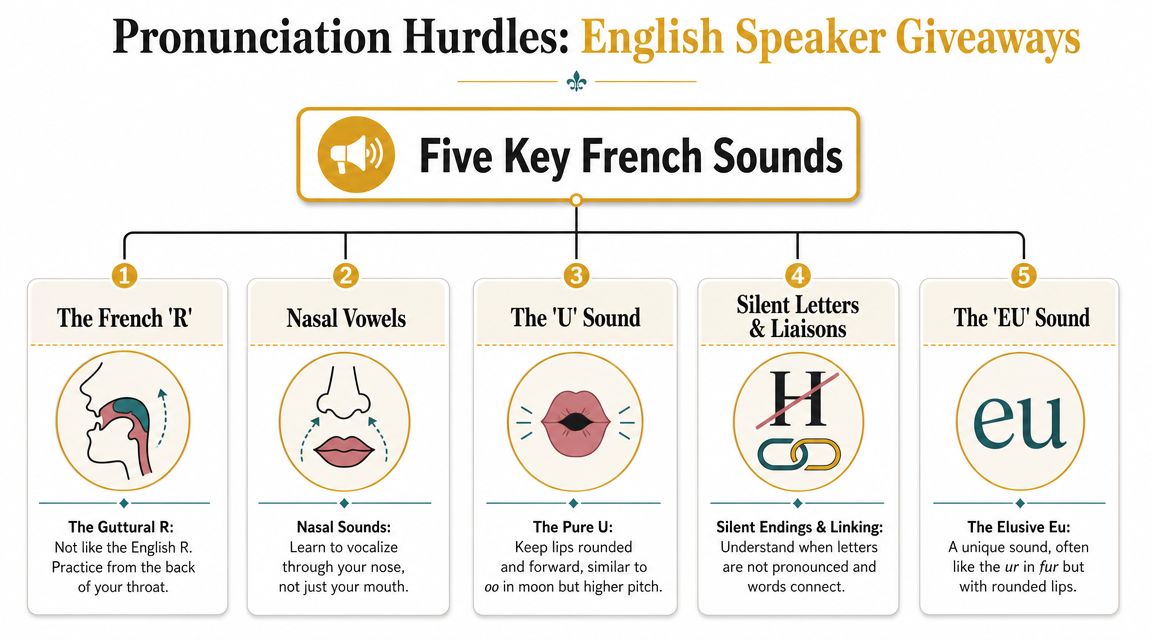
The French r
This sound tells on English speakers almost instantly.
In English, the tongue wants to curl and pull the sound forward. In French, I coach students to stop working with the tongue tip and start working farther back. The sound comes from light friction in the throat area. The first goal is not a dramatic growl. The first goal is placement.
A comparison helps here. English r lives near the front of the mouth. French r lives much farther back. If you are still making a clean, rounded English r, your listener hears your accent before they even process the word.
One cue works well in lessons. Start with the soft breath you would use to fog a window, then tighten it slightly until a controlled friction appears. If you want more examples of how this fits into overall speech, this guide on how to do a French accent gives useful context.
The u and ou trap
This is one of the highest-ROI fixes in French pronunciation.
English speakers often merge French u and ou because English does not train the ear to keep them separate. So tu starts sounding like tout, and rue starts sounding like roue. The student feels close. The French listener hears two different words collapse into one sound.
Here is the technique I use. Say English ee and freeze the tongue in place. Then round the lips. The tongue stays high and forward. If the tongue slides backward, you have drifted into ou.
I tell students to check two things at once. Front tongue, rounded lips. That combination feels strange at first, which is usually a good sign.
The French y sound
Students often ask me whether this is really worth training early. Yes, especially if you use French for work, presentations, interviews, or exams.
A small vowel error can force the listener to do extra decoding. That matters more than many learners realize. In coaching, I would much rather fix one contrast that appears in dozens of common words than spend the same time polishing a rare sound. That is the Big 5 approach. We go after the errors that buy clarity fastest.
A quick self-check helps:
- Lips rounded, tongue pulled back usually gives you ou
- Lips rounded, tongue high and forward gets you closer to French u/y
- If both sounds feel identical, your ear still needs contrast practice
Here's a short video I often recommend for hearing these mouth-position differences more clearly.
The nasal vowels
This is the point where many English speakers start spelling with their mouth instead of pronouncing French.
The usual mistake is adding a clear n or m at the end. French nasal vowels do not work that way. The vowel itself carries the nasal quality. If you close too hard at the end, you turn one French sound into two sounds.
I use a simple correction in class. Sustain the vowel a fraction longer than feels natural, and do not let the tongue “land” on n. You should feel some resonance in the nose while the mouth stays open enough for the vowel to remain alive. If the ending snaps shut, the consonant has taken over.
This roadblock matters because nasal vowels show up everywhere in everyday French. A student can know the word perfectly on paper and still sound strongly English each time it appears.
The silent e
The last roadblock is not one single sound. It is the habit of pronouncing too much.
English trains us to respect many written vowels. French often asks us to lighten or drop them so the phrase can move. That is why a learner may pronounce each word correctly in isolation and still sound unnatural in a full sentence.
I give students a practical test. Read the phrase once with every written vowel you want to say. Then read it again with less weight on the unstressed syllables and no extra ending sound unless the rhythm really needs it. The second version usually sounds more French at once.
Personalized coaching helps a lot. A teacher can hear whether the extra e supports the phrase or makes it heavy and choppy. Apps rarely catch that in a reliable way, but a trained listener can correct it in seconds.
A Comparison of Common Mistakes and Quick Fixes
When students feel overwhelmed, I simplify. We identify the mistake, compare it to the target sound, and assign one drill. That keeps practice concrete.
French Pronunciation English Mistake vs Correct Sound
| French Sound | Common English Error | Minimal Pair Example | Quick-Fix Drill |
|---|---|---|---|
| French r | Using a front English r | rue vs roux | Start with a soft throat friction, then add the vowel slowly |
| u | Replacing it with ou | rue vs roue | Hold an “ee” tongue position, then round the lips |
| Nasal vowel on | Saying a vowel plus n | bon vs beau | Sustain the vowel and avoid any closing n at the end |
| Nasal vowel in | Flattening it into an English vowel | pain vs paie | Alternate slowly and listen for nose resonance |
| Silent final consonant | Pronouncing every letter | les amis in a phrase vs isolated spelling habits | Read the whole phrase aloud, not word by word |
| Rhythm | Stressing one syllable too hard | professional phrases and exam answers | Clap the phrase evenly and soften English stress |
If you want a broader checklist of transfer errors, this roundup of common mistakes in French pairs well with pronunciation practice because many speaking errors begin as sound errors.
A real student story from presentation prep
One of our students was a lawyer who needed to present in French. His grammar was solid. His vocabulary was strong. But his nasal vowels kept collapsing into English-style sounds, so key terms in formal speech landed less clearly than he wanted.
We didn't overhaul everything. We focused on a small set of high-value contrasts from the table above. He practiced short phrases from his own presentation, recorded them, and repeated only the parts where the nasal vowel broke down. Within a few weeks, his delivery sounded cleaner, slower in the right way, and much easier for listeners to follow.
That's the pattern I see again and again. Progress comes faster when we stop treating pronunciation like a giant mystery and start treating it like targeted coaching.
Beyond Single Words to Sounding Truly French
A student can pronounce individual words well and still sound very English in full sentences. That gap usually comes from connected speech.
Liaison is flow, not decoration
French routinely suppresses written final consonants but reintroduces them through liaison before vowel-initial words. For example, the final consonant in les amis is not silent. It surfaces as a /z/-like link. English speakers who pronounce every written consonant or skip liaison entirely will sound accented and can be less intelligible in connected speech, as explained in this practical breakdown of liaison and final consonants.
I teach liaison as a flow pattern, not a grammar lecture. In speech, French often prefers one sound stream where English would separate words more sharply.
Compare these:
- les amis: the link appears before the vowel
- les garçons: no vowel follows, so the spelling does not create the same link
- j'aime: the vowel in je drops before the next vowel
- de école becomes d'école: the word shape changes for ease of speech
That's why reading French one word at a time sounds stiff. The spoken language constantly reshapes small function words and hidden consonants.
Read phrases as sound groups. If you pause after every word, your pronunciation work won't transfer to real conversation.
For students preparing for oral exams or meetings, I often suggest adding native listening to the routine. Curated French podcasts for learning French can help you hear how these links show up in natural pacing.
Rhythm and stress change everything
English uses strong word stress. French doesn't work the same way. English speakers tend to punch one syllable too hard, especially in longer words and business vocabulary. That instantly shifts the melody.
French rhythm is smoother and more even. The sentence carries the movement more than the individual word. If you stress every content word the English way, you may pronounce each sound correctly and still sound off.
I use three practical corrections:
- Shorten the pauses. French phrases often move forward without the little breaks English speakers add.
- Flatten the stress. Don't hammer the first syllable.
- Practice chunks, not isolated words. “Je suis ravi de vous rencontrer” should feel like a unit, not five separate tasks.
At this point, learners often notice the biggest jump in sounding “more French,” even before every individual vowel is perfect.
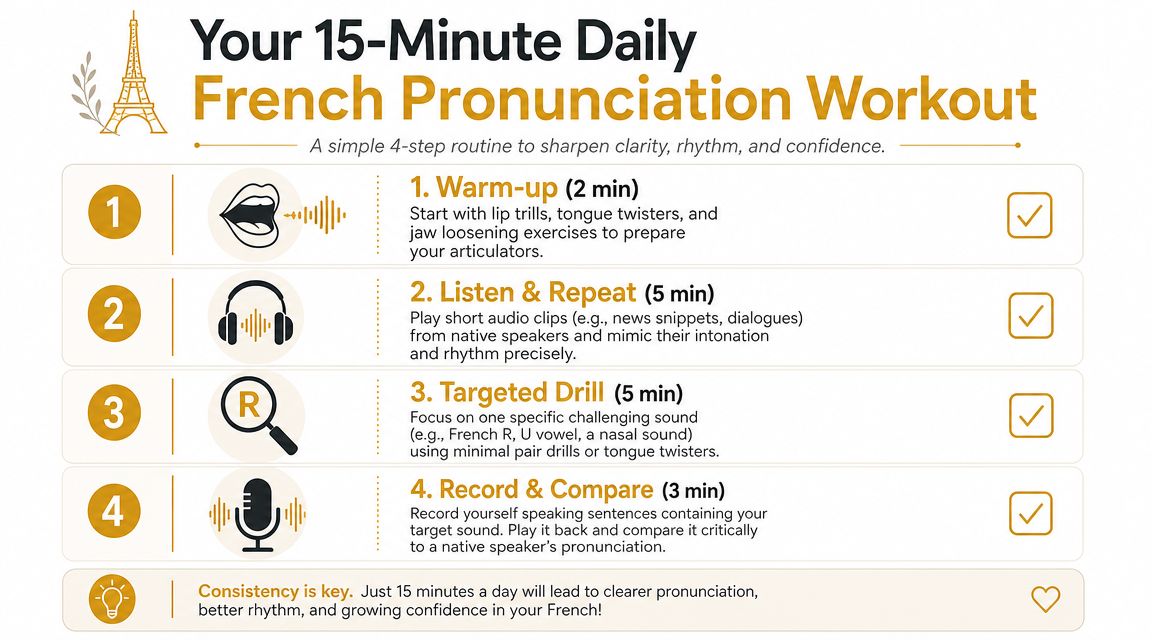
Your 15-Minute Daily Pronunciation Workout
A good workout has one job. It must fit into a real Tuesday.
I tell busy professionals and exam students the same thing: fifteen focused minutes every day beats an occasional one-hour marathon. French pronunciation changes through repetition, not through heroic effort once a week. If we train the same small set of sounds and patterns often enough, your mouth starts finding them faster in real conversation.
A simple routine that busy adults will actually do
Here's the 15-minute plan I use with learners who are trying to clear the Big 5 roadblocks without adding another heavy task to the day.
- 2 minutes: wake up the mouth. Loosen your jaw. Round and unround the lips. Say a few slow vowels, especially the ones English speakers blur together.
- 5 minutes: copy one short native clip. Use one sentence or two, not a whole dialogue. Match the pace, the vowel shape, and the melody.
- 5 minutes: drill one roadblock only. Choose one high-return target such as u, French r, or a nasal vowel. One sound is enough for one session.
- 3 minutes: record and check. Play your version back right away. Write down one correction for tomorrow.
That narrow focus matters. English speakers often try to fix every mistake at once, then nothing sticks. I'd rather see you improve one sound cleanly than touch five sounds vaguely.
A useful rule is this: one day, one target, one sentence family. If today's target is u, keep your examples close together, like tu, vu, sur, culture, tu peux, je suis sûr. Your mouth learns faster when the pattern repeats.
When feedback speeds things up
Self-study helps, but it has a blind spot. You can hear that something is off and still miss the exact cause.
I see this every week. A student says French u with the tongue in the right place but forgets to round the lips enough. Another gets the lips right but lets an English r sneak back in at the end of a phrase. Someone else reads carefully, yet the whole sentence still sounds English because the rhythm breaks in the wrong places. These are small mechanical problems, but they create big results.
That is why personalized correction often speeds up progress. A trained listener can spot which of the Big 5 is costing you clarity, then give you one fix that changes several words at once. If you want a structured way to work on those high-ROI problems, this guide on how to improve French pronunciation fast shows the kind of targeted practice that helps learners make quicker gains.
Shortcut: If you know which sounds trouble you but still repeat the same mistake, you need better feedback on mouth position, not more pronunciation theory.
When students compare lesson options, I suggest looking for three things.
- Correction tied to your real goal. A university oral exam, a client meeting, and a trip to Lyon do not need the same priorities.
- Work at both levels. You need help on the individual sound and on the full phrase.
- A repeatable home routine. Good coaching gives you drills you can keep using alone.
Clear French speech usually comes from a modest routine done well. Fifteen minutes is enough to make progress if we choose the right target and practice it with care.