

You're probably looking at a dozen tabs right now. One page offers university-style classes, another lists independent tutors, another promises conversational fluency online, and none of them make it easy to decide what fits your life in San Antonio.
That's the problem with searching for French lessons in San Antonio. The issue usually isn't a lack of options. It's figuring out which option matches your goal, your schedule, and the way you learn.
I've seen this decision go well, and I've seen people waste months in the wrong format. A parent books a casual conversation tutor when their child really needs structured academic support. A professional joins a group class when they need speaking drills for client calls. An adult learner buys app subscriptions when what they really need is correction, accountability, and a clear progression plan.
The good news is that the market is active enough to give you real choice. What matters is choosing with intention.
Table of Contents
Your Guide to Learning French in San Antonio
A San Antonio parent is trying to help a middle schooler stop melting down over French homework. Across town, an engineer needs speaking practice before a Montreal client visit. Another adult learner wants to order dinner, ask for directions, and hold a real conversation on a trip without freezing. All three are looking for French lessons, but they do not need the same kind of program.
That distinction matters more than people expect.
After years of placing students into the right format, I have seen the same mistake over and over. Learners compare tutors, prices, and schedules before they define the job the lesson needs to do. That usually leads to wasted time, a few discouraging sessions, and the feeling that French is harder than it is.
San Antonio gives you real options. You can find private tutors, school-based programs, online instruction, and small-group classes. The choice is not about picking the most impressive website or the cheapest hourly rate. It is about matching your goal, your schedule, and the amount of correction and accountability you need.
A good decision starts with a simple question. What do you need French to do for you in the next three to six months?
That answer changes everything. Travel learners usually need fast access to spoken phrases, listening practice, and confidence under light pressure. Students in academic French often need grammar explained in a more structured way, with review between lessons. Professionals and exam candidates need targeted speaking, writing, and error correction tied to a clear standard. If you are still weighing online study against local options, this guide to different ways to learn French online can help you compare the format before you commit.
I give the same advice to families in Stone Oak, professionals downtown, and adult learners fitting French in after work in Alamo Heights. Fit drives progress. A polished brand does not. The right teacher will make the lesson feel purposeful from the first session, with a pace and method that match your actual goal.
Choose well at the start, and French feels manageable. Choose poorly, and even a skilled teacher spends half the lesson correcting a plan that never fit you in the first place.
First Step Match Your Goals to a Learning Path
Learners often shop for French lessons backwards. They compare prices first, then schedules, and only later think seriously about what they want French for. That order causes a lot of frustration.
Start with the use case. A learner who wants café French for travel doesn't need the same plan as someone preparing for a formal oral exam or handling workplace communication.
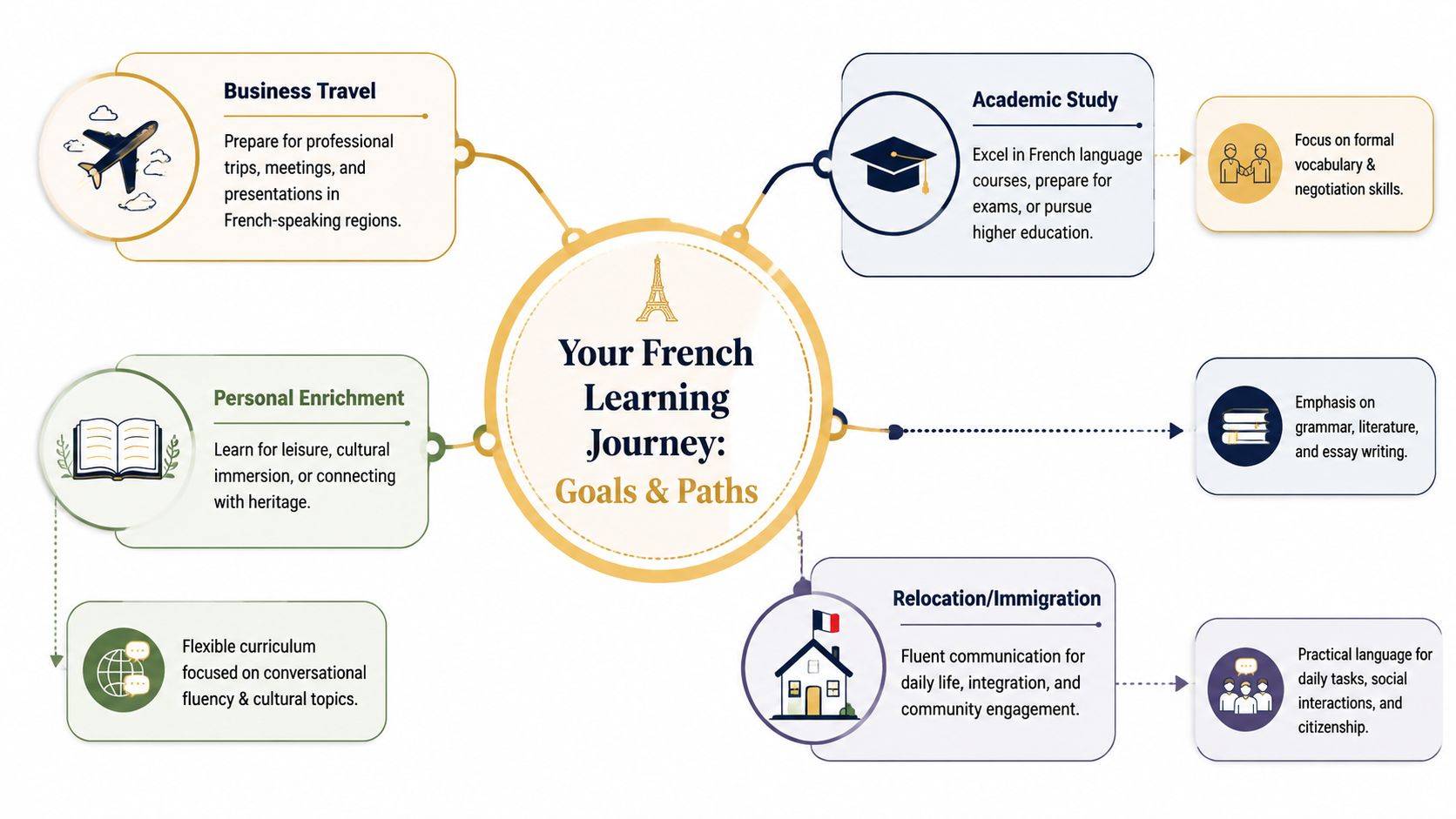
Travel and social conversation
If your main goal is travel, family connection, or cultural enjoyment, you need a path centered on usable speaking. That means short dialogues, pronunciation work, listening practice with clear correction, and a curriculum that teaches you to respond in real situations instead of reciting isolated rules.
For this kind of learner, I usually look for:
Frequent speaking time: You should spend a meaningful part of the lesson producing language, not just listening.
Controlled correction: The tutor should correct key errors without interrupting every sentence.
Practical vocabulary: Directions, meals, introductions, common past and future expressions, and social etiquette matter more than abstract grammar labels at the beginning.
A lot of adults stall because they choose an overly academic format. They learn about French more than they learn to use it.
Career, relocation, and exams
Professional, academic, and exam-driven learners need more structure. Business French, DELF preparation, school support, and relocation plans require level-based progression, stronger writing control, and more deliberate feedback loops.
Research on French immersion suggests that roughly 1,200 to 2,000 hours of sustained exposure is associated with measurable gains, and that practical tutoring should translate that into weekly communicative output, structured error correction, and periodic checks rather than unfocused grammar study, as discussed in this UBC research paper on French immersion and language progression. That doesn't mean every San Antonio learner needs an extreme schedule. It means your plan has to accumulate enough high-quality practice to move somewhere real.
Here's the buying-guide version of that principle:
If the goal is immediate functionality, choose private lessons or a very small group with a speaking-heavy plan.
If the goal is certification or academic performance, choose a teacher who works with level descriptors, writing correction, and mock assessment tasks.
If the goal is long-term fluency, choose a format you can sustain. Consistency beats enthusiasm that burns out in three weeks.
If you're not sure how your current ability maps to a progression system, this guide to CEFR French proficiency levels is a useful reference point when comparing programs.
The fastest-looking option often isn't the best option. The best option is the one you'll attend consistently and use actively.
Comparing Lesson Formats In-Person vs Online, Group vs Private
A San Antonio parent often asks one question first: “Should we find someone local, or should we just do this online?” An adult learner usually asks a different version: “Do I need private lessons, or will a group be enough?” Both questions matter, but the better question is simpler. Which format gives you enough speaking practice, correction, and consistency for your goal?
Most students are choosing between four formats: in-person group classes, private in-person tutoring, online group classes, and private online tutoring. Each one fits a different kind of learner, schedule, and budget.
Comparison of French Lesson Formats
| Format | Best For | Average Cost | Pros | Cons |
|---|---|---|---|---|
| In-person group classes | Learners who like routine and peer energy | Varies by provider | Social accountability, scheduled progression, classroom atmosphere | Less personalization, less speaking time per student, pace may be too slow or too fast |
| Private in-person tutoring | Learners who want tailored support and local face-to-face instruction | Usually higher than group classes, depending on experience and travel | Customized pacing, immediate feedback, easier to target school or career goals | Travel time, fewer scheduling options, quality varies widely by tutor |
| Online group classes | Budget-conscious learners who still want structure | Varies by provider | Convenient, no commute, shared motivation | Limited individual correction, easy to stay passive, mixed-level dynamics can be frustrating |
| Private online tutoring | Busy adults, professionals, teens, and families who need flexibility | Varies by provider | High flexibility, strong personalization, easy to fit around work and school | Requires self-discipline, screen fatigue for some learners, chemistry matters a lot |
The private market in San Antonio is more accessible than many learners expect, as noted earlier. That does not mean private lessons are automatically the right choice. A lower hourly rate can still be poor value if the lesson lacks structure, correction, or a clear plan.
That trade-off is where students often make the wrong decision.
A strong group class can outperform weak private tutoring. A strong private tutor can save months of wasted effort if you need fast progress, exam preparation, or targeted support for school and work. The format matters, but the teaching method matters more.
What usually works best by learner type
After placing and teaching hundreds of students, I see a few patterns repeatedly:
A child struggling with school French usually needs private support tied directly to classroom material, quizzes, writing assignments, and teacher expectations.
A casual adult beginner often does well in a structured group if they enjoy slower pacing, regular homework, and shared practice.
A professional learner usually gets better results from private lessons because the content needs to match meetings, travel, presentations, or client conversations.
An exam candidate needs a teacher who can correct writing, run timed tasks, and track level progression. Group or private can both work if the instruction is specific.
Online lessons deserve a more careful look than they usually get. They are not just the convenient backup option. For many adults in San Antonio, online study leads to better attendance, fewer cancellations, and more stable progress because it removes the commute and makes weekly lessons realistic. This guide to different ways to learn French online is useful if you are comparing remote options in more detail.
In-person lessons still have real advantages. Younger students often focus better in the room with a teacher. Some learners also speak more naturally face to face, especially at the beginner level. But convenience affects results. If an online format helps you show up every week and do the work, it often beats an in-person plan that keeps getting rescheduled.
Choose the format you can sustain, then judge it by what happens inside the lesson: how much you speak, how often you get corrected, and whether each session builds on the last one.
How to Vet a Tutor or School Like an Expert
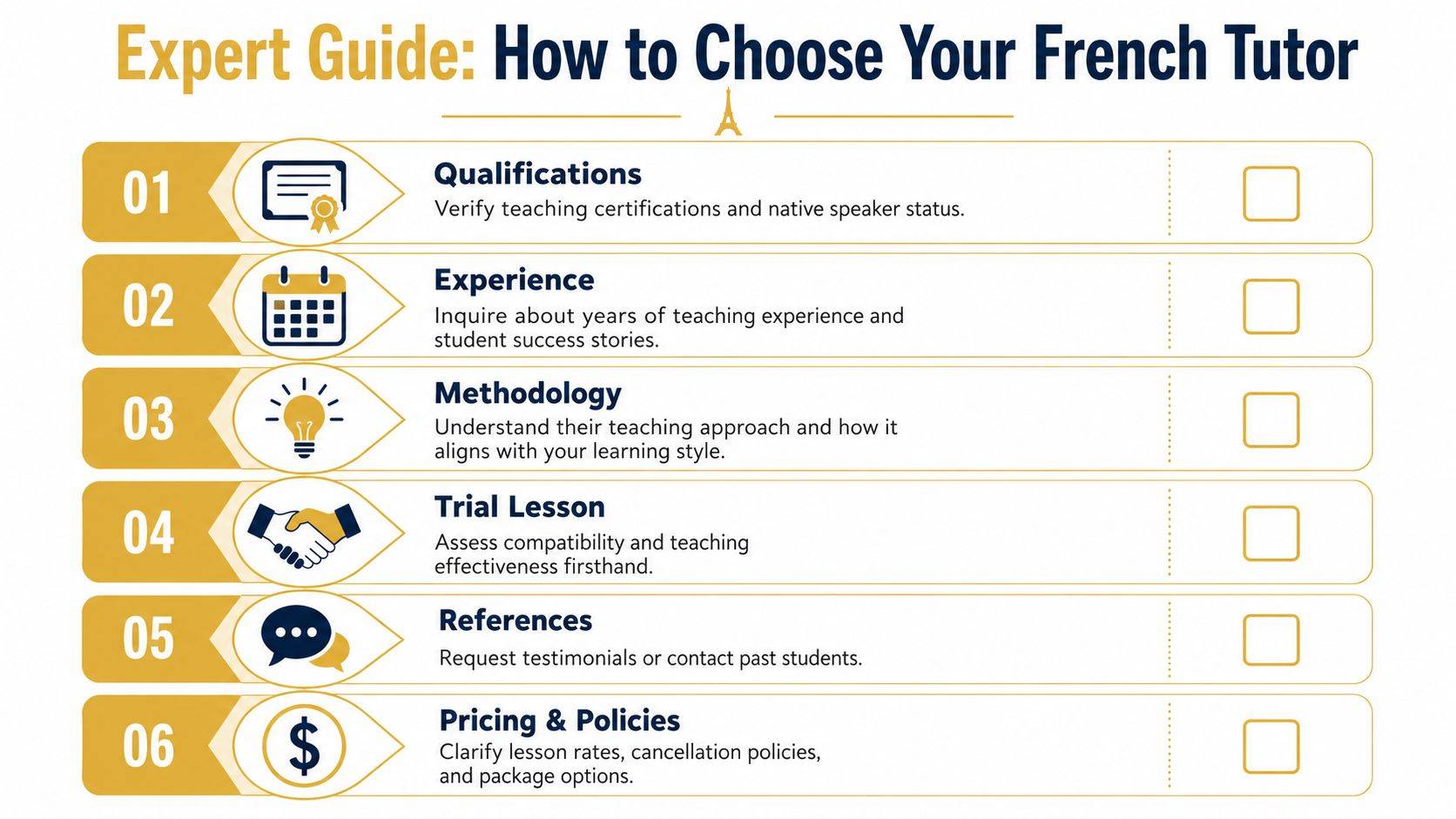
A polished site, a native accent, or a long tutor profile doesn't automatically mean the instruction is solid. The strongest providers usually make their teaching process visible. They can explain how they place students, how they correct mistakes, how they build momentum, and how they know when a learner is ready to move up.
What strong programs usually have in common
San Antonio already has evidence of structured French instruction beyond casual drop-in lessons. Some institutional-style programs offer four distinct levels with 60 hours of instruction each, plus 15-hour conversation courses, as outlined on this San Antonio French classes page. That kind of structure matters because it shows what serious language progression looks like. Levels, sequence, and speaking support are all built in.
A good tutor doesn't need to imitate a university. But they should still have a system.
Look for these signals:
Placement before promises: They ask about your level, not just your availability.
A visible method: They can describe what happens in a typical lesson and why.
Progress checks: They don't rely on “you'll feel improvement eventually.”
Skill balance: Speaking matters, but so do listening, reading, and writing when your goal requires them.
A tutor who can't explain how they teach usually ends up improvising from lesson to lesson.
Questions worth asking before you commit
Here are the questions I'd ask in any consultation:
How do you assess my level at the start?
If the answer is vague, expect vague lesson planning too.How do you correct mistakes during speaking?
Too much correction shuts learners down. Too little leaves fossilized errors in place.What materials do you use, and do you adapt them?
Good instruction rarely depends on one textbook alone.How do you track progress?
You want milestones, not just pleasant sessions.What happens between lessons?
Homework, review notes, audio practice, or targeted vocabulary work can make a huge difference.Have you taught learners with my goal?
School support, travel French, and DELF prep are not interchangeable.
If you want a useful benchmark for those questions, this resource on how adult learners can find the right French tutor reflects the kind of decision criteria worth using.
One note on provider mentions. Some services, including Elite French Tutoring, offer online private tutoring and a short virtual assessment before recommending a customized plan. That kind of intake process is usually a good sign because it puts fit before scheduling.
A San Antonio Student Success Story Meet Maria
Maria isn't a real client name, but she represents a very real type of San Antonio learner. She worked in tech, had growing contact with colleagues in Montreal, and felt embarrassed every time a French-speaking conversation drifted beyond greetings and polite phrases.
She had done what many motivated adults do first. Apps, scattered podcasts, saved vocabulary lists, and occasional bursts of study late at night. None of that had solved the actual problem. She still couldn't respond smoothly in live conversation.

Why Maria had been stuck
Maria's issue wasn't effort. It was mismatch.
Her goal was professional communication, but most of her study time had gone into isolated vocabulary and generic beginner content. She needed speaking practice tied to her work life. That meant simulated meetings, introductions, polite disagreement, clarifying questions, and clean follow-up language for emails and calls.
We also had to reduce the fear factor. Many adult learners know more French than they can comfortably produce under pressure. Until they practice retrieval in realistic settings, that hidden knowledge stays stuck.
What changed once the plan matched the goal
Her program shifted from broad study to narrow relevance. Lessons focused on work scenarios. Corrections targeted the errors most likely to affect clarity and professionalism. Homework stopped being random and started reinforcing phrases she could use immediately.
That kind of sequencing matters. Large district data on structured immersion programs shows that students in consistent, well-sequenced models can gain the equivalent of nine additional months of reading progress by eighth grade compared with nonparticipants, according to this French immersion outcomes summary from Prince George's County Public Schools. Maria wasn't in a school immersion program, of course, but the principle carried over. Structured progression beats scattered exposure.
The breakthrough often comes when the learner stops studying French in general and starts practicing the French they'll actually use.
If you like reading examples before choosing a provider, this story about a learner's path from zero to fluent offers another way to think about customized progression.
Your Checklist for a Successful Trial Lesson
A trial lesson tells you far more than a website ever will. But only if you treat it like an evaluation, not a performance. You're not trying to impress the tutor. You're trying to find out whether this person can teach you well.
Start by noticing how the session opens.

What to notice in the first few minutes
A strong trial usually includes level discovery, a little real teaching, and a practical conversation about fit. If the tutor talks the whole time about themselves, the session isn't giving you enough evidence.
Use this quick checklist during the lesson:
Did they ask about your goal clearly? A learner preparing for relocation should not get the same trial experience as a child needing homework support.
Did you speak French, even a little? You need to see how they prompt, listen, and correct.
Was the correction style helpful? You should leave feeling challenged, not shut down.
Did the lesson feel adapted? Even an introductory session should respond to your level and needs.
Could they explain the next step? Good teachers can describe what your first month would look like.
A trial should also reveal temperament. Some teachers are technically strong but too rigid. Others are warm but unfocused. You want both clarity and rapport.
Questions to ask before the trial ends
Ask directly. You're the buyer.
What would you prioritize first for me, and why?
How do you handle homework and review?
What happens if I'm busy and need a lighter week?
How do you know when I'm ready for the next level or a more advanced task?
What does a normal lesson sequence look like over time?
One final test matters more than people realize. After the trial, ask yourself whether you feel more organized than you did before. Even if your French is still basic, the path forward should feel clearer. If it doesn't, keep looking.
Frequently Asked Questions About French Lessons
How much do French lessons cost in San Antonio
For private tutoring, the clearest local benchmark comes from the San Antonio tutor marketplace noted earlier. Prices vary by tutor and format, but local listings show a broad private market rather than a single fixed rate. Group classes and specialized programs can price differently depending on structure and hours included.
Are online French lessons as effective as in-person lessons
They can be. For many adults and families, online lessons work better because scheduling is easier and attendance stays more consistent. If the teacher manages correction well and gives you active speaking time, online instruction can be very effective.
Should I choose a native speaker
Not automatically. A native speaker can be excellent, but teaching skill matters just as much. The better question is whether the tutor can diagnose your level, explain clearly, correct productively, and build lessons around your goal.
How long does it take to get conversational
It depends on your starting point, your goal, and how consistently you practice. Learners move faster when lessons include speaking output, targeted review, and realistic expectations. People move slower when they jump between resources without a plan.
Are group classes good for beginners
Sometimes, yes. They're often a good fit for learners who enjoy routine, like social energy, and don't need highly personalized feedback. If you need rapid progress, school support, or job-specific language, private lessons are usually a better fit.
What's the smartest next step
Book a trial lesson or consultation with one or two providers and compare how each one handles goal-setting, correction, and planning. That first conversation tells you a lot.
If you're comparing providers for French lessons in San Antonio, the most useful next move is to shortlist two or three options and book a trial or consultation with each. Pay close attention to structure, fit, and how clearly each provider maps your goal to an actual learning plan.