Skip to content

Yes, Americans can retire in France, but there's no dedicated retirement visa. The practical path is the VLS-TS visiteur, and the working income target is roughly €1,867.02 gross per month from June 1, 2026, with many guides putting the practical floor in the €1,800 to €1,950 range.
You're probably looking at your Social Security statement right now and wondering if it's enough. In a lot of cases, it isn't by itself, and that's the part many misunderstand before they start comparing apartments in Normandy, Brittany, or Provence. France is open to American retirees, but it's open to the ones who can document stable income, buy the right insurance, and handle the paperwork like a project instead of a fantasy.
Table of Contents
- The Short Answer for Americans Who Want to Retire in France
- Which Long-Stay Visa Route Actually Fits You
- Documents, Income Proof, and Housing You Need to Show
- Healthcare Coverage Before and After You Become a Resident
- How the U.S. and French Tax Systems Interact
- Realistic Monthly Budgets in Three Regions of France
- A Realistic Timeline From First Google Search to Year Two Renewal
- Your Twelve-Month Action Plan and How to Get French Ready
The Short Answer for Americans Who Want to Retire in France
Yes, Americans can retire in France, and the usual route is the long-stay visitor visa, the VLS-TS visiteur, not a special retirement visa. French consulates issue it for 12 months and renew it annually, so you need to treat the visa as a rolling file, not a one-time win. The consulate with jurisdiction over your U.S. address decides the case, and the file usually turns on four things, income, private health insurance, housing, and a clean administrative record. France's expat-tax guidance says applicants must show stable income, private health insurance, and proof of housing, with one 2026 guide citing an income benchmark of about €1,867.02 gross per month from June 1, 2026, while similar guides place the floor around €1,800 to €1,950 per month. Taxes for Expats France guide
The practical yes, no, or yes with a workaround
If your income is clearly above the floor and the paper trail is clean, you are a likely yes. If you are leaning on savings but cannot show regular monthly income, you are a probably no until you present the file correctly. If your monthly income comes up short but you qualify through a spouse, partner, or adult EU family tie, you may still be a yes with a workaround.
Practical rule: French consulates care less about how comfortable you feel and more about whether your file shows you can live in France without local work.
The next reality check is the money side. The average Social Security benefit for a 67-year-old American was $1,783.55 per month in 2023, which sits near the visa floor but can still miss it once exchange rates and housing costs hit your budget. That is why many Americans retire in France with a mix of Social Security, pensions, savings, or investment income rather than Social Security alone. A couple should also plan their monthly budget before they file, because the visa number and the cost of living are not the same thing.
If your file needs language proof for a later step, use a French language certification guide and get it handled early instead of waiting until the consulate asks for a clean answer.
Which Long-Stay Visa Route Actually Fits You
Not every American retiree should be looking at the same category. The biggest mistake I see is people copying a friend's visa path when their family structure is different, then wondering why the consulate keeps pushing back. France gives you a few realistic long-stay routes, but only one of them is usually right for a solo retiree with outside income.
Comparing the main long-stay routes for U.S. retirees
| Visa Route | Core Requirement | Best Fit For | Main Watch-Out |
|---|---|---|---|
| VLS-TS visiteur | Stable income, private insurance, housing, no work in France | Retirees living on pensions, Social Security, savings, or investments | The file fails if income is irregular or only shown as a balance |
| Spouse or partner of a French citizen | Family relationship, civil-status proof, French admin file | Americans married to or partnered with a French national | Civil paperwork has to be clean, translated, and consistent |
| Family route through an adult EU family member | Eligible EU family connection and residence logic | Americans whose legal residence follows an EU family member | The relationship and dependency rules are where cases get delayed |
The visitor route is the cleanest path for most retirees because it matches the way consulates think. They're looking for people who can support themselves without French employment, and they want proof that your housing and insurance are already lined up. If you're not in that lane, forcing the visitor route usually just creates friction.
For anyone planning to stay long term and wanting to build French fluency before and after arrival, I'd also look at French language certification support early, because language confidence helps with banks, landlords, and future renewals. It doesn't replace visa eligibility, but it does reduce the administrative drag that eats people alive in year one.
How I'd choose in real life
If you're single, retired, and living on predictable income, ask about the visitor visa. If you're married to a French citizen, go straight down that family track and stop trying to fit yourself into a retiree template. If you're relying on an adult EU family member, get specific legal advice before you assemble the dossier, because this is the least forgiving route.
If your file depends on explaining a complicated family situation, make the consulate do less interpreting, not more.
The consulate wants the cleanest category that matches your actual life. Pick the one that fits your documents, not the one that sounds easiest on a blog.
Documents, Income Proof, and Housing You Need to Show
The consulate file is boring, and boring wins. If you show up with a pile of statements that only prove you have money somewhere, you'll be asked to prove it again in a different format, and that's where applicants lose time. The French process rewards documented regularity, not vague comfort.
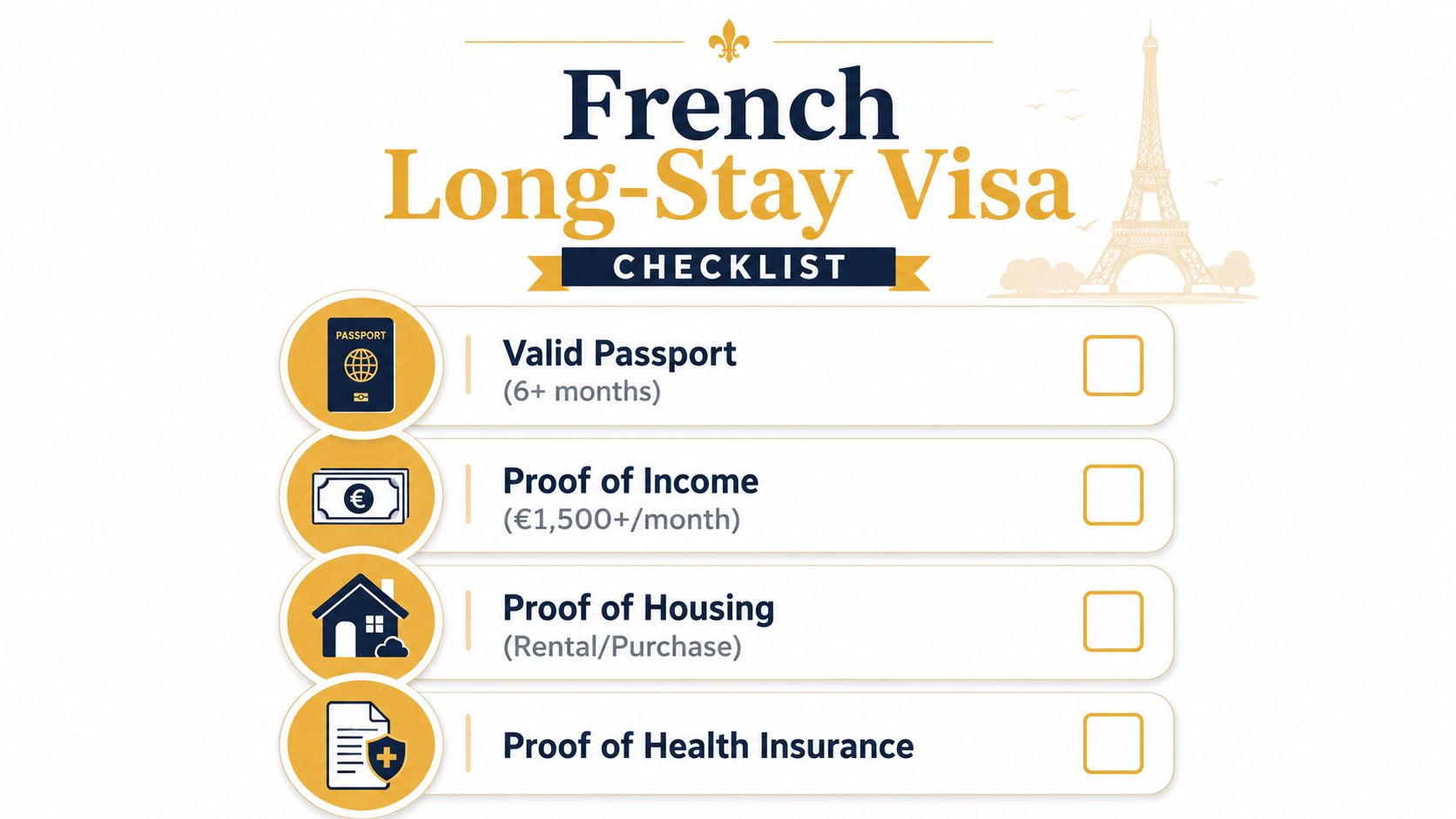
What the consulate actually wants to see
Start with the passport. It has to be valid for the entire visa period, and in practice you should treat six months of validity beyond your planned stay as the minimum to protect yourself from a dumb delay. Then come the visa form, proof of income for the last twelve months, private health insurance, and proof of housing. That housing proof can be a lease, a deed, or a notarized letter from a host.
The income file should show monthly deposits or distributions, not just one giant balance on a brokerage page. If you're living off Social Security, pensions, or retirement withdrawals, the consulate wants to see the flow. If you're using investments, the file is much stronger when it shows a predictable withdrawal pattern rather than a screenshot of net worth.
The mistakes that trigger avoidable refusals
A lot of Americans upload bank statements that prove they're wealthy but not that they're receiving income. That's the wrong question, and the consulate knows it. Another common mistake is buying health insurance that sounds international but doesn't clearly show France coverage and the required medical benefits in a way the consulate can review quickly.
You also need a housing story that makes sense. If you're saying you'll live in France, but you don't have a lease, a purchase plan, or a host letter, the dossier feels unfinished. Bureaucrats don't like unfinished.
Rule of thumb: if a document only proves intent, it's weak. If it proves an actual arrangement, it's useful.
The exact visa platform and appointment process changes by jurisdiction, so you should apply through your local consulate's instructions and keep your file consistent from the first upload to the appointment. That consistency is often the difference between a clean approval and a request for more paperwork.
Simple checklist before your appointment
- Passport: Make sure the validity covers the stay.
- Income proof: Bring clear monthly evidence, not just balances.
- Housing: Include a lease, deed, or host letter.
- Insurance: Show a policy that explicitly covers France.
- Fee: Bring the consular payment in the form they request.
If you want a practical reset before you book the appointment, print this list and check off every line by hand. That's still one of the best ways to catch the stupid little omissions that derail good applications.
Healthcare Coverage Before and After You Become a Resident
Healthcare is where people panic for no reason, then make a bad decision for a real reason. The clean way to think about it is in two phases, the year-one visa period and the post-residency period. If you blur those together, you'll cancel the wrong policy too early and create a gap you can't afford.

What you need before you're resident
Before you become a French resident, you're expected to carry private health insurance that satisfies Schengen and consular requirements. The brief here is simple, you need policy language that clearly covers France, and the coverage is commonly described at roughly €30,000 for visa purposes in the guidance that Americans use when they file. The policy should not just sound broad, it should state the territory and the inpatient care terms in a way the consulate can verify.
Medicare is not your French solution. If you're thinking of flying over and letting U.S. coverage float in the background, stop there. That is not how France works, and it's not how the visa file works either.
What changes after you've settled
Once you validate your visa and establish residency, you can usually move toward PUMA, France's public health system, and most retirees then add a mutuelle to cover the portion the state doesn't reimburse. That's the normal French pattern, and it's the one I'd plan for if you're serious about staying. Don't cancel private coverage until your French rights are confirmed in writing.
On the U.S. side, Medicare still needs a decision. If you expect regular U.S. healthcare trips, keeping Part B may make sense. If you'll live mainly in France, some retirees choose to suspend it, but that's a personal Medicare decision you should make before departure, not after your paperwork is already in motion.
A cultural note that matters more than people admit
French healthcare operates with its own expectations around documentation, appointments, and follow-up. If you're the kind of person who likes to argue with systems, France is not the place to improvise. The smoother your paperwork and your French communication, the less friction you'll get from doctors, insurers, and administrators. A solid primer on that mindset shift is worth reading alongside your relocation prep, especially if you're used to U.S. service norms. French and American culture differences for relocators
How the U.S. and French Tax Systems Interact
Tax is the part that scares smart people the most, mostly because they think the treaty will magically do the paperwork for them. It won't. You'll almost certainly file in both countries in your first year, and the right approach is to understand which income is taxed where, then use the treaty tools that keep you from paying twice.
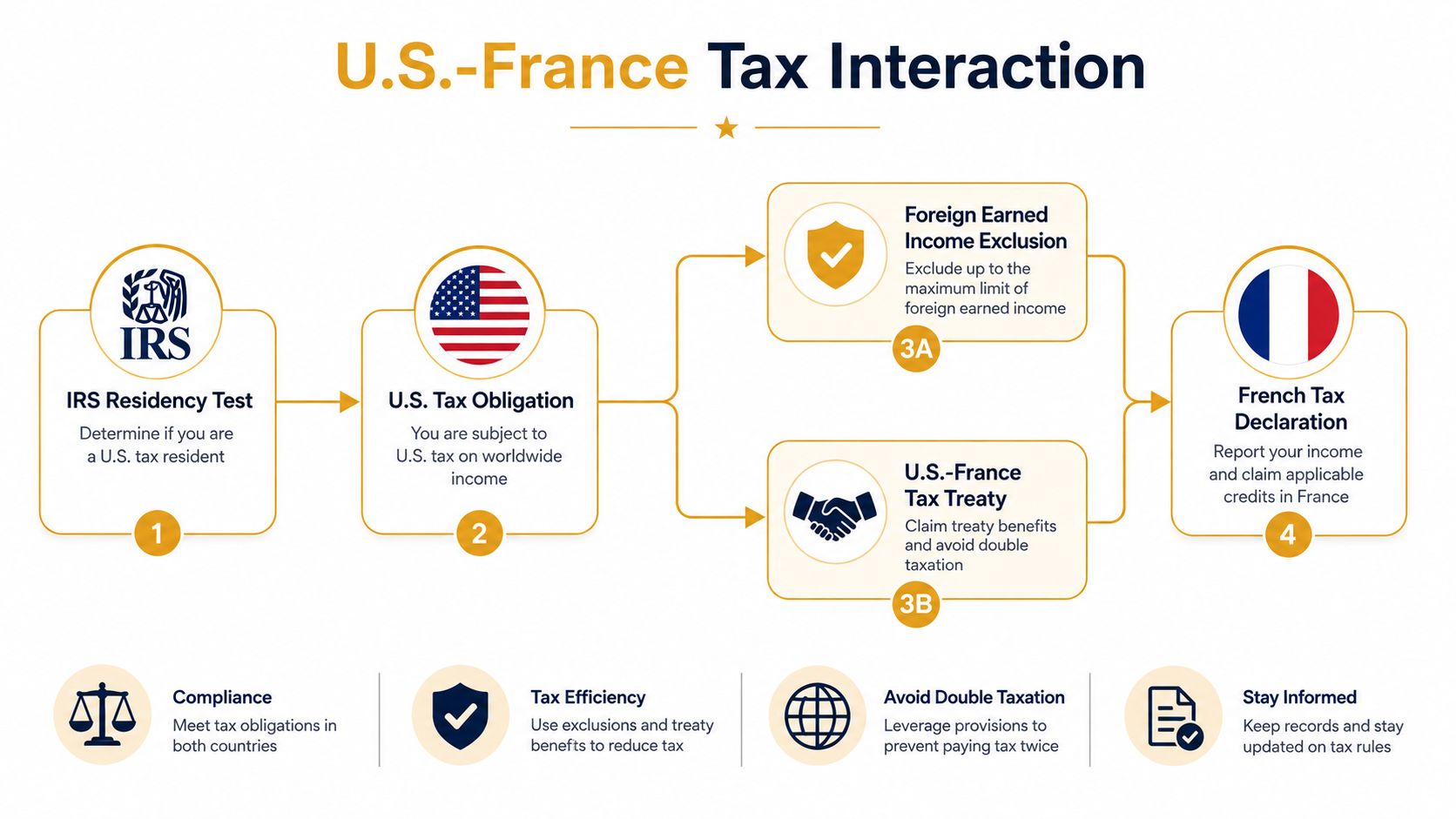
The U.S. side doesn't disappear
If you're a U.S. citizen, the IRS still wants your return even after you move to France. That's the starting point, not the ending point. The good news is that the U.S. system gives you tools like the Foreign Earned Income Exclusion and the Foreign Tax Credit, and those can keep your U.S. bill manageable if your income mix fits.
The practical issue for retirees is that the FEIE is designed around earned income, so it's not the magic answer people hope it is. If your retirement income is mostly pensions, Social Security, or withdrawals, the Foreign Tax Credit and treaty treatment matter more.
The French side kicks in when your home moves
France treats you as a French tax resident once your main home is there, and at that point your French filing obligations begin. The French system taxes worldwide income, then applies treaty rules and credits where needed to avoid double taxation. That means you may owe French income tax on some streams, while other streams are handled differently under the treaty.
The important part is not to assume that because the money came from the U.S., France ignores it. It often doesn't. The right move is to map each income source before you land, not after you're already sitting on a French tax return deadline.
What I tell retirees to do
- File both returns early: Don't wait until one country reminds you.
- Keep every income stream documented: Pensions, distributions, and bank deposits should all line up.
- Treat the first year as a cross-border setup year: This is when the mistakes happen.
- Use a real cross-border tax professional: This is not the year to wing it.
The treaty helps, but it's not a shortcut around filings. If you want the cleanest retirement life in France, handle tax like an administrative project and keep the records from day one.
Realistic Monthly Budgets in Three Regions of France
Your visa stress drops or explodes based on where you live. Paris-adjacent life and a practical small-town life are not even close to the same budget reality, and pretending they are is how people overcommit in month one. If you're retired, you want the place that fits your income, not the place that flatters your imagination.
Sample monthly budgets for a retired couple in France
| Expense Line | Medium City | Small Town | Coastal / Rural |
|---|---|---|---|
| Rent | Higher than a small town, lower than Paris | Lower, often the biggest advantage | Can vary widely by season and demand |
| Utilities | Moderate | Moderate to lower | Moderate |
| Food | Moderate | Moderate | Moderate |
| Transport | Moderate | Lower if you drive less | Lower to moderate |
| Healthcare | Similar baseline | Similar baseline | Similar baseline |
| Leisure | Comfortable, but disciplined | Comfortable and easier to control | Comfortable if you avoid tourist pricing |
| Furnishing and deposit | Expect a meaningful upfront hit | Usually easier to manage | Often easier, but still real |
How to read the table like a retiree, not a tourist
A medium city gives you decent access without the full Paris penalty. A small town gives you better breathing room, and that's where Social Security plus a modest supplement often works best. Coastal and rural areas can look cheaper at first glance, but I'd still watch for seasonal pricing and the hidden cost of needing a car more often.
The deposit and first-year furnishing cost are the silent budget killers. If you're renting long term, plan for two to three months of rent on top of the move itself, because French landlords and apartment setups don't magically come furnished to your American expectations. That upfront cash matters just as much as your monthly income.
If you're still comparing where to land, a practical travel-style scouting trip can save you from a bad choice. A well-structured trip through candidate towns is usually a better decision tool than reading another generic list of “best places to retire.” French travel itinerary planning support
My blunt recommendation
If your income is tight, skip prestige and choose a smaller town where your rent and daily life stay calm. If you have more flexibility, a medium city gives you easier admin, decent medical access, and a better long-term rhythm. Don't choose a place because it photographs well, choose it because you can live there without financial anxiety.
A Realistic Timeline From First Google Search to Year Two Renewal
A smooth move to France doesn't happen in one leap. It happens through a sequence of ordinary tasks that add up to a settled life, and the people who do best are the ones who stop treating the move like a dream and start treating it like a calendar. Here's how one representative retiree path looks when the moving parts stay in order.
The first year in practice
A 64-year-old from Ohio decides on Normandy and starts with the consulate file, not with apartment hunting. He gets the visa approved, lands in France, and does the OFII validation early instead of letting the clock run. That's the right instinct, because the first month is when momentum matters.
Then French life starts. He opens a bank account, gets a French phone number, and learns that some landlords and banks move faster when his documents are already translated and consistent. He also discovers the one thing no one warns Americans about enough, temporary setups are expensive and annoying, and every delay creates more of both.
What usually trips people up
The common frustration isn't dramatic. It's annoying, repetitive, and very French. A bank may want a French phone number before it opens the account cleanly. A long-term rental may involve fees and paperwork that feel heavier than expected. The renewal reminder arrives before you've mentally shifted from “new arrival” to “resident,” and that's exactly when people get sloppy.
The retirees who settle best are the ones who respect the order of operations, not the ones who try to speedrun it.
By the time year two rolls around, the people who planned properly have a working address, active healthcare coverage, and a renewal track that doesn't feel mysterious. The people who skipped steps spend that second year fixing the omissions they should've handled in month one.
The order that saves the most stress
- Visa first: Get the right category before you land.
- OFII early: Don't let the validation clock drift.
- Housing and utilities next: That proof of address is key to the next layer.
- Healthcare registration after residence is documented: France wants sequence, not improvisation.
- Renewal prep before expiry: The annual cycle is easier when you aren't late.
That Ohio-to-Normandy path is realistic precisely because it's not glamorous. It's paperwork, timing, and patience, then a normal life in France that feels boring in the best way.
Your Twelve-Month Action Plan and How to Get French Ready
Start twelve months out if you want this to be calm. At month twelve, choose your region and make the income decision. At month eight, book the consulate appointment window and gather the translated civil documents. At month eleven, fly with a clean file, and in month twelve, handle the OFII visit as soon as you can. If you want French to stop feeling like a barrier when you land, use our structured French study plan before the move, not after.
The three refusal triggers I see most are weak income proof, bad insurance language, and incomplete housing evidence. Fixing them means either reorganizing the file, buying the right policy, or securing the lease or host letter that closes the loop. Don't wait until the appointment to discover the gap.
If you want a move that feels controlled instead of chaotic, book a free 20-minute consultation with Elite French Tutoring and get a French prep plan that fits your timeline before the moving truck leaves.