Skip to content

You're probably in the same position as many others who search for French lessons in Toronto. You've opened six tabs, every tutor sounds “personalized,” every school says it gets results, and you still can't tell which option fits your life.
I've seen this problem for years. The mistake isn't choosing French lessons too late. It's choosing them too vaguely. If you're a parent with a child in French immersion, a professional who needs workplace French, or an adult who wants a tutor who won't waste time, the right choice looks very different in each case. Generic providers miss that. Good decisions start with matching the format, teacher, and curriculum to the reason you need French in the first place.
Table of Contents
Why Finding the Right French Lessons in Toronto Feels So Hard
Choosing Your Learning Format In Person Online or Group Classes
Why Finding the Right French Lessons in Toronto Feels So Hard
The overwhelm is real. Toronto doesn't have a shortage of tutoring options. It has too many. In fact, Toronto alone hosts 1,468 organizations offering some type of tutoring service as of October 2021, according to the Family Service Toronto evidence review on tutoring. If you want a more personalized path, Elite French Tutoring offers private online French lessons built around your goals and schedule.
That number explains why searching for French lessons in Toronto feels messy. You're not picking from a small, curated group. You're trying to sort through a crowded market where conversation tutors, homework helpers, exam coaches, and language schools all compete for the same search terms.
Most people search by location first and goal second
That's backwards.
When people type “French tutor Toronto” or “private French lessons near me,” they often start by filtering for convenience. Downtown. North York. Online. Weekends. That matters, but it shouldn't be your first filter. Your first filter should be the outcome you need.
A parent at a bilingual school needs curriculum-aligned support. A professional preparing for a government interview needs structured speaking correction. An adult learner planning travel may just need confidence and consistency.
Practical rule: Don't ask, “Who's the best French tutor in Toronto?” Ask, “Who's best for my exact use case?”
Generic tutoring creates expensive frustration
I'm direct about this because I've watched people lose months to the wrong setup.
A friendly native speaker isn't automatically the right teacher. A big language school isn't automatically the right fit. A low hourly rate isn't a bargain if the tutor drifts through lessons with no plan.
Here's what usually causes frustration:
Unclear goals: You say you want to “improve French,” but the tutor doesn't know whether to focus on speaking, school support, or exam tasks.
Wrong format: You sign up for a group class when you need correction-heavy private coaching.
Poor specialization: The tutor can chat well in French but can't support a child's school curriculum or a professional communication goal.
Scheduling mismatch: The program looks good on paper, but it doesn't fit your work hours, commute, or family routine.
The right tutor is specific, not universal
I don't believe in a single best option for everyone. I believe in fit.
Some Toronto learners need online flexibility because commuting across the city for a weekday lesson is unrealistic. Some need private sessions because they're working toward a narrow target. Others do better in a group because accountability matters more than speed.
That's why the smartest way to shop for French lessons in Toronto is to narrow the field fast. Define your goal. Choose the right format. Vet the tutor properly. Then compare price and scheduling.
Do that, and the market stops feeling chaotic.
Before You Book Anything Define Your French Learning Goal
A vague goal gives you vague lessons. That's where people get stuck.
If you tell a tutor you “want to get better at French,” you'll often end up with generic worksheets, loose conversation, and slow progress. If you say, “My daughter is in a Toronto French immersion program and needs help with school vocabulary, reading responses, and oral presentations,” the tutor can build something useful from day one.

Career goals need a different tutor than school support
For many adults, French is a career decision. That's not just a nice idea. Bilingual individuals in North America, especially those proficient in French and English, earn on average 10–15% more than their monolingual counterparts, based on the cited source in this discussion of bilingual wage advantage.
If your goal is professional advancement, don't hire a tutor who mainly teaches children. You need someone who can handle role-play, formal speaking, presentation language, and structured correction. The same goes for learners preparing for official proficiency milestones. If that's your lane, it helps to understand the CEFR French proficiency levels from beginner to advanced before you buy a package.
One real success story proves the point
One family I worked with had a Grade 7 student in a Toronto French school who was slipping. The parents did what most families do first. They hired a general French tutor.
It didn't work.
The tutor was pleasant, but the lessons had nothing to do with the student's reading assignments, writing expectations, or oral tasks at school. Once the support shifted to the actual class material, things changed. Homework stopped being a nightly fight, and the student's confidence came back because the tutoring finally matched the problem.
That's the pattern I want you to notice. Better results usually come from sharper alignment, not more hours.
Pick the lane before you compare providers
These are the most common buying paths I see in Toronto:
Parents in French immersion or bilingual schools: You need homework support, writing help, and curriculum vocabulary. Skip generic conversation lessons.
Professionals: You need business French, interview prep, or confident workplace speaking. Choose tutors who can run targeted scenarios.
Exam candidates: You need structured prep and feedback tied to the exam format.
Adults learning for life or travel: You need consistency, motivation, and practical speaking practice, not academic overload.
If your goal fits in one sentence, your tutor search gets easier immediately.
Write your goal in plain language before you book anything. Not “learn French.” Write a specific version. “Support my child at Lycée Français.” “Prepare for a bilingual interview.” “Speak confidently with Quebec clients.” “Get structured weekly conversation practice.”
That sentence is your filter. Use it.
Choosing Your Learning Format In Person Online or Group Classes
Format changes everything. A strong teacher in the wrong format can still be a bad choice.
The Toronto market now gives you three practical paths. In-person lessons, online private lessons, and group classes. Each can work. Each can also waste your time if it doesn't fit your routine and target.
The shift toward online learning isn't theoretical anymore. The global online tutoring market was valued at over $53 billion USD in 2021 and is projected to exceed $90 billion by 2030, according to this online tutoring market summary. That projection matters because it reflects how many learners now prioritize flexibility and access over location alone.
French Lesson Formats in Toronto What's Best for You?
| Format | Best For | Average Cost (Per Hour) | Flexibility | Key Benefit |
|---|---|---|---|---|
| In-person private | Learners who want face-to-face accountability and local sessions | Qualitatively, often higher than entry-level online options | Moderate | Strong personal connection and focused attention |
| Online private | Busy professionals, remote learners, families with tight schedules | Qualitatively, ranges from entry-level to premium depending on specialization | High | Easy scheduling and access to specialized tutors |
| Group classes | Social learners and students who want a shared class environment | Qualitatively, often more cost-efficient per learner | Low to Moderate | Built-in structure and peer motivation |
In-person works best when proximity is realistic
I like in-person lessons for younger students, some beginners, and learners who stay more accountable when they physically show up.
But this only works if the logistics are clean. If you live in Midtown and your class is across the city on a weekday evening, the program becomes harder to sustain than it should be. Toronto traffic and transit don't care how motivated you are.
Online private lessons are often the best commercial choice
For many adults and families, online private tutoring is the strongest option. It cuts out travel, opens up more scheduling windows, and gives you access to tutors with narrow expertise.
A professional in the Financial District can fit a lesson into a lunch break. A family can schedule after school without adding another commute. A teen can get targeted help before an oral presentation from home.
If you're comparing options, this guide to top ways to learn French online effectively is useful because it helps separate convenience from actual quality.
Group classes are fine, but only for the right learner
Group classes can be great for steady learners who enjoy social energy and don't need heavily customized correction.
They're weaker when your needs are narrow. If you need help with a bilingual school syllabus, a government interview, or a specific speaking barrier, group pacing usually gets in the way. You spend too much time waiting for the class, and not enough time fixing your own problem.
Choose the format that removes friction from your week. The best program is the one you'll actually attend consistently.
My bias is simple. If your goal is specialized and your schedule is busy, private online tutoring usually wins. If your goal is broad and you like a classroom atmosphere, group lessons can be enough. If you value face-to-face contact and can keep the commute simple, in-person still has a place.
How to Vet a French Tutor Like an Expert
Most tutor profiles are marketing. You need a filter.
You're not buying a pleasant accent or a polished bio. You're buying outcomes, structure, and fit. That means asking better questions than most buyers ask.
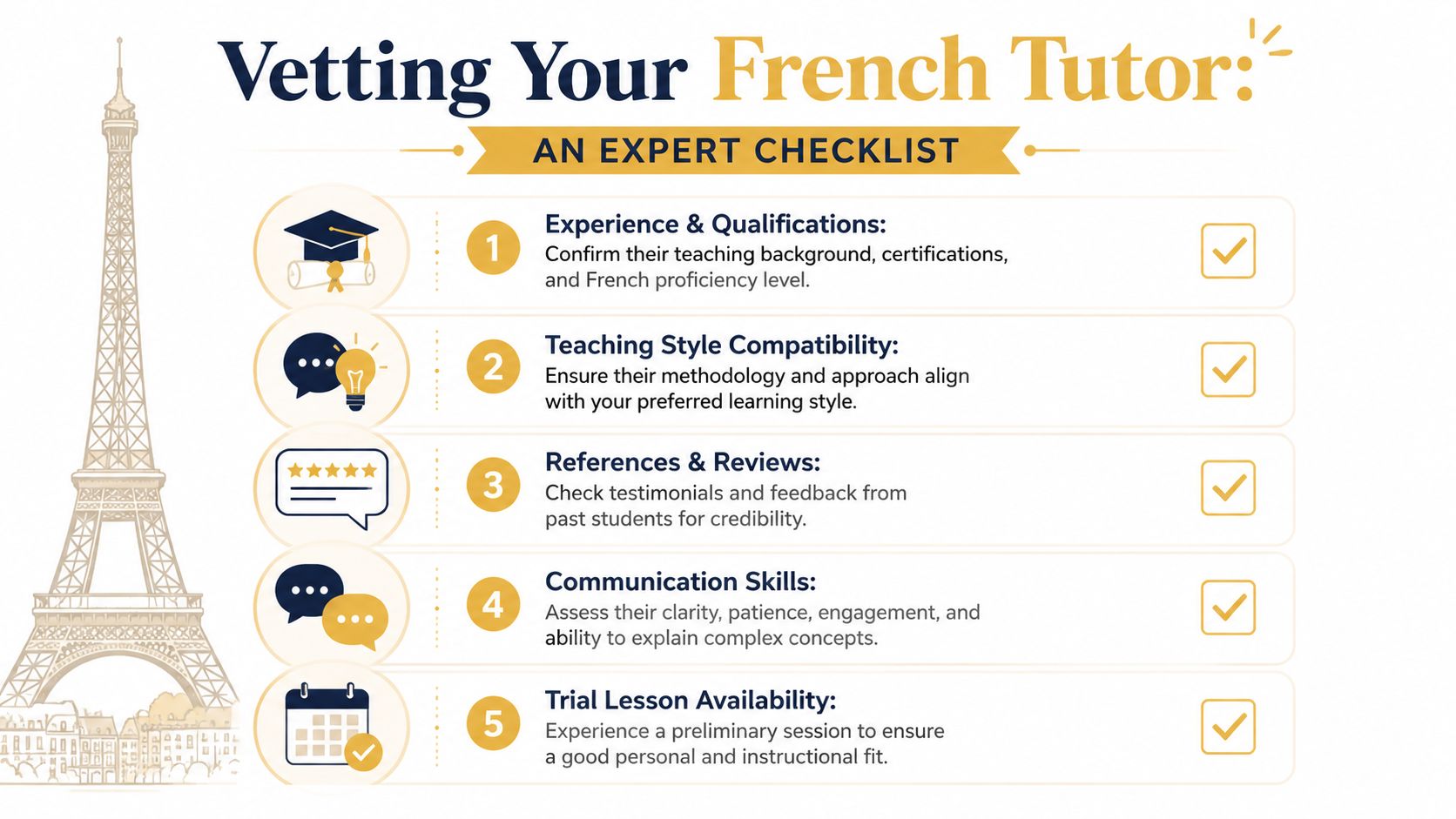
Check for goal-specific experience
This is the first screen.
If your child attends a bilingual school, ask whether the tutor has worked with school-based writing, reading comprehension, and presentation support. If you're preparing for an exam, ask how they structure timed practice and correction. If you need workplace French, ask for examples of role-play they use with professionals.
General fluency isn't enough. Relevant teaching experience matters more.
Ask how they assess level and build a plan
Strong tutors don't start blindly. They diagnose first.
The best programs tend to use placement, clear level benchmarks, and customized feedback. That's one reason expert-led, placement-tested, CEFR-aligned tutoring stands out. According to Elite French Tutoring's course overview, 98% of students in elite tutoring programs achieve A/A grades when following customized, feedback-rich curricula*.
That doesn't mean every premium tutor is excellent. It means structured personalization matters.
Use this short checklist in every consultation
Qualifications: Ask about teaching credentials, formal study, and whether they've taught your age group or use case.
Method: Ask what happens in a typical lesson. If the answer is fuzzy, that's a warning sign.
Correction style: Some tutors interrupt too much. Others barely correct at all. You need a balance that helps you improve without freezing up.
Materials: Ask whether they create custom resources or just pull random exercises from the internet.
Progress tracking: You should know how the tutor measures improvement.
If you want a sharper shortlist, I recommend reviewing these practical tips for finding the perfect French tutor as an adult learner.
Always take the trial seriously
A trial lesson isn't a formality. It's your test drive.
Watch for these signals:
Clarity: Do they explain mistakes well?
Presence: Do they listen, or do they dominate the lesson?
Adaptability: Do they shift based on your level, or force a canned plan?
Momentum: Do you leave knowing exactly what you worked on?
A good tutor should make you feel challenged, understood, and clear on the next step.
If the trial feels vague, charming but unfocused, or mismatched to your goal, move on. Toronto has too many options to settle for a tutor who “might work.”
What to Expect for French Lesson Pricing and Scheduling
Let's talk money without the usual fluff.
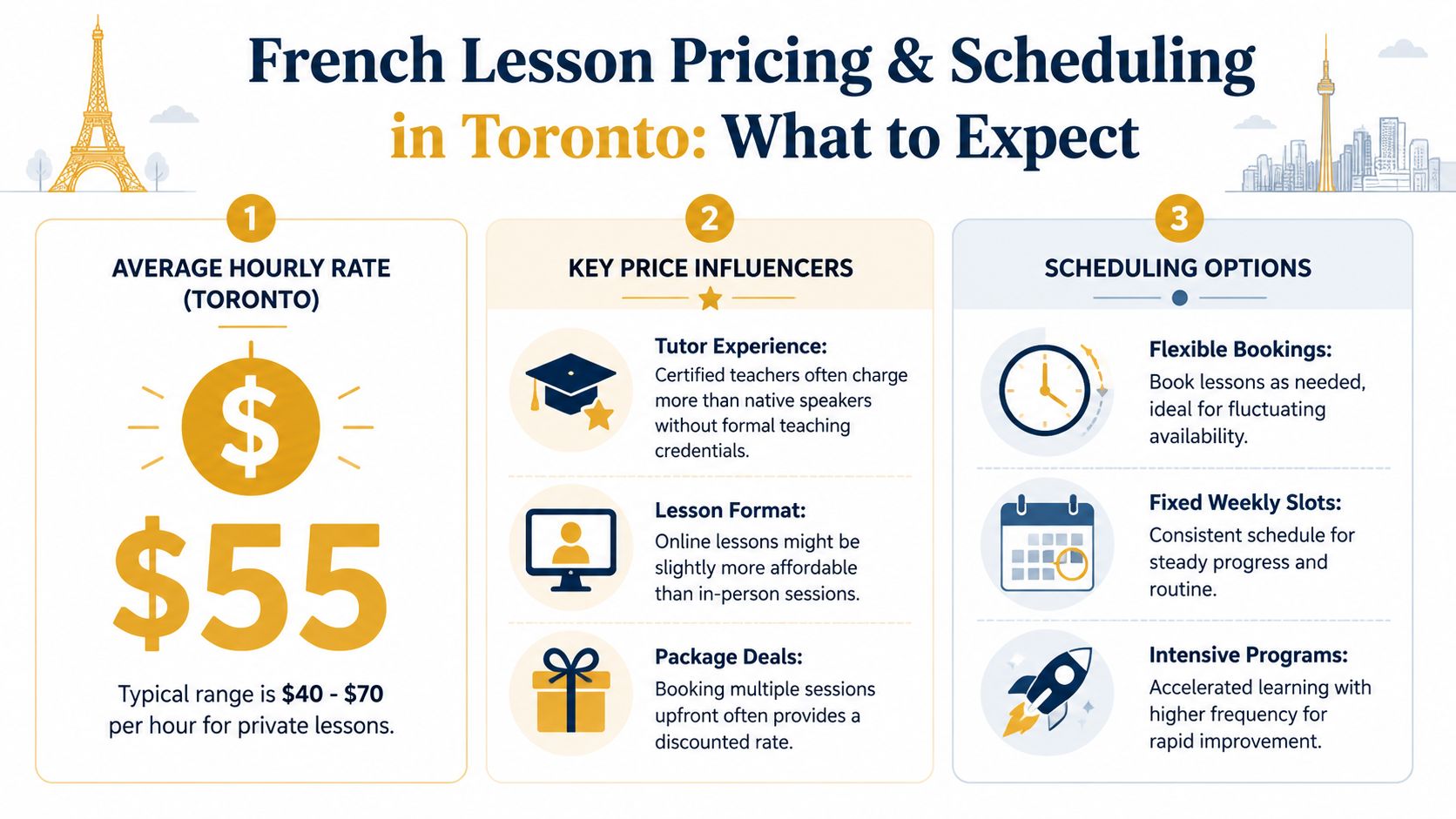
Pricing for French lessons in Toronto varies because the market includes everyone from entry-level conversation tutors to experienced specialists. Cheap isn't always bad. Expensive isn't always good. But price usually tells you something about specialization, preparation, and consistency.
What the market looks like
At the entry end, private French tutoring in Toronto is available through platforms like TUTOROO at a base rate of C$22 per hour, as shown on TUTOROO's Toronto French tutor listings.
In the more standardized local tutoring market, one-on-one French lessons range between $25 and $35 per hour, with premium TEF-focused programs using structured long-term roadmaps, according to this Toronto TEF French class pricing page.
For more experienced in-person tutors, the pricing tier rises. Part-time senior French tutor positions in the Greater Toronto Area can offer $35 to $50 CAD per hour, based on Indeed listings for French tutoring roles in Toronto.
What you're actually paying for
The tutor's hourly rate reflects more than live time on Zoom or at a table.
You're paying for:
Specialization: School support, exam prep, and professional French cost more because they require more precision.
Preparation: Strong tutors plan lessons, review work, and adapt materials.
Efficiency: A better tutor often gets you to the goal with less wasted time.
Reliability: Scheduling discipline, communication, and progress tracking matter.
I'd also keep one benchmark in mind. A Canadian middle school French teacher named Sarah built an online tutoring business serving Ontario students and generated over $5,000 CAD monthly, as shared in this video about her tutoring business. I mention that because it shows there is real paying demand in this market, especially for tutors who solve a clear problem well.
How often should you schedule lessons
Consistency beats intensity that you can't sustain.
For most learners, the best schedule is the one that survives a busy month. A fixed weekly slot often works better than constantly rebooking. Parents benefit from predictable after-school times. Professionals benefit from recurring early morning, lunch, or evening sessions.
If you're comparing delivery models across age groups, this guide on finding the best online French classes for kids, teens, and adults can help you match scheduling style to learner type.
Don't buy the biggest package first. Buy enough lessons to confirm the tutor, routine, and teaching style fit your life.
My advice is simple. Pay for clarity, not hype. Choose a tutor whose rate matches a visible skill set, and lock in a schedule you can keep.
How We Make Your French Learning Journey Successful
Learners don't need more options. They need the right match.
That's why our approach starts with the same standard I've argued for throughout this guide. We don't push one-size-fits-all lessons, because one-size-fits-all is exactly what wastes time in a city with so many choices. We start by listening carefully to your real goal, then we build around it.

We match the tutor to the outcome
If your child needs support tied to a bilingual school curriculum, we focus on academic alignment. If you need business French or speaking confidence for work, we pair you with an instructor who can build lessons around professional communication. If your goal is an exam or a formal proficiency target, we keep the sessions structured and measurable.
That matching piece is where many providers fall short. They sell “French lessons Toronto” as a broad service. We treat it as a placement decision.
Flexible online delivery matters for Toronto learners
Toronto schedules are packed. Parents juggle school, activities, and homework. Professionals protect every hour in the day. That's why flexible online instruction works so well for many of our clients. It removes the commute and makes consistency more realistic.
We also begin with a free 20-minute consultation, which gives us enough time to understand your goals, level, and preferred learning style before recommending anything.
Personalized lessons keep momentum high
A personalized curriculum changes the experience. Students stay engaged because the material feels relevant. Parents feel the difference when lessons connect directly to school expectations. Adult learners notice it when conversation practice finally sounds like the situations they encounter.
If you're ready to stop comparing random options and start narrowing in on the right fit, I'd suggest taking the next practical step. You can book a free consultation with Elite French Tutoring and see whether a customized program makes sense for your goals.
If you're shopping for French lessons in Toronto, don't buy based on proximity or promises alone. Buy based on fit. Match the tutor to the exact reason you need French, compare formats carefully, and choose a schedule you can maintain. That's how smart learners avoid wasted months and start making real progress.