You're probably doing what many others do when they search for French courses online in Canada. You open ten tabs, compare prices that don't seem comparable, see one platform promising flexibility, another promising certification, and a government program that sounds free but doesn't clearly say whether you can even join.
I've coached enough learners to tell you the hard truth. The wrong course type will waste months, even if the teacher is good and the platform looks polished. What matters is fit. If you need TEF results for immigration, a generic conversation class is the wrong buy. If you want workplace bilingual confidence, a rigid academic program can slow you down. If your child is drowning in French immersion homework, a large adult group class won't fix the underlying problem.
That's why I don't rank courses by hype. I match them to outcomes. Canada has a huge French-learning base, and that's one reason the market is so crowded. The Government of Canada reports that nearly 1.7 million young Canadians study French as a second language, and almost 10.7 million Canadians can carry on a conversation in French, which shows how broad the need is across the country, not just in Quebec (Government of Canada facts on Canadian Francophonie).
Table of Contents
- Finding Your Perfect French Course in Canada
- Comparing Your Main Online French Course Options
- How to Choose a Course for Your Specific Goal
- How Personalized Tutoring Unlocks Confidence
- Costs Accreditation and Free Government Programs
- Your Next Steps to Start Learning French
- Frequently Asked Questions
Finding Your Perfect French Course in Canada
What's needed isn't more options. It's a sharper filter.
I recently spoke with a learner who had narrowed her search to a university continuing education program, a tutoring marketplace, a TEF prep class, and a free newcomer course. On paper, all four looked reasonable. In reality, only one fit her goal. She needed French for a federal job competition, not academic enrichment, not immigration paperwork, and not casual conversation.
That mismatch is where buyers get stuck. They compare course brands when they should compare course types.
The first question I ask every student
I ask one thing before we discuss teachers, schedules, or price:
What do you need French to do for you in Canada?
That answer changes everything.
A learner preparing for a federal government profile usually needs structured speaking practice, correction, and role-based vocabulary. A newcomer targeting an immigration exam needs short, focused exam prep with mock tasks. A parent supporting a child in French immersion often needs curriculum-aligned tutoring and accountability. Those are different purchases.
Here's the decision frame I use with students:
- Immigration goal: Buy exam alignment.
- Career goal: Buy speaking practice and professional relevance.
- School support goal: Buy personalization and consistency.
- General interest goal: Buy a format you'll stick with.
Stop shopping by platform
The search term French courses online Canada sounds simple, but it mixes together public programs, private tutors, colleges, and self-study tools. That's why people feel overwhelmed. They're comparing things that solve different problems.
A course can be excellent and still be wrong for you.
My opinion is blunt. If a provider can't tell you who the course is for, how learners are grouped, and what outcome the curriculum is built around, move on. You're not buying “French.” You're buying a path to a specific result.
Comparing Your Main Online French Course Options
Some course formats look cheaper until you count the time they waste. Others look expensive until you realize they cut out detours. That's why I push students to compare delivery models first.
The four course types that matter
University and college programs usually appeal to learners who want formal structure. These programs can be solid for disciplined students who like term schedules, assessments, and a classroom feel. The downside is speed. If your needs are urgent or specialized, they can feel broad and slow.
Self-paced platforms work best as support tools, not primary training, unless your goal is very casual. They're flexible, easy to start, and often good for vocabulary review. They're weak for speaking correction, accountability, and goal-specific coaching.
Live online group classes are a stronger middle ground. They give you real-time interaction and a teacher who can correct you. The key detail is placement. The strongest model is live, teacher-led instruction with placement testing, because grouping learners by proficiency and aligning classes to CEFR levels makes the teaching much more precise than open-enrollment self-study formats (discussion of placement testing and CEFR-aligned online French courses).
One-on-one tutoring is the fastest route when the goal is narrow and important. It's the right choice for exam prep, workplace French, federal job preparation, presentations, interviews, and school support with specific weak points. The tradeoff is cost. You're paying for relevance and speed.
If you want a broader look at private lesson formats, I'd compare a few online French lesson options before you commit.
Online French course types compared
| Course Type | Best For | Typical Cost | Personalization |
|---|---|---|---|
| University & College Programs | Learners who want formal structure and scheduled study | Usually paid | Low to moderate |
| Self-Paced Platforms | Casual learners, review, vocabulary building | Usually lower-cost paid options | Low |
| Live Online Group Classes | Learners who want speaking practice with structure | Usually mid-range paid options | Moderate |
| Personalized One-on-One Tutoring | Exams, work, federal job prep, school support | Usually premium paid options | High |
A few buying notes matter more than is often realized:
- Placement first: If there's no initial level check, expect mixed pacing.
- Curriculum clarity: If the provider can't explain what happens after week one, be careful.
- Speaking time: In group classes, ask how much time each student speaks.
- Correction style: Some classes feel encouraging but don't correct enough to change performance.
Practical rule: If your French goal affects your job, immigration file, or child's school results, don't rely on self-study as your main plan.
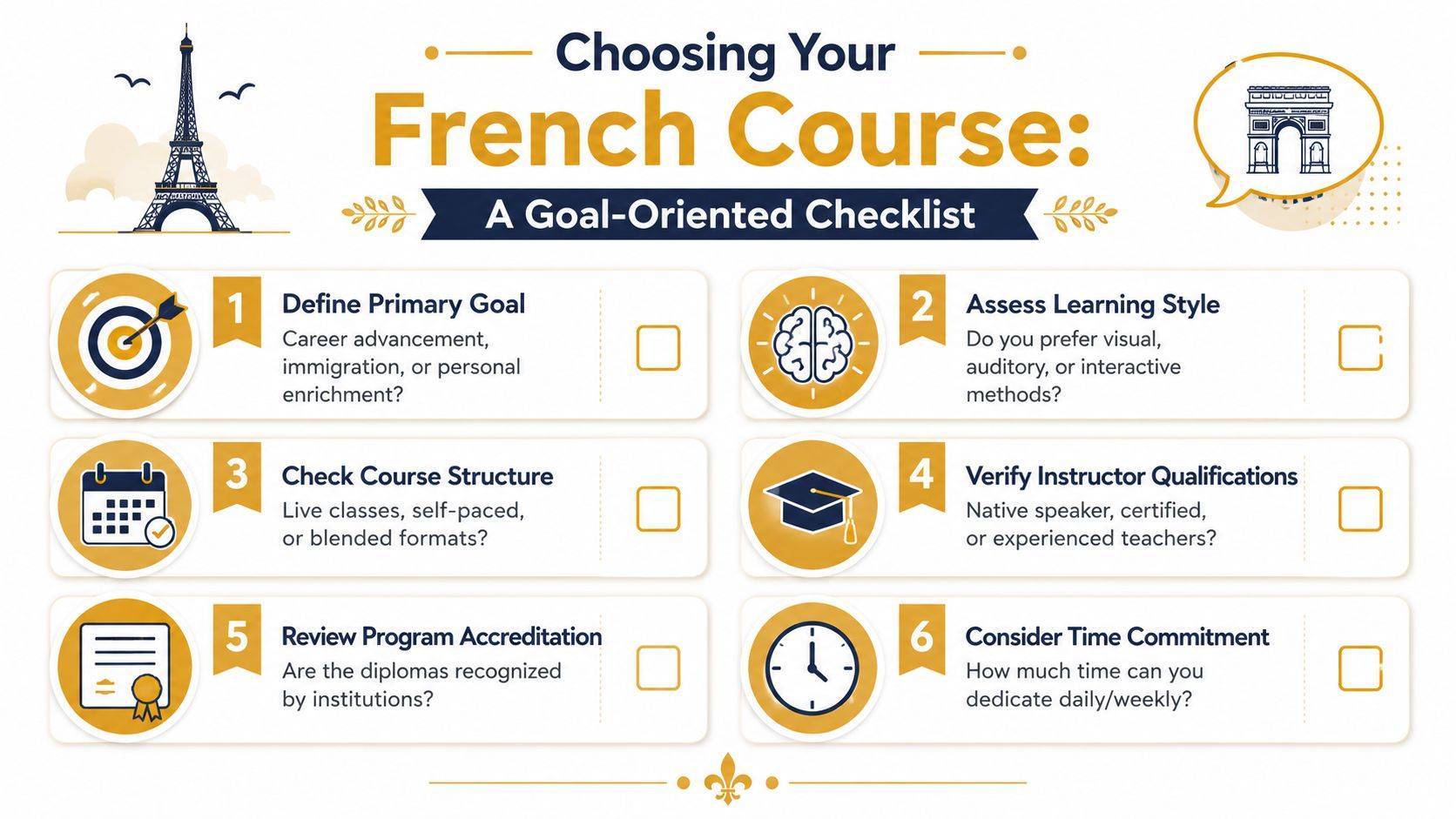
How to Choose a Course for Your Specific Goal
Most buying guides stay too generic. My approach avoids recommending course types in the abstract. Instead, I recommend them based on the result you need inside the Canadian context.
If your goal is immigration
Buy targeted exam preparation, not broad conversation training.
For TEF or similar exam goals, I prefer a short, structured prep block over a general class. That approach matches the way the exam is scored. One concrete benchmark is Cestar College's Power TEF, an 18-hour preparation course focused on the four TEF skills, exam structure, and a mock test (Power TEF course details).
That doesn't mean every student needs that exact course. It means you should look for the same design logic:
- Exam-specific tasks: Listening, speaking, reading, and writing must all be trained.
- Format familiarity: You need practice with the exam structure, not just French in general.
- Mock testing: You should know what pressure feels like before test day.
If you want a more academic path with live instruction and custom support, compare that with online university-style French classes and see which format better matches your timeline.
If your goal is work or federal career growth
Buy live correction and role-specific speaking practice.
Professionals often make the same mistake. They choose a broad “intermediate French” class and assume the teacher will somehow turn that into workplace performance. It rarely happens. If you need meetings, client calls, presentations, or federal interview readiness, you need lessons built around those tasks.
I usually recommend one of two formats:
- Live online group classes if your level is stable and you mainly need guided speaking.
- Private tutoring if your vocabulary, confidence, or job context is highly specific.
Federal job candidates especially need repeated speaking drills with correction. Not vague exposure. Not app streaks. Rehearsal.
If your goal is school support or long-term fluency
Parents should usually skip adult group programs for kids who need real academic support. If a student is in French immersion or a bilingual stream, they need tutoring tied to school expectations, current units, writing demands, and oral tasks.
For adults learning for life, travel, or family reasons, the equation is different. You can afford a slower format if you'll stay consistent. In that case:
- self-paced tools can support daily habit
- live group classes can build confidence
- tutoring works best when you've hit a plateau or need accountability
The right answer depends on urgency. If the result matters now, go targeted. If the goal is gradual growth, choose the format you won't quit after three weeks.
How Personalized Tutoring Unlocks Confidence
David came to us after trying to brute-force French on his own. He was a project manager in Calgary, aiming for a federal promotion that required stronger French, and he was frustrated. He'd used an app for months. He'd joined a group class. He still froze when he had to speak.

Why David finally made progress
His problem wasn't laziness. It was poor fit.
The app gave him repetition, but not pressure. The group class gave him exposure, but not enough correction. Neither one dealt with the French he needed at work. He had to discuss timelines, risks, stakeholders, and updates. Instead, he kept practicing generic dialogues that never showed up in real life.
So we stripped the process down. We looked at his exact goal, identified the grammar patterns breaking his fluency, and built speaking tasks around his job context. He practiced presenting project updates in French. He rehearsed responses to follow-up questions. He learned the phrases he'd need when conversations got uncomfortable.
The breakthrough usually comes when the student stops practicing French in general and starts practicing their French.
That's why I still believe personalized tutoring has a different kind of value. It's not just more attention. It's better relevance.
For a practical breakdown of when private lessons make financial sense, this guide on whether a French tutor is worth the investment is useful.
What personalized tutoring changes
A customized program fixes four common problems fast:
- It removes irrelevant content: You stop wasting energy on material that doesn't serve your goal.
- It increases speaking volume: You speak far more than you do in most group formats.
- It sharpens correction: Teachers catch recurring mistakes before they become habits.
- It improves follow-through: Scheduled lessons create momentum that self-study rarely sustains.
Here's a quick look at how focused speaking work can sound in practice:
David's result mattered, but the deeper change was confidence. Once he stopped guessing and started training for his real use case, French stopped feeling like a school subject and started feeling like a tool.
Costs Accreditation and Free Government Programs
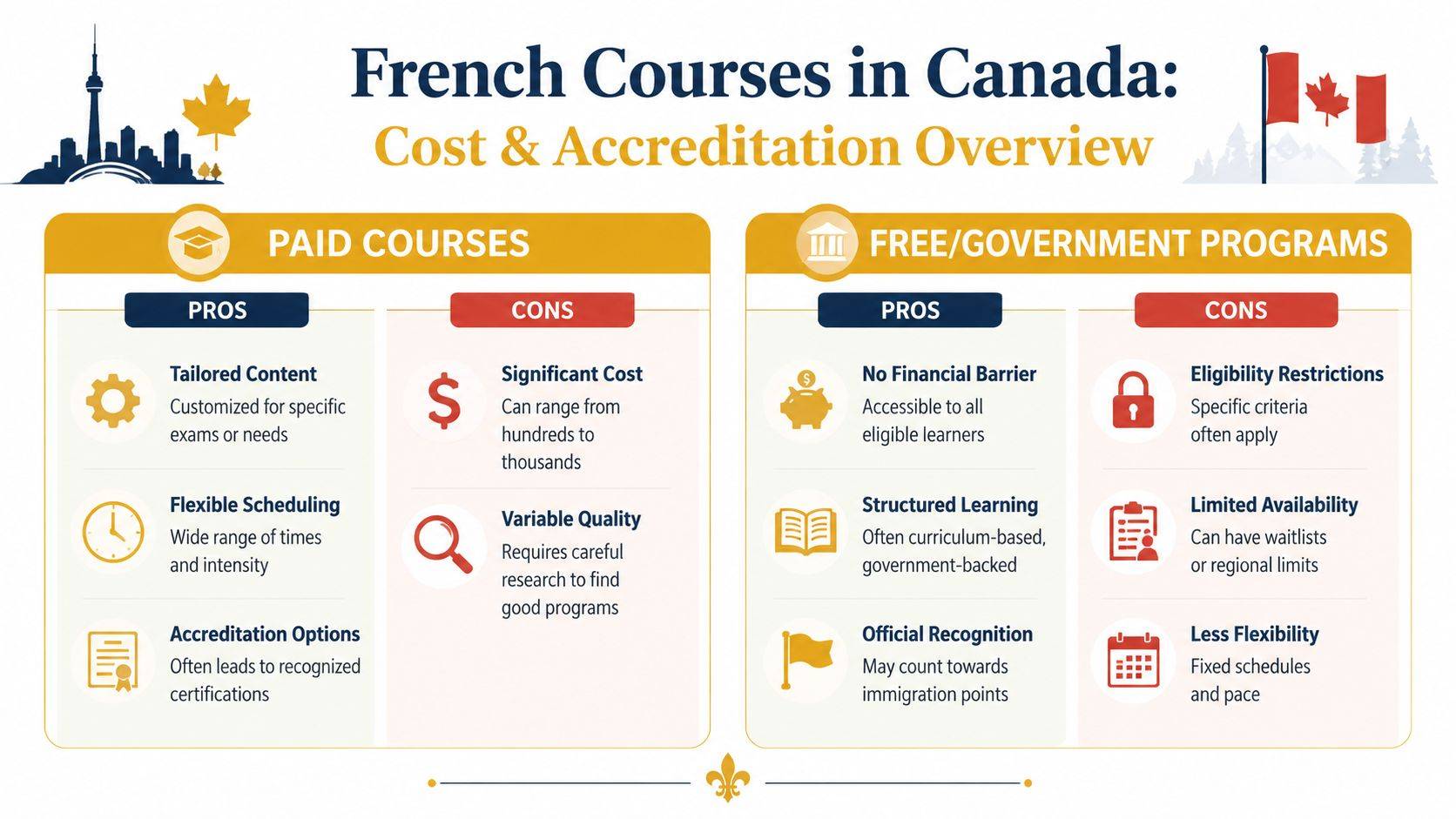
Money matters, but buyers often focus on the wrong cost. They compare tuition and ignore suitability. A cheaper course that doesn't match your goal is often the expensive choice.
What you're actually paying for
In paid programs, price usually tracks one thing more than anything else. Personalization.
University and college programs often charge for formal structure. Group classes charge for live teaching and community. Private tutoring charges for customization, scheduling flexibility, and direct correction. None of those is automatically “worth it.” The right question is whether the format matches the outcome you need.
When people ask me about accreditation, I simplify it. You want one of two things:
- Progress framework: CEFR or CECRL alignment helps you understand level progression.
- Recognized exam path: If you need official recognition, completion certificates aren't enough. You need preparation for recognized exams such as DELF, DALF, or TEF.
That's one reason some learners skip broad conversation programs and go straight to DELF and DALF test preparation options when certification matters.
Who should look at free government options
Free programs in Canada are real. They're useful. They're also frequently misunderstood.
One of the biggest mistakes I see is people assuming “online French in Canada” means “free for anyone in Canada.” That isn't how it works. Some of the most visible public options have strict eligibility and location rules. For example, CLIC en ligne is a free IRCC-funded program available across Canada outside Quebec, and enrollment often requires a formal language assessment at a designated centre (CLIC en ligne eligibility and enrolment details).
Quebec also offers free online French courses with in-person support for adults through deferred distance learning, with an initial needs analysis, an individualized training plan, and end-of-course assessment. The province states the courses are free, though educational materials may carry a fee, and there is no financial assistance for participation (Quebec online French course description).
Use this filter before you count on a free option:
- Check status: Are you a newcomer or otherwise eligible?
- Check province: Some programs are outside Quebec only. Others are province-specific.
- Check intake process: You may need assessment before registration.
- Check flexibility: Free programs can be structured, but not always convenient.
Free doesn't mean open-entry. In Canadian French training, public access often comes with conditions.
My advice is simple. If you qualify and your timeline is flexible, free programs deserve serious attention. If you need speed, specialized exam prep, or a highly personalized plan, paid instruction is usually the more practical route.
Your Next Steps to Start Learning French
At this point, the decision should feel smaller. Not because there are fewer options, but because you're choosing by outcome instead of marketing.
The highest-value option usually isn't defined by online versus in-person. It's defined by whether the curriculum matches a real Canadian objective such as exam preparation, workplace communication, or relocation readiness, as noted in this comparison of French course paths in Canada.
Here's the cleanest plan I give students:
- Name the goal clearly. Immigration, federal career growth, workplace communication, school support, or personal fluency.
- Pick two course types, not ten brands. For example, exam prep plus tutoring, or group class plus self-study.
- Test the fit before committing. Ask about placement, curriculum, speaking time, correction, and outcome alignment.
If you're leaning toward personalized instruction, a short consultation is the fastest way to avoid a bad purchase decision.
Elite French Tutoring offers customized online French lessons with a short initial consultation to assess level, goals, and learning style. If that kind of individualized path fits what you need, you can review the options directly on Elite French Tutoring's website.
Frequently Asked Questions
How long does it take to become fluent with an online course
There isn't one honest timeline that fits everybody. It depends on your starting point, your weekly consistency, and what you mean by “fluent.” If you mean casual conversation, that arrives much sooner than exam-level writing or professional speaking.
I tell students to judge progress by function, not fantasy. Can you handle a call, answer follow-up questions, write a clear email, or complete the exam task? That's more useful than chasing a vague idea of fluency.
Can I get a certificate from an online French course
Yes, many online courses offer a certificate of completion. But that's not the same as an official credential for immigration, university, or formal evaluation.
If you need recognized proof, choose a course that prepares you for a standardized exam such as DELF, DALF, or TEF. The course itself may help you prepare, but the recognized result comes from the official exam process, not from class attendance alone.
Are online courses effective for speaking skills
Yes, if you choose the right format.
Self-paced apps can help with vocabulary and habit, but they're weak for speaking. Live group classes are much better because they force real-time listening and response. One-on-one tutoring is strongest when speaking matters a lot, because you get immediate correction, more airtime, and practice tied to your actual goal.
If speaking is the priority, don't buy a course that lets you stay silent most of the time.
That's the simplest buying rule in this whole guide.