You've probably done this already. You typed French New Jersey into Google, opened six tabs, and ended up with a strange mix of school directories, generic “learn French” pages, scattered meetup listings, and tutors who may or may not be a fit for what you need.
That confusion usually comes from one problem. Individuals often search before they define the job the French program needs to do. A parent in Princeton, a pharma manager in North Jersey, and a student preparing for DELF are all searching the same phrase, but they should not buy the same kind of instruction.
I've spent years helping families, professionals, and exam candidates sort through that mess. The fastest way to make a smart decision is to stop asking “Where can I learn French?” and start asking “What outcome am I paying for?” That shift saves time, money, and a lot of false starts.
Table of Contents
Finding Your Way in the World of French in New Jersey
A lot of New Jersey learners think the hard part is pronunciation or grammar. Usually, the hard part comes earlier. It's choosing the right format before you spend a month in the wrong one.
I see this with adults who join a casual group class when they really need job-specific speaking practice, and with parents who hire a fluent speaker who has no idea how to support a child's school curriculum. The search term is broad, but the purchase decision shouldn't be.
There's also a small historical twist that gives this topic a nice local texture. New Jersey's name traces back to the island of Jersey, which sits about 14 miles off the coast of France and was part of Normandy until 1204, remaining under strong Norman-French influence for centuries, as outlined in the history of Jersey. That doesn't make New Jersey a French-speaking state, of course, but it does remind us that the phrase “French New Jersey” has deeper roots than a random keyword.
Why broad searches create bad decisions
Most search results flatten everything into one bucket. They treat:
A child needing homework support
An executive needing meetings practice
A traveler wanting conversation
A DELF candidate needing structured correction
as if they were versions of the same problem.
They're not.
Practical rule: don't compare providers until you can state your goal in one sentence that starts with “I need French for…”
That single sentence changes what matters. Schedule flexibility may matter more than classroom community. Written feedback may matter more than conversation volume. Native fluency may matter less than teaching skill in a school-aligned setting.
A smarter local search mindset
If you're in New Jersey and your options feel thin nearby, widen your frame. Many strong learners compare local in-person choices with flexible regional and online options, especially if they need a specialist rather than a generalist. Some families even look across nearby metro areas when evaluating fit, similar to how students compare French classes near Philadelphia when local listings don't match their actual objective.
The goal isn't to find the longest list. It's to find the shortest path to the result you need.
First Define Your Goal Before You Search
The phrase French New Jersey means very different things depending on who's searching. For one family, it means help with school expectations. For another, it means relocation support or French-speaking services. For a professional, it may mean industry communication rather than academic French.

A useful way to think about it is this. New Jersey learners often aren't looking for “French lessons” in the abstract. They're looking for support tied to curriculum alignment, exam prep, or workplace communication, and that distinction matters in communities where language support and service access vary widely, as noted in New Jersey's medically underserved area guidance.
The three questions that narrow your search fast
Before you book anything, answer these:
What does success look like in plain English?
“My daughter needs to keep up with her bilingual school writing.”
“I need to handle conference calls with a French-speaking team.”
“I want to pass DELF without guessing what examiners expect.”What's the pressure point?
Is it grades, confidence, promotion, relocation, travel, or a deadline?What kind of accountability do you need?
Some learners do well with a weekly class and light homework. Others need targeted corrections, progress tracking, and someone who will adjust the plan quickly.
Goal types I see most often in New Jersey
Here's the practical breakdown we use.
School support: best for children and teens who need help with class content, writing, oral presentations, reading comprehension, or confidence.
Professional French: best for adults who need meetings, email tone, presentations, intercultural communication, or role-specific vocabulary.
Certification prep: best for students and professionals who need DELF or DALF structure, timed practice, and precise correction.
Relocation and daily life: best for adults who need useful conversation, listening, and real-life functional language.
A common mistake is choosing by convenience instead of objective. A nearby class that doesn't map to your need can cost more in the long run than a more focused option with better fit.
Match the provider to the outcome
If you're not sure how to describe your target, it helps to frame it by proficiency and use-case. I often tell clients to review the CEFR French proficiency levels before they contact programs, because it makes conversations with tutors and schools much more concrete.
If you can describe the situation where you need French, you're already halfway to choosing the right format.
That's the buying decision often skipped. They shop for lessons before they shop for the right kind of result.
Comparing Your Options Tutors Schools and Centers
Once your goal is clear, the New Jersey market usually narrows into three real choices. Private tutors, language schools, and community or university centers. None is automatically better. The right one depends on pace, customization, scheduling pressure, and how high-stakes your outcome is.
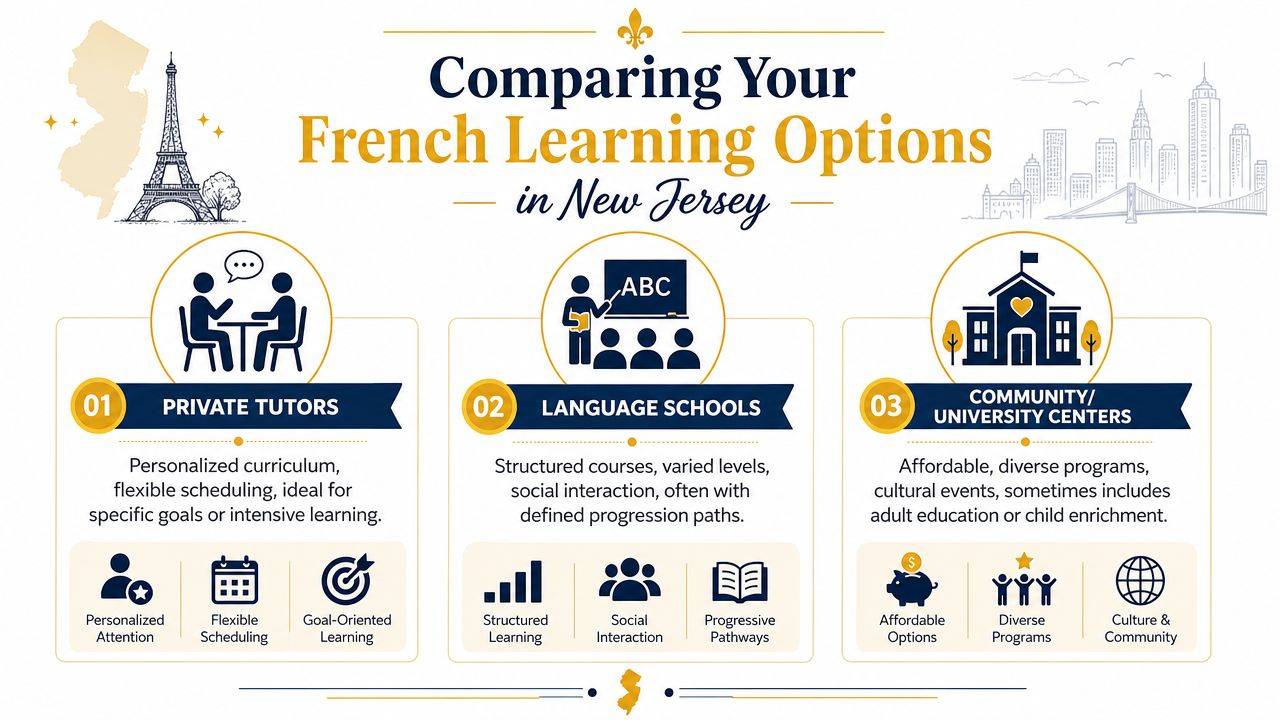
French Instruction in NJ A Comparison
| Factor | Private Tutor (e.g., Elite French Tutoring) | Language School (e.g., Alliance Française) | Community Center / University Extension |
|---|---|---|---|
| Personalization | High. Lessons can target one learner's exact goal | Moderate. Curriculum usually serves a group level | Low to moderate. Often broad and fixed |
| Scheduling | Flexible | Set calendar | Usually fixed term schedules |
| Best for | Exams, business French, school support, fast progress | Learners who like structure and group energy | Budget-minded learners, casual enrichment |
| Pace control | High. Can speed up or slow down quickly | Moderate. Group pace rules | Low. Pace usually follows the class |
| Feedback quality | Direct and detailed | Shared across a group | Variable |
| Social interaction | Low unless paired or small-group format | High | Moderate |
| Fit for high-stakes goals | Strong | Sometimes suitable | Usually not the first choice |
What private tutoring does well
Private tutoring works when the learner has a specific target and not much room for drift. That includes corporate learners, students with school-specific needs, and exam candidates.
For specialized goals like DELF or DALF, research reviewed by Cambridge indicates that one-on-one tutoring can produce passing rates up to 30% higher than group classes alone because learners get personalized feedback on speaking and writing, according to this review of second-language tutoring effectiveness.
That advantage shows up most clearly when correction quality matters. In group settings, many learners don't get enough targeted speaking or writing feedback.
Where schools and centers fit better
Language schools can be excellent for adults who want a defined progression path and enjoy learning alongside other people. Group energy helps some learners stay consistent, especially if their goal is general improvement rather than a narrow, urgent outcome.
Community and university programs often make sense when the learner wants affordable exposure, cultural enrichment, or a low-pressure reentry into French. They're often not the first thing I recommend for exam deadlines or school intervention, but they can be a solid fit for exploratory learners.
A real client example
One client I worked with, a corporate lawyer based in Newark, had already tried group classes. He was diligent, attended regularly, and liked the instructor. But he wasn't getting enough speaking time, and nobody was correcting the kind of formal language he needed for a secondment abroad.
We shifted him into one-on-one sessions built around presentations, meeting simulations, and written corrections. His progress changed because the lessons finally matched the job. That's the part many learners miss. It wasn't that the earlier class was “bad.” It was just the wrong tool.
If you're deciding between formats, this guide on how to find the right French tutor as an adult learner is useful for spotting fit issues early.
The best format is the one that makes your weak points impossible to hide.
That usually means more customization for high-stakes goals, and more community for broad, low-pressure learning.
How to Vet Any French Program or Tutor
After you choose a format, the next risk is buying into polished marketing that doesn't tell you how the teaching works. A slick website won't tell you whether the tutor can correct writing well, manage a shy child, or run a serious business role-play.
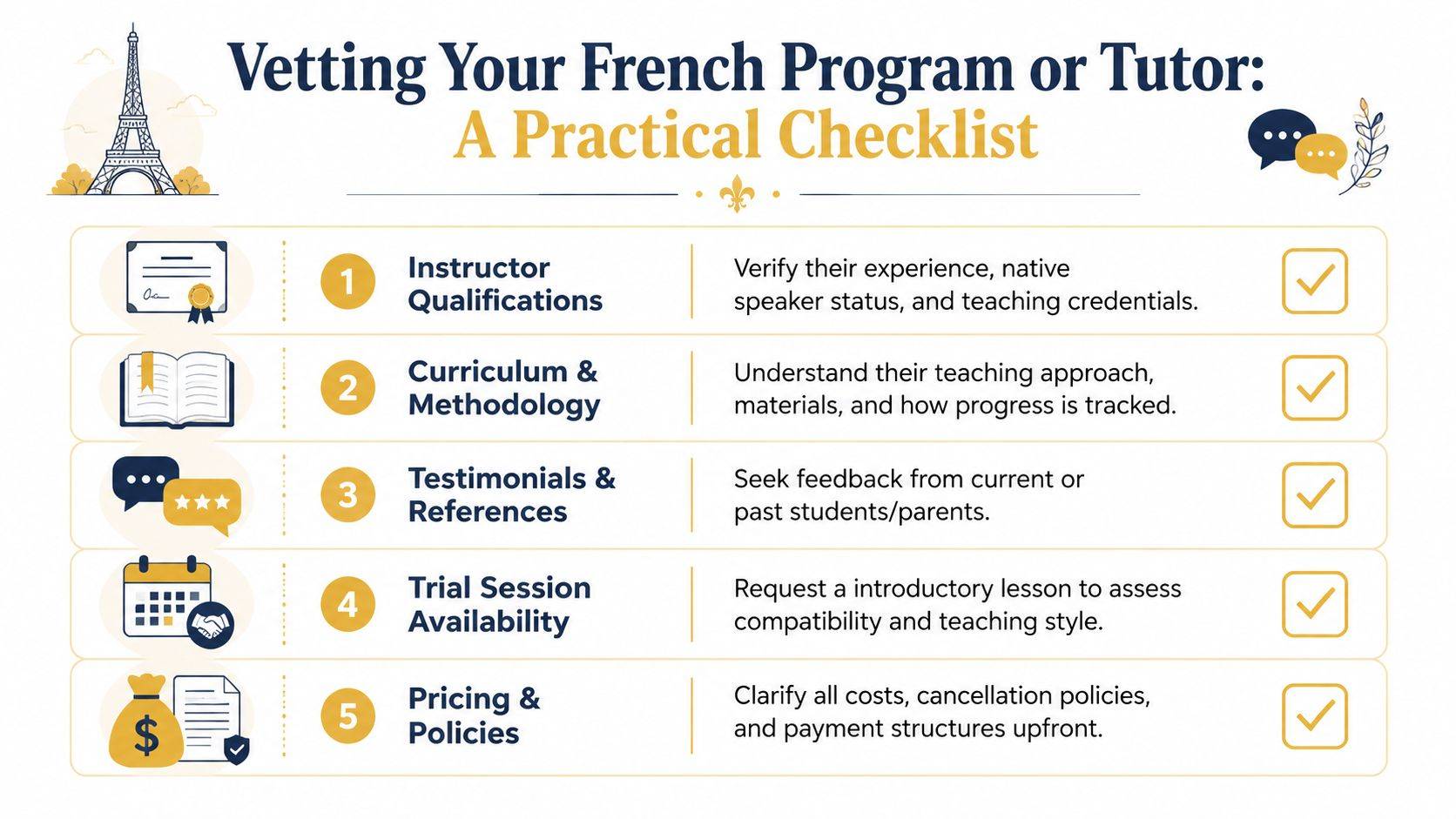
I tell clients to vet French programs the same way they'd vet any serious professional service. You need evidence of fit, not just fluency.
Use a quality benchmark
ACTFL gives a practical standard here. It suggests evaluating whether instructors have at least Advanced-Low proficiency, use authentic materials, and maintain at least 90% target language use in the classroom, as described in ACTFL's guidance on using the target language in class.
That doesn't mean every lesson should feel intense or inaccessible. It means the program should create enough real French exposure for learners to build usable language, not just memorize rules in English.
The questions I'd ask before booking
Use these in a call or trial lesson.
How do you assess level?
You want more than “beginner” or “intermediate.” Ask how they evaluate speaking, listening, reading, and writing.How do you adapt for my goal?
A strong provider should answer differently for a child, a business professional, and an exam candidate.What materials do you use?
Good answers include authentic audio, current articles, guided writing tasks, school materials, or exam-style prompts. Weak answers stay vague.How do you correct mistakes?
Some tutors interrupt constantly and kill confidence. Others never correct enough. Ask how they balance fluency and precision.How is progress tracked?
You want some kind of milestone, feedback loop, or written summary, especially if you're paying for a premium service.
Warning signs that usually predict frustration
Not every bad fit looks bad at first. Watch for these:
All fluency, no teaching method: speaking French well and teaching French well aren't the same job.
No clear lesson objective: if every lesson is “conversation,” progress often gets fuzzy fast.
No experience with your use-case: a great children's tutor may not be the right choice for legal or corporate French.
Rigid materials: if the provider can't adapt to school assignments, business scenarios, or exam tasks, you may end up doing the actual work elsewhere.
Trial lessons matter more than brochures
A trial session often tells you more than any testimonial. You can hear whether the tutor explains clearly, whether they listen, and whether the pacing fits your personality.
I also watch whether the teacher can make the learner do the work. That sounds obvious, but it's where weak programs fail. They perform instead of teaching.
For a practical decision lens, I often suggest reading this perspective on whether a French tutor is worth the investment before comparing prices alone.
A good consultation should leave you with a clearer path, even if you don't buy on the spot.
That's usually the sign you're speaking with someone who understands outcomes, not just lesson packages.
Navigating Specialized French Learning Paths
Generic French lessons can be pleasant and still be the wrong purchase. When the goal is school support, workplace performance, or certification, the program has to mirror the pressure of the actual setting.
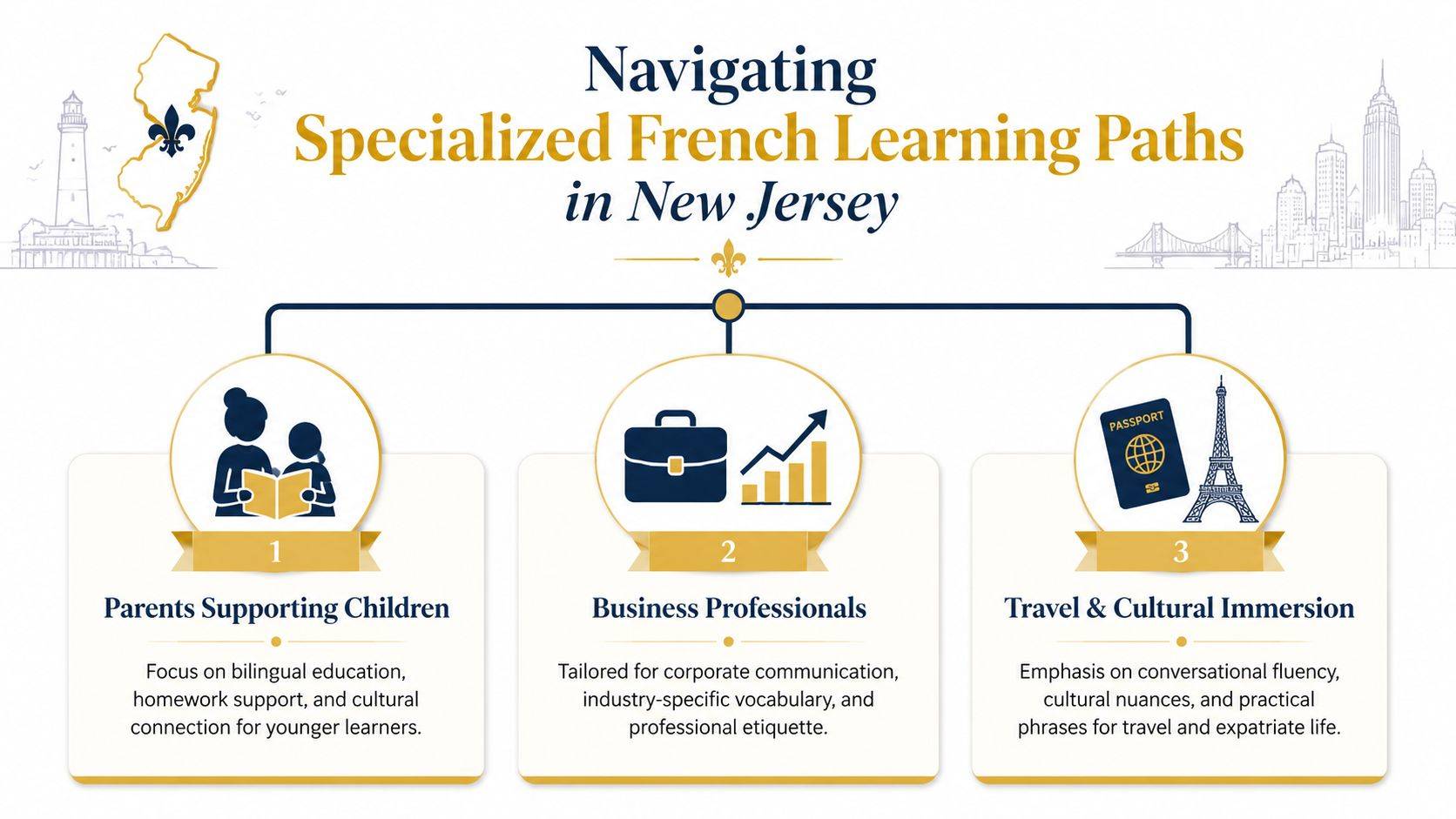
Parents supporting children
Parents often tell me their child “takes French,” but that phrase hides several different problems. The child may be behind in grammar, freezing during oral participation, struggling with reading comprehension, or losing confidence after one difficult term.
For children and teens, the right support usually includes:
Curriculum alignment: the tutor should work with the school's expectations, vocabulary, and writing style.
Age-appropriate engagement: younger learners need momentum and variety, not adult-style correction.
Confidence building: school French is emotional for many kids. If they start to identify as “bad at languages,” progress slows.
The wrong fit here is often a fluent adult who can chat in French but can't scaffold learning for a student.
Business and corporate French
Corporate learners need a different architecture. Casual conversation alone won't prepare someone to join a meeting, manage tone in emails, or handle professional nuance.
A 2025 report from the Committee for Economic Development found that companies investing in bilingual training for employees in key roles reported 15% better performance and access in relevant international markets, according to the report on foreign language skills in the U.S. workforce. If an employer is paying, that's the business case for making the training role-specific rather than generic.
What works better in corporate settings:
Industry vocabulary: pharma, finance, law, luxury, diplomacy, and tech all need different language.
Scenario practice: meetings, presentations, negotiations, small talk, and email review.
Tone coaching: many advanced learners know the words but miss the register.
DELF and DALF candidates
Exam prep is its own category. Within this category, many intelligent learners waste time in general classes that never train the exam tasks directly.
A serious prep plan should include:
Task familiarity so the candidate knows exactly what each section demands
Timed practice because knowledge and performance under clock pressure are different
Speaking correction that addresses structure, not just pronunciation
Writing feedback that shows what to change line by line
I've seen strong conversational speakers underperform because nobody taught them the exam format. I've also seen quieter students do very well once they understand the scoring logic and practice under realistic conditions.
Specialized French works because it removes irrelevant content. You stop paying for lessons you don't need.
That's the core buying principle for French New Jersey searches. If your goal is specific, your program should be specific too.
Your Next Step to Speaking French With Confidence
A good French decision in New Jersey usually comes down to three moves. Define the outcome, choose the right format, then vet the provider with real questions.
That approach filters out most of the noise. It also keeps you from paying for a pleasant but poorly matched program.
If your goal is broad and social, a school or community setting may be enough. If your goal is narrow, urgent, or high-stakes, private instruction is often the cleaner route because it gives you more control over pacing, correction, and content. That's especially true for school intervention, professional communication, and exam prep.
One practical option to compare is Elite French Tutoring, which offers customized private French lessons online and begins with a free consultation to assess level, goals, and learning style. Whether you choose that route or another provider, I'd strongly recommend having a real conversation before you commit.
Use that conversation to test for clarity. Can the provider describe how they'd handle your exact situation? Can they explain what the first month would look like? Can they tell you what they'd prioritize first?
If they can, you're getting closer.
If you're weighing private lessons against classes and want a custom recommendation, booking a short consultation with a French provider can save a lot of trial and error. It's often the fastest way to decide whether you need curriculum support, exam prep, business French, or a more flexible conversation-focused plan.