You've probably reached the stage where standard French classes no longer feel like enough. You can follow conversation, handle everyday topics, maybe even work in French, but reading Camus, Molière, Duras, or Sartre in the original still feels just out of reach. The problem usually isn't motivation. It's finding an online course that gives you enough structure, feedback, and discussion to make literature manageable instead of intimidating.
I see this all the time with adult learners, exam candidates, bilingual school families, and professionals preparing for relocation or higher-level certification. They don't need another generic app. They need a course that helps them read closely, discuss ideas clearly, and build the kind of vocabulary and interpretive confidence that literature demands.
That's where online french literature courses can be excellent, if you choose the right format. Some are flexible and well-designed. Some are academic but rigid. Some look impressive on paper but leave you doing all the hard thinking alone.
If you're weighing options, this guide will help you sort through them practically. And if you're still deciding between literature study and broader language training, it can help to compare these options alongside other best online French classes.
Table of Contents
Beyond Duolingo Unlocking French Literature Online
You finish your daily app lesson, feel sharp for ten minutes, then open L'Étranger and hit a wall by the second paragraph. The problem usually is not motivation. It is course design.
French literature asks for a different set of skills from general language study. You need help with tone, syntax, historical context, and interpretation, not just vocabulary recall. A learner can hold a solid conversation and still struggle to explain why Camus sounds flat on purpose or why Molière's comedy depends on rhythm and social codes.
That gap matters because literature study rewards guided reading. The strongest online french literature courses teach students how to read closely, discuss clearly, and write about a text with control. They move beyond sentence-by-sentence translation and into interpretation.
I see the same sticking points again and again with students who come to me after trying apps, recorded courses, or random YouTube lectures. They have access to texts. They often have summaries too. What they do not have is correction on their written analysis, a sensible reading sequence, or a teacher who can tell them which confusion is productive and which confusion will keep slowing them down for weeks.
Your goal should shape the kind of course you choose:
Exam preparation: You need structured practice with analytical vocabulary, timed writing, and targeted feedback.
School support: You need a course that matches the author, movement, or assignment already on your syllabus.
Personal enrichment: You need guided discussion that makes the reading more rewarding, not a content library you never finish.
Professional or academic use: You need precision, strong reading habits, and the ability to discuss ideas in formal French.
A simple rule helps here. If a course offers readings and recorded lectures but no serious feedback, it functions as self-study with better packaging.
That format can still be useful. Self-paced courses are affordable and convenient. They work well for independent learners who already know how to annotate a text, track themes, and correct their own written French. Serious learners usually reach a point where convenience stops being the main question. Results become the main question.
That is why comparing course formats by outcomes matters more than comparing them by brand name. A polished platform is not the same thing as real progress. Students who want broad exposure can do well with the best online French classes for independent and guided study. Students who want to read literature well usually need more. They need discussion, correction, and adaptation to their level.
Online study makes that possible. The best options now let students work from home while still getting structure and live interaction. The core choice is not whether French literature can be studied online. It can. The important choice is whether your course gives you enough guidance to read with confidence and say something worthwhile about what you read.
What to Expect from a Modern Literature Course
A strong literature course should feel layered. You read first. You listen next. You think on your own. Then you discuss with someone who can sharpen your interpretation and your French at the same time.
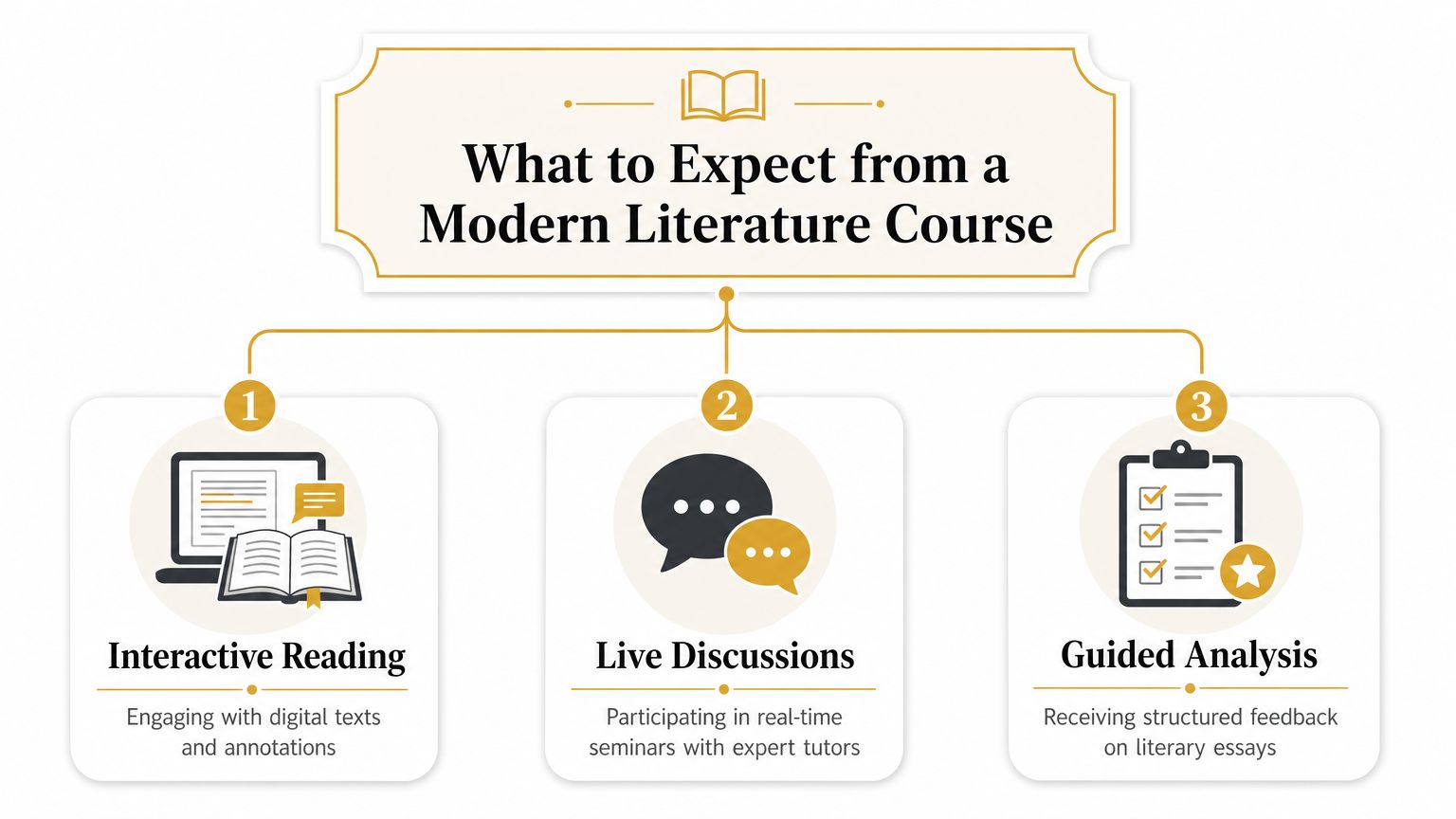
That structure isn't just convenient. It's pedagogically sound. The most effective online French literature programs combine asynchronous inputs such as recorded lectures, readings, quizzes, and writing tasks with live discussion sessions. LinguaTute's literature course is one example. It runs for 8 weeks and uses recorded lectures, self-study, quizzes, writing assignments, and live online discussions while covering literary history from the 16th century to the present in both English and French, as outlined on LinguaTute's online French literature course page.
What a good weekly rhythm looks like
A typical week in a well-built course often includes:
Assigned reading
You read a short excerpt, scene, poem, or chapter with guiding questions.Context input
A recorded lecture or note packet gives historical background, themes, and stylistic markers.Language work
You review vocabulary, key expressions, tone, register, or grammar that affects interpretation.Written reflection
You answer prompts, annotate passages, or draft a short paragraph.Live discussion
You test your understanding in real time, ask questions, and refine your interpretation aloud.
Why this works better than live class alone
Literature is heavy cognitive work. Students need time to reread difficult passages, check meaning, and notice patterns before they're asked to discuss symbolism, narrative voice, or irony. If everything happens live, weaker readers fall behind. If everything happens asynchronously, students often miss nuance and drift into passive consumption.
That's why I look closely at course architecture before I recommend any program. The course should create a sequence: decode first, interpret second.
A literature course works best when the live session isn't spent translating every line. It should be spent testing ideas, clarifying meaning, and improving how you express those ideas in French.
Programs built this way also suit different schedules better than old-fashioned classroom models. If you want to see how that structure translates into individual learning support, our French tutoring methodology shows the same principle applied in a more customized format.
Comparing Online French Literature Course Formats
Not all online french literature courses solve the same problem. Some are for exploration. Some are for accountability. Some are for high-stakes outcomes. Choosing well means being honest about how much feedback you need.
Comparison of Online French Literature Course Formats
| Format | Personalization | Feedback Quality | Pacing | Typical Cost | Best For |
|---|---|---|---|---|---|
| MOOCs | Low | Low | High flexibility | Usually lower-cost | Casual learners exploring literature independently |
| University extension programs | Moderate | Moderate | Fixed schedule | Moderate to premium | Learners who want academic framing and institutional structure |
| Self-study with apps and books | Very low | Minimal | Fully flexible | Usually lowest direct cost | Independent readers with strong self-discipline |
| Private tutoring | Very high | High | Flexible and adjustable | Premium | Serious learners with specific goals |
MOOCs and large-scale platforms
A MOOC can be useful if your goal is exposure. You may get lectures from respected instructors, a broad reading list, and some historical framing. What you usually won't get is close correction on your spoken analysis or writing.
That trade-off matters more in literature than in general language study. You can watch a lecture on symbolism, but that doesn't tell you whether your own interpretation is clear, convincing, or linguistically accurate.
University extension programs
These sit in the middle. They often provide stronger structure and better academic sequencing than open platforms. If you like a semester rhythm, assigned readings, and a more formal environment, they can be a solid choice.
The downside is rigidity. If the syllabus spends weeks on authors you don't need, or the pace doesn't match your reading speed, you can't usually reshape the course around your goals. For learners comparing institution-led options with more flexible alternatives, it helps to review how online university-style French classes differ from personalized instruction.
Self-study with books, podcasts, and apps
This route can work for advanced readers who already know how to annotate, summarize, and check comprehension independently. It's less effective for students who need accountability or spoken practice.
The common failure point isn't lack of content. It's lack of calibration. Learners don't know whether the text is too hard, whether they're focusing on the right features, or whether their interpretation would hold up in class or on an exam.
Buyer's lens: If feedback is essential to your goal, eliminate any format that treats discussion and correction as optional extras.
Private tutoring
Private tutoring is the premium option because it removes the mismatch between the course and the learner. The reading list, pace, homework, and discussion level can all change based on your goals. That matters if you're preparing for DALF, supporting a child in a bilingual school, or trying to discuss literature professionally and intelligently rather than casually.
It's not the right choice for everyone. If you only want a light introduction and don't care about output, tutoring can be more than you need. But if you want measurable progress in analysis, expression, and confidence, it's hard to beat.
How to Choose a Course Based on Your Goals
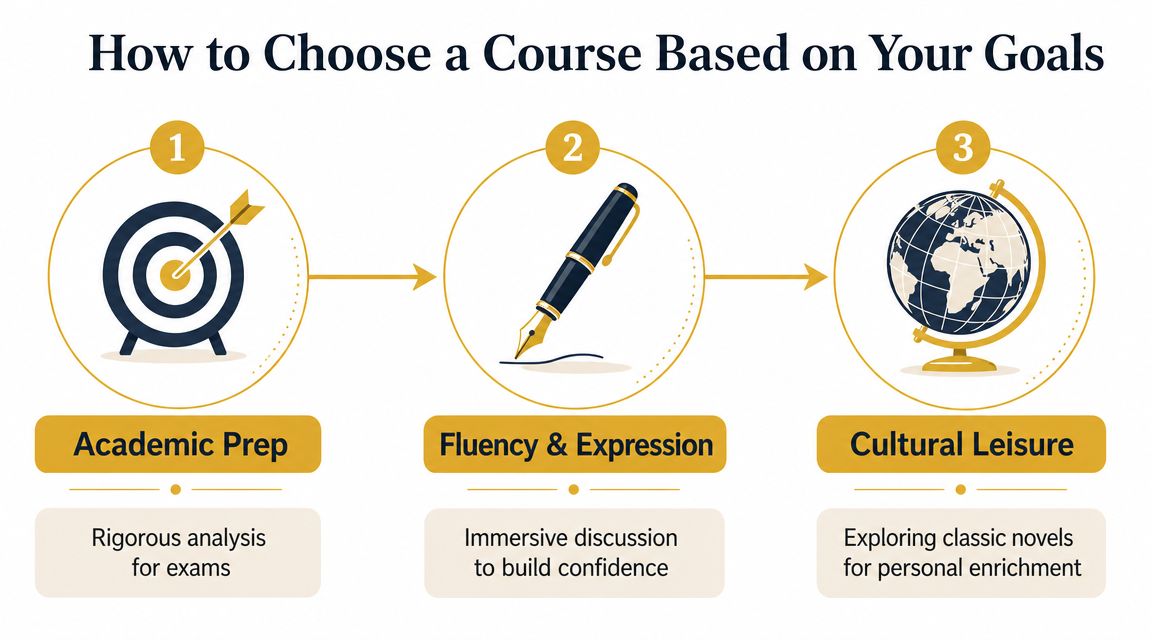
The right format depends less on the title of the course and more on the outcome you want. A good buying decision starts with the question, “What do I need this course to do for me?”
Some immersive literature programs are entirely in French and require at least B1. Learn French at Home states that its literature course is conducted fully in French, requires a B1 level, and pairs a 50-minute live class with up to one hour of homework, which creates a roughly 1:1 live-to-independent workload suited to reading-intensive study. That benchmark is useful for buyers deciding whether they need a French-only course or a more scaffolded format, as described on Learn French at Home's literature course page.
For academic credit or school support
If you need support for school, assigned texts matter more than prestige. A generic “French literature survey” may not help a student who needs guidance on one novel, one play, or one essay format.
Look for a format that can do three things well:
Align with the syllabus
Correct written work closely
Prepare the student for class discussion or essays
Private tutoring or a very small seminar usually fits best here. Large-scale programs often move too broadly.
For DELF or DALF exam preparation
Exam prep is where personalized feedback becomes most valuable. Literature-based tasks ask for precision, structure, and interpretation under pressure. You need someone to correct not just grammar, but argument quality, register, and how you support a point from the text.
A self-paced course can help with exposure. It usually won't be enough on its own for high-level exam output.
For professional and cultural enrichment
Many professionals don't need academic commentary. They want to speak about books, ideas, and cultural themes with more sophistication. In that case, a bilingual or guided literature course can be a smart choice if your reading level is still developing.
The biggest mistake here is choosing a course that's too hard too soon. If the course is fully immersive and your reading speed is still fragile, you'll spend all your energy decoding instead of engaging.
Start with the format that lets you participate fully, not the one that sounds most impressive.
For the passionate lifelong learner
If your goal is pleasure, consistency matters more than intensity. A small-group seminar can be wonderful if you enjoy hearing how other readers respond to a text. One-on-one tutoring works better if your interests are narrow, such as existentialism, poetry, or women writers of the twentieth century.
If you're choosing with an exam or proficiency target in mind, it may help to compare your reading goals with a broader prep path through our specialized French programs.
A Student Success Story From Law to Literature
One of the clearest examples I've seen involved a corporate lawyer I'll call Amelia. She already had strong professional French and could handle meetings, email, and formal discussion without much trouble. But when she began preparing for advanced certification and wanted to work in a Paris-based legal environment, she ran into a different problem. Literary analysis exposed every weak spot that business French had allowed her to hide.
Her first instinct was to join a general advanced course. It gave her reading material, but not enough targeted correction. She could summarize a passage. She couldn't yet build a polished commentary on it.
Before the breakthrough
Amelia's main frustration was that her French sounded competent but not intellectually flexible. When faced with dense twentieth-century prose, she translated too word-for-word and hesitated to interpret. She knew what the words meant. She didn't yet control the language needed to discuss tone, ambiguity, or philosophical tension.
That's a common turning point for advanced learners. Literature doesn't just test comprehension. It tests how well you can think aloud in French.
What changed
Her work shifted once she moved to a custom plan built around her actual goal. Instead of following a generic syllabus, she focused on selected twentieth-century texts and on the written and oral structures she needed most. Sessions centered on passage analysis, guided discussion, and the discipline of building a strong commentaire composé.
We also adjusted the pacing constantly. Some weeks required slower text work. Others focused on synthesizing ideas and speaking more spontaneously.
She didn't need more content. She needed tighter feedback and a reading plan that matched her objective.
After the shift
The result wasn't just better literary vocabulary. Amelia became more precise, more confident, and much less afraid of complexity. She could defend an interpretation, support it from the text, and do it in controlled French.
That kind of progress is hard to get from a one-size-fits-all course. If you want to see how customized plans can support different learner profiles, our French tutoring case studies offer more examples.
The Elite Tutoring Difference Custom Literature Journeys
The biggest weakness in many literature courses is simple. The syllabus is fixed, but the learner isn't. One student needs help with close reading. Another needs oral argument. Another needs school support for a specific author. A standardized course can't adapt very far.

Premium online French literature courses tend to work best in structured small-group or one-on-one settings. Some online classes are capped at 10 students, and providers such as the French Library emphasize that this small-format approach supports more speaking practice, individualized feedback, and deeper text discussion, often with university-trained tutors, as described on the French Library online classes page.
Why customization matters more in literature than in conversation classes
In a conversation class, a broad topic can still generate useful practice. In literature, misalignment shows up fast. If the text is too difficult, discussion collapses. If it's too easy, analysis stays shallow. If the tutor doesn't know how to guide interpretation, students spend the session paraphrasing plot.
That's why serious learners often do better with a custom path built around:
Reading level and discussion ability
Specific authors, genres, or school texts
Exam expectations or writing tasks
Schedule realities and homework tolerance
A premium tutoring model allows all of that to change without losing coherence.
What a premium tutoring model changes
The first difference is curricular. We don't have to force everyone through the same author list. A learner interested in Camus and Beauvoir shouldn't have to spend weeks in a survey course that doesn't serve that goal.
The second difference is instructional. A skilled native tutor with literature and pedagogy experience can correct much more than pronunciation or grammar. They can show you how to move from observation to argument, and from vocabulary recognition to interpretation.
Here's a closer look at what that can sound like in practice:
The third difference is accountability. Good tutoring doesn't just personalize content. It keeps every lesson tied to a result, whether that's stronger essays, better seminar participation, or greater fluency discussing books and ideas.
If you want a course built around your own literary goals rather than a fixed catalog, Elite French Tutoring offers a gentle starting point through a free consultation and customized lesson planning.
Frequently Asked Questions About Literature Courses
How fluent do I need to be to start?
Start with the reading demand, not the course label.
A literature course taught fully in French usually works best once you can read a short passage without stopping for every line and explain your reaction in simple French. If you still depend on translation to follow the plot, you will learn more from a bilingual or heavily scaffolded course. I often recommend those formats to A2 to early B1 students because they build literary vocabulary without turning every lesson into a decoding exercise.
Can these courses help a child in French immersion or bilingual school?
Yes, if the course matches the child's actual schoolwork.
The strongest support usually focuses on assigned texts, written responses, oral presentations, and class discussion. A general adult literature course rarely fits those needs well. School-age learners do better with a teacher who can adjust pace, explain expectations clearly, and help them write and speak about the books they are already studying.
How much time should I expect to commit each week?
Plan for reading time, class time, and some form of follow-up.
For a light enrichment course, that may mean one live session plus short weekly reading. For a serious course with essays or close reading, the workload rises quickly. The right amount depends on your reading speed, the difficulty of the text, and whether the teacher gives written feedback. As noted earlier, some established online programs use a mix of live teaching and independent work. That format can be efficient, but only if the workload is clear before you enroll.
Are online french literature courses worth it if I mostly want cultural enrichment?
Yes, if the course includes real discussion.
Passive video content is fine for background knowledge, but literature becomes rewarding when you can test an interpretation, ask why a passage matters, and hear how another reader understood it. For cultural enrichment, small groups and one-to-one tutoring usually produce a better experience than large lecture platforms because you get conversation, accountability, and a reason to keep reading.
What should I ask before enrolling?
Ask questions that reveal how the course teaches, not just what books appear on the syllabus.
Who reads your work and responds to it? Tutor feedback, professor comments, and automated quizzes produce very different results.
What happens in live sessions? A discussion seminar builds interpretation skills. A slide presentation does not do the same job.
How heavy is the weekly reading and writing load? Ask for a realistic estimate, not a vague promise.
Can the instructor adjust the reading list or pace if your level changes? That matters more than many students expect.
What outcome is the course designed for? Cultural enjoyment, exam performance, essay writing, and advanced discussion require different teaching choices.
If you're comparing options and want help choosing the right fit, you can book a free consultation with Elite French Tutoring to discuss your level, goals, and the kind of literature course that will work for you.