You're standing at the airport app, comparing Paris, Lyon, Nice, and Bordeaux, and the worry isn't whether France will be beautiful. It's whether you'll feel comfortable enough to order, ask, adjust plans, and connect without defaulting to English the moment things get slightly awkward. That's the part most travelers underestimate, and it's exactly where a smart French travel itinerary pays off.
The itineraries below are the ones I'd recommend to travelers who want more than a photo list. They balance movement, pacing, and the kind of French preparation that changes the trip from “I saw it” to “I lived it.” Since domestic and regional travel shape so much of how France moves, the best plans usually work with rail corridors, short hops, and real local rhythm, not with a frantic dash from one famous stop to the next. France's travel pattern is heavily domestic, with most long-distance trips staying within metropolitan France, so these routes are built the way people travel there, by connected regions, not isolated landmarks. Official mobility data for long-distance travel in France helps explain why that matters.
Table of Contents
- 1. The Classic Paris-Provence Romance 10 Days of Iconic French Culture
- 2. The Business Traveler's French Intensive 5 Days in Paris Plus Regional Headquarters
- 3. The Family Budget Explorer 8 Days Across Multiple Regions with Kids
- 4. The Riviera Escape 7 Days of Mediterranean Coastal Living
- 5. The Wine Country Analysis 6 Days in Burgundy and Bordeaux
- 6. The Literary and Artistic Pilgrimage 9 Days Tracing French Creative Legacy
- 7. The Remote Worker Extended Stay 3-4 Weeks Living Like a Local
- 8. The Student Exchange Preparation 6-Months Pre-Departure Intensive Path
- 8 French Travel Itineraries Compared
- Choose Your Path A Comparison of French Itineraries
1. The Classic Paris-Provence Romance 10 Days of Iconic French Culture
This is the route I suggest when someone wants the most recognizable version of France, but still wants room to breathe. Paris gives you the language shock in the best way, then Provence slows the pace so you can use what you learned. That combination fits the way French travel often works, since package-style multi-stop travel has long been central to the market, and a structured multi-night rhythm usually feels better than a single-city sprint.
Why this route works for first-time confidence
Book the first part of the trip in the 5th or 6th arrondissement if you want the city to feel walkable and lived-in rather than staged. Stay near cafés, bakeries, and metro lines, and use the neighborhood itself as your first classroom. Then take regional rail south, because the train ride becomes practice time, not dead time.
Practical rule: If you can order breakfast, ask for directions, and handle a simple train question in French before you leave Paris, Provence becomes much easier.
A Manhattan executive I worked with told me the breakthrough happened not in a museum, but at a vineyard tasting after two pre-trip lessons. She'd practiced wine and restaurant phrases with us, then used them naturally at the table, which turned a polite tasting into a real exchange. That's what language prep does, it removes the social friction that keeps travelers passive.
For this itinerary, I'd pair the trip with targeted tutoring focused on:
- Restaurant French, so menus stop feeling like puzzles.
- Shopping and market phrases, so local stalls feel approachable.
- Regional vocabulary, because Provence has its own food and place-based language.
- Transport questions, since train stations reward quick, functional French.
I've also seen families use this route well. One Chicago family said their teenager started speaking French daily in Provence villages after a few focused sessions, because the setting made even short phrases feel useful. The win isn't perfect grammar. It's the moment your words get you a better table, a clearer answer, or a longer conversation.
How to sound more natural in Paris is the kind of pre-trip resource that pairs well with this route, especially if you want your first days to feel less scripted and more local.
2. The Business Traveler's French Intensive 5 Days in Paris Plus Regional Headquarters
For professionals, the best French itinerary isn't the most scenic one, it's the one that protects energy and gives you usable language under pressure. I'd keep Paris for the meetings, networking, and dinners, then add a secondary city such as Lyon, Lille, or Bordeaux so the trip feels rooted in the country instead of trapped in conference rooms. That blend matters because France's travel market is now strongly digital and mobile-led, and travelers expect trips to be organized with the same clarity they use for work. France Travel Market Report 2023 to 2027 is a useful reminder that planning and booking behavior have become more mobile-first.
Business French changes the quality of the trip
The biggest mistake I see is treating business French as optional polish. It isn't. Negotiation phrases, softeners, and culturally appropriate openings change how people hear you, especially in dinners and informal office settings.
A UN mission staffer I know followed a similar pattern for years, with repeated business French preparation before each trip. Over time, those sessions helped him feel more comfortable leading conversations, and he credited that confidence with a promotion to department head. Another executive used a focused intensive before a short trip and got far more out of the partnership meetings because he could move past small talk without hesitation.
A strong prep plan here usually includes:
- Industry vocabulary, so your role sounds specific, not generic.
- Negotiation language, because tone matters as much as meaning.
- Dining etiquette, since business often continues over dinner.
- Cultural nuance, especially formality and turn-taking.
- Arrival buffer time, ideally one day early so you're not learning under jet lag.
If you want the simplest formula, schedule tutoring at least four weeks before departure and keep the final sessions tightly tied to your meetings. I'd rather see a traveler rehearse one actual dinner conversation than memorize fifty random verbs. The goal is practical credibility.
French for business fits this kind of trip well, especially if your itinerary includes office visits, client meals, or presentations that depend on tone as much as accuracy.
3. The Family Budget Explorer 8 Days Across Multiple Regions with Kids
Families often assume France means Paris and one tired day trip. That's the wrong frame. A better family itinerary gives kids movement, variety, and enough repetition that French starts to feel usable instead of academic, which matters because families respond well to structured pre-trip booking and advance planning. In fact, independent market data for France shows 63% of holiday trips are booked online, 77% are booked in advance, and 91% of accommodation spend is prepaid. France market information for holiday booking behavior supports the kind of planning families already do when they want fewer surprises.
Keep the route active, but not exhausting
I'd start with two days in Paris, then move through Normandy, Burgundy, and the Loire Valley with enough time in each place to settle in. The point isn't to collect countries inside France. It's to let children see different rhythms, foods, and accents while still sleeping well and eating predictably. That is where language learning sticks.
One Boston family, with children aged eight and eleven, practiced French with local children at château picnics and village markets after months of group lessons. The parents told me the kids were less interested in “studying French” and more interested in being understood by other children, which is exactly the right motivation. Another Manhattan family used a teen program before departure, then came home saying their children wanted to keep taking lessons because they'd experienced real communication wins.
For families, I'd strongly recommend:
- Family-run guesthouses or Airbnbs, because breakfast conversations become part of the trip.
- Short lessons before departure, especially for children who need confidence fast.
- One free-choice day per region, so kids feel ownership over the itinerary.
- Morning markets, where numbers, food words, and simple questions come naturally.
- Train rides as practice time, with word cards or French language games.
The best family itineraries make children participants, not passengers.
I'd also avoid overloading the schedule with “must-see” stops. Smaller restaurants and local cafés usually offer better conversation opportunities than big tourist venues, and that matters when you want kids to hear French used by real people, not just on a worksheet.
Common French phrases for travelers is a smart pre-trip companion here, because families need phrases that work fast, at breakfast, at the market, and on the train.
4. The Riviera Escape 7 Days of Mediterranean Coastal Living
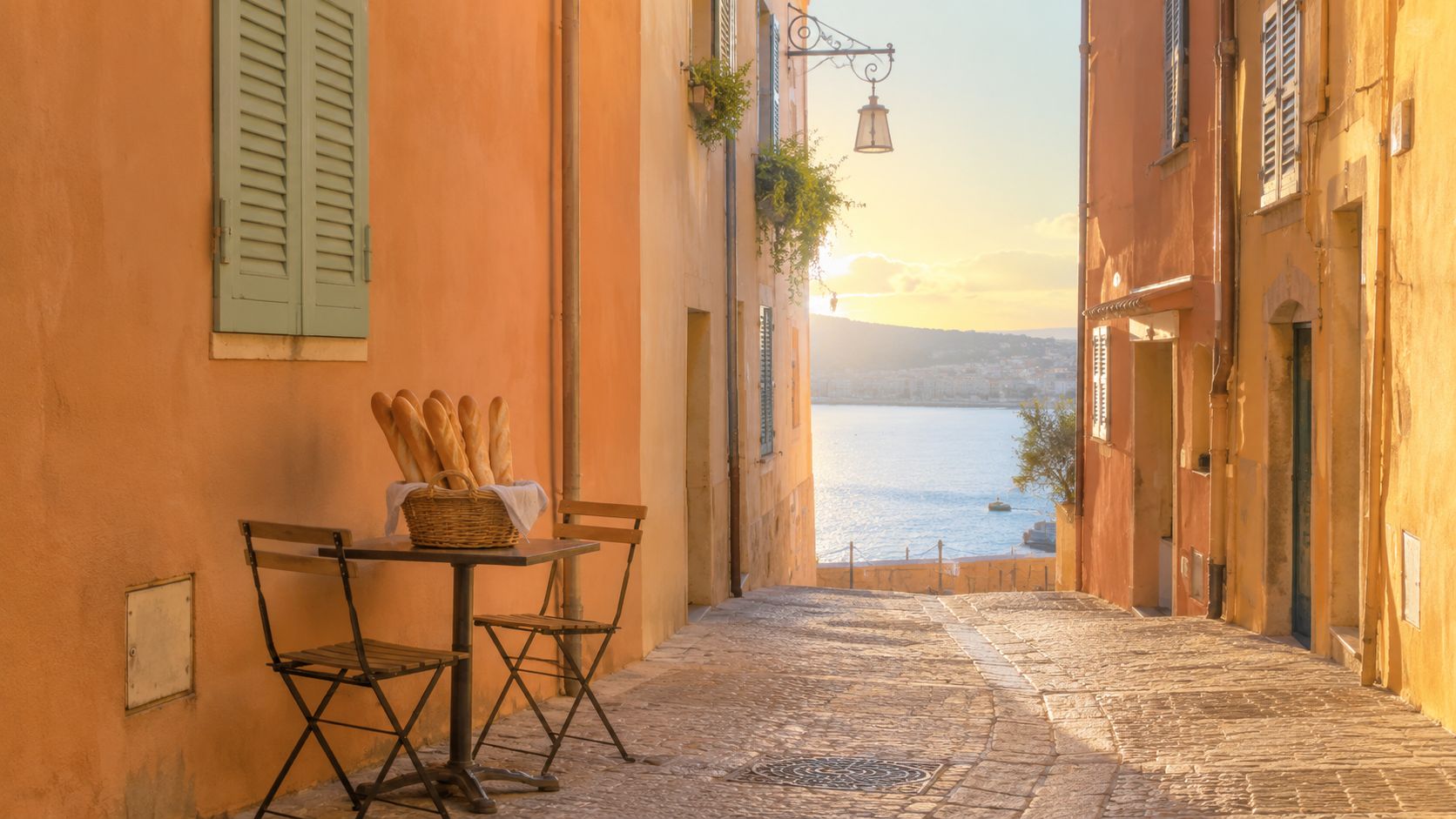
The Riviera works best when you stop trying to “do” it all. This is the itinerary for travelers who want light, pace, and repeat encounters with the same places until they feel familiar. Nice, Cannes, Antibes, Juan-les-Pins, and Villefranche-sur-Mer all reward a slower rhythm, and so do the inland villages that many visitors skip. I'd treat this as a conversation itinerary as much as a leisure one, because repeating the same café, market, or harbor walk lowers the social barrier every time.
Where to stay and how to move
Stay in Nice's Old Town, Vieux Nice, rather than defaulting to the beachfront if you want more café culture and a less polished feel. The old streets make it easier to return to the same baker, the same market stall, the same terrace. That familiarity matters more than people expect, because once a vendor recognizes you, French becomes less intimidating.
I always tell travelers to visit Cours Saleya more than once. Not because the market is “a must,” but because repetition is what creates real conversation. A first greeting is polite. The third or fourth visit is where people start asking where you're from, what you like, and whether you've tried the local specialties.
A retired diplomat I worked with rekindled her fluency in Nice after a few conversation sessions and then carried those skills into easy daily exchanges with shopkeepers and café staff. A businessman used the same region to merge work and leisure, which made his evenings feel less transactional and more human. That's the Riviera's hidden advantage, it rewards calm, not haste.
Best move: prioritize aperitif hour at waterfront cafés, then keep dinner simple in neighborhood bistros where staff have time to talk.
I'd book three or four tutoring sessions before departure, focused on café ordering, wine and food vocabulary, beach and leisure phrases, and simple social language for repeating encounters. The language doesn't need to be formal. It needs to be usable when you're relaxed.
5. The Wine Country Analysis 6 Days in Burgundy and Bordeaux
Wine travel in France gets better when you treat it as a conversation rather than a tasting checklist. Burgundy and Bordeaux both support that approach, because each region invites talk about vineyards, vintages, and style, and both reward travelers who can join in with the right words over the glass. If you are booking this kind of itinerary, you are already thinking like a planner instead of a spontaneous wanderer, which matches the fact that many French holidays are arranged in advance and paid before departure. That same planning habit works very well for winery appointments.
Start speaking before the first pour
I'd divide the time evenly between three days in Burgundy and three days in Bordeaux. Burgundy suits travelers who want a tighter focus on Pinot Noir and Chardonnay. Bordeaux gives you broader estate variation, from Left Bank to Right Bank, and more room to compare tasting styles. Both regions reward scheduled visits, because the best conversations happen when staff have enough time to talk with you.
Tell wineries that you are learning French when you book tastings. The tone shifts immediately.
I have seen that play out in practical ways. A New York sommelier completed an eight-session wine French intensive and went on to build consulting relationships with producers. A Manhattan couple preparing for wine certification used wine-focused French to get more informal barrel tastings and longer producer conversations. Those results were not magic. They came from knowing the vocabulary that makes serious wine people take you seriously.
I would make the preparation very specific:
- Tasting terms, so you can describe what you smell and taste.
- Producer conversation language, because good questions matter.
- Reservation French, since many visits are arranged ahead of time.
- Restaurant wine talk, because local meals often extend the learning.
- Family-owned winery etiquette, which often feels more personal than larger operations.
The conversations later in the trip should feel less like a performance and more like a shared interest. That is where French becomes useful, not decorative.
Learning French through French wine fits well if your trip centers on tastings, cellar visits, and the kind of conversation that makes producers open up.
I also recommend slowing the evenings down. In small neighborhood restaurants, staff have more room to explain the bottle, the dish, and the regional connection, and that is often where the trip starts to feel memorable. Wine country stays with you when the language is part of the tasting, not separate from it.
6. The Literary and Artistic Pilgrimage 9 Days Tracing French Creative Legacy
A literary and artistic trip to France works best when you treat each stop as a chance to listen, read, and respond. Paris, Giverny, Arles, and Provence each offer a different way into French creative life, but the experience changes when you can speak about what you are seeing with more than guidebook phrases. I have found that these trips invite some of the best spontaneous conversations, because museum staff, guides, and even café owners often open up when you ask a precise question in French.
Begin with a reading-and-looking rhythm
Start in Paris with literary neighborhoods and artists' homes, then move on to Monet's Giverny, Arles, and the Provence sites connected to Cézanne. Give the trip time to breathe. A quieter pace gives you room to notice details, return to ideas later in the day, and ask better questions than you would in a rushed circuit.
I have seen this play out with travelers who prepared in advance and then got more from the trip than simple sightseeing. An Ivy League literature professor I know used an eight-session art and literary French program before a museum-heavy visit and ended up speaking with guides and academics in ways that supported collaborative research. A Manhattan writer used advanced conversation French while researching a novel, then brought those local exchanges back into her professional network. In both cases, the language did more than solve practical problems. It opened intellectual access.
A few habits make the days more productive:
- French-speaking museum guides, booked ahead of time.
- Small-group literary tours, because the setting invites discussion.
- Early visits to artist homes, when the rooms are less crowded.
- Café time for note-taking, since ideas settle better when you pause.
- A few focused tutoring sessions, centered on art, literature, and opinion language.
If you can ask a guide a thoughtful question in French, you stop being just another visitor.
The difference is easy to feel. You begin to speak about style, context, and interpretation instead of only identifying names and dates. You also notice that a conversation in French often changes the pace of the day, which matters on a trip built around reflection. For this itinerary, that deeper exchange is the true reward.
7. The Remote Worker Extended Stay 3-4 Weeks Living Like a Local
Remote work in France sits in an awkward middle ground at first. You are not a tourist rushing through sights, and you are not fully settled either. That in-between stage is exactly where the best progress happens. If you want to work from France for a few weeks, choose one main city, such as Paris, Lyon, Bordeaux, or Nantes, then spend a second stretch in a smaller town. Repetition in one neighborhood builds routines, and those routines are what make everyday French stick.
The first week is for routine, not perfection
I would tell any remote worker to use the first week to build a stable rhythm before trying to make the trip feel optimized. Pick a café, learn the grocery store, figure out your commute, and get comfortable ordering the same things more than once. The awkwardness is normal. It usually fades once the place starts to feel predictable.
One Manhattan marketing executive paired weekly online tutoring with a four-week stay in Lyon and moved from intermediate to advanced conversational French over the course of the trip. A freelance designer in Nantes worked from cafés, kept twice-weekly sessions, and accelerated her acquisition in just a few weeks. Those results came from steady use, not cramming.
The structure I trust looks like this:
- Choose strong co-working infrastructure, so work does not take over the trip.
- Book long-term stays, because monthly rates often make the stay more practical.
- Keep tutoring consistent, ideally twice a week throughout the stay.
- Return to the same café, so staff start recognizing you.
- Join one local activity, such as a hiking club, cooking class, or book group.
- Expect some initial discomfort, because that discomfort is part of the adjustment, not a sign of failure.
Language preparation changes this itinerary more than people expect. A remote worker who can ask for help, solve a housing issue, or chat with a café owner in French gets more than convenience. The trip starts to feel lived in instead of rented. That is the core payoff for adults who want French to become functional, not just decorative.
8. The Student Exchange Preparation 6-Months Pre-Departure Intensive Path
For students heading into a French exchange, the smartest itinerary starts long before the flight. I mean that. The strongest outcomes come from a six-month preparation window, because students need time to build confidence in conversation, classroom language, and the daily logistics of living abroad. In practice, that means the trip begins at home with repeated exposure, correction, and role-play.
Don't wait until the last semester
Four months is too short for substantial advancement if the student is starting from a low or uneven base. Six months gives enough room to build habits, not just memorize phrases. Twice-weekly sessions tend to work well because they keep French active without overwhelming a student's school workload.
A Columbia student's daughter completed twice-weekly private sessions before her exchange and arrived reading French literature fluently. She went on to earn a 3.8 first-semester GPA and extended her study at the Sorbonne. Twin brothers from a bilingual family followed a similar long-prep path before a Swiss immersion year, and their parents described the experience as transformational. That's what happens when preparation covers both language and the reality of independent student life.
I'd focus the program on:
- Academic vocabulary, tied to the student's actual courses.
- Homestay dynamics, so everyday living feels less intimidating.
- Banking, housing, and healthcare French, because real life starts immediately.
- School systems and social customs, so the student understands context.
- Anxiety reduction, because confidence is part of fluency.
Students do better when they rehearse real-life situations before they ever need them abroad.
I also like to combine private tutoring with classroom study whenever possible. The private work fills the gaps that larger classes leave behind, and it lets us address weak spots early, before they become real problems abroad.
8 French Travel Itineraries Compared
| Itinerary | 🔄 Complexity | ⚡ Resources | ⭐ Expected Outcomes | 📊 Ideal Use Cases | 💡 Key Advantages |
|---|---|---|---|---|---|
| The Classic Paris-Provence Romance: 10 Days of Iconic French Culture | Moderate, multi-city (Paris + Provence) logistics, flexible pace | 10 days; mid-range hotels €80–180/night; Paris–Provence train €50–80; 4–6 pre-trip tutoring sessions | ⭐⭐⭐⭐, strong cultural immersion and conversational practice in varied settings | First-time visitors seeking cultural depth, photography, leisurely exploration | Balanced mix of landmarks + local life; good for organic French practice (book markets, 5th/6th arr.) |
| The Business Traveler's French Intensive: 5 Days in Paris Plus Regional Headquarters | Low operational complexity but high prep for meetings and schedules | 5 days; business hotels €150–250/night; travel €50–120; 8–12 intensive tutoring sessions ($125/session corporate) | ⭐⭐⭐⭐, high business communication confidence and negotiation readiness | Executives, negotiators, short-business missions requiring fast impact | Time-efficient, targeted vocabulary for meetings; recommend arriving a day early and industry-specific prep |
| The Family Budget Explorer: 8 Days Across Multiple Regions with Kids | Moderate–High, multiple moves (4 locations) add logistics | 8 days; family guesthouses €70–150/night; regional trains/car; group kids' lessons (4–6 weeks) | ⭐⭐⭐, good natural language exposure for children; memorable family experiences | Families with school-age children seeking varied, budget-conscious travel | Kid-focused activities, varied regions to avoid boredom; use guesthouses and morning markets for practice |
| The Riviera Escape: 7 Days of Mediterranean Coastal Living | Low, single-base with day trips simplifies logistics | 7 days; Nice/Cannes hotels €110–240/night (peak high); regional transport €25–50/week; 3–4 leisure tutoring sessions | ⭐⭐⭐, solid conversational gains in relaxed, repetitive social settings | Luxury/leisure travelers seeking relaxation, café culture, and local rapport | Consistent base fosters repeated interactions; stay in Old Town and frequent markets/cafés for practice |
| The Wine Country Deep Dive: 6 Days in Burgundy and Bordeaux | Moderate, focused regions with scheduled tastings and reservations | 6 days; region hotels €100–180/night; flights/trains €50–120; 8-session wine French intensive ($125/session) | ⭐⭐⭐⭐, strong industry-level vocabulary and networking within wine culture | Wine professionals, sommeliers, serious enthusiasts seeking producer access | Direct engagement with winemakers and sommeliers; book tastings in advance and request family estates |
| The Literary & Artistic Pilgrimage: 9 Days Tracing French Creative Legacy | Moderate, museum bookings and timed visits require planning | 9 days; neighborhood hotels €100–160/night; regional transport €80–150/week; 3–4 art/lit tutoring sessions ($110/session) | ⭐⭐⭐⭐, deep thematic vocabulary and enriched cultural conversations | Writers, academics, art lovers seeking contemplative, museum-centered travel | Thematic focus enables meaningful dialogue; book French guides and small-group tours |
| The Remote Worker Extended Stay: 3–4 Weeks Living Like a Local | Medium, longer-term logistics (accommodation, connectivity) but simpler day-to-day | 3–4 weeks; monthly Airbnb €600–1,200; co-working €60–150/month; pre 4–6 sessions + twice-weekly tutoring during stay | ⭐⭐⭐⭐⭐, highest practical daily-life fluency and community integration | Remote professionals, digital nomads, those seeking genuine immersion and routine | Routine + necessity accelerate acquisition; secure long-term stay and local routine (cafés, clubs) |
| The Student Exchange Preparation: 6-Months Pre-Departure Intensive Path | High, sustained 6-month schedule and progress tracking required | 6-month program; ~48 sessions; $95–125/session; total ~$4,560–6,000; in-person or online options | ⭐⭐⭐⭐⭐, very high readiness for academic, social, and practical exchange demands | High school & university students preparing for semester/year abroad | Comprehensive academic and life-skill prep; begin ≥6 months out and maintain twice-weekly sessions |
Choose Your Path A Comparison of French Itineraries
The easiest way to choose a French travel itinerary is to start with your real goal, not your dream Instagram board. Do you want romance, business efficiency, family momentum, wine education, artistic depth, remote-work immersion, or student readiness? Each of these itineraries supports a different kind of trip, and each one changes what kind of French you need before you board the plane.
The biggest pattern across all eight is simple. Travelers who prepare language before departure get more out of every stop. They ask better questions, make faster decisions, and feel less trapped by uncertainty. That matters even more in a country where domestic and regional movement shape travel so strongly, and where structured, advance-planned trips fit the way people already book, budget, and move around France. Official tourism data shows how domestic and multi-night travel sit inside the French market, and that makes a language-first itinerary feel more practical than ever. France's tourism and travel-market summaries and the 2023 market overview both point in the same direction, travelers respond best when plans are structured and bookable.
If you want the most balanced first trip, I'd start with Paris and Provence. If you need work-ready French, go straight to the business itinerary. If your priority is family confidence, the multi-region route gives kids more chances to interact naturally. For slower immersion, the Riviera and remote-worker stays are hard to beat. For depth, the wine and literary itineraries reward travelers who want conversation, not just scenery.
I've seen the difference language prep makes too many times to call it a small detail. It changes how people greet you, how long they keep talking, and how comfortable you feel saying yes to the unexpected. That's why the right French travel itinerary isn't just about place. It's about preparing your voice for the trip you want.
Ready to plan a trip that feels personal instead of patched together? Book your free 20-minute consultation with Elite French Tutoring, and we'll help match your itinerary with the French you'll use, whether you're traveling for family, work, study, or a once-in-a-lifetime adventure.