Skip to content


Your phone map has frozen at a street corner, a stranger is walking past, and you're trying to remember what comes after Excusez-moi. You manage the question. Then the answer arrives too quickly, and you're still not sure which way to turn.
When I teach how to ask directions in French, I focus on that second moment: keeping the conversation going until you know where to go. If you're choosing travel French lessons, that's the skill to look for, not just a polished opening question.
Table of Contents
- Core Phrases for Asking Directions in French
- How to Ask a Stranger Step by Step
- Sample Dialogues at the Station and the Shop
- What to Say When You Miss the Answer
- Politeness and Regional Differences Across Francophone Places
- Book a Free Call to Practice Your Route
Core Phrases for Asking Directions in French
A useful request has three parts: get attention, name your destination, and confirm what you heard. You don't need an elaborate sentence. You need wording you can retrieve while someone waits.
Start with Excusez-moi. It works with strangers without requiring you to judge how formal the situation is. Then choose a destination question from this comparison.
Direction phrases by register and pronunciation
| French phrase | English meaning | Register | Say it like |
|---|---|---|---|
| Excusez-moi | Excuse me, to get attention | Neutral, works with any stranger | ex-kew-zay-MWAH |
| Pardon | Pardon me, a quick interruption | Informal, similar age, but also used more widely | par-DON |
| Pour aller à… ? | How do I get to…? | Neutral, short and direct | poor ah-lay ah |
| Pourriez-vous m'indiquer comment aller à… ? | Could you tell me how to get to…? | Formal, polite | poo-ree-ay-VOO man-dee-kay koh-mahn ah-lay ah |
| Tu peux me dire comment aller à… ? | Can you tell me how to get to…? | Informal, friends and young people you know | too puh muh deer koh-mahn ah-lay ah |
| Où est… ? | Where is…? | Neutral, any place | oo eh |
| Vous pouvez répéter, s'il vous plaît ? | Could you repeat, please? | Formal | voo poo-vay ray-pay-TAY seel voo PLAY |
Pour aller à… ? is a sentence fragment, but it's a practical spoken question. Add the destination: Pour aller à la gare, s'il vous plaît ? means “How do I get to the station, please?”
Où est… ? asks where something is. France's official tourism site uses this pattern for asking a passerby about the village of Saint Paul. For a plural destination, change est to sont: Où sont les toilettes ?
Treat the pronunciation column as a starting aid, not an exact transcription.
- Phrase rhythm: Give a gentle emphasis to the final pronounced syllable of a phrase group, rather than stressing every word.
- Silent endings: Don't pronounce the final s in vous or the final t in plaît in these examples.
- Nasal vowels: In bon and pardon, let the vowel resonate through your nose without adding a hard n.
Try a 60-second practice round: say each phrase aloud three times, then ask an imaginary passerby a complete question in the mirror. Keep our common French phrases for travelers nearby if you also need greetings and everyday requests.
How to Ask a Stranger Step by Step
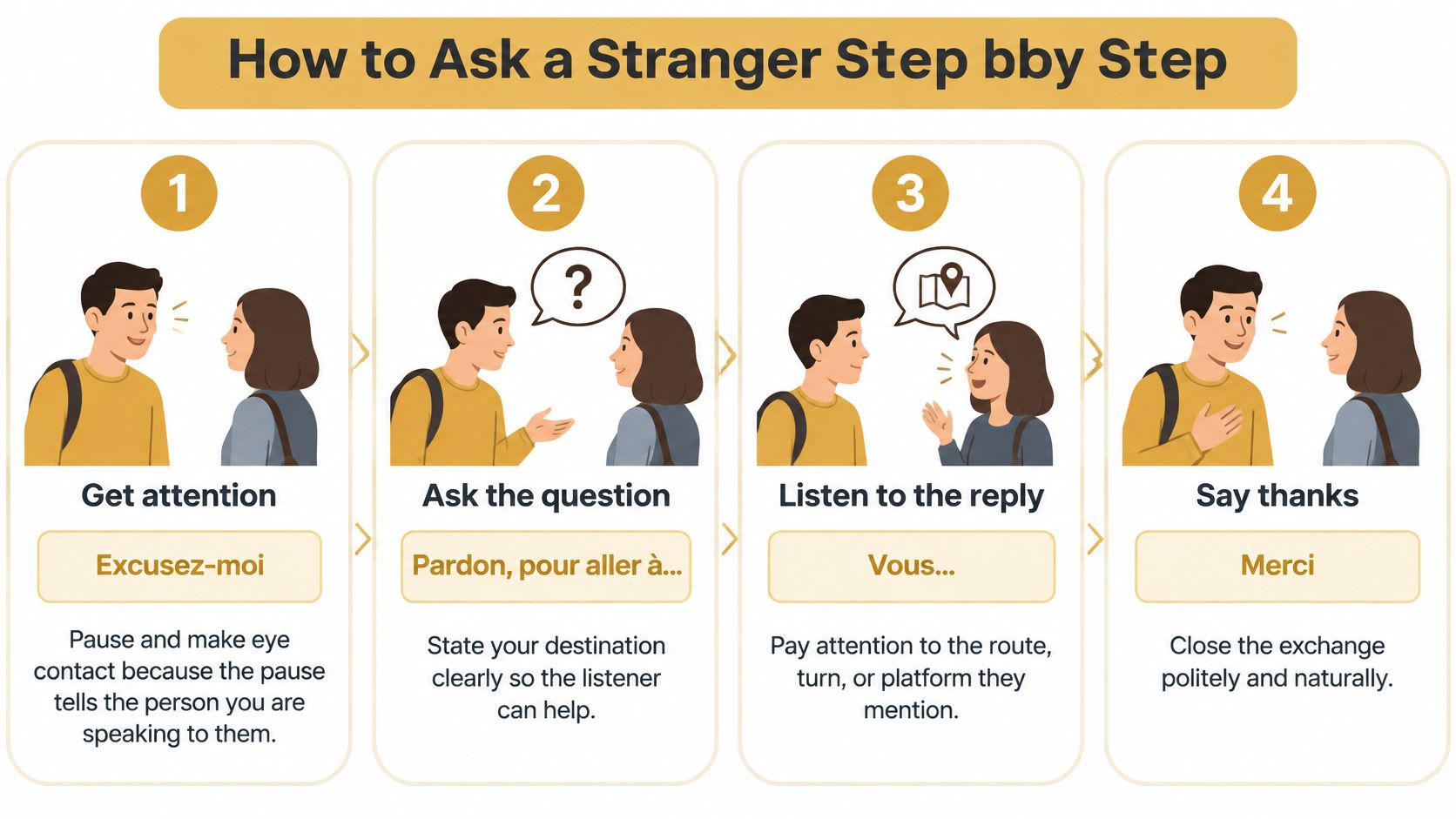
I recommend practising the exchange as a sequence, not memorising it as a speech. Leave space for the other person to respond.
Get attention. Say Excusez-moi, pause, and make eye contact. That pause helps the stranger recognise that you're speaking to them.
State the destination. Try Pour aller à la gare, s'il vous plaît ? or Pouvez-vous me dire comment aller au musée ? Keep the destination clear rather than adding your travel history.
Decode the route. Listen for Allez tout droit (go straight), tournez à droite/gauche (turn right/left), and prenez la première rue (take the first street). Puis means “then,” while ne… pas signals a negative, as in Ne tournez pas.
Verify before leaving. Repeat the route starting with the first landmark, then ask C'est loin ? if distance matters. Finish with Merci once you understand.
Use this visual reminder to rehearse the opening, listening, and polite closing.
Direction words to listen for
| French | English | Use it when |
|---|---|---|
| Tout droit | Straight ahead | The route continues forward |
| À gauche | To the left | A turn or a landmark on the left |
| À droite | To the right | A turn or a landmark on the right |
| Au coin | At the corner | A landmark at the intersection |
| En face | Opposite | A landmark across the street |
| Puis | Then | Marking the order of steps |
| Sens unique | One way | A road sign you may see while walking or driving |
| Cédez le passage | Give way | A road sign at an intersection |
The road-sign meanings of sens unique and cédez le passage also appear in the RAC's French road-sign guide.
Hear the instruction, then repeat it
The Open University's directions lesson explains that formal imperatives drop the subject: Vous continuez tout droit becomes Continuez tout droit. If you're giving instructions yourself, use tournez, not the infinitive tourner.
Suppose you ask for the museum and hear:
Continuez tout droit, puis prenez la deuxième à gauche.
That means “Continue straight, then take the second left.” Check it with Donc, tout droit, puis la deuxième à gauche ?
These exchanges matter beyond France. The International Organisation of La Francophonie reported 321 million French speakers worldwide in 2022, as summarised in the University of Minnesota's Francophone studies chapter. Practise with an unfamiliar map until you can follow a route and interrupt politely when something is unclear.
Sample Dialogues at the Station and the Shop
A station employee may give directions differently from a shopkeeper. The useful habit is the same: identify the action, then confirm the place you need.
Use the following station scene as an imagined role-play, not as directions for a particular Paris station.
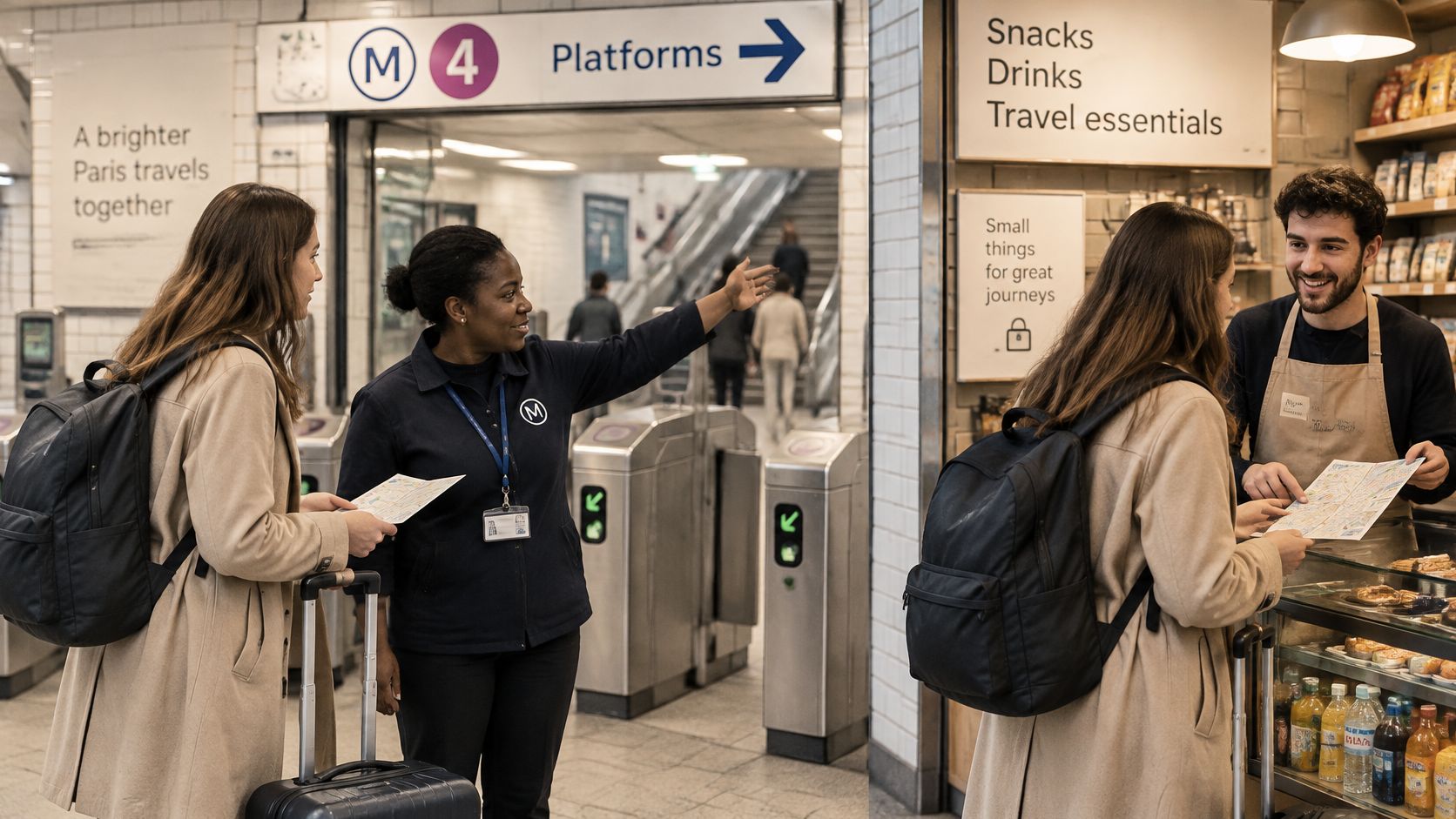
Finding a métro connection
You: Bonjour. Pardon, pour aller à la ligne 4, c'est où ?
Hello. Excuse me, where do I go for line 4?
Employee: Vous prenez l'escalator, puis vous suivez les panneaux bleus.
Take the escalator, then follow the blue signs.
You: Où est la correspondance ?
Where's the connection?
Employee: Au bout du couloir, à droite. Ensuite, suivez les panneaux de la ligne 4.
At the end of the corridor, on the right. Then follow the signs for line 4.
You: Pour choisir le quai, je regarde la direction indiquée ?
To choose the platform, do I check the direction shown?
Employee: Oui, vérifiez la direction avant de descendre sur le quai.
Yes, check the direction before going down to the platform.
You: D'accord, merci beaucoup.
Okay, thank you very much.
The phrase that keeps this exchange useful is Où est la correspondance ? You're narrowing the question rather than starting again. Remember sortie for exit, correspondance for connection or transfer, and quai for platform.
France's official tourism site describes highly developed train, tram, métro, and bus networks. Include bus questions in your practice too: Où est l'arrêt du bus 72 ? means “Where's the stop for bus 72?” To ask about a change, use Où dois-je changer de ligne ?
For a listening-practice break, try repeating useful phrases aloud as you watch.
Asking inside a boulangerie
You: Bonjour. Excusez-moi, la pharmacie la plus proche, c'est où ?
Hello. Excuse me, where's the nearest pharmacy?
Shopkeeper: Au coin, à gauche, puis c'est juste en face.
At the corner, turn left, then it's just opposite.
You: En face de la boulangerie ?
Opposite the bakery?
Shopkeeper: Non, en face de la banque.
No, opposite the bank.
You: D'accord. Merci beaucoup, bonne journée.
Okay. Thank you very much, have a good day.
En face de la boulangerie ? carries the exchange because it exposes a misunderstanding before you leave.
Swap the destination for l'école, l'hôtel, or le musée, then say the exchange aloud. Our French conversation questions and answers can help you extend the role-play beyond directions.
What to Say When You Miss the Answer
You ask clearly. The stranger answers fast. You catch gauche and the rest blurs. Your question did not fail. You now need repair moves.
The Collins guide to asking directions includes follow-ups such as Par où ? and Comment y aller ? A location alone does not tell you how to reach it, so these small questions keep the route usable.
Use them as a ladder. Start at the top and stop when you understand again:
- Request repetition: Pouvez-vous répéter ? means “Could you repeat?”
- Reduce the speed: Plus lentement, s'il vous plaît. means “More slowly, please.”
- Check the direction: C'est bien par ici ? means “Is it this way?” Point toward the route you mean.
- Identify the street: Je dois prendre quelle rue ? means “Which street should I take?”
- Check walking time: C'est à combien de minutes à pied ? means “How many minutes on foot?”
Repeat the first landmark before you try to hold the whole route. Say Donc, jusqu'à la banque ? Once that part is confirmed, ask for the next turn. Confirm the first landmark and the final landmark before you leave.
If someone points and says Là-bas, answer Je vois, merci only when you see the target. Otherwise ask À côté de quoi ? That phrase means “Next to what?” and it forces a concrete reference point. Our advice on recovering from embarrassing language mistakes explains how to stay in the conversation instead of retreating.
Check whether the route works for you
Specify à pied for walking, en voiture for driving, or en transports en commun for public transport. A correct route for one mode may not suit another.
Ask Est-ce que la rue est ouverte ? when access is uncertain. Check closures and access with local or regional tourist offices. For mobility needs, ask Y a-t-il un accès pour les fauteuils roulants ? and ask transport operators about wheelchair access.
Politeness and Regional Differences Across Francophone Places
How do you sound polite without sounding robotic? Choose wording that fits the person, then speak naturally.
Politeness choices by situation
| Situation | Form to use | Opening line | Watch for |
|---|---|---|---|
| Adult stranger in France | vous, with Bonjour first | Excusez-moi, pourriez-vous m'indiquer… ? | Avoid tu unless invited |
| Child or friend | tu | Tu peux me dire… ? | Use vous with unfamiliar adults |
| Police officer or official | vous, formal | Pardon, monsieur, pourriez-vous… ? | Keep the request short and specific |
| Shop or transit staff | vous, with Bonjour | Bonjour, pour aller à… ? | Thank them and close politely |
| Someone already helping you | vous | Merci, je vois | Don't repeat a question already answered clearly |
Politeness is interactional, not just grammatical. Your greeting, acknowledgement of the interruption, request, and thanks all contribute. The Connexion's explanation of tu and vous helps explain why choosing the right form matters.
With an adult stranger, vous avoids assuming familiarity. With a friend or child, tu can fit naturally. Don't choose tu solely because an unfamiliar adult looks young.
With an official, Pourriez-vous… ? gives you a respectful opening without requiring a long speech. Monsieur is appropriate when addressing a man, but you can omit the title and say Pardon, pourriez-vous… ?
These everyday settings call for slightly different openings.
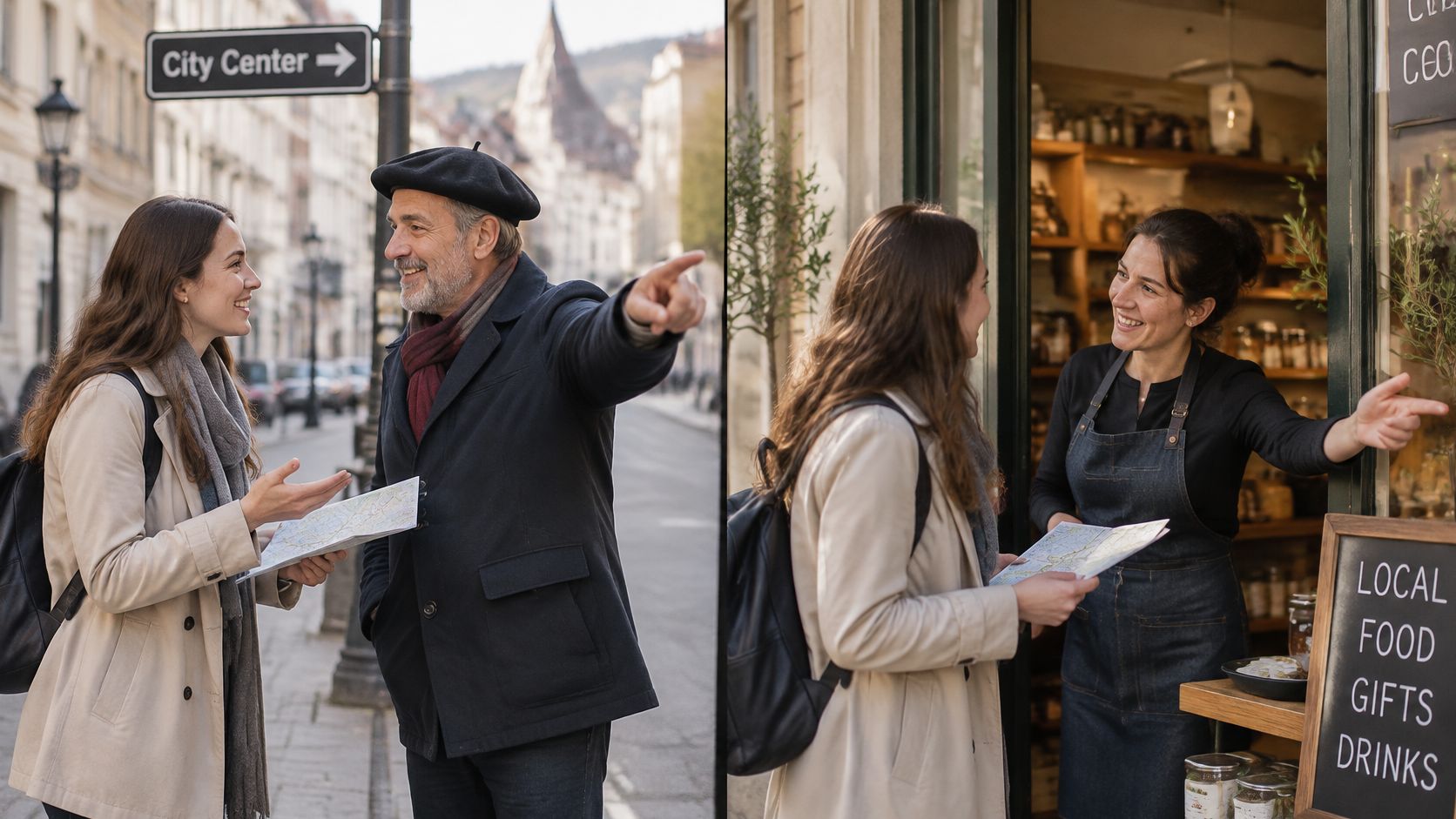
Adapt without guessing
A grammatically correct question can still sound demanding if you deliver it as an order. A Journal of French Language Studies study of request perspectives examines requests in formal and informal role-play contexts, including asking strangers for directions.
My practical recommendation is to begin with a respectful request, then respond naturally. If someone has already offered help, you don't need to restart with your longest memorised sentence.
You can be brief and courteous at the same time. A greeting and a clear question are more useful than a formal sentence you can't finish.
Across Francophone places, vous with unfamiliar adults is a safe starting point, not a claim that every community follows identical customs. Listen for local destination and transport vocabulary, and reuse the words your helper uses when confirming.
If an unfamiliar regional term appears, ask Qu'est-ce que ça veut dire ? (What does that mean?). You don't need to pretend you understood. Our guide to French language rules and etiquette offers more context for choosing an appropriate tone.
Book a Free Call to Practice Your Route
A phrase sheet lets you rehearse what you'll say. A live partner lets you practise what happens when the answer isn't what you expected.
Before choosing lessons, try a map task with a friend. Use two unfamiliar maps, and ask your partner not to reveal the route in advance.
Check what you can actually do
- Polite opening: Use Excusez-moi and include Bonjour when addressing staff. Record whether you used a polite marker in each attempt.
- Destination question: Ask Pour aller à… ? with a specific destination.
- Route understanding: Note at least three route steps, including the turns or landmarks.
- Repair move: Use Pouvez-vous répéter ? or another clarification question when you lose the route.
Don't mark yourself down for needing repetition. The useful distinction is whether you recovered or walked away uncertain.
Choose support for the part that breaks down
| Practice option | Best suited to | What to check |
|---|---|---|
| Phrase sheet and solo rehearsal | Retrieving your opening question | Can you speak without reading? |
| Map role-play with a friend | Following a changing route | Can your partner vary the answer? |
| Private French lessons | Correcting listening, pronunciation, or register | Does practice include unexpected replies and clarification? |
At Elite French Tutoring, we offer private French lessons in-home or online. Our complimentary 10–20 minute call includes an assessment of your French level, so you can discuss the gaps that matter for your trip or relocation.
David, a marketing professional preparing to relocate to Paris for work, became fluent in French in 90 days after starting an intensive French course. His result isn't a promise of the same timeline for everyone. It's a concrete example of a learner working toward a specific real-world goal.
Your immediate goal can be smaller: ask for a route, understand the next action, and clarify anything you missed. That's a useful starting point for deciding what support you need.
To book your complimentary call, contact Elite French Tutoring at (212) 470-2128. Bring a route you want to practise and ask about rehearsing the full exchange with a tutor, including the moment when you need the answer repeated.