Skip to content


You've got the offer, or you're close to one, and now the key question hits. Can you just fly to France, open your laptop, and start? We see Americans ask this every week, usually after they've already priced flights. The honest answer is no, and the reason isn't one rule. It's three separate systems that don't talk to each other: immigration permission, tax residence, and social security. Get one right and the other two can still trip you up. Add workplace French to that mix, and you've got the difference between a move that works on paper and a move that works in your first team meeting. I'll walk you through how to choose your route, file in the right order, and build the French you'll use at work.
Table of Contents
- Pick Your French Work Route Before Anything Else
- How to Get Your Work Permit Approved, Step by Step
- Tax and Social Security Rules Most Guides Skip
- Where American Candidates Find French Jobs
- How Much French Your Job Really Requires
- Workplace Norms That Surprise Americans in France
- Choose Your French Lesson Format
Pick Your French Work Route Before Anything Else
Say you're an engineer offered a role in Lyon. The start date is in six weeks, HR says "we'll sort the paperwork," and you assume a visitor visa will cover your first months while things settle. That assumption is where most problems start. A visitor visa doesn't authorize paid work in France, so working from a Lyon apartment on visitor status puts you and your employer at risk from day one.
Your route depends on three facts, not on your passport alone. How long will the assignment last? Who is your legal employer, a French entity or a U.S. parent? And is the role salaried or self-employed? Answer those three questions, and the right route usually becomes clear.
The Four Routes We Compare Most Often
Work routes for Americans in France
| Route | Typical case | Stay length | Key requirement |
|---|---|---|---|
| Short-stay visa | Salaried posting or service obligation | Up to 90 days | Visa covers the declared assignment |
| Long-stay temporary-worker visa | Contract longer than 90 days | Over 90 days | Visa must be validated online within three months of arrival |
| Talent passport | Qualifying professional or project role | Up to four years | Contract and intended stay over three months; tied to the specified activity |
| U.S. employer posting | Employee sent by a U.S. company or affiliate | Five years or less | Certificate of coverage from the employer |
The talent route deserves a closer look if your role is senior, technical, or project-based. The French Service-Public guidance on the talent residence permit confirms the employment contract and intended stay must exceed three months, and the permit can authorize residence for up to four years from arrival. That's a very different planning horizon from a one-year visa you have to renew almost as soon as you've unpacked.
The U.S. employer posting row works differently. You're not hired locally at all. Your American employer sends you, keeps you on its books, and documents which social security system covers you. Confusing that setup with a local French hire is expensive to unwind later.
Practical rule: Pick your route before you sign. Changing routes after signing usually means a new application, a new consulate appointment, and a delayed start date.
Your Ten-Minute Checklist
Grab a notebook and write down three things before you do anything else.
- Expected stay: Count the months in your contract, not the months you hope for.
- Employer name: Write the exact legal entity that will sign your contract, including the country.
- Job title and status: Note whether you're salaried or self-employed, and what the role involves day to day.
Now match those three lines to one row in the table. If you can't match them cleanly, that's useful information. It means your situation needs a professional opinion before you book anything non-refundable, not a guess. I recommend sending those three lines to your employer's HR team and asking, in writing, which route they'll file under. Their answer tells you whether they've done this before.
How to Get Your Work Permit Approved, Step by Step
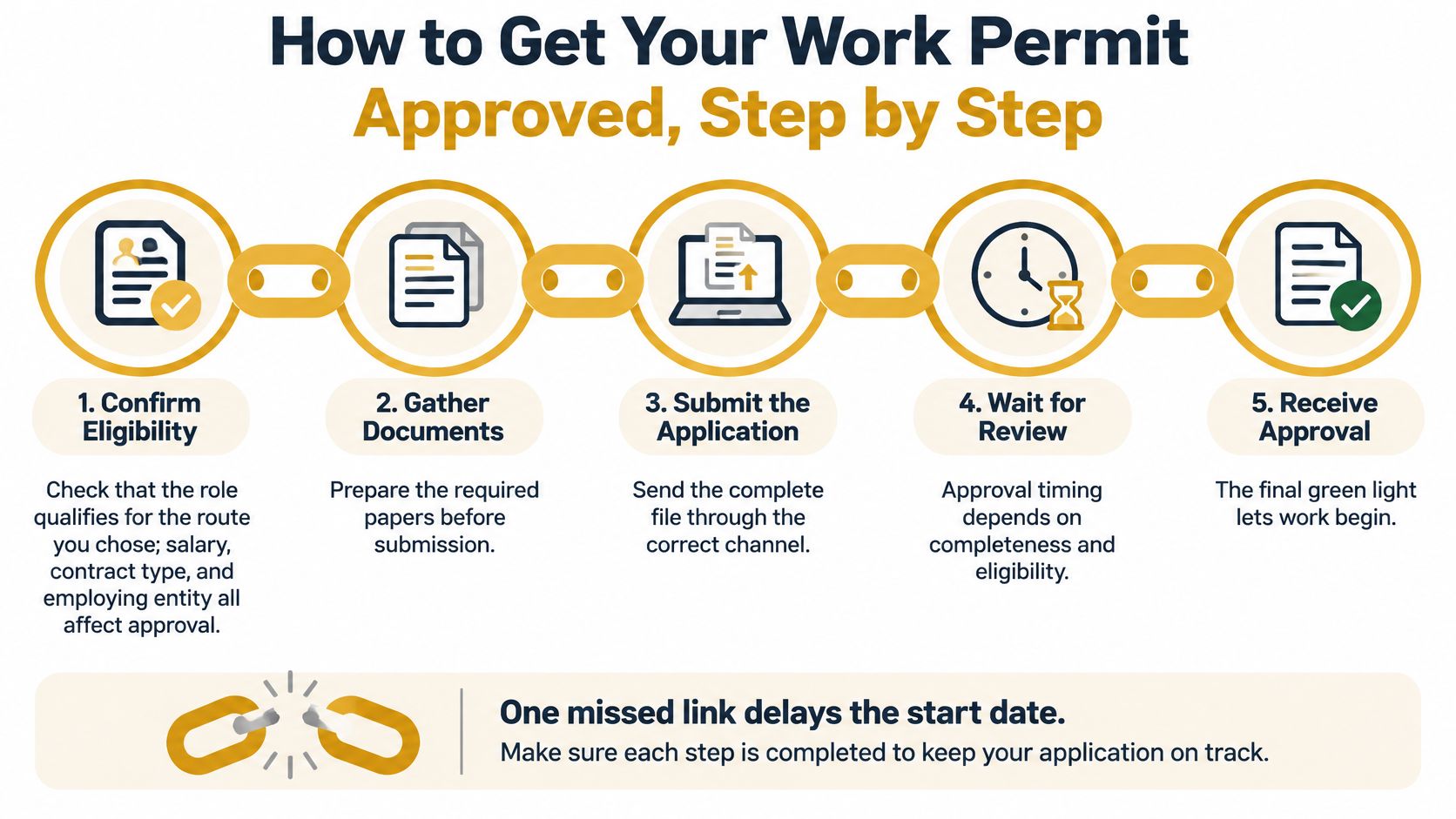
Think of approval as a chain. Each link depends on the one before it, and a weak link doesn't just slow you down, it sends you back to the start. Here's the sequence we tell our clients to follow, with the slip we see most often at each stage.
Steps One to Three Happen Before You Leave
1. Confirm the role qualifies for your chosen route. Salary, contract type, and the employing entity all affect eligibility. For talent passport roles, check first whether you need a separate work permit at all, because salaried holders may not. The slip here is assuming the job title alone settles it.
2. Have your employer start the work authorization request. Where a separate permit is required, the application is filed by your employer or an authorized agent, not by you alone, and it should start before you enter France. If HR tells you to "just handle the visa," push back politely and ask who owns the employer filing.
3. Gather your consulate documents early. You'll typically need your signed contract, an employer letter describing the role, your diplomas, and the approved work authorization once it's issued. The France-Visas page on salaried activity is clear that the approved work permit must accompany your visa application, and that assignments over 90 days generally lead to a long-stay visa marked "travailleur temporaire."
Steps Four to Six Protect Your Start Date
4. Apply at the French consulate serving your U.S. residence. Book the appointment as soon as your file is complete. Don't book non-refundable flights against a hoped-for appointment date.
5. Validate your visa online within three months of arrival. This is the classic slip. People treat the visa in their passport as the finish line, skip the online validation, and their stay can become unlawful. Put the deadline in your calendar before you board the plane.
6. Keep your permit tied to your actual job. Your permission is linked to your role and employer. A new employer, or a materially different role with the same employer, can trigger fresh immigration obligations. Tell HR before you accept an internal move, not after.
Plan the whole application months before your start date. That buffer is what turns a consulate delay into an inconvenience instead of a lost job.
Tax and Social Security Rules Most Guides Skip
Your visa answers one question: may you live and work in France? Two others stay open. Does France tax you as a resident? Which country's social security system do you pay into? Treating visa, tax residence, and social security as one question is one of the most expensive mistakes Americans make when working in France. Each system runs on its own rules, and each needs its own check before you sign a contract.
How France Decides Tax Residence
France generally treats you as tax-resident when your main professional activity is carried out there, unless that activity is merely secondary. The French tax authority guidance on the special expatriate regime explains that newly recruited expatriates may qualify for targeted relief if they were tax-resident outside France for at least five calendar years before starting work for the French recruiting company. That five-year lookback surprises people who spent earlier years in France on a posting or a degree, so check your history against it before assuming you qualify.
French tax residents are generally taxed on French and foreign-source income, subject to the U.S. and France tax treaty. Salary, investment income, equity awards, and any remote-work arrangement all belong in the same calculation. Your U.S. citizenship doesn't switch any of this off. You keep your American filing obligations on top of the French ones.
How Social Security Coverage Is Decided
Social security follows its own logic. The U.S. Social Security Administration pamphlet on the France agreement confirms coordination generally prevents coverage by both systems for the same work, and an employee temporarily sent by a U.S. employer for five years or less can generally remain under U.S. Social Security with a certificate of coverage. A locally hired employee in France normally pays French contributions instead.
Tax and social-security questions by work scenario
| Scenario | Social-security question | Tax-residence question | First document to request |
|---|---|---|---|
| Transferred by a U.S. employer for five years or less | Can U.S. coverage continue with a certificate of coverage? | Treaty review needed to resolve dual residence | Certificate of coverage from the employer |
| Hired directly by a French employer | French contributions normally apply | Likely French tax resident if work is the main activity | Employment contract and French payroll set-up |
| Remote worker for a U.S. company, living in France | Physical work location can determine French coverage | Household and centre of economic interests decide | Proof of where work is physically performed |
| Freelancer serving U.S. clients from France | Self-employed coverage under French rules | Where the main professional activity is carried out decides | Proof of French self-employed registration and client contracts |
The remote worker row deserves a second look. An employer's permission to work from France is a company policy decision. It settles nothing about your French tax residence or your social security coverage, because physical work location can drive both.
A visa that lets you live in France doesn't, by itself, settle where you're taxed or where you pay social contributions.
Your Pre-Payroll Checklist
Before your first payday in France, I recommend four moves.
- Get coordinated advice: Hire one advisor or a coordinated team covering both the French and U.S. sides.
- Model the numbers: Run payroll withholding and treaty relief on your actual salary before you negotiate, not after.
- Confirm retirement credits: Ask which system you're affiliated with and how your credits carry.
- Check account reporting: List every French and U.S. account you'll hold and confirm your foreign-account reporting duties.
Do this work once, early, and your first French tax season becomes paperwork instead of a crisis.
Where American Candidates Find French Jobs
The biggest hiring channel for Americans in France is the network of U.S. company subsidiaries already operating there. Its scale surprises most candidates who assume their only options are teaching English or tourism work.

U.S. affiliates and jobs in France
| Year | Metric | Value |
|---|---|---|
| 2023 | Jobs at U.S.-controlled companies | About 523,400 |
| 2024 | Total employed people in France (INSEE) | 30.4 million |
The French Ministry for Europe and Foreign Affairs economic report puts employment at U.S.-controlled companies at approximately 523,400 people in 2023. For context, France's statistics office reports 30.4 million employed people at the end of 2024 in its INSEE employment release. These figures count jobs at U.S.-controlled businesses, not American citizens, but they show where the institutional route runs.
That route covers internal transfers, executive assignments, technical roles, consulting, finance, technology, manufacturing, and professional services. If your background sits in any of those areas, you are looking at a mature cross-border hiring channel with established processes, not a fringe market.
A Search Approach You Can Start This Week
Check the ultimate parent company of every employer on your list. A French-sounding brand may be U.S.-owned, and that ownership often means an existing transfer process on the American side.
Then target roles that bridge American and French teams. Your cross-border experience is the pitch, so lead with it in your application rather than listing it as a footnote. Pair it with a properly structured French cover letter instead of a translated American one, because French recruiters read for different signals than U.S. hiring managers do.
This short video walks through how candidates spot those bridging roles in practice.
Ask one question early in every process: will you file my work authorization? An employer who answers clearly has sponsored foreign hires before. Treat that yes as the start of your paperwork questions, not the end. The employer's authorization filing is a separate system from your tax residence and your social security coverage, which you already saw can follow different rules.
Expect daily contact with French colleagues in almost all of these roles. Even at American subsidiaries, the subsidiary itself runs in French for most day-to-day work, so factor that contact level into your preparation timeline before the start date.
How Much French Your Job Really Requires
David, a marketing professional preparing to relocate to Paris for work, became fluent in French in 90 days after starting an intensive French course. His company ran in English on paper. His meetings, lunches, and follow-up emails didn't. That gap is the one that surprises our students most, and it's why we build his kind of preparation around workplace situations rather than textbook dialogues.
Alex's path looked different but landed in the same place. A senior project manager at a global tech firm promoted to lead cross-border operations in Europe, Alex used corporate French classes to succeed internationally. The promotion came with French stakeholders who switched languages the moment discussions got detailed.
Company Language Is Not Workplace Language
Company language is the official working language in your contract and your slide decks. Workplace language is what you need to follow a fast-moving meeting, disagree without giving offense, read a labor-related email, and build trust over coffee. The European Commission summary of French integration statistics reports that four years after admission, 89% of new arrivals speak French most often at work. English may get you hired. French is what you'll hear around you.
Employers know this, which is why training budgets reflect it. That same integration reporting notes language learning is a substantial professional-development market, and professionals who invest early tend to hear about opportunities that never get translated.
What to Prioritize First
We sequence workplace French by situation, not by grammar chapter.
- Meetings: Train your ear for speed, interruptions, and the moment colleagues switch from English to French mid-sentence.
- Email and hierarchy: Learn the greetings, sign-offs, and levels of directness that signal respect to a French manager.
- Negotiation: Build the vocabulary for proposing, pushing back diplomatically, and summarizing agreements.
- Sector terms: Add the technical words from your own projects, contracts, and reports.
Conversational fluency beats grammar perfection in almost every one of these moments. A colleague will forgive a wrong article. They won't loop you into a decision you couldn't follow. To set a realistic target, map your current level against the CEFR levels used across Europe and aim for the level your role's meetings demand, not the level a holiday requires.
Target conversational fluency for your role first, grammar polish second.
This matters beyond your own desk. If you're relocating with a family, your workplace integration often decides whether the move succeeds at all, because your confidence at work shapes everything from your energy at home to how long you stay.
Workplace Norms That Surprise Americans in France
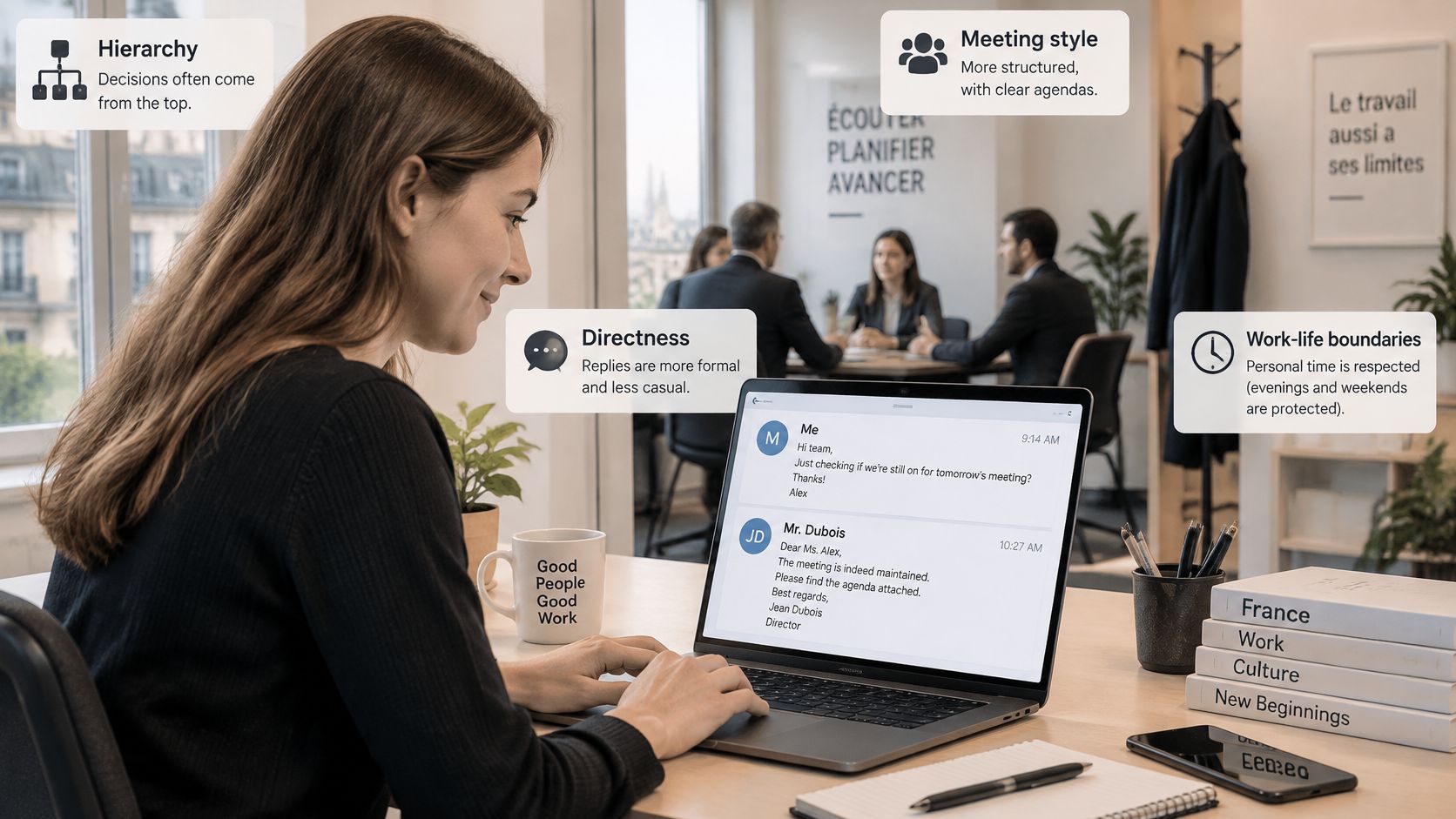
Your first week, you send a fast, friendly email to your new manager. First name, no greeting line, three quick bullets, done. The reply comes back formal and a little distant, and you spend the evening wondering what you did wrong. Probably nothing serious. You just signaled a level of familiarity your manager hadn't invited yet.
Four Norms to Learn Early
Formality comes first. French workplaces often keep more distance with managers, and colleagues use formal forms of address until someone senior suggests switching. Let the other person make that move. You'll look respectful, never stiff.
Meetings reward argument. Agendas may be followed loosely, and debate isn't a sign the meeting is failing. Disagreeing openly with a senior colleague is common when your reasoning is well built. Staying silent to be polite can read as having nothing to contribute.
Schedules run on a different rhythm. Lunch breaks are often longer and taken seriously, and the summer holiday period can slow decisions across whole departments. Plan key launches, approvals, and contract signings around that period instead of discovering it in July.
Written communication carries weight. Greetings and sign-offs aren't decoration in French business culture, they're how you show you've understood the relationship. A short, polite email with one clear request usually lands better than a long bullet list fired off between meetings.
One Habit That Fixes Most Early Mistakes
Ask a French colleague you trust to review your first three emails and the first agenda you write. Then watch how people respond over the next two weeks and adjust. You'll learn more from those small corrections than from any etiquette list, ours included, because you'll see the norms applied to your actual team, your actual manager, and your actual projects.
Choose Your French Lesson Format
You've picked your route, checked your tax questions, and named the workplace situations you need French for. Now choose a lesson format that matches that list, not a generic course. Our professional French courses are designed for people navigating opportunities in the business and corporate worlds, and they can be private, online or in-person, so the format flexes around your relocation timeline.
Three Steps From Goal to First Lesson
1. Write your target. Take your workplace goals, meetings, email, negotiation, and note the level your role requires. Bring that list to any consultation.
2. Test where you stand. Every engagement with us begins with a free 20-minute consultation to evaluate your objectives, current level, and learning style, so your programme is built specifically for you. All of our teachers are native French speakers, and private lessons are offered in-home or online.
3. Compare formats against your goals. Use this table, and if you're weighing providers, our guide to choosing among the best French schools helps you compare on teaching quality rather than marketing.
French lesson options by goal
| Option | Best for | Outcome |
|---|---|---|
| Private online sessions | Relocating professionals with tight schedules | Conversational French for meetings and email |
| Private in-person sessions | Learners who want face-to-face practice | Conversational French with pronunciation feedback |
| Business French | Employees who work in French every day | Role-specific vocabulary for negotiation and reports |
| DELF or DALF preparation | Candidates who need an official certificate | Recognised French certificate |
If Working in France as an American is on your calendar this year, don't leave your French to chance encounters in the office kitchen. Book your free consultation with Elite French Tutoring, bring the workplace goals you wrote down, and we'll map the two or three lesson formats that fit your timeline, your role, and your start date, so you arrive ready for your first meeting, not just your first day.