Skip to content

You're probably staring at a browser full of tabs right now. One school offers playful group lessons. Another promises immersion. A third says online private tutoring is the fastest route. Your child is somewhere between curious, distracted, shy, excited, and already overbooked. That's why choosing kids language classes feels harder than it should.
I've seen parents make the same mistake again and again. They choose based on age alone, or convenience alone, or whatever class had the prettiest website. Then a few months later, the child says language learning is “boring,” when the actual problem was fit. The right class format can spark momentum. The wrong one can shut a child down fast.
The good news is that there's a practical way to choose. You don't need more options. You need a decision framework that matches the class to your child's temperament, goals, and real schedule.
Table of Contents
- Your Guide to Choosing the Right Language Class
- Aligning Class Goals with Your Child's Personality
- Online vs In-Person Classes A Practical Comparison
- How to Evaluate Teachers and Curricula
- Making the Most of Trial Lessons and Measuring Success
- Next Steps Budgeting Scheduling and Enrolling
Your Guide to Choosing the Right Language Class
A parent recently described her search to me like this: “I just want my child to learn French without turning every Tuesday into a battle.” That's the main issue for most families. You're not shopping for enrichment in the abstract. You're trying to find kids language classes that your child will stay with.

Many families are searching because schools aren't filling the gap. More than 21% of U.S. households speak a language other than English at home, while only 15% of public elementary schools offer any foreign language classes, which is exactly why so many parents end up looking for private support (America the Bilingual on the language instruction gap).
That mismatch creates a lot of pressure. Parents know language skills matter, but they're left sorting through group classes, private tutors, apps, bilingual programs, and enrichment centers without a clear standard for comparison.
Practical rule: Don't ask, “What's the best program?” Ask, “What format will my child stay engaged in long enough to make progress?”
I also want parents to stop assuming that any exposure is good exposure. It isn't. Some classes are little more than themed babysitting with a few vocabulary words sprinkled in. Others are far too rigid for young learners. A child can spend months in a poorly matched class and come away with less confidence than they started with.
What works is a tighter process:
- Define the purpose: Is this for school support, confidence in speaking, heritage connection, travel, or long-term fluency?
- Profile the child: Social or reserved, fast-paced or reflective, independently motivated or externally prompted.
- Choose the format last: Online, in-person, group, and one-on-one all work in the right context.
Parents who want a broader sense of why sustained language learning matters often find it helpful to read about the benefits children gain from acquiring a second language.
If you get the match right early, everything gets easier. Attendance improves. Resistance drops. The child starts using the language instead of just tolerating it.
Aligning Class Goals with Your Child's Personality
Parents often start by filtering classes by age band. I think that's too shallow. Age matters, but personality matters more.

A talkative seven-year-old who loves games may thrive in a small group. A thoughtful child who hates being put on the spot may do far better one-on-one. A student at a French school who needs curriculum support has different needs from a child exploring French for fun on weekends. If you ignore those differences, you're guessing.
Start with the goal, not the class
At the kitchen table, I'd want you to answer one question first: what does success look like in six months?
For one family, success is simple. Their child should stop dreading French homework and feel capable in class. For another, success means conversational confidence before a move abroad. For another, it means structured preparation toward DELF or DALF later on.
Those aren't small differences. They change what kind of teacher, pacing, and lesson design your child needs.
Here's the profile I ask families to build:
Academic support or enrichment
If your child attends a bilingual or French curriculum school, you need alignment with classroom content. Random theme-based classes won't be enough.Confidence or acceleration
Some children know more than they show. They need space to speak without peer pressure. Others get bored in mixed-level groups and need faster pacing.Social motivation or low-pressure learning
Group energy can help some children. It can also overwhelm others. Don't confuse sociability with learning readiness.
A child who's quiet in a group class isn't always disengaged. Sometimes they're processing deeply and need a setting where they can respond without performing.
There's also a practical buying question parents deserve a straight answer on. Parents often lack data on whether premium one-on-one tutoring delivers measurably superior outcomes compared to group classes. For high-performing learners or those needing curriculum-aligned support, individualized learning plans can significantly accelerate fluency and reduce the “plateau effect” common in group settings, providing a better ROI for goals like DELF/DALF certification (discussion of individualized learning and ROI).
Match the format to the child
I'd simplify the decision this way:
- Choose group classes if your child feeds off peer interaction, enjoys games, and doesn't mind waiting their turn.
- Choose one-on-one lessons if your child is shy, advanced for their age, needs school support, or has a very uneven profile.
- Choose curriculum-aligned tutoring if grades, writing, reading comprehension, or oral participation at school are part of the problem.
- Choose playful exposure programs only if your goal is light introduction, not measurable progress.
A short video can help you think about how children engage with spoken language and classroom interaction:
I'm especially direct with families of perfectionist kids. They often look “easy” on paper because they're compliant. In reality, they may freeze in group settings where they fear mistakes. Those students often blossom once a tutor slows down, personalizes topics, and creates room to try, fail, and try again.
If you're considering a more personalized approach, customized programs can make sense when the lesson needs to fit the student rather than the other way around.
Online vs In-Person Classes A Practical Comparison
This debate gets framed too narrowly. Parents ask which is better, online or in-person. My answer is the same almost every time: neither. The better option is the one your family can sustain consistently and your child can engage with without constant friction.
That matters because access is already uneven. Formal school options are limited in many communities, and families often have to build their own solution outside school. That's one reason so many parents end up comparing private and supplemental kids language classes instead of relying on school offerings.
Comparing Kids Language Class Formats
| Criterion | Online Private Tutoring | Online Group Class | In-Person Private Tutoring | In-Person Group Class |
|---|---|---|---|---|
| Scheduling flexibility | Highest. Easiest for busy families and travel-heavy calendars | Good, but tied to set group times | Moderate. Depends on local availability and commute | Lowest. Fixed schedule plus travel time |
| Personalized feedback | Strong. Every minute can adapt to the child | Limited. Teacher attention is shared | Strong. Personal and immediate | Limited to moderate depending on class size |
| Social interaction | Low unless built intentionally | High | Moderate | Highest |
| Fit for shy learners | Often excellent | Mixed | Often excellent | Often difficult |
| Fit for energetic extroverts | Good if the teacher is dynamic | Often strong | Good | Often strong |
| Curriculum support | Excellent for school-aligned goals | Usually weak to moderate | Excellent | Usually moderate |
| Ease for parents | Very high | High | Moderate | Moderate to low |
| Sensory environment | Controlled and predictable | Can be busy even online | Controlled if one-on-one | Most variable |
| Best use case | Fast progress, confidence, school support | Social exposure and routine | Deep support with in-person presence | Community feel and basic ongoing exposure |
I usually tell families not to romanticize in-person learning. Yes, it can be wonderful. It can also mean traffic, late pickups, rushed dinners, and a child arriving dysregulated before class even starts. If the logistics are bad, the class won't feel magical. It will feel exhausting.
By contrast, online learning has a bad reputation with some parents because they picture passive screen time. That's not what a well-run lesson looks like. A live online private lesson can be highly interactive if the teacher is skilled and the child's attention span is respected.
How I tell families to decide quickly
If you're stuck, use these filters:
- Choose online private tutoring when your child needs flexibility, targeted support, or a calmer setting.
- Choose online group classes when you want lower-pressure exposure and your child already handles screens well.
- Choose in-person private tutoring when your child benefits from physical presence and you can manage the schedule consistently.
- Choose in-person group classes when your main goal is routine, social energy, and broad enrichment rather than tight personalization.
Convenience isn't a minor factor. If a format creates weekly stress, it will quietly sabotage consistency.
Parents comparing remote options often want to see what a strong online program involves. A useful starting point is this guide on how to find the best online French classes for kids, teens, and adults.
One more opinionated point. Don't choose group classes just because they seem more “normal.” If your child needs individual attention, group classes can become an expensive way to tread water.
How to Evaluate Teachers and Curricula
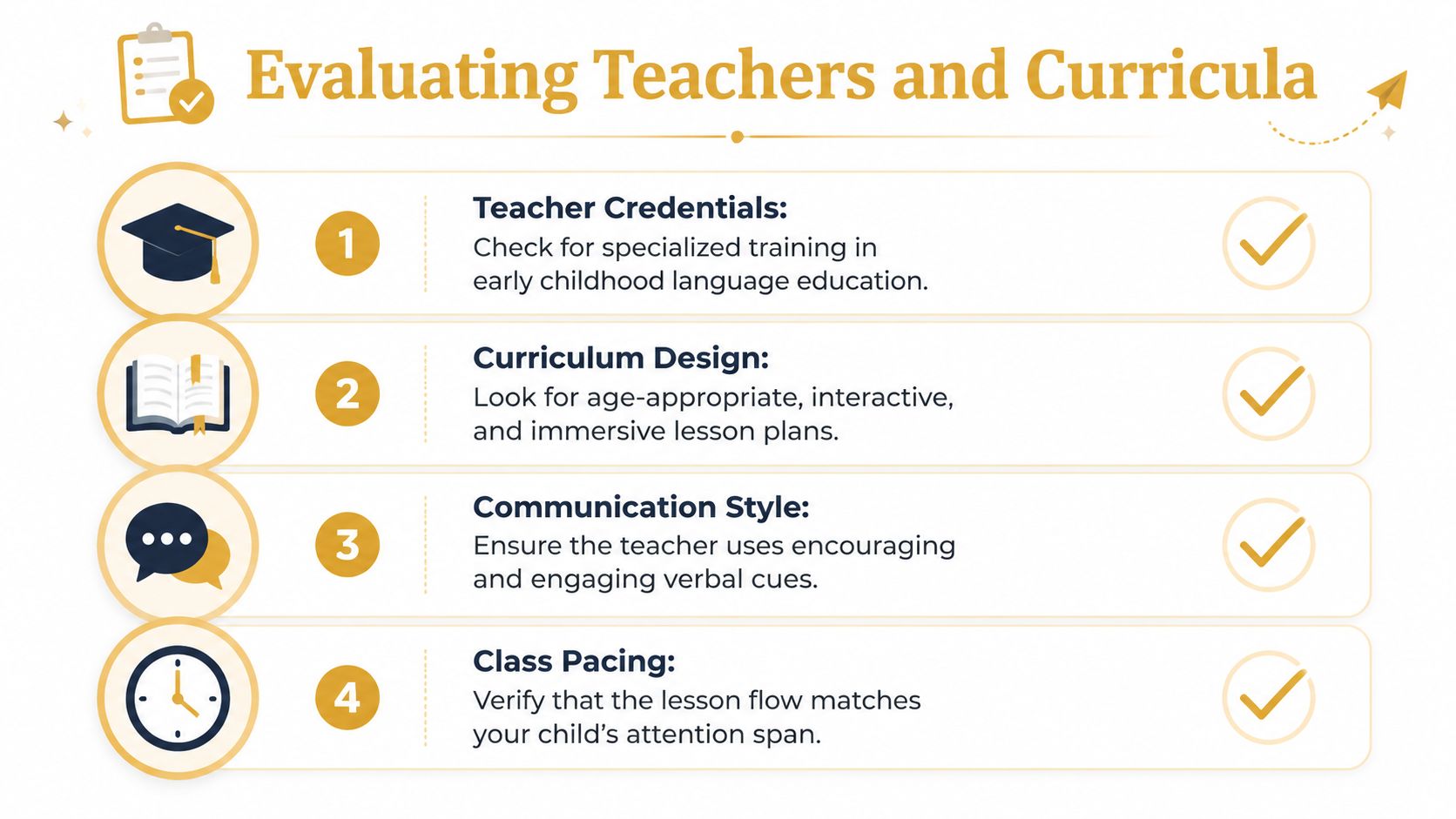
Parents often focus on format first and teacher quality second. That's backwards. A strong teacher with a smart curriculum can make online lessons excellent and in-person lessons effective. A weak teacher can waste either format.
What to ask a teacher before you enroll
Skip vague questions like “What's your style?” Ask questions that force specifics.
- Ask about age-level experience: “How do you teach a child this age when attention drops halfway through?”
- Ask for a sample lesson flow: “What happens in the first ten minutes, the middle, and the close?”
- Ask how they correct mistakes: “Do you interrupt, recast naturally, or save corrections for later?”
- Ask how they adapt: “What changes if my child is shy, distractible, or ahead of grade level?”
- Ask what progress looks like: “What would you expect my child to do after a few months that they can't do now?”
A teacher who can't answer those questions clearly usually doesn't have a real system.
The best teachers don't just know French. They know what to do when a child goes silent, gets silly, stalls out, or pretends not to care.
I'm also skeptical of programs that advertise “fun” as their whole methodology. Kids should enjoy class, yes. But enjoyment is not a teaching strategy. You need a teacher who knows how to build comprehension, confidence, and recall.
What strong curriculum design actually looks like
This is the part many parents miss. The strongest evidence for K-12 language learning points to exposure intensity and duration as the main performance drivers, more than the age at which instruction starts, and programs with more contact time and immersive activities generally outperform those built around infrequent short lessons (ACTFL summary on intensity and exposure).
That should change how you evaluate a program. Stop being impressed by “starting early” if the actual class only offers thin exposure and scattered practice.
Look for these signs of a stronger curriculum:
- High-volume understandable input: The teacher speaks in the target language in ways the child can follow.
- Repetition without boredom: Key phrases return across stories, games, reading, and conversation.
- Clear progression: Lessons build on prior material instead of hopping randomly from topic to topic.
- Output at the right time: Children are invited to speak, not pressured into constant performance before they're ready.
- Content linked to meaning: Vocabulary appears in stories, routines, visuals, and real interaction, not just flashcards.
Weak curricula tend to rely on isolated vocabulary lists, grammar worksheets, and performative speaking prompts. Children may look busy, but they aren't building durable language.
If you want to see what a structured, personalized approach can look like, French tutoring methodology pages are often more revealing than general marketing copy. One option in this space is Elite French Tutoring, which offers customized private lessons for children online and in person in New York, with programs designed for level, pace, and school needs.
Making the Most of Trial Lessons and Measuring Success
Most parents waste the trial lesson. They sit back, hope the child smiles, and then ask, “Did you like it?” That isn't enough.
Treat the trial like an assessment. You're not buying entertainment. You're checking for fit, responsiveness, and the teacher's ability to draw your child in without forcing it.
Use the trial lesson like a parent detective
During the lesson, watch three things.
First, watch your child's body language. Do they lean in? Do they hesitate but stay engaged? Do they shut down when corrected? I care less about instant enthusiasm than whether the teacher can recover attention when it drifts.
Second, watch the teacher's pacing. Good teachers notice quickly when a child needs a visual cue, a shorter task, more wait time, or a change of tempo. Weak teachers keep plowing through the plan.
Third, listen for the balance of language. Is the target language used naturally and supportively, or does the class collapse into mostly English with occasional vocabulary words?
After the lesson, ask better questions:
- “What do you remember?” This checks retention.
- “What felt easy or hard?” This reveals fit.
- “Would you want this teacher again?” Kids answer this directly.
- “What was your favorite moment?” Specifics matter more than “fun.”
If your child says, “I liked that she waited for me,” or “He made it less scary,” pay attention. That's often the start of real progress.
Parents also worry that immersion-style learning will hurt English performance. The research summary I trust most is more reassuring than the myths suggest. Some students in immersion settings may show a temporary lag in certain English literacy subskills, but that lag typically disappears within a year or two after English language arts instruction begins, with no long-term negative repercussions and, in some settings, students in bilingual programs match or outperform monolingual peers (Tara Williams Fortune's immersion research summary).
A real student story
We recently worked with Leo, an eight-year-old who was struggling in his school's group French class. He was bright, curious, and knew more than he showed, but he hated speaking in front of peers. Every week he looked less confident.
His turning point came when the format changed. In one-on-one sessions, the teacher used comics and simple storytelling connected to his interests in bandes dessinées. He started answering in short phrases. Then full sentences. Then he began volunteering ideas without being pushed.
His mother's reaction said everything: she wasn't just hearing more French. She was seeing her child's confidence return.
If your child needs motivating input between lessons, curated media can help reinforce momentum. Families often like starting with French kids shows that support language learning at home.
Next Steps Budgeting Scheduling and Enrolling
At this point, the decision usually isn't about whether language learning is worth it. It's about what your family can maintain.
That's where I get blunt. Don't enroll in a program that looks impressive but clashes with your week. Consistency matters more than ambition. A manageable plan beats an idealized one that falls apart by month two.
Teacher access is also tighter than many parents realize. Forty-four states and Washington, D.C., report shortages of qualified world language and bilingual teachers, which makes consistent, high-quality instruction harder to find (Migration Policy Institute data on teacher shortages). That's one more reason to choose carefully when you find a teacher who fits your child well.
Use a final enrollment filter:
- Budget for continuity: A modest plan you can sustain is better than an intense plan you'll cancel.
- Schedule realistically: Don't choose a time slot that depends on everything else going perfectly.
- Commit to one clear objective: Confidence, school support, conversation, or exam prep. Not all at once.
- Reassess after the first stretch: Keep what's working. Change what isn't.
If you're comparing options and want a more personalized recommendation, a short consultation can save you from choosing the wrong format and having to restart later.
If your child needs French support that's matched to their personality, learning style, and school goals, booking a brief consultation is often the cleanest next step. It gives you a realistic plan before you commit to a full program.