
You're probably weighing a real trade-off right now. A bilingual program may sound exciting, but it also raises practical questions. Will your child keep up academically? Will they feel confident in class? Is the extra support, tuition, commute, or tutoring worth it?
I've had this conversation with many families over the years. Some are choosing between an English-only school and a dual-language option. Others already have a child in French immersion at schools like Lycée Français or UNIS and can see the opportunity, but also the pressure. What they want isn't a romantic idea about language. They want to know the return on investment.
That's the right question. The profound benefits bilingual education offers aren't limited to sounding impressive at dinner or ordering croissants on vacation. Parents are making a long-term decision about academic performance, thinking skills, confidence, identity, and future work opportunities. When you evaluate bilingual education that way, the decision becomes much clearer.
Table of Contents
Is Bilingual Education Really Worth the Investment
A parent sits across from me with two spreadsheets open. One shows tuition, commute time, and after-school logistics. The other shows hopes that are harder to price: stronger communication, a lasting connection to family language, and better options later in school and work. That is the core decision. Families are not buying extra vocabulary lessons. They are judging the return on an investment that may shape a child's confidence, opportunities, and earning power for years.
I've had this conversation many times through our tutoring work. The strongest decisions usually come from parents who stop asking whether bilingual education sounds impressive and start asking what they are likely to get back for the cost, effort, and consistency it requires.
Research supports that lens. The Bipartisan Policy Center's review of family demand and outcomes in bilingual education reported strong parent demand for bilingual programs in California and found that children of immigrants who developed strong bilingual and biliteracy skills were more likely to attend college and earned an average of $5,400 more per year than peers who lost their home language and spoke only English. For parents, that is not an abstract cultural benefit. It is a long-term payoff signal.
The decision isn't just academic
A good decision starts with an authentic comparison. Compare a bilingual program to your child's actual alternative, not to an ideal school model that does not exist in your area.
Here's how I suggest families assess the return:
Academic return: Is the program strong enough in reading, writing, and core instruction to support long-term progress?
Identity return: Will your child keep a meaningful connection to family, culture, or community?
Future return: Does this path widen options for college, travel, and work?
Support return: If your child struggles at any point, can you add the right help early instead of waiting for frustration to build?
Trade-offs are real. Some programs have excellent language exposure but weak communication with parents. Others have a strong curriculum but move too fast for children who need more guided support. A bilingual program does not produce a strong return because it carries the label alone. The return comes from fit, consistency, and staying power.
The best program is the one your child can remain engaged in long enough to benefit from it.
I often compare this decision to any other serious family investment, such as music training or sport. Early effort matters, but long-term results depend on whether the structure is sustainable. If you are also weighing the broader payoff of language study, our guide on whether learning French is worth it for students and families can help you assess that choice with the same ROI mindset.
The Bilingual Brain A Mental Gym for Executive Function
A bilingual program works on more than vocabulary. It trains the management system of the brain. That's why I often describe it to parents as a mental gym. Every time a child selects one language, suppresses another, switches based on context, or adapts to a new speaker, they're practicing control, focus, and flexibility.

Research summaries report that bilingual students often outperform monolingual peers on executive-function tasks such as conflict resolution, attention control, and multitasking because the brain repeatedly practices inhibiting one language while activating another, as explained in Participate Learning's summary of dual-language cognitive benefits.
What executive function looks like in real life
Parents don't usually say, “I want stronger executive function.” They say things like, “My child loses track halfway through instructions,” or “She knows the material, but she freezes when the classroom gets busy.”
The benefits of bilingual education can become visible outside of language class. In practice, stronger executive function often looks like:
Better task switching: A student moves from reading to math to discussion with less friction.
Stronger listening control: They can hold onto directions while filtering out distractions.
More flexible problem-solving: When one approach fails, they try another instead of shutting down.
Improved self-monitoring: They notice errors sooner and correct them with less prompting.
Those aren't abstract advantages. They affect homework efficiency, test performance, class participation, and the ability to handle demanding school days without melting down.
What actually builds the advantage
Not every language setup creates the same result. Children benefit most when the program requires active, controlled language use, not passive exposure alone. A child who occasionally hears another language at home may gain familiarity. A child who must respond, read, write, and shift between languages in meaningful situations is doing much more cognitive work.
That distinction matters when parents choose support.
What tends to work:
Consistent use in real contexts: discussion, storytelling, reading, classroom participation
Structured switching: using the right language for the right teacher, subject, or task
Low-pressure repetition: enough practice that the child builds automaticity without fear
What usually doesn't work:
Random exposure with no routine
Correction-heavy environments that make the child avoid speaking
Treating bilingualism as a side activity instead of a working skill
A helpful visual overview of how this looks in learning settings is below.
When a child is regularly choosing, adjusting, and responding across two languages, they aren't just learning words. They're training attention under pressure.
Beyond Report Cards The Academic Edge of Bilingual Students
One of the most common worries I hear is simple. “I understand the cultural benefits, but will my child fall behind academically?” That concern is reasonable, especially if you're paying for a demanding school or supplementing with tutoring. Parents want proof that bilingual education supports core subjects, not just language exposure.
The strongest evidence points in a reassuring direction. A 32-year longitudinal study across 16 U.S. states found that students in developmental bilingual education programs outperformed peers in English-only programs on standardized tests. Major reviews also found higher English-proficiency test scores and similar or better gains in mathematics for students in bilingual programs, according to the research review published in the National Library of Medicine archive.

What the long-term research found
The key phrase is long-term. Families often judge a program too early. They look for immediate proof in a single report card or one testing cycle. But bilingual education often builds deeper academic capacity over time.
Here's what that means in practical terms:
English development still progresses: bilingual students in reviewed programs showed higher English proficiency than peers in mainstream English settings.
Math doesn't have to suffer: students showed similar or better gains in mathematics.
The effect can last: the long-range study followed outcomes across many districts and states, which makes it far more useful than a short classroom snapshot.
That changes the decision-making frame. You're not choosing between language and academics. You're often choosing whether language learning becomes a tool that supports academics.
Why language learning can help math and literacy
Parents sometimes find math results especially surprising. But in tutoring, the connection makes sense. Language learning asks students to notice patterns, track meaning carefully, compare structures, and hold multiple possibilities in mind. Those habits transfer well to reading and problem-solving.
I see this most clearly when students begin to:
read directions more carefully,
notice small grammatical or logical differences,
tolerate complexity without panicking.
That combination matters in both literacy and math. For families supporting a child in immersion or dual-language schooling, our page on the benefits of children acquiring a second language gives a practical overview of how these gains show up across development.
Main takeaway: The academic case for benefits bilingual education is strongest when you evaluate sustained performance, not just a short-term snapshot.
From Shy Student to Confident Speaker A Success Story
A lot of children don't struggle in bilingual programs because they lack ability. They struggle because the environment asks them to perform before they feel safe enough to try.
Sophie is a composite of several students we've supported over the years. She attended a demanding French immersion school in New York. On paper, she was capable. At home, she understood more French than her parents realized. In class, though, she barely spoke. Native-speaking classmates answered faster, sounded smoother, and made her feel exposed.
Why Sophie was struggling
Her parents first came to us with a concern that sounded academic. They thought she might be falling behind. After a few sessions, the underlying issue was clearer. Sophie wasn't blocked by grammar. She was blocked by hesitation.
She needed a setting where she could practice without the social cost of being wrong.
A few things were getting in her way:
Speed pressure: classroom conversation moved too fast for her to enter comfortably.
Comparison pressure: she measured herself against children who sounded effortless.
Identity pressure: she started to think of herself as “the quiet one” in French.
What changed when support matched the child
We shifted away from performance and toward participation. Instead of drilling lists, we used topics she cared about, including animation, style, and visual storytelling. She practiced short speaking turns first, then expanded into guided conversation, role-play, and curriculum-linked vocabulary.
Within months, her parents and teacher noticed the difference. She started volunteering answers. Then she started asking questions. Later, she began helping classmates who were stuck.
That's the part families often miss when they only look at grades. Confidence is not a soft extra in bilingual education. It's the switch that lets the child access the benefits already built into the program.
If your child sounds a lot like Sophie, it helps to look at examples of individualized progress. This story about how Emma mastered French in just six months shows how structured, individualized support can change a learner's trajectory when classroom demands feel too high.
Choosing Your Path A Comparison of Bilingual Program Models
Parents often talk about bilingual education as if it were one thing. It isn't. The model matters. A lot. Two programs can both use French and English, for example, while aiming for completely different outcomes.
That's why the smartest buying decision starts with fit. You need to know what the school is trying to produce, how language is used during the day, and whether that setup matches your child.
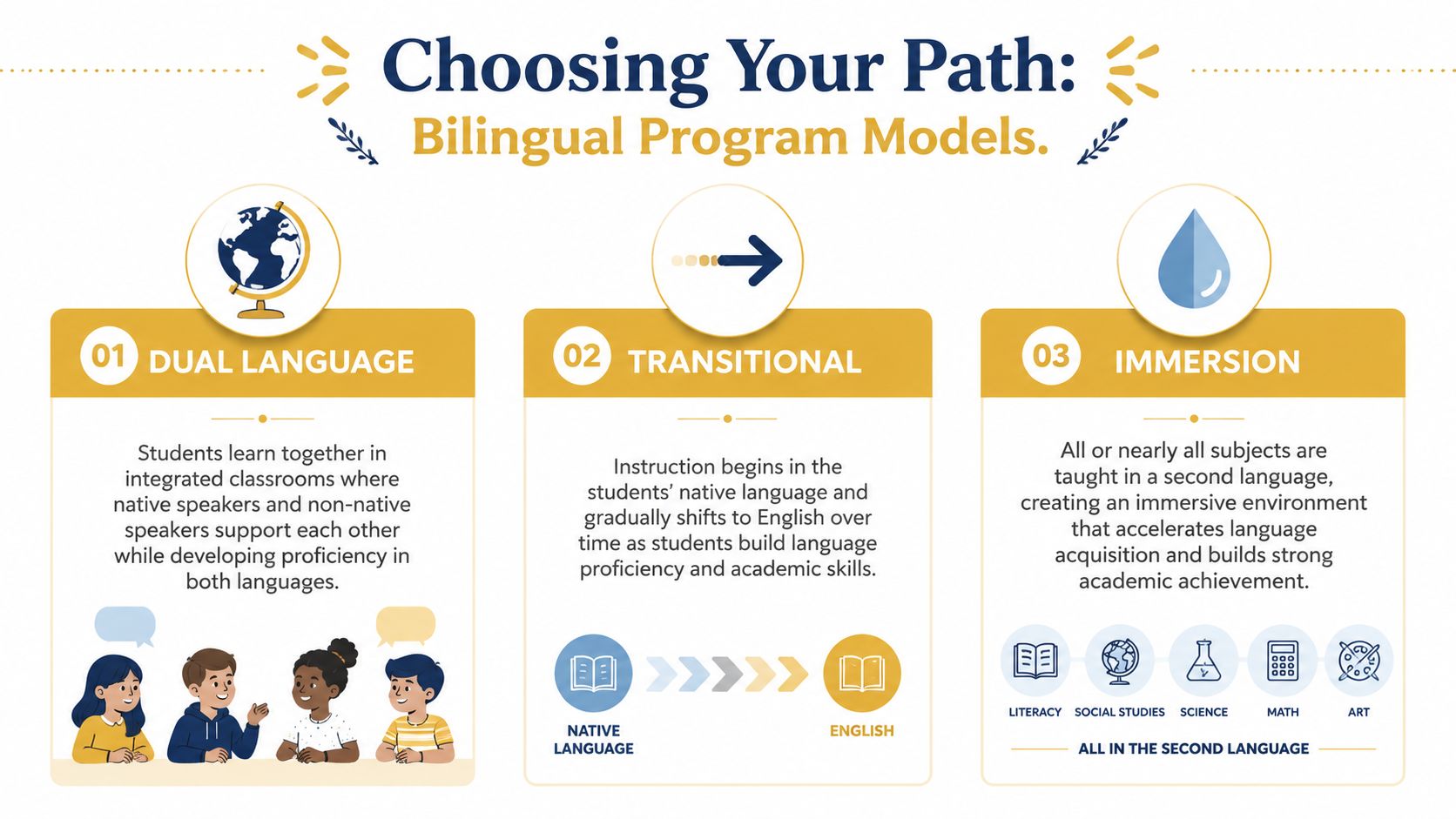
Bilingual Education Program Comparison
| Program Model | Instructional Mix | Primary Goal | Best For… |
|---|---|---|---|
| Dual Language | English and partner language are both used for academic instruction | Biliteracy, bilingualism, and long-term academic growth in both languages | Families who want sustained two-language development and can commit for years |
| Transitional Bilingual | Home language is used as a bridge while English increases over time | Support access to grade-level content while moving toward English proficiency | Students who need language support entering an English-dominant system |
| Foreign Language Immersion | Core subjects are taught partly or largely in a second language | Strong second-language acquisition through subject-based learning | Families seeking deep language exposure, often without a home-language preservation goal |
Each model can work well. Each also has trade-offs.
Dual-language programs usually offer the strongest long-term path toward biliteracy, but they require patience. Transitional models can be helpful for access and adjustment, but they may not aim for lasting high-level literacy in both languages. Immersion programs can produce strong language confidence, yet some children need outside support to keep up with subject vocabulary and classroom participation.
How to choose the right fit
I encourage families to ask schools five practical questions before enrolling or before deciding on tutoring support.
How much of the day is spent learning in each language? Marketing language can be vague.
What happens when a student understands content but hesitates to speak? This reveals whether the program supports temperament differences.
Is the goal full biliteracy or mainly English transition? Those are not the same promise.
How are reading and writing developed in both languages? Conversation alone won't carry academic success.
What support exists when the child's confidence dips? Every strong program needs a plan for this phase.
For families comparing school options or looking for targeted support alongside school, our overview of French immersion programs is a useful starting point. If you need supplemental help, options can include school-based intervention, private tutoring, or customized language support such as the programs offered by Elite French Tutoring, which provides one-on-one French instruction aligned to learner pace and school context.
The Long View Career Advantages and Social-Emotional Growth
The deepest return on investment rarely appears in elementary school. It becomes visible later, when the child you're supporting now enters more complex academic, social, and professional environments.
That's why I encourage parents to widen the frame. Report cards matter. Confidence in class matters. But the long-term value of bilingual education often shows up in access. Access to better communication, wider communities, stronger cultural fluency, and more choices about where and how a person can work.

Why the long-term payoff matters most
A child who becomes comfortable operating in more than one language develops a practical advantage in a connected world. In my experience, that doesn't just help in obvious international careers. It helps in leadership roles, client-facing work, collaborative environments, and any situation where nuance, listening, and adaptation matter.
The strongest long-range evidence in the provided research connects bilingual and biliteracy skills to college attendance and earnings, which I referenced earlier. But even without repeating those figures, the pattern is clear. Families aren't investing in bilingual education only for short-term classroom performance. They're building optionality.
That can matter for students who may later pursue:
Global-facing careers: diplomacy, policy, education, nonprofit work, business, hospitality
Cross-cultural teams: workplaces where trust depends on communication across backgrounds
Advanced study: programs that value language depth, international experience, or regional specialization
A second language doesn't guarantee a career outcome. It does expand the range of rooms your child can walk into with confidence.
The social return is just as important
The part many parents underestimate is the social-emotional growth. Children who use two languages also learn to adapt to two sets of cues, expectations, and perspectives. They get practice noticing audience, adjusting tone, and understanding that meaning depends on context.
Those are leadership traits.
They can also be profoundly personal. For some children, bilingual education preserves connection to grandparents, family stories, and parts of identity that might otherwise fade. For others, it creates genuine curiosity and empathy because they learn early that there is more than one valid way to express an idea.
When families ask me whether the benefits bilingual education are “worth it,” my answer resonates most powerfully. If the program is a good fit and the child is supported well, the return is not limited to school success. It shapes how that child relates to people, opportunity, and the wider world.
Answering Your Toughest Questions on Bilingual Education
A parent sits across from me, lowers their voice, and asks the question they have been holding back the whole meeting: “What if we invest in bilingual education and my child falls behind in English?”
It is a fair question. Bilingual education asks families to accept some short-term uncertainty in exchange for a larger long-term return. The mistake is judging that investment too early, especially during the adjustment phase.
What parents ask me most often
Will my child's English suffer?
Some children show a temporary dip in English test performance while they are building literacy across two languages. That early wobble can feel alarming. It does not mean the placement is wrong. A review from the UCLA Civil Rights Project explains that short-term score patterns should be interpreted cautiously because bilingual learners often develop on a different timeline than peers in English-only settings, especially in the early years, as summarized in the UCLA Civil Rights Project review of bilingual education evidence.
This is one of the biggest judgment calls for parents and schools. In my experience, families make better decisions when they ask, “Is my child progressing in both comprehension and school readiness?” instead of treating one test cycle as the whole story.
What if my child seems quiet in the second language?
Quiet students are often working hard, not failing. I see this all the time. A child may understand much more than they can produce, hesitate because classmates sound more fluent, or avoid speaking until they feel safe making mistakes.
That usually points to a support need, not a reason to abandon the program.
Is it too late to start?
Later starts can still work well. Older students often respond well to explicit grammar patterns, direct feedback, and scheduled speaking practice. The trade-off is that progress may require more intentional support than it would for a child who started younger.
Parent check: The strongest return on investment usually comes from looking at trend lines, not panic points. If the program fits and support is in place, a temporary dip in English scores is a reason to monitor closely, not a reason to quit immediately.
When extra support makes sense
Parents do not need to panic early. They do need to respond early when the same problem keeps showing up.
Support is worth considering when:
Your child understands more than they can express: comprehension is growing, but spoken or written output stays stuck.
Homework creates repeated frustration: not a rough night, but the same bottleneck week after week.
Participation drops: the child stops volunteering, avoids reading aloud, or pulls back socially.
The school model looks sound but the fit needs adjustment: the issue may be pacing, confidence, or language load, not the program itself.
A small intervention can protect a much larger investment. A short consultation with a specialist can save families months of guessing, especially when the underlying issue is confidence, output practice, or uneven support at home.
If you are comparing tutoring formats or deciding whether one-on-one French support would help your child stay on track in a bilingual setting, a focused review of school demands, language level, and confidence barriers is often the fastest way to make a clear decision.