Skip to content

You're probably staring at a university course page right now, trying to decode whether “online French” means real progress or just another semester of assignments, discussion boards, and vague promises about communication skills.
That's the buying problem with french classes online university. The branding feels reassuring. The structure looks serious. But if your actual goal is speaking confidently in meetings, preparing for relocation, passing the DELF, or helping your child keep up with a demanding school program, prestige alone won't answer the question that matters most: Will this format get you the outcome you need?
I've seen this decision go well, and I've seen it go wrong. The difference usually isn't intelligence or motivation. It's fit. A university course can be exactly right for one learner and frustratingly indirect for another.
Table of Contents
- Is a University French Course Really Your Best Option?
- What a University Online French Class Involves
- University Courses vs Tutoring vs Apps
- A Student Success Story From Credits to Confidence
- How to Evaluate and Choose Your Online French Program
- The Enrollment Process and What to Expect
- Is a University Course Your Best Path to French Fluency?
Is a University French Course Really Your Best Option?
A common scenario goes like this. A motivated learner finds an online French course from a respected university, sees words like “credit-bearing,” “semi-intensive,” or “elementary sequence,” and assumes that formal must mean effective. Then the doubts start. How much speaking is there? Will anyone correct pronunciation in real time? Is this built for adult professionals, or for students moving through a general academic curriculum?
That uncertainty is legitimate. Most university pages emphasize credit-bearing structure but don't clarify how much live speaking practice a learner should expect or how fast oral fluency improves, which leaves many career-minded learners unsure whether the format matches a speaking-heavy goal, as seen on the University of Texas Austin French Online Program page.
I don't see university programs as overrated. I see them as mis-purchased. People often buy them for the wrong reason. They enroll because the institution feels credible, when what they really need is conversation intensity, exam targeting, or schedule flexibility.
The real buying question
If you need academic credit, a university course may be the obvious fit.
If you need French for work, relocation, family support, or oral confidence, a university course may only solve part of the problem.
Practical rule: Buy the format that matches your bottleneck. If your bottleneck is accreditation, choose academic structure. If your bottleneck is speaking, choose live practice and feedback.
I also find that many adults underestimate the gap between “I understand the lesson” and “I can respond naturally in French under pressure.” Those are different skills. A polished syllabus doesn't automatically bridge that gap.
If you're weighing motivation, time, and long-term payoff, this broader look at why adults choose French classes for benefits beyond language can help clarify what outcome you're really buying.
What a University Online French Class Involves
French classes online university often leads to very different products being lumped into one category. That creates bad comparisons. A for-credit online course, a university extension program, and a university-branded MOOC may all look similar in search results, but they function very differently once you enroll.

The main university formats
For-credit online courses are usually tied to a semester calendar. You'll typically get graded work, deadlines, and a formal syllabus. These are strongest when you need transcriptable study and a predictable academic framework.
Non-credit university-affiliated programs often sit in continuing education or language institute divisions. They may still be rigorous, but the learner profile is broader. Working adults, international students, and independent learners often prefer these because they feel less bureaucratic.
University MOOCs and platform courses sit at the lightest end of the structure spectrum. Carnegie Mellon describes its French offering as part of a set of flexible and affordable online courses for independent learners, with instructor-led and self-paced options. That matters because not every university-linked option is trying to replicate a traditional class.
What the structure tells you
A real example helps. The Cours de civilisation française de la Sorbonne (CCFS) offers online general French from A0 to C1, including a 12-week beginner track totaling 20 hours, a 4-week monthly online general French course totaling 24 hours, and semester-length options priced at €240, €690, and €1,950 depending on intensity and format, according to the CCFS online courses page. CCFS also states that its online courses are designed for learners who can't attend in person, and that some sessions run daily from 10 a.m. to 5 p.m. Paris time.
That tells you a lot before you ever click “enroll.”
- Leveling is formalized. You're not buying random lessons. You're entering a structured progression.
- Time commitment varies sharply. A monthly course and a semester track ask for different kinds of consistency.
- Scheduling matters. Paris-time delivery may be convenient or impossible depending on where you live.
- Price is tied to format and intensity. You're not just paying for content. You're paying for cadence, access, and program design.
For buyers comparing structured options, this roundup of a virtual French language course is useful because it separates academic-style formats from more flexible lesson models.
University Courses vs Tutoring vs Apps
Most buyers don't need “the best way to learn French.” They need the best way for their goal, budget, and timeline. That's why this comparison matters more than broad advice.
Where each option wins
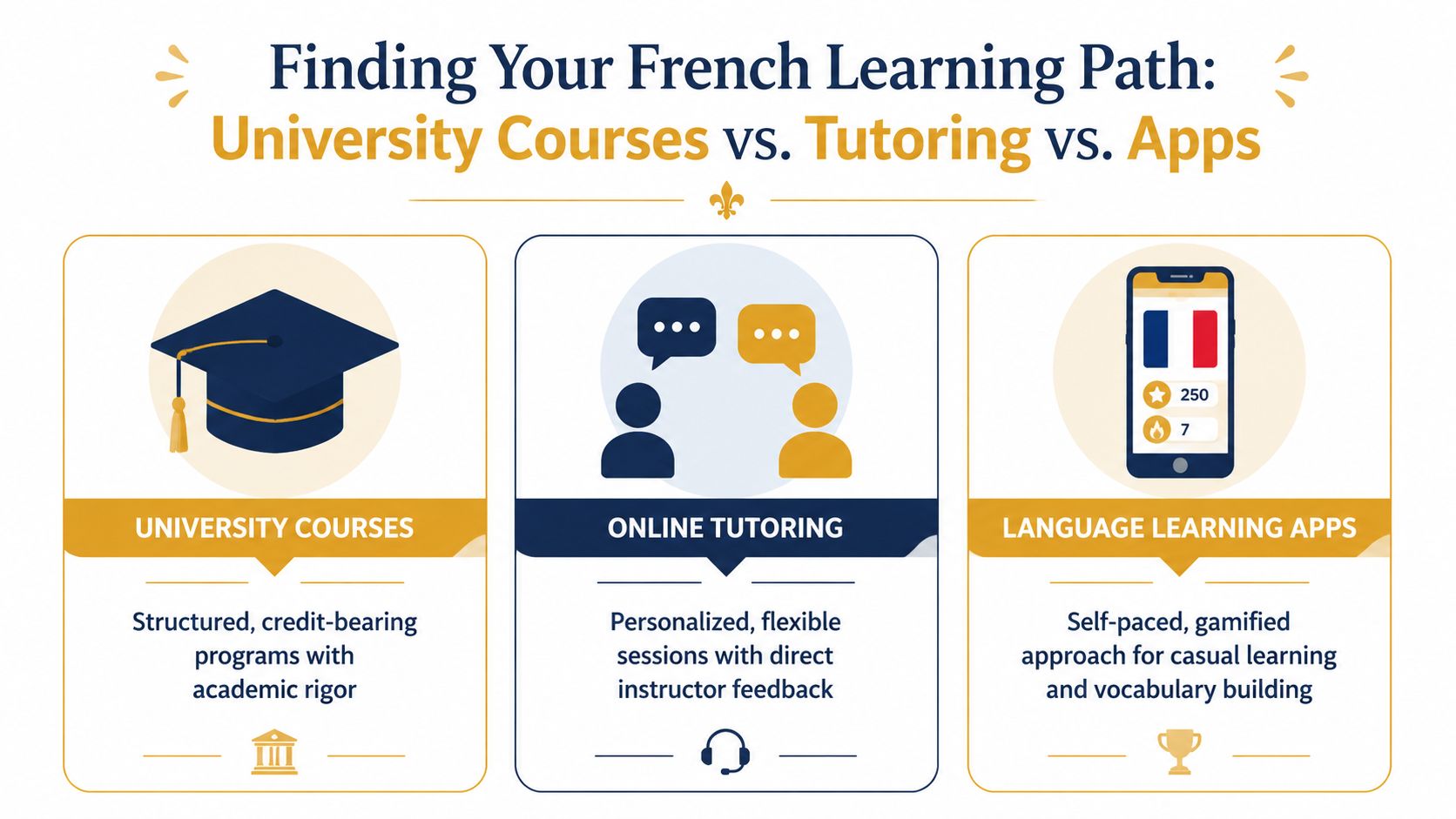
University courses win on structure, credibility, and accountability. If you like deadlines, reading assignments, graded work, and a recognized institution behind the course, this path makes sense. It's also the cleanest choice when you need academic progression or a university-style environment.
Private tutoring wins on specificity. That matters because demand for French learning is increasingly specialized, while university programs often stay broad. For goals like DELF/DALF prep, business communication, or curriculum-aligned support for children, a customized tutoring model can be more efficient and effective than a standard university course outline, a gap that becomes clear when you compare broader university offerings such as Harvard's elementary French course listing.
Apps win on convenience and repetition. They're useful for habit-building, vocabulary review, and low-pressure practice. They're much weaker when the goal requires nuanced speaking, correction, or adaptation to a real-world use case.
If your goal has a deadline, such as an exam date, a relocation date, or a work presentation, general-purpose learning often feels too slow.
Learning Method Comparison: University vs. Tutoring vs. Apps
| Criterion | University Online Course | Private Tutoring (Elite French Tutoring) | Language Apps (e.g., Duolingo) |
|---|---|---|---|
| Primary strength | Academic structure and formal progression | Personalized instruction around a clear outcome | Daily convenience and self-study momentum |
| Scheduling | Fixed calendar, set class rhythm | Flexible scheduling, often easier to adapt | Fully self-paced |
| Speaking practice | Varies by program and cohort | Usually much higher and more targeted | Limited and often not truly conversational |
| Feedback quality | Can be solid, but shared across a group | Direct, specific, and immediate | Automated and generic |
| Best for | Credit, disciplined learners, formal study | Exam prep, work goals, speaking, child support | Vocabulary review, consistency, beginner exposure |
| Weak spot | May not focus enough on your exact objective | Less useful if you specifically need university credit | Weak for live interaction and corrective depth |
| Pacing | Set by syllabus and class design | Adjusted to your pace and bottlenecks | Set by app flow and user discipline |
| Content focus | Often general French and culture | Can be narrowed to business, exams, school support, travel, or conversation | Usually broad and standardized |
One practical compromise works very well for many adults: use a university course for foundation and accountability, then add targeted speaking support outside it. Others skip the academic route entirely because they don't need a transcript, only results.
If you want to compare these formats with a stronger buyer lens, this guide on ways to learn French online is a good next step.
A Student Success Story From Credits to Confidence

Sarah enrolled in an online university French course for a practical reason. She needed academic structure, graded work, and a credential she could point to. For that goal, the course fit.
She handled the class well. Her written French improved, her grammar became more accurate, and she kept up with the syllabus. Then she had to speak spontaneously with a native-speaking colleague during a real conversation. Her knowledge was there, but access was slow. She paused too long, searched for words she already knew, and lost confidence mid-sentence.
I see this pattern often. Students mistake successful coursework for usable communication, and the two are related but not identical.
Why the first format wasn't enough
Sarah's university course did its job. It gave her foundation, accountability, and proof of progress. What it did not give her was enough repeated pressure in live, unscripted speaking.
That trade-off matters. A learner can earn strong marks and still struggle with turn-taking, listening speed, repair strategies, and speaking without rehearsal. University courses often reward preparation. Conversation rewards retrieval.
The problem was not the quality of the course. The problem was fit. Her main outcome had shifted from academic performance to spoken confidence, and her study format had not shifted with it.
What changed after targeted speaking practice
Her progress picked up once the practice became specific. Instead of working through broad textbook units, she trained the moments that had been breaking down in real life: answering follow-up questions, buying time naturally, recovering after a mistake, and using the vocabulary she needed for meetings and workplace small talk.
That change sounds small. In practice, it changes everything.
Within a few weeks, she was speaking in longer stretches and hesitating less because the exercises matched the situations she faced. She still kept the academic base from her course. She incorporated the missing layer.
That is the part many learners miss when choosing a program. Credits, syllabus quality, and instructor reputation all matter. Outcomes matter more. If the target is conversational fluency or DELF performance, the winning plan is often a mix of structured study and narrower speaking work.
For another example of how focused support can speed up progress, see this case study on going from zero to fluent in six months.
A short example of spoken French in context also helps reset expectations:
Sarah's result was straightforward. The university course gave her knowledge. Targeted speaking practice made that knowledge usable.
How to Evaluate and Choose Your Online French Program
Good marketing hides weak teaching surprisingly well. A polished website can make a passive course look interactive, and a university label can make a general program look more personalized than it is. Buyers need a sharper filter.
The questions that actually matter
Start with your primary outcome. Do you need credit, exam readiness, speaking confidence, or child-specific support? If the provider can't tell you how the course serves that outcome, keep looking.
Then ask practical questions:
- Who teaches the class? Native proficiency alone isn't enough. You want instructors who can diagnose errors, sequence learning, and adapt explanations.
- How much live interaction is built in? If the page talks mostly about lectures and readings, speaking may be a small part of the experience.
- What gets corrected? Pronunciation, sentence structure, register, and listening breakdowns should all be addressed somewhere in the process.
- How is pacing handled? Fast learners get bored in rigid systems. Busy learners get buried when the pace is too aggressive.
- What happens between sessions? Strong programs give you a way to retain momentum, not just attend and forget.
A weak online course gives you content. A strong one gives you correction, pacing, and enough speaking to make the content usable.
What strong online instruction looks like
The most effective online French learning happens when the curriculum includes interactive speaking and structured pacing. The strongest formats, whether university-based or private, include frequent corrective feedback and live conversation to compensate for what online learners lose from not being in a physical classroom, as outlined in this discussion of what makes online French learning effective.
That principle helps you evaluate any option quickly.
A useful checklist looks like this:
Match the format to the goal
Credit and academic progression point one way. Speaking-heavy or exam-heavy goals point another.Look for live speaking as a core feature
Not a nice extra. A core feature.Check whether feedback is individual
Group exposure is helpful. Individual correction is what changes performance.Test the schedule against real life
The best course on paper fails if you can't attend consistently.Judge value, not just price
A cheaper option that delays your goal can cost more in time and frustration.
One example in this category is Elite French Tutoring, which offers customized online lessons built around goals such as conversation, exam preparation, professional French, and school support. That model is useful for buyers who already know they need personalization rather than a broad academic track.
The Enrollment Process and What to Expect
The buying experience differs almost as much as the teaching model. People often compare learning outcomes without comparing onboarding friction, and that's a mistake.
What university enrollment usually looks like
With a university program, expect a more formal process. You may need to choose from fixed start dates, work around application windows, complete placement steps, and wait for the next session to open. If the course sits inside a larger institution, you may also deal with account creation, student portals, payment systems, and policy documents before you attend your first class.
That's not a flaw. It's just what happens when education is delivered through an academic structure.
A tutoring-based option usually feels lighter. Many can start sooner, adjust around your schedule, and refine the plan after an assessment conversation instead of requiring you to fit a prebuilt semester track.
What your first weeks feel like
In a university-style online French class, the first weeks often involve orientation as much as language learning. You'll likely receive a syllabus, learn the platform, sort out readings or assignments, and understand how participation works.
Expect these common elements:
- Placement or level confirmation so you enter at the right stage
- A defined weekly rhythm with deadlines, readings, and graded tasks
- A learning platform where course materials, announcements, and submissions live
- A cohort experience that can be motivating if you like moving alongside others
Buy based on the whole experience, not just the class hour. Administration, scheduling, and platform friction all affect whether you stay consistent.
If your timeline is urgent, this matters even more. Someone preparing for a trip, job transition, or exam usually benefits from a format that can start quickly and adjust quickly.
Is a University Course Your Best Path to French Fluency?
A university online French course can be an excellent purchase. It offers structure, seriousness, and a clear progression that many learners need. If you want academic discipline, documented study, or a broad foundation in the language, it may be exactly the right tool.
But french classes online university aren't automatically the fastest route to every outcome.
If your real target is conversational ease, DELF or DALF preparation, business communication, relocation readiness, or support for a child in a demanding school environment, a general university curriculum may feel too broad. You might still choose it, but you should do so knowingly, and often with a plan to supplement the missing piece.
The strongest decisions come from honesty. Ask yourself what you need the course to do in real life. Not what looks impressive. Not what sounds formal. What it needs to do.
If you're comparing options and want a lower-pressure next step, consider booking a consultation or reviewing lesson formats before you enroll anywhere. A short conversation can often reveal whether you need a university course, a customized tutor, or a blended plan.
If you want a practical way to compare your options, you can book a French lesson consultation or review online lesson types before committing to a full program.